People of Righteousness target Sri Lanka

Michael Roberts, 28 June 2011……… from the Island, 22 June 2011, after an initial draft appeared in transcurrents on 20 June 2011. Readers are encouraged to visit the transcurrents site to see a number of caustic (and puerile?) comments. A more significant reaction from Radhika Coomaraswamy is inserted as Epilogue to this entry.

The war crimes accusations levelled against the Sri Lankan government at the moment are driven by a complex coalition of forces. Though the principal engines are Tamil migrants in the Western world bent on vengeance, there are Western people of righteousness in the vanguard as well. Such a man is Gordon Weiss. His demeanour as he addresses television audiences is that of a crusader. The iconic picture of himself adopted in his very own website,[1] benignly overseeing a mass of African children, reminds one of a missionary. Continue reading

64 Comments

Filed under world events & processes

The diary of an extraordinary human being: A Review of Ben Bavinck’s “Of Tamils and Tigers”

Shanie in his Notebooks of Nobody, in the Island, 25 June 2011

“This is a time of reflection for the Tamil community; a time for refashioning its politics. Even though the Tamil nationalist vision for a separate state met with a decisive military defeat in 2009, the politico-military decline of the LTTE had begun far earlier, with the convergence of multifarious set of political developments, both local and international, that began the downward spiral at a time when seemingly the LTTE was at its strongest….. This time of reckoning is not just for the Tamils but also for the majority Sinhala community….Today, after the end of the war, the minorities fear that history is being rewritten. They fear that injustices meted out to the minorities are being written off that there is an unwillingness on the part of the majority community, even after years of destruction and polarisation in the country, to …understand and acknowledge the history that pushed the Tamils to the edge, into the arms of the Tigers, (to understand) the uneasy relationship that ordinary Tamils had with the LTTE ……(and) that the demands for democracy and accountability are being brushed aside by an arrogant authoritarian state.”
      Rajani Thiranagama, an academic attached to the Medical Faculty of the University of Jaffna, was brutally shot and killed allegedly by an LTTE cadre in 1989. It was she, along with a few of her colleagues in the University of Jaffna, who formed the University Teachers for Human Rights which became well known for the courageous stand they took against violations of human rights by the different actors in the Thirty Years War. Because of the principled stand the UTHR took, Thiranagama was gunned down and the other leaders like Rajan Hoole and Sritharan were driven underground. But despite these setbacks, the UTHR continued to publish their bulletins at regular intervals. These bulletins came to acquire a reputation for reliability in investigative reporting. They were able to do this because they obviously had a network of trusted informants which they cross-checked for accuracy before publication. It was this independence and integrity that made the UTHR bulletins become so very reliable, leading to the UTHR receiving the Martin Ennals Award as brave defenders of human rights. Continue reading

3 Comments

Filed under citizen journalism, cultural transmission, Fascism, historical interpretation, life stories, LTTE, reconciliation, Sinhala-Tamil Relations, terrorism, unusual people

Big history to give students big picture: Bill Gates and Christian in innovative teaching paths

Bernard Lane, in The Australian, 25 June 2011

TWO Australian schools have been chosen to trial what may be the first universal history syllabus able to be taught in any country and any language.  The project brings together academic David Christian, who pioneered a new way to teach history at Sydney’s Macquarie University, and Microsoft co-founder Bill Gates, who wants to help him revolutionise the way schoolchildren learn. Next year, students at Nossal High School in Melbourne and Narara Valley High School on the NSW central coast will join US schools by sampling “big history”, which kicks off the human story 13.7 billion years ago with the Big Bang. Students will have free access to a website rich with video, animation and all manner of resources, one of many benefits flowing from Mr Gates’s chance discovery of Professor Christian. Continue reading

1 Comment

Filed under australian media, historical interpretation, unusual people, world events & processes

Killing Fields’: Problems and Prospects

Kalana Senaratne, in the Island, 24 June 2011

‘Killing fields’ can be a phrase used to describe a most mundane fact known to humanity, or it could be a most provocative phrase to an ethnic majority or minority group. When viewed from the standpoint of a human being, one need not try hard to realize that the moment one factors in the number of killings that may have taken place, the amount of brutal wars that have been fought by man against man in the past, the kind of death and destruction that resulted in policies and practices of various states, such as colonialism etc., all of us belonging to the human race belong to one large ‘killing field’.

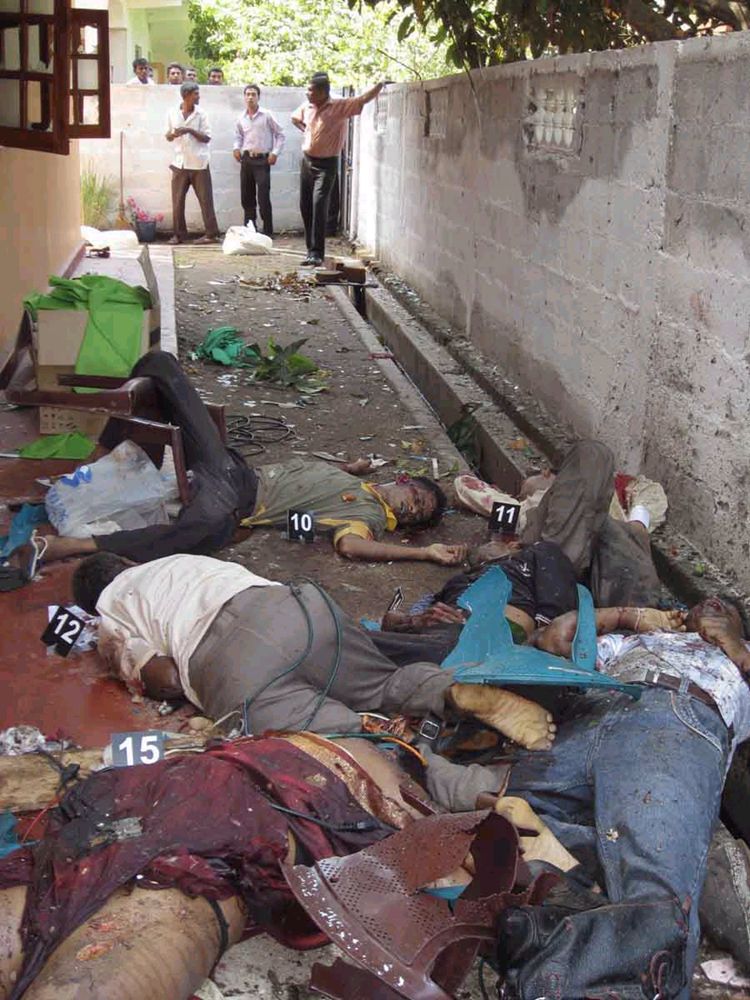
For the Pics, see comment at end of this item

But we are sentient beings with a lot of dust in our eyes, we are easily provoked and even enjoy being provoked at times, and we often view things from a narrow ‘ethnic’ or ‘nationalist’ lens (merely conventional truths or sammuti-sacca, as a great philosophical teacher has stated). So when ‘killing fields’ is thrown at us, as Britain’s Channel 4 recently did, we are provoked, for various different reasons. A trap is set, and we walk straight into it.

But how do we deal with such a sensitive issue? Are we to believe everything that we see, are we to reject all, can we to be selective, or do we whilst seeing what we see make an attempt to see the unseen as well? Can there be a more critical appreciation of the numerous factors and facets surrounding the episode, the moving image, the movers and shakers, their motives, the whole works? What are some of these factors? Continue reading

12 Comments

Filed under historical interpretation, LTTE, reconciliation, Sinhala-Tamil Relations, terrorism, welfare & philanthophy, world events & processes

Sinhala-Tamil strife: We are only small step ahead of Neanderthals now

Kirillapone Anandasivam, Courtesy of www.transcurrents.com, where there are many comments

PIC from http://channel.nationalgeographic.com/episode/who-was-neanderthal-man-3724/Photos

The global exposure of war crimes committed is an ongoing sicking and depressing saga. It is now difficult to call yourself Sri Lankan. Discussions happening in news groups’ twitter and other social networks are further exposing our true nature to a world that remains revolted by what they have just seen on TV.

Fights are no longer local. They are global. The internet has now made it possible for everyone to participate in it. The prevalence of digital technology and video sharing is now making it possible to share human experiences beyond boundaries. Thanks to this, the war crimes of the Sinhalese army is getting exposure that rivals the worst atrocities committing within living memory. Sinhalese atrocities could not have had better exposure. Many Tamils understandably are happy that it is now exposed. But, they should not – because 99% of the people in the world cannot tell the difference between Sinhalese and the Tamils. We look the same and worse, for those who know us both – we behave just the same.

Why the expat Tamil elite is also responsible: The world did watch what happened and the mass jubilation that accompanied the government’s victory. But it did not watch Continue reading

1 Comment

Filed under citizen journalism, cultural transmission, historical interpretation, life stories, LTTE, Rajapaksa regime, Sinhala-Tamil Relations, Tamil migration, world events & processes

Shrunken Head DNA Proves Horrific Folklore True

Kahila Bar-Gal

The genetic make-up of a shrunken head has been obtained for the first time.

  • The DNA analysis reveals that the head is authentic and belonged to an Afro-Ecuadorian man.
  • The genetic evidence suggests many myths about head-hunting were true.

A remarkably well-preserved shrunken head has just been authenticated by DNA analysis, which provides strong evidence that anecdotal accounts of violent head-hunting inSouth America were true.  The study, published in the latest issue of Archaeological and Anthropological Sciences, marks the first successful effort to unveil the genetic make-up of a shrunken head. “The shrunken heads were made from enemies’ heads cut on the battlefield,” co-author Gila Kahila Bar-Gal told Discovery News. “Then, during spiritual ceremonies, enemies’ heads were carefully reduced through boiling and heating, in the attempt to lock the enemy’s spirit and protect the killers from spiritual revenge.”

SEE  http://beforeitsnews.com/story/723/197/DNA_Proves_Horrific_Folklore_To_Be_True.htm

Kahila Bar-Gal is a senior lecturer in the Hebrew University of Jerusalem’s Koret School of Veterinary Medicine. She is also a faculty member within the university’s department of Agriculture, Food and Environment.

Leave a comment

Filed under historical interpretation, life stories, world events & processes

Malcolm Speed’s Sticky Wicket

Peter Roebuck

Former International Cricket Council (ICC) and Cricket Australia (CA) Chief Executive Malcolm Speed’s memoir of his time in cricket, ‘Sticky Wicket’, is an unbiased and relevant eye-opener about what went on behind the scenes in cricket in the past 10 years, noted cricket columnist Peter Roebuck has said. “If the style is as dry as a paper clip, the content is colourful. Along the way Speed describes the rumour-ridden inquiry into Bob Woolmer’s death at the 2003 Cricket World Cup, an investigation hijacked by a vainglorious detective and a silly coroner,” Roebuck wrote in his syndicated column for the Sydney Morning Herald. “He talks about the disastrous 2003 Cup, the growth of Indian power, the move from London to Dubai, the advent of Twenty20, the attempt to spread the game beyond the Old Empire, and the sensible changes made to the throwing law.”

“He focuses on the notorious SCG Test against India that showed numerous players and both boards in a poor light, an issue from which only a Kiwi judge emerged with credit,” he added.Speed also outlines the crass manipulations over former Australian Prime Minister John Howard’s candidacy for the ICC vice-presidency. “The Zimbabweans were especially alarmed by it, and worked relentlessly behind the scenes to block him, only to deny it later,” Roebuck wrote.

Roebuck further highlighted that Speed talks about the Allen Stanford debacle, and describes the great West Indian players hanging to his coat-tails and Desmond Haynes and Viv Richards raging at the ICC’s reluctance to accept their man’s grandiose proposals. (ANI)

ISBN:    9780732293390 ISBN-10:    0732293391 Publisher:    HarperCollins Publishers Date Published:    1/04/2011 Format:    Paperback Book Pages:    336 Language:    English

 Paperback | April 2011
ISBN-13: 9780732293390

Leave a comment

Filed under historical interpretation, life stories

Renton de Alwis on Channel 4’s One-sided Blindness

Renton de Alwis, Daily News, 22 June 2011

With the Channel 4 ‘spin’ of telecasting the ‘Killing Fields of Sri Lanka’ programme last week, we were once again reminded that relating only one side of the story can be as convincing to an audience, wishing to hear only that side of the story. Watching it on ‘You Tube’, the question I, as an ordinary Sri Lankan citizen asked throughout its craftily-spun-rolling was, where then is the LTTE in all of this? They were always featured as the victims but for a few passing references to just a few of their crimes, there was very little mention of them.

One-sided affair:  It was as if this was a ‘clapping of hands with one hand’, where the sole agenda is to get a legitimately elected government of my country and its armed forces on its knees for effectively wiping out a group of terrorists, or their representatives who were once ‘friends’ or were ‘friends of friends’ of yours. It was as if there were no terrorists or terrorism against the Sri Lankan state, citizens of this country and even on a leader ofIndia, Rajiv Ghandi, involved in this story. For someone who has only little knowledge of the over 25 years of unleashing of bloody terrorist attacks by the LTTE, it would seem as if the Sri Lankan government was hell-bent on killing its own innocent Tamil civilian citizens, when the truth is far from that.

At one point I wondered, if it would not have been tactically advantageous for the LTTE terrorists to shell the hospitals located within the ‘No-Fire Zones’ themselves, to achieve the very objective of attracting the sympathy and involvement of the ‘international community’. This could have been a ploy to discredit the government and its fighting outfit. I wondered why that possibility was not even suggested to the viewers. It was to me a portrayal of a totally one-sided affair and not at all ‘unbiased reportage’ of the end-stages of the defeating of what was termed by the international media themselves as the ‘most ruthless terrorist group in the world’.

Hell on earth; For those UN and Amnesty International ‘officials’, featured in the programme, who have been party to only a limited period of this bloody conflict, I can only say ‘You should have lived through what I and 20 million others like me, had to live through as Sri Lankans during those over 25 years’. To us, it was ‘hell on earth’ when our brothers and sisters were indiscriminately murdered by the LTTE suicide bombers. It was sure hell to see many lives of our young being sacrificed while fighting ruthless terrorists on those battle-fields. There will be testimony on both sides of the fence of mothers, fathers, brothers and sisters and sons and daughters of those who have been victims of the traps laid in LTTE killing fields at various locations, at various times, in various forms and the kidnappings and summary executions carried out during those over 25 years.

For these spin doctors and those who chose only to be associated with one part of the story, such news goes to achieve their singular objective of wanting to place another obstacle in the way of a nation, that so yearns to heal its wounds and move on to achieve a better future for all its citizens.

Our brethren:  I, for one am someone who does not hold any political party affiliations or blind loyalties. I was part of an entirely voluntary effort working at the interim camps in helping Tamil civilians in the immediate aftermath of the defeat of the LTTE and met and interacted with them on several occasions and assisted in solving some of their immediate problems. There were many others who did very much more and helped ease their plight. At no time did we associate the LTTE’s inhuman ways with any of the innocent civilians, in those camps. To us they were brethren who had undergone much suffering.

Just this week in the Deep South where I live, we eagerly wait to welcome and interact with 10 Tamil students and their teachers on a Peace Secretariat, US AID and Rotary Club sponsored programme. They are here for a week, will visit schools and have fun meeting their counterparts. Several children here are gearing to horn their Tamil speaking skills to be able to interact with their brothers and sisters from the North. I am told that the visiting students are doing the same. There are yet many other ongoing programmes in the North and the East and in the rest of the country to help rebuild the lives of these very people depicted in the film. There are committed counsellors, doctors, engineers, government employees, members of the armed forces, volunteers and other well-meaning persons, who are chipping-in to assist our Tamil brethren to heal their wounds and regain hope and ability to build a better tomorrow.

We are healing:  It is certainly the summation of the work of the leadership, such individuals and events that will bring us together to cement real peace within our nation. Attempts of ‘spin doctors’ and their sponsors with PR funds, who seem to be hell-bent on creating more and more rift and division among us, will certainly not help the process. The good news is that in spite of all of this we are healing, and we are fully aware that it is not an easy road ahead.

On a recent web-forum a fellow Sri Lankan Asoka Weerasinghe ofCanadahad had this to say: “Graphic footage of the murder of Tamil civilians in a powerful documentary should move the world to seek justice”, wrote Chris Cobb.

“I myself was reviled by this documentary as was Chris Cobb. But my revulsion was for a very different reason. This was a video when challenged by independent experts as not being authentic footage, was admitted by Channel 4’s Callum Macrea who directed it, that it was put together with photographic stills, LTTE (Tamil Tiger) websites, video clippings, from official Sri Lankan Army video footage and satellite imagery, contrary to what we were made to believe were completely shot by a simple mobile phone in the killing fields. I also noted that it was Channel 4’s News team, Nick Paton Walsh, producer Bessie Du and cameraman Matt Jasper who were deported fromSri Lankaon May 10, 2009, as they alleged were arrested for false reporting on the Tamil Tiger terrorist war and subsequently deported.

Suicide bombing: It is also clear that the motive to air this video to be seen around the world is to insist that Sri Lanka has to be tried for war against humanity and war crimes during the final few months of the war, when we know that the Tamil Tigers did kill over 100,000 innocent unarmed Sinhalese and Muslim civilians, men, women, pregnant mothers, children and infants for 27 long years and hijacked the right-to-life of 21 million people who were just scared to step outside their homes for the fear of being bombed to smithereens by the Tamil Tigers. They were the terrorists who perfected the art of suicide bombings with suicide body packs, and executed 388 suicide bombings by the time the war ended on May 18, 2009, which also assassinated two heads of state Rajiv Gandhi ofIndiaand President Premadasa ofSri Lanka”.

Ethical practises and the precepts or commandments followed by rational and good media, just do not jell well with efforts such as that of Channel 4. They take bits and pieces of images, thought-lines, comments and commentaries out of context, out of time lines and thread them together to tell stories to audiences who want to hear it that way. Ground realities, rationality and facts are ignored as a rule and the sources are always secondary at best and tertiary most often.

There is no doubt that we live in an imperfect world and there is so much of wrong-doing that needs to be exposed. It is also true that the role of the media in that pursuit is of vital importance. Human freedom and expression would never be the same if not for the presence of fine, rational media men and women, who often take huge risks on their own lives to bring to us, the realities of the world as they are.

Have what it takes :  Yet it seems that the objective and the rationale behind covering ‘bad and sad news’ while being in the comforts of the studios using the best of technology and doctoring skills, working with editing machines and with third and second party materials, without an understanding of what really goes on in the places or the situations they are reporting on, seem to pass on today as ‘hits’ of stories as they are touted.

What we need today is a new dictum where bad news is not considered good news. We need to focus more on the good and encourage more and more of that good to happen more often around us. There is no merit in rubbing on wounds that are healing. One needs to amputate only cancerous growths and not healthy tissues.

Once again, I as a citizen of Sri Lanka want to observe and impress upon the many friends and well-wishes around, that we as a nation have the resolve, will, energy and whatever else it takes to heal our wounds. We only need you to encourage, constructively criticise, support us and cheer us along the way. It is with such effort that ‘good news will become good news’. renton@wow.lk           ALSO SEE http:/dh-web.org/place.names/posts/Ch4TVallegations.ppt THE MENU BAR DOES NOT OPEN BUT BE PATEINT AND KEEP CLICKING TILL A POP-UP ASKS YOU TO SAVE OR OPEN. DO BOTH.



1 Comment

Filed under citizen journalism, historical interpretation, LTTE, military strategy, Rajapaksa regime, reconciliation, Sinhala-Tamil Relations, suicide bombing, terrorism, welfare & philanthophy, world events & processes

Groundviews’ searching Interview with McCrae of Channel Four

SEE http://groundviews.org/2011/06/21/exclusive-interview-with-callum-mccrae-director-of-sri-lankas-killing-fields-produced-by-channel-4/

Groundviews caught up with Callum McCrae, Director of the highly controversial and very disturbing film by Channel 4, Sri Lanka’s Killing Fields, in New York, a day before the film was due to be screened for senior diplomats, UN staff and others at the Church Centre, in front of the UN Headquarters. Callum was joined by Marion Bentley, Channel 4′s Publicity Manager.

The interview is around 43 minutes. Download the MP3 (~51Mb) of this interview here to listen offline. This podcast is anchored to the following questions.

General

  • What was your objective in doing the C4 video now, more than 2 years after the end of the war?
  • Killing of unarmed civilians, collateral damage, has occurred in other wars, other contexts British troops have been involved in? Has C4 covered them in as great detail?
  • What is accountability for you? Do they think the video will help in achieving accountability in the SL case? How so?
  • Who is your primary audience for the documentary? Why?
  • What do you expect the viewers to do? Is the video empowering or overwhelming? There has been criticism that the video is so visceral, it takes away from the viewer taking any action.
  • Do you believe a video such as what they produced will help those who were directly affected by the conflict and remain in SL?
  • Have you spoken to any in SL before or after the video was made public? What has been the reaction?
  • Do you have any future plans to work on similar videos or other initiatives regarding SL? If so, what?
  • What do you make of the Government of Sri Lanka’s response to this documentary?
  • What responses have they received from diaspora communities?
  • Why are you here inNew York?
  • Where else do you intend to show the film? Continue reading

Leave a comment

Filed under historical interpretation, Left politics, LTTE, Rajapaksa regime, Sinhala-Tamil Relations, world events & processes

Channel Four’s Shoddy Sensationalism exposed

AA Gill, in Sunday Times, http://www.topix.com/forum/world/sri-lanka/TRTFUQMJ6JFOM7CKS

 Choosing to Die [Terry Prachett’s BBC 2 documentary on euthanasia] was billed, hyperbolically, as the first time the moment of death has been shown on television. It isn’t. Not by many, many deaths. What they meant was the first death of a white western man in a sitting room; there is death all over television all the time.

Jon Snow and Krishnan Guru-Murthy of Channel Four

  Sri Lanka’s Killing Fields, Channel 4’s documentary on that country’s civil war, was made up of little else but the moment of death. Just before we get into it, I am going to pause, yet again, to have an eye-rollingly weary word about Jon Snow’s comic ties and jocund socks. And to explain why I mind and why they matter. The ugly garish ties are worn to semaphore the fact that this is a chap who is only wearing a suit because the headmaster says he must. Inside, he is really a far more relaxed, counterculture kind of dude, not at all the establishment flunky the two-piece single-breasted implies. It is a pathetically and worryingly childish pose in a man approaching retirement who wants what comes out of his mouth to be taken seriously. Back to the programme.

Channel 4 has been flogging this story for more than a year, ever since it was given an unattributed but disturbing clip of Continue reading

1 Comment

Filed under cultural transmission, historical interpretation, LTTE, Rajapaksa regime, Sinhala-Tamil Relations, Tamil migration, world events & processes