Category Archives: reconciliation

From Tsunami Medical Logistics to IDP Camp Medical Aid, 2004-09; Q and A with Dr Herath

From Tsunami Medical Logistics to IDP Camp Medical Aid, 2004-09

Speaking at Adelaide Universityon one occasion the Australian Ambassador, French, stressed that an experienced disaster relief team from Australia played a critical role in coordinating information and logistics for the massive task of relief and recovery in Sri Lanka after the tsunami of 26 December 2004. I do not have those details. But I can now reveal to those interested how a central coordinating unit of medical personnel played a critical role in organising the medical relief work in the coastal regions of the southwest, south and east that were hit by the tsunami and thereafter directed the tasks associated with re-building the institutions and other medical services that had been destroyed by the waters.
Dr. Hemantha Herath was assigned to the Health Desk of the Disaster Preparedness and Response Division (DPRD) of the Ministry of Health on 28 December 2004, while the Tsunami Rehabilitation Unit was also set up at about the same time with Dr. Thushara Ranasinghe as Coordinator, Planning) and Dr. Eeshara Vithana as Coordinator, Operations. The DPRD and TRU together directed the tsunami relief and re-establishment tasks. Their duties were extended in 2007-09 to handling the logistical requirements of drugs and equipment for the medical aid that was being provided to the Tamil refugees in the Eastern Province by personnel by local and foreign NGOs.

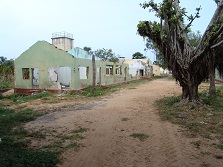
Kattankudy district hospital completely destroyed

Setting up a Field Hospital, Zone 2, 21 April 2009  –Pic by Donnie Woodyard

For a number of reasons Herath delayed his sabbatical leave till late 2008 when he eventually proceeded to UK. The unit was still functioning however (now downsized and housed within the offices of the Ministry of Health). The central point is that an experienced team of co-ordinators was at hand when the issue of Tamil IDPs from the north developed in late 2008/early 2009 after a large mass of people were assembled in the Menik Farm camps near Chettikulam over a period of time and especially in April-May 2009. They undertook the duties of (a) marshaling and organizing the erection of temporary health centres within the camps; (b) selecting and assigning doctors, nurses and other staff to service the camps; (c) distributing the equipment and drugs required for the medical centres; and (d) bolstering the pre-existing medical services within Vavuniya District so that they could assist the IDP camps in the handling of more serious cases. Continue reading
7 Comments

Filed under australian media, disaster relief team, IDP camps, life stories, Rajapaksa regime, reconciliation, rehabilitation, Sinhala-Tamil Relations, sri lankan society, Tamil civilians, Tamil migration, tamil refugees, unusual people, welfare & philanthophy, world events & processes

Melbourne hosts Mental Health Practitioners from Vietnam and Sri Lanka

The Centre for International Mental Health is hosting 29 delegates from Sri Lanka and Vietnam to participate in the 10th International Mental Health Leadership Program1 from 5th-30th September2011 as part of mental health system development programs in both countries. These lectures will  highlight the impressive work of our colleagues. It is open to the public via previous arrangement. This gathering will be held at 12 – 26 September 2011 at the Centre for International Mental Health, Melbourne School of Population Health Basement Theatre 1, School of Population Health,207 Bouverie St, Carlton.

Pic = Daya Somasundaram

Programme:

Monday 12 September 2011, 5.30–6.30 pm Friday 16 September 2011, 5.30–6.30 pm

Dr To Xuan Lan (National Psychiatric Hospital No.1,Vietnam)An overview of Vietnam Mental Health System

Friday 16 September 2011, 5.30–7.30 -pm 

Dr Prasantha De Silva (Ministry of Health, Sri Lanka): A review of implementation of the Sri Lankan National Mental Health Policy and its way forward

Wednesday, 21 September 2011, 5.30–6.30

Mrs Thi Thu Thao Nguyen (from VVAF) :   VietnamVeterans of America Foundation and the expanding role of NGOs in Vietnam Continue reading

2 Comments

Filed under accountability, IDP camps, reconciliation, rehabilitation, Sinhala-Tamil Relations, sri lankan society, Tamil civilians, unusual people, voluntary workers, welfare & philanthophy, world events & processes

A Verbal Joust between a Tamil Nationalist and a Thuppahi Mongrel

Michael Roberts

Early in September I circulated an item describing efforts mounted by private enterprise in cooperation with the Sri Lankan state (military as well as government agents) to alleviate the life world of Tamil people being re-settled in the northern Vanni – a continuation of efforts in the IDP camps at Menik Farm in 2009 – through the establishment of psycho-social units working on the mental health of children in particular. Clearly, this note and its documents were part of the empirical terrain relevant to the propaganda war raging since early 2009.

 It drew a sharp response from a Sri Lankan Tamil of my generation writing to one of my friends. I have responded with a riposte. This exchange was circulated by email to those who had received the original item on “Mental Health Facilities for the Tamils at the IDP Camps and Now for Those Being Resettled … Reports from Manori Unambuwe.” However, a request from Victor Melder has prompted me to make this exchange more widely available.

I do so for several reasons. Firstly, as backdrop, we must note that Anton Chelvarājah is obviously of my generation – one that reached adulthood in the 1950s and 1960s. Secondly, in mistaking me for a Burgher, he proceeds on a disparaging course of a sweeping character that reveals his mix of caste and ‘racist’ prejudices tinged perhaps with hierarchical class airs (via his use of malicious rumour to describe SWRD Bandaranaike’ supposed bloodline).

Now, this latter feature is precisely the ideological fusion of caste ideology antipathetic to the mixing of blood on the one hand and on the other, the racist thinking of West European origin seeking to stamp its dominance in the course of imperial expansion from the sixteenth century onwards. I identified this current of thinking among the Sinhala nationalists of the late 19th and 20th centuries during the research work that led to the central chapter on “Pejorative Phrases: The Anti-Colonial Response and Sinhala Perceptions of the Self through Images of the Burghers,” in Roberts, Raheem and Colin-Thomé, People Inbetween: The Burghers and the Middle Class in the Transformations within Sri Lanka, 1790s-1980s. Continue reading

1 Comment

Filed under cultural transmission, disparagement, LTTE, politIcal discourse, propaganda, racist thinking, Rajapaksa regime, reconciliation, rehabilitation, Sinhala-Tamil Relations, Tamil civilians, Tamil migration, truth as casualty of war, violence of language, world events & processes

Val Daniel’s Introduction of Ben Bavinck and Ben’s Diary over the Years of Conflict in Lanka

E. Valentine Daniel, August 2010

Modern warfare, by any measure, is a display of excess; but the excesses just before the end of wars—the excess of inhumanity, indiscriminate use of force, a frenzy of unmatched cruelty, wanton destruction and devastation, blind firepower, unworldly carnage followed by gratuitous torture as well as generalised infliction of pain—exceed everything that comes before. If this was true at the end of the American Civil War and at the end of the Second Battle of the Marne,  in Hiroshima and Nagasaki, and Dresden at the end of World War II,then it was also true in the far less infamous 27-year old war between the Sri Lankan state and the Liberation Tigers of Tamil Eelam, which ended on 18 May 2009.

Bavinck with Tiger ‘boys”  

The bang with which it ended on the streets of the capital city of Colombo was mightier than the bang with which it ended on the battlefield of Mullaitivu; while all the unwilling and frightened children whom the LTTE, at their final hour, had recruited with bravado, didn’t even have a chance to whimper. They were mowed down. It is worth noting that the OED finds that in American slang, in kinship with the Indian hemp, bhang, “bang”, also describes the effect of a hallucinogenic   drug, such as cocaine. Such was the victors’ jubilation on the streets of Colombo after the war had ended: other-worldly.

 This war was called a “civil war,” which is an oxymoron, a violence of language upon the common Latin root, civilis, from which have issued citizen, civic, civility, civilization. How paradoxical, obscene, wrong and insulting to both savage and beast that the “civilized” (and who would deny that Tamils and Sinhalese belong to a great and old civilization?) choose to qualify their own extreme indulgences in violence as “brutal” or “savage”. In fearsome symmetry, the end of the war resembled its beginning. Once we discount the hundreds of “first causes” of the civil war, hypostasised and hypothesised by hundreds of scholars, politicians, commentators and citizens, we may mark the beginning of the Sri Lankan civil war as the 23 July 1983, the day the display of hatred – a spectacle in its own right, a literal flaring up of violence, arson and mayhem, stoked by a government charged with protecting its citizens, which unleashed a pogrom against the Tamil-speaking minority – that swept through the South as an angel of death. The beginning was as grotesquely carnivalesque as the end. But if there was an excess of cruelty during these moments, there were also extreme acts of kindness. There are many accounts of Sinhalese soldiers refusing to shoot to kill, touched to the quick by the law of karma and the Buddhist concept of karunava. Many are the accounts of priests and nuns, at the risk of being fired at from behind, who secreted children, women and the feeble to freedom from the spit of land where they were trapped with the LTTE. Some LTTE cadres themselves, coming to terms with the odds they faced, protected the stealthily escaping trickles of civilians. Why is it so difficult to admit to one’s own enemy’s virtues? The balanced account of Ben Bavinck’s diary forces us to examine this selfcensure Tamils and Sinhalese impose on themselves. Continue reading

9 Comments

Filed under accountability, citizen journalism, historical interpretation, Indian Ocean politics, liberation tigers of tamil eelam, life stories, LTTE, military strategy, prabhakaran, reconciliation, Sinhala-Tamil Relations, sri lankan society, Tamil civilians, Tamil Tiger fighters, terrorism, unusual people, world events & processes

Mental Health Facilities for the Tamils at the IDP Camps and Now for Those Being Resettled … Reports from Manori Unambuwe

Michael Roberts, 9 September 2011

When I was shown round the health facilities at some of the IDP camps – “detention centres” as they were in my view up to 1 December 2009 — in the Menik Farm area in early June 2010 by Dr. Safras [who had worked there from April 2009], he happened to mention the fact that one of the Psycho-Social units he was in the process of showing me had been set up with the aid of a friend in Colombo, namely Manori Unambuwe, who had rustled up the monies required.

Psycho-Social Centre at midiay – Pic by Roberts

The hard work done by all sorts of agencies in alleviating the life of some 280,000 Tamil civilians[i]in these camps has hardly been revealed to the outside world in Colombo and beyond by anyone – not even by the government media outfits who follow His Majesty’s Command; though one report on this particular branch of welfare was presented in 2009 by the Sunday Leader [which is ranged against the government].

My uncovering of these dimensions of welfare philanthropy involving body, time and money has only been of the flimsiest character; but something is better than nothing …. … or SILENCE. I know little of the work done by the military personnel overseeing and running the camps; or that of the civilian government functionaries tasked to work alongside them’; or the many camp inmates who undertook tasks – sometimes as paid employees and sometimes as unpaid voluntary workers. Again, my reviews of the NGO activity have only embraced a few agencies.[ii] Hopefully, this partial tale will raise questions about the gross fabrications and/or exaggerations about the camps peddled by Western acolytes of the Tamil migrant lobby, such as David Feith, and other Tamil hands such as Niromi de Soyza.  

9 Comments

Filed under accountability, anton balasingham, australian media, IDP camps, liberation tigers of tamil eelam, life stories, LTTE, propaganda, reconciliation, rehabilitation, Sinhala-Tamil Relations, sri lankan society, Tamil civilians, Tamil migration, unusual people, voluntary workers, welfare & philanthophy

Media and the suffering of the Tamil people — Noel Nadesan’s Open Letter to Australians

Noel Nadesan, courtesy of the Daily Mirror, 14 July 2011 — republished here because of its relevance. Also visit www.transcurrents.com to review wide-ranging and sometimes virulent comments, Web editor

As a Tamil domiciled in Australia I served the Tamil community by editing the only Tamil community newspaper, UTHAYAM. I ran it for 14 years My experiences in dealing with the Tamil community, both inAustraliaand inSri Lanka, make me feel sad about the callous way in which the media is exploiting the suffering of our Tamil people for self-serving ends. I think I could speak as an independent voice with no allegiances to the politics of either community or political parties. My main concern has been to help our Tamils inSri Lankawho had to face the brunt of all attacks from the Indians soldiers, Sri Lankan forces and, above all, the so-called Tamil liberators, the LTTE. I have just completed building a small hospital in the island of Eluvaitivu, in which I grew up and, sooner or later, I plan to go back to serve our Tamil people who are desperately in need of help.
It is against this background that I thought of forwarding my comments to you after viewing the re-broadcast of Channel 4 programme, The Killing Fields of Sri Lanka. I must confess I felt depressed and I could not sleep that night. I have recovered since then and I feel I must send you my comments for your consideration because I feel that you aired it to exploit the suffering of our people whose need of the hour is not to rake up the bloody past but to find a way out of the past Continue reading

8 Comments

Filed under accountability, asylum-seekers, australian media, authoritarian regimes, Eelam, Fascism, IDP camps, Indian Ocean politics, liberation tigers of tamil eelam, life stories, LTTE, military strategy, news fabrication, power politics, power sharing, prabhakaran, Rajapaksa regime, reconciliation, Sinhala-Tamil Relations, sri lankan society, Tamil civilians, Tamil migration, terrorism, truth as casualty of war, unusual people, war crimes, world events & processes

“He who knows only one [language] knows none,” Max Muller -quoted by Dharmadasa in Debate with Uswatte-Aratchi

KNO Dharmadasa, in Island, 8 September 2011

Having read Uswatte-aratchi’s letter to The Island (on 12.08.2011) titled, Have our universities failed to address the language Issue?, I have had some afterthoughts on the issue of multilingualism in Sri Lanka, which I intend to put before the readers. My senior in Peradeniya, Dr. Uswatte-aratchi raises many interesting questions and I am happy that he has done so. Our good friend, again a product of Peradeniya, Dr. Gunadasa Amarasekera laments often that there is hardly any intellectual discourse in present-day Sri Lanka. And, a few months ago when he launched his Gamanaka Aga, the last in the series of nine novels depicting the saga of modern Sri Lankan society, which he started with Gamanaka Mula, way back in 1984, he was again deploring the intellectual poverty of the society around us today when to his pleasant surprise, he received a personal letter from a friend and admirer, Prof. G. H. Pieris, former Professor of Geography in Peradeniya, in which he had discussed some of the social problems portrayed in Amarasekera’s novel. Moved by the incisive remarks in that letter, Amarasekera got Prof. Pieris’s permission and had it published in the literary supplement of a Sinhala newspaper. Now the economist Uswatte-aratchi raises questions, which should have been posed by a language professor. (I do not intend to ask why that has not happened!) These incidents for me point to a historical fact. That is that our universities or to put it more precisely, our University as it existed in its formative years, did not fail us in producing “educated men and women of the fullest sense of the word who are capable of fulfilling any function in the world that may fall to their lot… citizens of high intelligence, complete moral integrity and possessing energy, initiative and judgment, tact and qualities of leadership.” I am quoting these words from The Student’s Guide to University Education (1949) written by our first Vice Chancellor, Sir Ivor Jennings. The ‘educated’ people thus produced were such that an economist like Uswatte-aratchi can raise highly intelligent issues regarding language studies and a geographer like Pieris can engage in an intellectual discourse on issues raised in a novel. University education at that time was able to equip a graduate who had specialised in Sinhala studies to become eventually the Principal Collector of Customs or the Secretary to the Treasury. A graduate of Sanskrit Honours could become a Deputy Inspector General of Police and so on. (Here I am narrating historical facts relating to people I know). I hope I am not misunderstood as saying “let us go back to the old university system in which there was a Faculty of Oriental Studies, given primacy of place in the Faculty hierarchy, make everyone study languages and all our problems will be solved.” I am not saying that because that period is no more. The dedicated school teachers, university professors of that era will never come back and the bilingual education that produced those graduates is no longer there. The social values of that era can never be re-established either. I am only stating some historical facts in a narration merely for the serene joy and emotion of those willing to read it. Continue reading

Leave a comment

Filed under cultural transmission, historical interpretation, language policies, life stories, reconciliation, Sinhala-Tamil Relations, sri lankan society

Forbidden Fruits? Niromi de Soyza under Scrutiny

Michael Robertscourtesy of www.groundviews.org, where the article appeared earlier  under a slightly different title

The literary world is now poised on the brink wondering if the Tamil Tigress (Allen & Unwin, 2011) is going to join Forbidden Love (Random House, 2003) and The Hand that signed the Paper (Allen and Unwin, 2000) in the house of literary infamy. Has the Tamil lady who uses the nom de plume Niromi de Soyza[1] woven an autobiographical tale of lies that match those coined by Norma Toliopoulos and Helen Darville who wrote their memoirs as Norma Kouri and Helen Demidenko?

When Kouri’s book was challenged by the Jordanian National Commission for Women on the ground that it contained 70 exaggerations and errors, Random House Australia indicated that “they were satisfied with the veracity of the story, [though] names and places had been changed to protect the identities of those involved.”[2] Their defense did not hold up for long as Malcolm Knox spearheaded the media questioning in Australia. Random House pulled the book from the shelf [3] – but that was after the first run of this memoir had sold over 200,000 copies in Australia alone and after “enthusiastic Australians voted it among their favorite 100 books of all time.”[4]

Pirapāharan, Ambassador Dixit and Major-General Harkirat Singh, Commander of the IPKF in a relaxed mood after a conference on 26 Sept. 1987 and before a split developed and the LTTE went to war with the IPKF — Pic from Sachi Sri Kantha, “Prabhakaran and the LTTE”

 When Demidenko’s manuscript was submitted to the Universityof Queensland Pressin 1993, they had rejected it,[5] but The Hand That Signed the Paper appeared in print under the masthead of Allen and Unwin in 1994. It is said that the Allen & Unwin editorial staff believed that it was essentially autobiographical, though they persuaded the author to alter the family’s name in the book to “Kovalenko.”[6] The book won the Vogel Award for a first novel in 1994, which was followed in 1995 by the most prestigious literary prize inAustralia, the Miles Franklin Award, as well as the Gold Medal of the Association for the Study of Australian Literature. When it was subsequently discovered that Demidenko had no Ukrainian background, a literary storm erupted. This furore was further exacerbated by Darville’s continued evasions as well as her manifest anti-Semitic prejudices.

    The issue facing us today, therefore, is whether Tamil Tigress is going to join such ‘august shelves’ in some attic that contains Forbidden Love and The Hand that signed the Paper. The latter books are placed within the context of serious issues, honour killing in Continue reading

1 Comment

Filed under asylum-seekers, australian media, authoritarian regimes, cultural transmission, Eelam, gordon weiss, historical interpretation, indian armed forces, life stories, LTTE, martyrdom, military strategy, news fabrication, prabhakaran, Rajapaksa regime, Rajiv Gandhi, reconciliation, Sinhala-Tamil Relations, Tamil civilians, Tamil migration, Tamil Tiger fighters, terrorism, truth as casualty of war, world events & processes

James Jupp answers Michael Roberts in measured and amiable tones

James Jupp, by email dated early September [emphasis by Web Editor]

Dear Michael Roberts,

Nice to hear from you even if some of the remarks you make about my book review were out of place and need not have been made.  Your remarks connecting me with “Trotskyism” are quire misplaced.  My life-long friendship with Anil and Jeanne Moonesinghe began atLondonUniversity and the Labour League of Youth (official Labour Party) in 1949.  I was not then, or ever, a Trotskiyist — later on atYorkUniversity I was even an active campaigner against the local Socialist Workers Party- the quasi Trotskyist followers of Tony Cliff (Anil’s earlier faction).

 Anil and Jeanne are now deceased but my friendship remains with their children Vinod (inSri Lanka) and Janaki (inUSA). Vinod keeps me swamped with information (they call me “uncle”).

To say that I have not “kept in touch with Sri Lankan research is a bit over the top — how do you know?  It is not my main interest as I am quite disgusted with the lies, rumours, mass murders and chaos that have characterised this once peaceful country — as my review should show.  However I have been a member of a small diaspora group of mainly Sinhalese in Canberra and have taken a regular role in their meetings. I also read the English-language press regularly on the internet.  My small home library includes more books on Sri Lanka than most public libraries in Canberra — including your own classic collections on colonial politics and early nationalism.  For many years I also received the Tamil Times from England but it ceased in the face of the militant Tigers in the diaspora. Continue reading

1 Comment

Filed under australian media, authoritarian regimes, citizen journalism, democratic measures, Eelam, gordon weiss, historical interpretation, Left politics, life stories, LTTE, military strategy, power politics, prabhakaran, Rajapaksa regime, reconciliation, Sinhala-Tamil Relations, Tamil civilians, Tamil Tiger fighters, terrorism, truth as casualty of war, war crimes, world events & processes

Sri Lanka UNICEF expands family reunion programme

Charles Haviland,  courtesy of the BBC,


A crucial project to reunite family members separated in the last phase ofSri Lanka’s civil war is being expanded, the United Nations Children’s Fund, Unicef, says. The programme, run in co-operation with the government, began in late 2009 months after the end of the war. Although progress has been slow, it has succeeded in reuniting a number of children with their families.

Hundreds are still missing and many adults are also unaccounted for. UNICEF’s staff, trained in family tracing skills, have been working in two districts of northern Sri Lanka trying to Continue reading

5 Comments

Filed under accountability, reconciliation, rehabilitation, Tamil civilians, terrorism, world events & processes