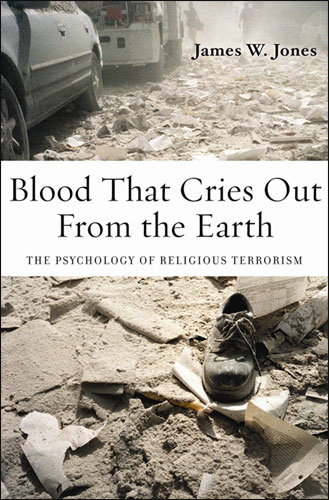
Blood that cries out from the Earth: The Psychology of Religious Terrorism

James Jones: Blood that cries out from the Earth: The Psychology of Religious Terrorism, Oxford University Press, ISBN 978-0-19-533597-2

Reviewed by Richard A. Koenigsberg  
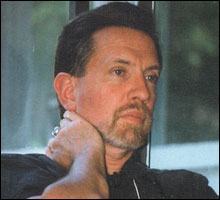
Professor James Jones of Rutgers University

James Jones seeks to understand Islamic terrorism as a form of sacrificial behavior undertaken in the name of a religious ideology and community. Citing Ivan Strenski, he observes that suicide bombers are regarded as “sacred” by their communities of reference—as sacrificial victims. A Palestinian militant stated that it is when a bomber gives his life that he earns the most respect and is “elevated to the highest level of martyrdom.” The Tamil Tigers of Sri Lanka pioneered the use of terrorism as a political methodology. They described their call to suicide bombings by a word that means “to give oneself” and conceived of their violent actions as a “gift of the self.” In joining the Tamil Tigers, one took an oath that the “only promise is I am prepared to give everything I have, including my life. It is an oath to the nation.” Continue reading

1 Comment

Filed under military strategy, suicide bombing, terrorism, world events & processes

Reading the geography of Sri Lankan island-ness: colonial repetitions, postcolonial possibilities

Tariq Jaleel

Reprint from Contemporary South Asia, 17: 399-444 courtesy of Informaworld, http://www.informaworld.com/smpp/section?content=a917049547&fulltext=713240928

Abstract

This article focuses on the cultural dimensions of Sri Lanka’s island geography. In particular it argues the importance of regarding the geography of Sri Lankan island-ness as a representational and imaginative trope repetitively and textually inscribed over time. I trace the contours of a topological enclosure that seem so matter-of-fact, natural and characteristic of the Sri Lankan island-state. Inviolability and historical-territorial integrity have become eponymous with the very sign ‘Sri Lanka’, but these ways of imagining and mapping Sri Lankan island space have European, colonial and post-independent spatial histories that are textual and representational. In reading a range of disparate texts that inscribe and map these insular geographies, the essay argues the importance of placing Sri Lanka’s island geographies, and its civil war that had the contested island imagination at its core, in a critical postcolonial and spatial historical context. By tracing and loosening some of the misplaced concreteness surrounding settled geographical imaginations and understandings of a Sri Lankan island-state, the essay intervenes in that spatial discourse thereby gesturing toward the political possibilities of thinking and imagining island space differently.
Keywords: Sri Lanka; island-ness; geography; postcolonial; repetition

 On 17 May 2009, the Sri Lankan government formally declared victory in its 26-year war with the Liberation Tigers of Tamil Eelam (LTTE). In his victory speech to the nation via Parliament two days later, the President, Mahinda Rajapakse, made clear the paramount importance the government attached to restoringSri Lanka’s territorial and sovereign integrity by stressing that: “For almost three decades the laws enacted by this legislature were not in force in almost one-third of our land. When I won the Presidential Election in 2005 there were LTTE police stations in the North and East. There were Tiger courts. What was missing was only a Tiger parliament … Today, this session of Parliament opens in a country where the writ of this august legislature spreads equally throughout the 65,332 sq. km of territoryof Sri Lanka …’ (Rajapakse 2009) Continue reading

Leave a comment

Filed under historical interpretation, Indian Ocean politics, Rajapaksa regime, world events & processes

Narendran Rajasingham’s Note on the Moon-Panel’s Report

Dr Rajasingham Narendran who worked in Saudi Arabia for many years and is retired now, is a Tamil nationalist who has not hesitated to expose the LTTE for what it had become. He has advocated the case for national reconciliation and mutual accomodation between the communities in Sri Lanka over several years. In the last few days there has been a heated discussion on the Moon-Darusman Report within a web circle, with some of the Tamil participants hurling sharp criticisms at each other. Narendran submitted this MEMO as a contribution to this debate. I consider it useful for a wider audience to have access to his viewpoint. Also see his more recent essay describing his two-month stay in Jaffna in transcuurents. Michael Roberts
 Dear [deleted name]

Thanks for your clear and wise stand.  You have said what had to be said very well and unambiguously.   What we have to be concerned  is justice for those who survived the direct effects of the war.  This covers the Tamils, Sinhalese and the Muslims. This is a concern that should be shared by all Sri Lankans.  How we are going to set about it in an organized manner is a big question.  Those who are seeking revenge, believing that the side they supported during the war were angels, while those on the opposite side were the devils, are responsible for the debate that has enveloped the Ban Ki Moon sponsored report. Revenge and damning the various players in the war will not bring back the dead, replace lost limbs, and heal various wounds that have befallen the people who were in the midst of the war and survived it.  However, they can be helped to put their lives together and take steps towards an acceptable future. Continue reading

6 Comments

Filed under historical interpretation, island economy, LTTE, power sharing, Rajapaksa regime, reconciliation, Sinhala-Tamil Relations, Tamil migration, welfare & philanthophy

Gruesome Bodies: Osama, Pirapāharan, Wijeweera

Michael Roberts, 10 May 2011

Rohana Wijeweera, Velupillai Pirapāharan, Osama bin Laden. In that temporal order their bodies were sent to the realms beyond quietly and secretly after they were shot dead.

If grapevine gossip that eventually emerged can be relied upon, Wijeweera, the leader of the Janathā Vimukthi Peramuna insurgency in Sri Lanka,[1] was summarily executed by bullet to head at the Kanatte Cemetery in Colombo on the 13th November 1989 and then cremated. In my conjecture Pirapāharan received a bullet to his head while traversing the swampland on the inland side of Nandhikadal Lagoon with a few of his fighters in May 2009; so that those Sri Lankan soldier behind the gun was probably not  aware that it was the famous Tiger leader he had bagged till the corpse was retrieved. Osama bin Laden was executed on 1/2 May 2009 during an American Seal commando operation at Abbottabad in Pakistan.

In all three instances the state forces that carried out these operations made sure that the corpses were not buried at a site that could become a mausoleum and icon for inspiration in the future. With Wijeweera and Pirapāharan the act of cremation was in accord with the common practice among Buddhists and Saivites generally. TheUSgovernment claims that Osama’s corpse was treated in the manner favoured by Muslims before it was confined to the unfathomable sea (though we have no means of testing this statement). Continue reading

2 Comments

Filed under historical interpretation, life stories, LTTE, military strategy, Rajapaksa regime, terrorism, unusual people, world events & processes

“It is wrong to review the expert committee report from a racist angle,” Nimalka Fernando

An Interview with Nimalka Fernando published in the Sunday RAVAYA dated 24/4/2011 and now translated.

Q1: What are the issues contained in the report prepared by the expert panel appointed by the Secretary General of the UN Ban Ki- Moon?

The main challenge before this committee was to arrive at an understanding regarding the incidents that took place during the last stages of the war in Sri Lanka since there were confusing reports and information. Both the government and the LTTE had declared war. It was no more a guerilla warfare both parties were engaged in a conventional war. During this period allegations were brought against the government by Diaspora as well as several humanitarian agencies. Many spoke about efforts related to humanitarian work being hampered, that hospitals were being bombed, areas inhabited by civilians being shelled and or bombed. There were many such reports re such incidents. Since this is now a conventional war it has to come under such rules like the Geneva Convention. Therefore if such an inquiry is being held as to whether there was compliance to Geneva Convention this is not interference into sovereignty. Continue reading

Leave a comment

Filed under historical interpretation, Indian Ocean politics, power sharing, Rajapaksa regime, Sinhala-Tamil Relations, world events & processes

A lasting solution to power-sharing: SJV Chelvanayakam Lecture

 M. A. Sumanthiran

I consider it a great honour to have been asked to deliver the Thanthai Chelva memorial oration this year. Last year too I had the honour of delivering the key-note address at the annual commemoration ceremony held inJaffnaon the 26th of April. Today, I am doubly delighted since Thanthai Chelva’s true disciple Mr Sampanthan presides over this event. I am truly humbled by this singular honour bestowed on me.

Some years ago, at a ceremony to unveil the bust of Dr Colvin R de Silva at the Colombo Law Library, Colvin’s junior-most junior, Ms Chamantha Weerakoon Unamboowe recounted an anecdote. One day Colvin was greatly worried about a criminal appeal that he was going to argue before the Supreme Court that day. Chamantha had told him, “Sir, why are you so worried; half the criminal law of this country was made by you”, to which Colvin is supposed to have replied: “And the other half was made because they did not listen to me”!

I think it would be right to say that the state of our country is what it is today, because they did not listen to Thanthai Chelva. Ironically, it was Colvin who eventually did not listen in the Constituent Assembly in the early 1970s, after having himself prophesied in 1956: “Two languages – one country; one language – two countries”. The first Republican Constitution of 1972 gave the last rites to the slow death for ethnic coexistence in this country that started when a unitary constitution was handed to us by the departing British. Having earned the distinction of being the first Asian country to enjoy universal suffrage, we buried all the benefits of democracy to this island by ignoring the rich diversity of its Peoples and their different heritages, and treating it like a homogenous society. Continue reading

1 Comment

Filed under historical interpretation, power sharing, Rajapaksa regime, reconciliation, Sinhala-Tamil Relations, world events & processes

Sri Lanka has to face up to an uncomfortable truth: Factual reliability of the UN Report

Kumar David, from The Sunday Island, 8 May 2011

The core issue I will address in this article is this: By and large can we accept as true the description of events in the UN Report? A corollary issue that I will not touch on is: If the facts as described are truthful do they add up to a prima face case of war crimes and crimes against humanity by the Government of Sri Lanka (GoSL) and the LTTE? Other related or interesting issues have surfaced, but are logically subordinate and separate from my scene-setting question. However I will enumerate these first before laying them to one side. The three that surface most often are:-.

(a) Yes, what the Panel says is factually true but the Lankan state had no choice but to resort to measures that violated international law so as to root out a ruthless enemy.

(b) Yes, what the Panel says is factually true but theUS, the British and the French have committed worse atrocities, so why blame the protagonists in Lanka’s civil war when these nations have done worse.

(c) Yes, the LTTE did behave as described in the report but an oppressed minority nation, in the course of a national liberation war, is pushed to regrettable extremes. Continue reading

1 Comment

Filed under Left politics, life stories, LTTE, military strategy, Rajapaksa regime, Sinhala-Tamil Relations, terrorism, world events & processes

Cameos of Jaffna: a visit after three decades

Nan, from Sunday Island, 8 May 2011

Less palmyrah trees, more coconut palms; less typical leaf fences due to less houses; hotels sprung up while there were hardly any long ago; a distinct military presence similar to khaki-clads in Colombo roads and of course the high security zones and check points. Devastated houses, decrepit buildings, deserted homes with shelled walls. The most shocking – the yellow tape with black letters warning of mines – strung round certain areas and the deep, deep sadness making heavy the heart silently crying for all the lost youth both, Sinhalese and Tamil, Tamil Tigers and Tigresses, led completely astray with heedless nationalism to a state of their own. Tears unshed but very much present at a lost generation – lost in death or lost with 30 years war, fear and turmoil.

Pictures in June 2010 by Michael Roberts


Continue reading

Leave a comment

Filed under island economy, LTTE, power sharing, Rajapaksa regime, reconciliation, Sinhala-Tamil Relations

Upcountry Tamils recede into Shadows in Sri Lanka

Kumar David, courtesy of Eurasia Review, 9 May 2011

 S. Thondaman

 Mano Ganesan                   

Though unnoticed, commentaries on the Upcountry Tamils (UcT) or Mallai-naatu Thamilar, also referred to as Indian Tamils or Tamils of recent Indian origin, have been  sparse in both media and scholarly periodicals in the recent decades. Focus on the war has hogged headlines and pushed everything else out of view; but this is not the only reason. Changes in the socio-economic fabric and the political landscape have contributed to the eclipse of the UcTs from the limelight. This essay will explore how an introversion of the Sinhalese political psyche induced by war and war victory, demographic changes, the very fact of some economic advancement in the 1980s and 1990s, and declining Indian interest, have worked to relegate the upcountry Tamils to the sidelines.

Continue reading

Leave a comment

Filed under historical interpretation, island economy, Sinhala-Tamil Relations, world events & processes

Escape from Auschwitz: Kazimierz Piechowski

 Homa Khaleeli, from The Guardian, 11 April 2011


Kazimierz Piechowski in 2011– Photograph: Christian Sinibaldi for the Guardian

On 20 June 1942, the SS guard stationed at the exit toAuschwitzwas frightened. In front of him was the car of Rudolph Höss, the commandant of the infamous concentration camp. Inside were four armed SS men, one of whom – an Untersturmführer, or second lieutenant, was shouting and swearing at him.

“Wake up, you buggers!” the officer screamed in German. “Open up or I’ll open you up!” Terrified, the guard scrambled to raise the barrier, allowing the powerful motor to pass through and drive away. Continue reading

Leave a comment

Filed under historical interpretation, life stories, unusual people, world events & processes