Category Archives: reconciliation

“War — Never again,” — A Muslim Intellectual

Dr.M.A.Mohamed Saleem, in The Sunday Island, 5 June 2011

We learn from the media that External Affairs Minister G. L. Pieris, speaking to a select group of journalists inNew Delhirecently declared… “There is never going to be another civil war in Sri Lanka. Never again” (The Sunday Island May 22). Although it is indeed comforting there are many, inside and outside this country, who would have asked the same question that was raised by one from audience – how could he be sure? And, also find the Minister’s answer less convincing. No one inSri Lanka, given its size, could have even dreamt that our country will ever go to war with anyone. This country cannot afford to earn anyone’s enmity, and the best course for it therefore is non-alignment, and that is what was adopted by the early leaders all along. Unfortunately, the very leaders had discounted emotional sensitivities of the various groups of people in this country, and for the minorities, some government policies were discriminative and meant to marginalize them from the mainstream. In the eyes of many therefore, this country did not belong to everyone. That incited some to agitate for a separate homeland and pushed the extreme militant Tamil fringe to take up arms to fight for it although, at one time, Tamils of this country were considered most docile and law abiding compared to other communities. Continue reading
Leave a comment

Filed under LTTE, power sharing, reconciliation, Sinhala-Tamil Relations, terrorism, unusual people, world events & processes

IOM and Danziger aid ex-Tiger cadres

Shamindra Ferdinando, in Island, 29 May 2011

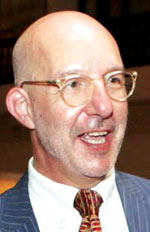
Ex-LTTE combatants can now benefit from a unique project executed by the International Organisation for Migration (IOM) with the support of international donors. The scheme launched in the aftermath of the conclusion of the war in May 2009, provides assistance to those who once fought for the LTTE. Richard Danziger, Chief of Mission, IOM Sri Lanka, told The Island that they had designed and implemented a comprehensive Information, Counselling, and Referral Services (ICRS) programme for ex-LTTE personnel. Danziger said that the ICRS project would help the ex-combatants to return to civilian life in a dignified and timely manner. That would definitely contribute to the process of peace and national reconciliation, thereby building a positive environment for the resumption of economic activities in war torn areas, Danziger said

Danziger was speaking after the last week’s IOM’s 60th anniversary celebrations. Danziger revealed that as at May 16, 2011, 1,730 ex-LTTE personnel had received individual assistance, through the ICRC project.

On the invitation of the government of the Government of Sri Lanka, the IOM has so far profiled about 6,800 ex-LTTE personnel. Danziger said that it was an ongoing project conducted with the blessings of the government. He said: “As of today, more than 6726 former LTTE cadres have been profiled by IOM. Each beneficiary receives individual support following their release from the government’s rehabilitation facilities. They can apply for a small grant to set up a business, find employment, start formal education or be engaged in apprenticeships and on-the-job training schemes. Similarly, through the ICRS referral mechanism, beneficiaries are put in contact with job vacancies, vocational training opportunities and some of the specialist services that they may need to access such as health, psycho-social and legal support. As at 16 May 2011, 1,730 former combatants have been given individual assistance through the ICRS mechanism.” Continue reading

Leave a comment

Filed under life stories, LTTE, Rajapaksa regime, reconciliation, Sinhala-Tamil Relations, welfare & philanthophy

“The bravest thing is not to fight” said Einstein — BUT…

Rohana Wasala, from Island, 27 May 2011, where it appears under a different title

The tri-services parade today, accompanied by a fly past and a sail past by the Air Force and the navy respectively, marks the second anniversary of the Sri Lankan nation’s triumph over terrorism. The terror movement against the country which was defeated two years ago was of a much larger scale and more far-reaching significance than the Marxist insurrections of 1971 and 1989 in the south of the country, which were also decisively crushed by the state. Twenty-six years of mindless terrorism left many thousands dead, and many more thousands maimed for life. The material damage the country sustained was immense. A victory achieved at such a costly price cannot be consigned to history as just another achievement like the cricket world cup triumph in 1996. It is an event to be celebrated not only by this generation, but by many generations to come

Balraj leads Tiger troops–Pic from transcurrents

Pic from Minsitry of Defence

Continue reading

Leave a comment

Filed under Fascism, historical interpretation, life stories, LTTE, military strategy, power sharing, Rajapaksa regime, reconciliation, Sinhala-Tamil Relations, terrorism, world events & processes

Tuyilam Illam: Positivist readings and new debating grounds

Michael Roberts, courtesy of groundviews, where it wasposted on 20 May 2011,

Some sections of the Tamil intelligentsia remain bitter and defiant today after the demise of their plans for national self-determination. “We are a defeated people,” said one articulate professional in the Jaffna Peninsula in June 2010 in an unsolicited remark that conveyed his defiance.  The heavy presence of security forces and the proportion of land occupied by the various arms of state power in the northern reaches were among the grievances throbbing in the hearts of those hostile to the new dispensation (a body whose proportions I am in no position to assess). Thus, the HSZ spaces and the many buildings that had been commandeered by the three armed services since 1995 and 2009 remained a bone of contention when I was in the Lanka in 2010.

 The government is not blind to these sentiments. It has periodically reduced goblets of its territorial tentacles and proclaimed these steps far and wide. One of the army’s ‘acquisitions’ was the old Subash Hotel in Jaffnatown which had been turned into the local Army HQ. So, it was with some implicit breast-beating that the government recently told the world that the “new headquarters of the 51st Brigade of the Army [had been] opened on the Koppai Cemeteryground” on the 4th March and that they were in the process of vacating Subash Hotel.[1]

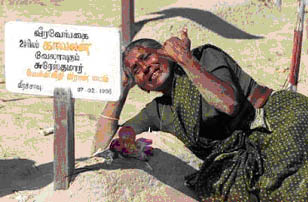
  Homage ot a maaveerar kinsperson at Koppay, 2004 -Pic source unknown

Koppai was one of many tuyilam illams, or “sleeping houses,” built by the LTTE to commemorate their māvīrar or “great heroes” (also translated loosely as “martyrs”). In terms of the Tamil cultural classifications the translation of this term as “cemeteries” may be a misnomer, but one should not be too pedantic on this point. Likewise, it is possible that many epitaphs did not contain any remains.

 Kopay natukal -Pic by Roberts, 24 Nov. 2004

My criticism[2] of the government’s obliteration of the LTTE”s tuyilam illam was directed along two paths: (A) that it was an act of desecration and “not done”’ and (B) that it was unintelligent politics in the sense that the epitaphs could highlight the LTTE”s folly rather than serving as an inspiration for rejuvenation, while their obliteration could also activate sentiments of vengeance. The second line of reasoning spelt out above is a form of instrumental pragmatic reasoning.

 Sarvananthan has questioned my argument in amiable style by emphasizing that the tuyilam illam were monuments of commemoration not “real” cemeteries with the remains of the dead. There are no remains, so there is no desecration. Continue reading

Leave a comment

Filed under historical interpretation, life stories, LTTE, Rajapaksa regime, reconciliation, Sinhala-Tamil Relations

Dancing Ex-Tigers at IOM function: From Vanni to Cinnamon Grand Hotel

Shamindra Ferdinando, Island, 25 May 2011

An opportunity to perform at a five-star hotel would have been the last thing on their mind when the LTTE collapsed on the Vanni east front two years ago. Today, the majority of LTTE cadres taken into custody are free with those undergoing rehabilitation expected to come down to about 1,500 by end of this year. The military held about 11,700 LTTE cadres at the conclusion of the war in the third week of May, 2009.

At a reception held at the Cinnamon Grand (formerly Oberoi) on Monday to celebrate the 60th anniversary of the International Organisation for Migration (IOM), a group of ex- LTTE cadres had a rare chance to perform for a distinguished gathering. The LTTE exploded a bomb at the Oberoi on January 21, 1984, killing one person. Trained at the Abhina Academy of Performing Arts, situated at Kalapura, Templer’s Road, MountLavinia, under the guidance of versatile actress Ms. Anoja Weerasinghe, the unprecedented show reflected the post-war reality. Their energetic performance enraptured the audience, including those sceptical ofSri Lanka’s rehabilitation programme, due to it being placed under the Sri Lanka Army. Under Ms. Weerasinghe’s guidance, several groups of ex-LTTE cadres and those affected due to terrorism received training at the Abhina Academy. Continue reading

Leave a comment

Filed under life stories, LTTE, Rajapaksa regime, reconciliation, Sinhala-Tamil Relations, terrorism

Janith Aranze Essays: Omanthai Checkmate and Dual Citizenship Time-Out

Janith Aranze, from the Sunday Leader, 15 May 2011

Dual Citizenship Put On Hold

The current review of the system of dual citizenship could deprive thousands of expatriate Sri Lankans the right to a Sri Lankan identity. With many choosing to live abroad due to work commitments or family reasons, dual citizenship is seen as the ideal way to integrate into a new community while still keeping an allegiance to your country of birth.  With dual citizenship currently suspended,

It is almost impossible for travellers heading North with foreign passports to get past checkpoints — Photo by B.A.Perera

 the new system is expected to be a lot tighter for those wishing to obtain it. Continue reading

Leave a comment

Filed under life stories, Rajapaksa regime, reconciliation, Sinhala-Tamil Relations, Tamil migration

North-East and Beyond: Welcome Developments on Several Fronts

Beyond sweet words and never-ending talks with the TNA and others, on the political front the government has done little so far to indicate concrete movement towards some form of power-sharing. The gradual reduction of lands delimited as High Security Zone is a welcome development albeit rather belated. On the development front, however, there are some very encouraging steps and ventures. Several are identified here through reiteration of news items in print and web sources. Michael Roberts.

Indian railway project in Sri Lanka in full steam

R. K. Radhakrishnan, from The Hindu

With an Indian de-mining team clearing the 107-km stretch of a railway alignment from Medawachchiya to Talaimannar in record time, the Indian Railway Construction Corporation (Ircon) has shifted gears on the construction of a railway line. Ircon is aiming to complete the sections allocated to it in a year-and-a-half. When the ISO-certified de-mining team, Horizon, began its work about eight months ago, it faced a host of obstacles. “We did not know where the alignment was,” said Shashikant Pitre, chairman, Horizon Group. The LTTE had destroyed the alignment and bridges and had taken away the railway track. “The ground was heavily compacted with gravel making the raking to a depth of 15 cm quite difficult,” he added. Continue reading

Leave a comment

Filed under Indian Ocean politics, island economy, power sharing, Rajapaksa regime, reconciliation, Sinhala-Tamil Relations, welfare & philanthophy

Narendran Rajasingham’s Note on the Moon-Panel’s Report

Dr Rajasingham Narendran who worked in Saudi Arabia for many years and is retired now, is a Tamil nationalist who has not hesitated to expose the LTTE for what it had become. He has advocated the case for national reconciliation and mutual accomodation between the communities in Sri Lanka over several years. In the last few days there has been a heated discussion on the Moon-Darusman Report within a web circle, with some of the Tamil participants hurling sharp criticisms at each other. Narendran submitted this MEMO as a contribution to this debate. I consider it useful for a wider audience to have access to his viewpoint. Also see his more recent essay describing his two-month stay in Jaffna in transcuurents. Michael Roberts
 Dear [deleted name]

Thanks for your clear and wise stand.  You have said what had to be said very well and unambiguously.   What we have to be concerned  is justice for those who survived the direct effects of the war.  This covers the Tamils, Sinhalese and the Muslims. This is a concern that should be shared by all Sri Lankans.  How we are going to set about it in an organized manner is a big question.  Those who are seeking revenge, believing that the side they supported during the war were angels, while those on the opposite side were the devils, are responsible for the debate that has enveloped the Ban Ki Moon sponsored report. Revenge and damning the various players in the war will not bring back the dead, replace lost limbs, and heal various wounds that have befallen the people who were in the midst of the war and survived it.  However, they can be helped to put their lives together and take steps towards an acceptable future. Continue reading

6 Comments

Filed under historical interpretation, island economy, LTTE, power sharing, Rajapaksa regime, reconciliation, Sinhala-Tamil Relations, Tamil migration, welfare & philanthophy

A lasting solution to power-sharing: SJV Chelvanayakam Lecture

 M. A. Sumanthiran

I consider it a great honour to have been asked to deliver the Thanthai Chelva memorial oration this year. Last year too I had the honour of delivering the key-note address at the annual commemoration ceremony held inJaffnaon the 26th of April. Today, I am doubly delighted since Thanthai Chelva’s true disciple Mr Sampanthan presides over this event. I am truly humbled by this singular honour bestowed on me.

Some years ago, at a ceremony to unveil the bust of Dr Colvin R de Silva at the Colombo Law Library, Colvin’s junior-most junior, Ms Chamantha Weerakoon Unamboowe recounted an anecdote. One day Colvin was greatly worried about a criminal appeal that he was going to argue before the Supreme Court that day. Chamantha had told him, “Sir, why are you so worried; half the criminal law of this country was made by you”, to which Colvin is supposed to have replied: “And the other half was made because they did not listen to me”!

I think it would be right to say that the state of our country is what it is today, because they did not listen to Thanthai Chelva. Ironically, it was Colvin who eventually did not listen in the Constituent Assembly in the early 1970s, after having himself prophesied in 1956: “Two languages – one country; one language – two countries”. The first Republican Constitution of 1972 gave the last rites to the slow death for ethnic coexistence in this country that started when a unitary constitution was handed to us by the departing British. Having earned the distinction of being the first Asian country to enjoy universal suffrage, we buried all the benefits of democracy to this island by ignoring the rich diversity of its Peoples and their different heritages, and treating it like a homogenous society. Continue reading

1 Comment

Filed under historical interpretation, power sharing, Rajapaksa regime, reconciliation, Sinhala-Tamil Relations, world events & processes

Cameos of Jaffna: a visit after three decades

Nan, from Sunday Island, 8 May 2011

Less palmyrah trees, more coconut palms; less typical leaf fences due to less houses; hotels sprung up while there were hardly any long ago; a distinct military presence similar to khaki-clads in Colombo roads and of course the high security zones and check points. Devastated houses, decrepit buildings, deserted homes with shelled walls. The most shocking – the yellow tape with black letters warning of mines – strung round certain areas and the deep, deep sadness making heavy the heart silently crying for all the lost youth both, Sinhalese and Tamil, Tamil Tigers and Tigresses, led completely astray with heedless nationalism to a state of their own. Tears unshed but very much present at a lost generation – lost in death or lost with 30 years war, fear and turmoil.

Pictures in June 2010 by Michael Roberts


Continue reading

Leave a comment

Filed under island economy, LTTE, power sharing, Rajapaksa regime, reconciliation, Sinhala-Tamil Relations