Category Archives: demography

The Hill-Country Tamils: Their Shitty-Situation Then … and NOW

Ahilan Kadirgamar, in Daily Mirror, 21 November 2022, where the title reads “Hill-country Tamils and Crisis Times” …. with highlighting imposed by The Editor, Thuppahi

When our country collapses before our own eyes with one of the deepest crises in historical memory, from what vantage point should we analyse our predicament? Sri Lanka’s political economy over the last two centuries is anchored in the travails and strivings of Hill Country Tamils. Their sweat and blood, that began with the horrifying journey from South India two centuries ago as indentured labour to work in the coffee and later tea plantations, were central to building the country’s modern economy under British colonialism. However, their position in society, and for that matter even the writing of their history, was marginalised. And despite the great democratic and social welfare advances in Sri Lanka with universal suffrage in 1931 and a powerful legacy of free healthcare and education, the social, economic and political life of the Hill Country Tamil community is characterised by struggle amidst persistent crisis times.

‘Ceylon tea’ gave Sri Lanka the recognition in the world map, but the plantation workers are still languishing in their ages-old abode, known as line rooms and continue to be marginalised in education, community wellbeing and healthcare.

Continue reading

3 Comments

Filed under accountability, anti-racism, British colonialism, centre-periphery relations, charitable outreach, communal relations, cultural transmission, demography, discrimination, economic processes, education policy, electoral structures, ethnicity, governance, historical interpretation, human rights, Indian Ocean politics, island economy, landscape wondrous, language policies, legal issues, life stories, modernity & modernization, plantations, politIcal discourse, power politics, self-reflexivity, Sinhala-Tamil Relations, social justice, sri lankan society, Tamil civilians, Tamil migration, tolerance, truth as casualty of war, unusual people, welfare & philanthophy, women in ethnic conflcits, world events & processes

Sikh Troops as British Punishing Rods during the 1915 Riots

Joe Simpson, in Email Note responding to the Thuppahi Item https://thuppahis.com/2021/05/23/percy-colin-thome-and-the-composition-of-the-book-people-inbetween/

Most interesting, Michael. I’ve had the privilege of periodic correspondence with the estimable Ismeth Raheem in the past, and thanks to the kindness of Vancouver, BC-resident Ranil Bibile who agreed to be courier, once sent Ismeth a Giclée reproduction of a previously-unknown 1840s painting by Andrew Nicholl from his outbound voyage to Colombo, the original of which has been purchased by a British Columbia collector with whom I’d been in touch.
In regards to your attached bibliography, specifically the scholarly article on the 1915 communal riots that particularly affected the Galle-Tangalle area, while I was on VSO teaching at Richmond College (1973-74) some RCG colleagues and I were in Matara on our way to visit a rural jungle primary school in the Moneragala area, when we fell into conversation with an elderly local, who had been a fisherman all his working life [photo taken then].


Continue reading

7 Comments

Filed under accountability, Africans in Asia, atrocities, authoritarian regimes, British imperialism, centre-periphery relations, communal relations, demography, disparagement, economic processes, ethnicity, governance, historical interpretation, Indian Ocean politics, insurrections, landscape wondrous, legal issues, life stories, military strategy, politIcal discourse, power politics, riots and pogroms, security, sri lankan society, trauma, unusual people, vengeance, world events & processes

The Kaffir in Sri Lanka: A Partial Bibliography from Thuppahi

Michael Roberts 

The first two photographs provide just a glimpse of their ‘markings’; while the map composed I think by Shihan de Silva Jayasuriya indicates the long history of African migratory flows (sometimes as slaves) to Asian lands.


Continue reading

2 Comments

Filed under atrocities, British colonialism, British imperialism, centre-periphery relations, communal relations, cultural transmission, demography, discrimination, disparagement, Dutch colonialism, economic processes, ethnicity, hatan kavi, heritage, historical interpretation, landscape wondrous, life stories, performance, politIcal discourse, population, racism, religiosity, self-reflexivity, sri lankan society, travelogue, unusual people, working class conditions, world events & processes

Seeking Aid for Poverty-Stricken Estate Children in Lanka

An Appeal from Ranjan Sivagnanasundaram of VANNI HOPE

PROJECT OBJECTIVE: THE OVERALL OBJECTIVE OF THIS PROJECT IS TO CREATE AN ENABLING ENVIRONMENT FOR THE YOUTH OF THIS AREA SO THAT THEY CAN BE SELF-DEPENDENT, CONTRIBUTE TO THE DEVELOPMENT OF THE AREA AND BE AN ACTIVE PARTICIPANT IN DEVELOPMENT EFFORT OF THE FUTURE NATION.

SPECIFIC OBJECTIVES OF MORAL EDUCATION HELPS ONE TO DISTINGUISH BETWEEN RIGHT AND WRONG. IT GETS REFLECTED IN ONE’S PERSONALITY. IT HELPS IN BUILDING A GOOD PERSONAL AND PROFESSIONAL LIFE. IT HELPS TO ELIMINATE PROBLEMS LIKE VIOLENCE, DISHONESTY, JEALOUSY ETC FROM ONE’S LIFE.

Continue reading

4 Comments

Filed under accountability, centre-periphery relations, charitable outreach, demography, economic processes, education, heritage, life stories, performance, plantations, self-reflexivity, social justice, sri lankan society, voluntary workers, welfare & philanthophy

The Machinations of Vellala Lawyer Leaders that Deepened Tamil-Sinhala Divisions from the 1920s-to-the-1960s

Sebastian Rasalingam, reproducing an article presented in 2008 in The Sri Lanka Guardian in October 2008 with this title “An Excellent and Timely Feature on the Tamils” **

 Please permit me to make some comments on the recent article on the “Sri Lankan Identity” by R. M. B. Senanayake, continuing a discussion in a previous article by Anne Abeysekera. Both these articles, written by authors who are familiar with the English-educated Sinhalese point of view, deal very inadequately with the issues of Tamil Nationalism in Sri Lanka and in erstwhile Ceylon. In fact, the modern generation, even the Tamils, are on the whole unaware of the true nature of the present conflict and the role of Tamil nationalism. They are misled and mesmerized by simplistic histories concocted by the great political agenda set in motion by the Tamil leaders of the pre-1956 era. In fact, I will outline below how the battlelines were drawn in the Donoughmore days, by G. G. Ponnambalam (GGP) and others who followed.

Continue reading

1 Comment

Filed under accountability, anti-racism, caste issues, centre-periphery relations, communal relations, constitutional amendments, cultural transmission, demography, disparagement, economic processes, electoral structures, ethnicity, governance, heritage, historical interpretation, Indian Ocean politics, island economy, language policies, legal issues, life stories, LTTE, political demonstrations, politIcal discourse, power politics, power sharing, self-reflexivity, Sinhala-Tamil Relations, Sri Lankan scoiety, Tamil civilians, Tamil migration, tamil refugees, unusual people, world events & processes

UNHRC Resolutions Display Blatant Double Standards

Fair Dinkum, with this sub-title “UN resolutions reveal the West is opposed to international democracy, while it tries to block attempts directed against racism and Xenophobia”

The UN Human Rights Council has just concluded its 51st session, adopting 41 resolutions and decisions. Examining the way countries vote on these resolutions reveals much about the hypocrisy of Western values, and that all their talk of democracy, equity, and valuing human rights is just meaningless rhetoric – a fact that can be observed in two important resolutions just passed by the UNHRC.


Continue reading

4 Comments

Filed under accountability, american imperialism, authoritarian regimes, centre-periphery relations, China and Chinese influences, demography, discrimination, disparagement, economic processes, ethnicity, European history, governance, heritage, historical interpretation, human rights, Indian Ocean politics, legal issues, life stories, modernity & modernization, nationalism, Pacific Ocean politics, politIcal discourse, power politics, propaganda, self-reflexivity, sri lankan society, truth as casualty of war, Ukraine & Its Ramifications, UN reports, vengeance, world events & processes

An Exposure: “Human Rights” as A Tool of US Intervention in Sri Lanka

 Natasha Gooneratne, an item entitled “Under the Guise of Protecting Human Rights and Establishing Democracy: US Intervention in Sri Lanka,” …. presented in 2015 or 2016 (?)

Introduction

The discourse regarding Sri Lanka within international media has intensified since 2009, when the then government of president Mahinda Rajapaksa announced that it had defeated terrorism in the form of the armed non-state group known as the Liberation Tamil Tigers of Eelam (LTTE) [recognized as an international terrorist organisation by the US in 1997], that Sri Lanka had been in armed conflict with since the early 80s. Sri Lanka’s announcement prompted widespread reports of humanitarian law violations, and human rights abuses by both sides. A week after the announcement, on May 26th, the UN Human Rights Council held a special two-day session on the situation in Sri Lanka, concluding in the adoption of a resolution commending the state for the policies it had adopted. The resolution passed with 29 votes in favor, 12 against, and 6 abstentions.

Continue reading

Leave a comment

Filed under accountability, american imperialism, authoritarian regimes, centre-periphery relations, demography, economic processes, foreign policy, governance, historical interpretation, human rights, Indian Ocean politics, life stories, military strategy, nationalism, politIcal discourse, power politics, security, self-reflexivity, Sinhala-Tamil Relations, sri lankan society, Tamil civilians, the imaginary and the real, truth as casualty of war, UN reports, unusual people, world events & processes

Sustaining Cultural Performance Practices across the Indian Ocean

Shihan De Silva Jayasuriya et al

PREFACE to her new book entitled “Sustaining Support for Intangible Cultural Heritage” (ICH)

Sustaining Support for Intangible Cultural Heritage (ICH) continues the conversations on cultural heritage which commenced at a virtual conference held on August 3, 2020, at the Institute of Commonwealth Studies. The conference was spurred by the screening of my film – “Indian Ocean Memories and African Migrants” – at the Social Scientists Association, Colombo. The interest shown by UNESCO Global Network Facilitators, Dr Bilinda Nandadeva and Dr Gamini Wijesuriya, who attended the screening, was a catalyst to convening the conference. The Covid-19 pandemic further exposed the significance of heritage and the vulnerability of intangible culture. The book is a call to value ICH and an inspiration for academics, researchers, stakeholders, civil society, cultural practitioners and policymakers to understand the threats to sustaining heritage.

Continue reading

Leave a comment

Filed under Aboriginality, Africans in Asia, ancient civilisations, art & allure bewitching, centre-periphery relations, cultural transmission, demography, economic processes, ethnicity, female empowerment, heritage, historical interpretation, Indian traditions, landscape wondrous, life stories, literary achievements, performance, population, religiosity, self-reflexivity, sri lankan society, the imaginary and the real, transport and communications, travelogue, unusual people, working class conditions, world events & processes

Religion within Tamil Militancy and the LTTE

  Iselin Frydenlund, presenting her article in Oxford Encyclopedia of Religion, May 2018, …. one entitledTamil Militancy in Sri Lanka and the Role of Religion” …. https://sangam.org/wp-content/uploads/2020/04/Tamil-Militancy-in-Sri-Lanka-and-the-Role-of-Religion.pdf  … OR … https://www.semanticscholar.org/paper/Tamil-Militancy-in-Sri-Lanka-and-the-Role-of-Frydenlund/4cbf5235611dd3407dfa3a2962e6ea635ac50674 … with highlights and pictures being impositions by the Editor, Thuppahi

Induction of Tiger recruits into fighter ranks with receipt of the kuppi containing cyanide

Tiger soldiers relaxing in camp with cyanide kuppi around their necks Pix by Shyam Tekwani


Historical Background

Understanding the role of religion in the Tamil insurgency requires an understanding of Sri Lanka’s cultural mosaic and of the development of modern nationalism before and after independence from British colonial power. Sri Lanka is a geographically small yet culturally rich and complex island, with numerous ethnic, linguistic, religious, and caste subgroups. The majority of the population identify as ethnically Sinhala, and they speak Sinhala, an Indo-European language. The great majority of the Sinhalese are Theravada Buddhists who live mostly in the south and central regions of the island. A small minority of Sinhalese are Catholics, and some also belong to evangelical Christian churches. The largest minority group in Sri Lanka is the Tamils, who speak Tamil (a South Indian Dravidian language) and comprise several subgroups. The largest of these are the so-called Sri Lankan Tamils, who traditionally have lived in the north and east. The so-called Indian Tamils are labor immigrants from India who were brought in by the British to work in the plantation sector in the highlands. The majority of Tamils are Hindus of the Śaiva Siddhanta tradition, but there are also a significant number who are Catholics and a few to smaller Evangelical denominations. The Tamil Muslims identify based on religious belonging, not on a common ethnic identity, and they speak Tamil. Historically, the Muslim communities are scattered throughout the island; they form a stronghold in urban trading centers in the south but are also farmers in the Tamil-majority Eastern Province. Social stratification based on caste and regional identities was strong in precolonial Lanka, and then the colonial classifications of the island’s inhabitants produced new identities with intensified religious and racial signifiers. These were reproduced in the emerging Tamil and Sinhala nationalisms of the late 19th century.

Continue reading

4 Comments

Filed under accountability, art & allure bewitching, atrocities, authoritarian regimes, caste issues, centre-periphery relations, communal relations, cultural transmission, demography, devolution, discrimination, economic processes, Eelam, electoral structures, ethnicity, female empowerment, fundamentalism, governance, heritage, historical interpretation, Indian religions, insurrections, island economy, landscape wondrous, language policies, law of armed conflict, life stories, LTTE, martyrdom, mass conscription, military strategy, nationalism, patriotism, politIcal discourse, power politics, prabhakaran, riots and pogroms, self-reflexivity, Sinhala-Tamil Relations, sri lankan society, suicide bombing, Tamil civilians, Tamil migration, tamil refugees, Tamil Tiger fighters, terrorism, trauma, truth as casualty of war, unusual people, vengeance, world events & processes

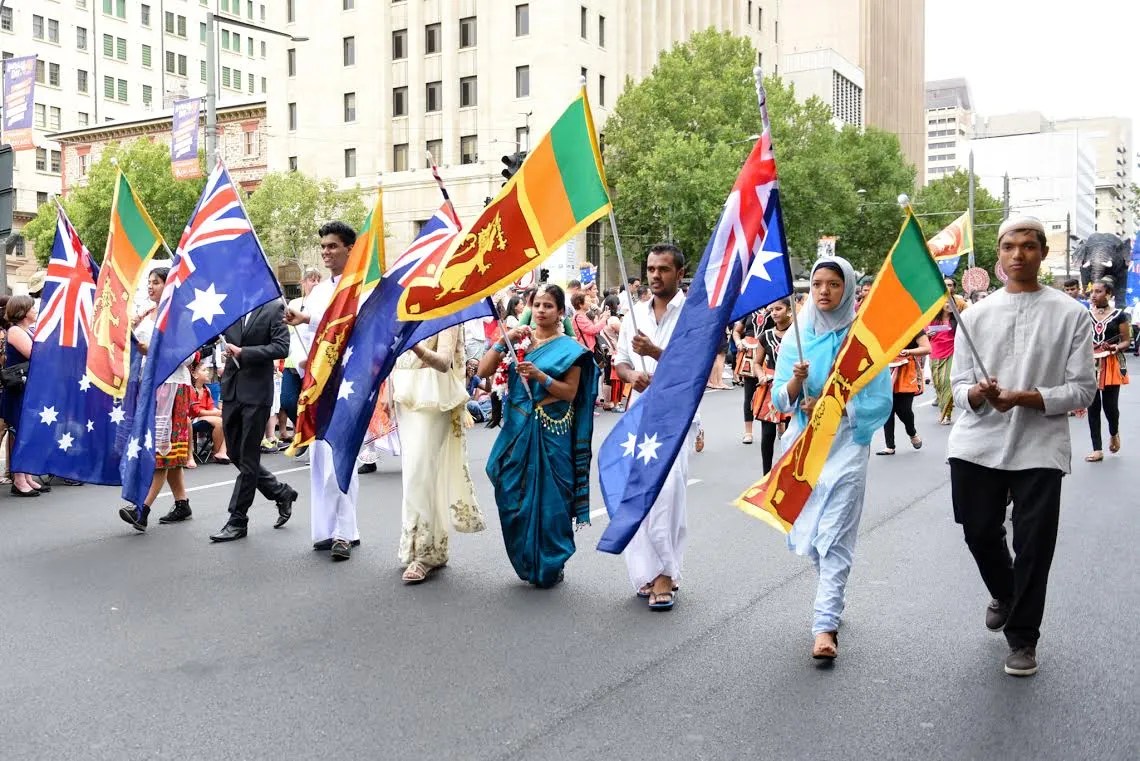
Sri Lankans in Australia: 2016 Census Data …… The Demographic Profile

Item sent to Thuppahi by Victor Melder ….  at https://www.abs.gov.au/census/find-census-data/quickstats/2016/7107_0 …. presented here with some selective highlights from the Thuppahi pen

People 109,853
Male 57,280
Female 52,573
Australian citizen 60.3%
Not an Australian citizen 38.3%

Families 43,816
Couples with children 26,914
Couples without children 13,326
One parent families 2,972
Other families 592

All private dwellings 52,548
Median monthly mortgage repayment $2,100
Median weekly rent paid $351


Continue reading

1 Comment

Filed under accountability, Australian culture, australian media, communal relations, demography, economic processes, education, ethnicity, governance, heritage, historical interpretation, immigration, island economy, legal issues, life stories, literary achievements, performance, population, self-reflexivity, sri lankan society, travelogue, unusual people, working class conditions, world events & processes