Deadly, cruel lesson from Norway

Clive Williams, in The Australian, 26 July 2011

COULD Norway have done anything to anticipate the weekend terrorist attacks? And what are the lessons from those events? The obvious place to start is with the perpetrator, and whether there were warning signs that could have alerted authorities to the danger he posed.

Pic of McVeigh when in US Army

 Pic from AP

Anders Behring Breivik, the man arrested for killing at least 93 people, appears to be a behavioural combination of Timothy McVeigh and Martin Bryant. McVeigh was responsible for the Oklahoma City bombing in 1995 that killed 168. Bryant was responsible for the Port Arthur shootings in 1996 that resulted in 35 dead. McVeigh was executed in 2001; Bryant is serving 35 life terms.

Continue reading

Leave a comment

Filed under australian media, Fascism, historical interpretation, life stories, terrorism, world events & processes

Poetic Musings on the Fate of the Pirapāharan Family — Shelagh Goonewardene

Shelagh Goonewardene nee Jansen has a background in drama as well as literary and aesthetic productions. Resident in Melbourne for quite some time she has been an active participant in the Ceylon Society of Australia and sustained exchanges with such well known people as Ernest MacIntyre, playwright and theatre producer, and Neville Weereratne, painter and outstanding designer of books. She also has links with literary circles in Lanka and is at present visiting the island.

I got to know Shelagh after she married Ranjit Goonewardene, a childhood Continue reading

1 Comment

Filed under cultural transmission, life stories, LTTE, Sinhala-Tamil Relations, world events & processes

Outcomes from my Think-Piece … and Thoughts on Pictorial Imagery

Michael Roberts, 24 July 2011

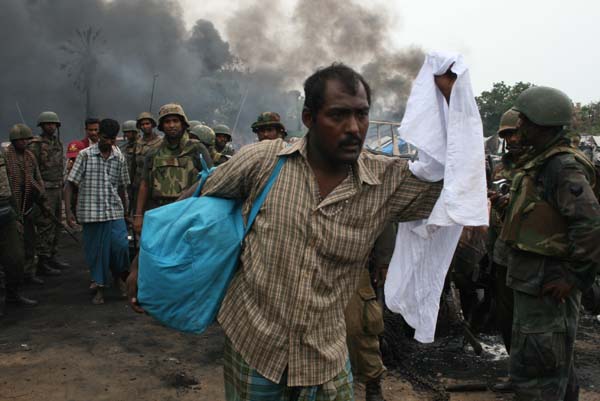
Pic courtesy of Ministry of Defence — note that this image can be read in different ways according to subjectivity and degrees of partisanship.

The May 2011 “Think-Piece” posted a few days back in this site resulted in several  articles within the same site and/or in other web sites and newspapers. These are now listed below together with a listing of crucial sets of photographs in my Flickr site.

Critical to any overview of the last stages of the war are whatever authentic images one can recover. I was first led to the value of this kind of data when working on what is conventionally referred to as “communal violence” in South Asia. In particular, two photographs depicting obscene acts of aggression at Borella Junction in Colombo on the 24/ 25th July night in 1983 captured my attention. These appeared initially in the Tamil Guardian and it was only subsequently that I discovered Chandragupta Amarasinghe, the brave cameraman who recorded these atrocities. The images featured in my “The Agony and Ecstasy of a Pogrom: Southern Lanka, 1983,” which has appeared in two outlets in 1994 and 2003 respectively.[i] Continue reading

1 Comment

Filed under citizen journalism, historical interpretation, life stories, LTTE, military strategy, Rajapaksa regime, Sinhala-Tamil Relations, terrorism, world events & processes

Blundering into the Westernized English-speaking World … and the Left Movement in Old Ceylon

Charita Wijeratne, in the Sunday Island, 24 July 2011

LSSP leaders at Horana with Bracegirdle, circa 1937 –Pic from Victor Ivan

I was fortunate to have sat the SSC in the late 1940s. Those days passing the English medium SSC was as simple as eating cadju. So simple that even I, in Kegalle where Eng lish was never spoken except by the teacher when taking a particular lesson, was  through at the first shy. First, because, syllabuses were within the scope of ordinary humans; second, because, only 33 marks had to be scored for a pass and; third, because, of the seven subjects required to be passed four required no English and one required only a faint acquaintance – Sinhala language, Sinhala Literature, Art, Buddhism and Arithmetic. With those five and two others you are through. I shudder at the vastness of today’s syllabus for GCE (O/L). If I were to attempt it today I would never get even an ordinary pass, because, I am not a studious person, least a crammer.

Continue reading

1 Comment

Filed under cultural transmission, historical interpretation, Left politics, life stories

How many roads must a man walk down?

Capt Elmo Jayawardena, in the Sunday Island, 24 July 2011

The journey has been long, very very long. It started in a little village called Dandu Bendi Ruppa in Nuwara Kalaviya when Dingiriamma rolled Jayathilaka in a ‘borrowed’ wheel chair for his first day in the village school. “Hodatama Wahinawa Mahaththayo” she told me; the skies were gray and

raining and the distant clouds were coughing thunder. She had covered her 10-year old handicapped son with a plastic sheet and pushed him on rickety old wheels which were gifted to them when some old man died in the next village. Such was the beginning….

That was then, twenty five years ago. 

The ceremony was solemn, opulent and almost sacred. The National University of Singapore does not spare anything when it comes to their ‘limelight’ events. The Class of 2011 all gathered in their robes of black and flat hats, mostly young, ‘this medal winner’ and ‘that medal winner’ of Singapore’s best brains in youth. Continue reading

4 Comments

Filed under citizen journalism, life stories, welfare & philanthophy

Local Polls in the north: people and analysts comment before the event

Courtesy of IRIN

COLOMBO, 22 July 2011 (IRIN) – Voters in northern Sri Lanka go to the polls on 23 July in what could prove a litmus test of public sentiment in the former conflict zone, say experts. The crucial local elections are the first in the area since the government declared victory in 2009 over the Liberation Tigers of Tamil Eelam (LTTE), which had been fighting for an independent Tamil homeland since 1983. “This is a real opportunity for the people of the north to have a voice; to let the government know how they are feeling,” Soosaipillai Keethaponcalan [ http://www.internationalpeaceandconflict.org/profile/SoosaipillaiIKeethaponcalan ], head of the department of political science at the University of Colombo, told IRIN. Continue reading

Leave a comment

Filed under island economy, life stories, Rajapaksa regime, reconciliation, Sinhala-Tamil Relations, welfare & philanthophy

Reviewing Eelam War IV, 2006-09: A Think-Piece drafted in May 2011

Michael Roberts, 23 July 2011

In May 2011, in the context of debate and emotions arising from the Moon-Darusman report and the anniversary of the final blow against the LTTE regime, I drafted a “Think-Piece” for my own edification. This was in point-form and as such lacked elaboration and comprehensiveness. It provided the foundations for my subsequent explorations in a series of articles (listed separately). These essays only surveyed some aspects of the issues raised by this Memo and were also informed by the ongoing discussions in print and cyber-world in May-June onwards.

 Pirapaharan and Anton hold court at Kilinochchi, April 2002

The Pirapaharan family home in Nov 2004 with the talaivar’s formal title on wall — Pic by Roberts                                                        

I present this Think-Piece in its original form here so that readers can derive a succinct overview that will enable them (a) to question my directions; and (b) perceive those aspects that have not been developed so far. This ‘stepping-out’ in incomplete attire anticipates potential new essays from my pen.

Continue reading

14 Comments

Filed under historical interpretation, LTTE, power sharing, reconciliation, Sinhala-Tamil Relations, terrorism, world events & processes

A Report on Jaffna … as the people gear for the local govt polls

SEE Imtiaz Issadeen’s site http://www.ozlanka.com/2011/jul/jaffna.html

Leave a comment

Filed under island economy, life stories, Rajapaksa regime, reconciliation, Tamil migration

Rajiva on Sanga’s tour de force … and pointless juxtapositions

Rajiva Wijesinha, in the Island, 14 July 2011

On going through the papers after I got back home, I noticed a letter which compared the talks given by me and Kumar Sangakkara while we were both inLondon. I was honoured by the letter, but I should point out that Mr Sangakkara’s achievement was by far the more laudable. I was responding to questions about facts I have been studying closely for the last couple of months, and with which I have been closely concerned for the last four years. Mr Sangakkara however, whilst talking lucidly about cricket, which is his specialty, and which he has been engaged in productively over the last several months, also talked illuminatingly about the recent socio-political history of Sri Lanka. He was both informative and emotionally compelling, as in his description of what happened in July 1983. Throughout the talk he presented a Sri Lankan perspective that made clear both the essential unity and pluralism of this country, and also the traumas we have undergone. The need for reconciliation is paramount now, and I could only wish there were more heroes in other fields such as Mr Sangakkara who can also contribute inspiringly to the need of the moment.

Web Editor’s Comment The note by Rajiva Wijseinha as “Adviser on Reconciliation to President” was probably prompted by comparisons of his performance on Hard Talk in response to Stephen Sackur and Sangakkara’s Cowdrey Lecture in some bog comments. I insert two comment on my article on “Kumar Sangakara steps forth like Young Ceylon”  in groundviews.org on 12th July by way of illustration. Continue reading

Leave a comment

Filed under historical interpretation, life stories, Rajapaksa regime, reconciliation, Sinhala-Tamil Relations

Sanga and Sangfroid

Eymard de Silva Wijeyeratne, in the Island, 14 July 2011

“And, indeed, our intellectual as well as our ethical education is corrupt. It is perverted by the admiration of brilliance, of the way things are said, which takes the place of a critical appreciation of the things that are said (and the things that are done). It is perverted by the romantic idea of the splendour of the stage of History on which we are the actors. We are educated to act with an eye to the gallery”. (Karl Popper – ‘The Open Society and Its Enemies’. Vol. II, ‘The High Tide of Prophecy’, Chapter 25 – ‘Has History Any Meaning?’)

I was wary of writing this piece, because it would appear trivial when set against the superbIslandeditorials and the contributions made by others on the same subject. Even today’s (11th July 2011) editorial on Peter Roebuck’s shot-gun blast atSri Lankadeserves congratulations.

The introductory paragraph may create an impression in the minds of readers that my intention is to devalue and dismiss Kumar Sangakkara’s ‘Cowdrey Lecture at Lords’. On the contrary, I use it to highlight its value in the context of the contemporary social scene in Sri Lanka, as it relates to governance, cricket administration, the destruction caused by terrorism and the struggle to get back to a life of peace and tranquillity. The following extracts from his speech, which indicate the suffering endured by the Sri Lankan people, are important because of the international audience that listened to it. I will quote a short passage from his speech to illustrate its value. Continue reading

Leave a comment

Filed under citizen journalism, cultural transmission, historical interpretation, life stories, reconciliation, Sinhala-Tamil Relations