Pirapaharan: The Man who destroyed Thamililam

Shyam Tekwani, courtesy of TEHELKA Magazine, Vol 6, Issue 20,  May 23, 2009

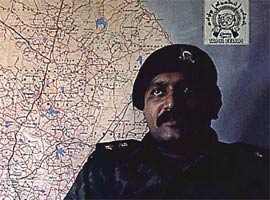
Prabakaran had everything: territory, international support and committed fighters. Senior journalist SHYAM TEKWANI, who has covered the LTTE and Sri Lanka for almost three decades tracks the alarming rise and astonishing fall of a man who sought to live to fight another day, but found only death at the hands of his nemesis.

All Pics are by Tekwani
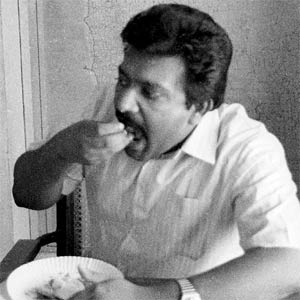
MORE VIVIDLY THAN anything that came afterwards in theSri Lanka war, I remember his first handshake. The hand was soft, the grip delicate and limp. On that occasion inMadras, as he contentedly claimed credit for assassinating the Tamil Mayor ofJaffna and later, the slaughter of 13 Sri Lankan soldiers that ignited the conflict following the anti-Tamil riots of 1983, Velupillai Prabakaran’s dainty handshake seemed in harmony with his soft voice.

A few more meetings and a couple of years later in 1987 — after successfully evading a media ban to reach the frontlines in Jaffna — I found myself reporting in the company of Prabakaran’s ragtag troops in their war against the Indian Peace Keeping Force (IPKF). In the bougainvillea-lined mud tracks, while attempting to photograph his boys gunning down the Indian soldiers in an ambush, I was transfixed by the memory of that handshake as I watched the blood seep from an ill-fated jawan’s head and mingle with the Jaffna dirt.

The other memory is his startled expression when I congratulated him on his newborn towards the end of a long discourse on Eelam. Soon after his fleeting pause, it became clear that he had lost interest in going on and on with his vision of Eelam. He was less voluble, withdrawn and then abruptly left the room. It was left to the master’s voice, Anton Balasingham, to cautiously quiz me on how and what I knew of the addition to his leader’s family. Continue reading

Leave a comment

Filed under anton balasingham, Eelam, Fascism, historical interpretation, island economy, life stories, LTTE, military strategy, prabhakaran, propaganda, Rajapaksa regime, Sinhala-Tamil Relations, suicide bombing, Tamil civilians, Tamil Tiger fighters, terrorism, unusual people, world events & processes

Resettlement of Tamil Refugees in India within Lanka in process

Chamikara Weerasinghe, in the Daily News, 1 September 2011

Also SEE the note circulated by an NGO friend of mine re the bureaucratic process of settling land rights in the Northern and Eastern Provinces which has been appended at the end of this item. Web editor.

With the resettlement process in the North reaching its final-phase, the Ministry of Resettlement has stepped up its resettlement drive by making moves to bring back to this country Displaced Sri Lankans living in some 31 camps in Tamil Nadu. Resettlement Ministry Secretary Uthpala Basnayaka yesterday said the Sri Lankan High Commission inNew Delhiis currently working with the concurrence of the Indian authorities to bring back the Sri Lankan Displaced living in camps in Tamil Nadu.The Sri Lankan Deputy High Commissioner’s office in Chennai has been asked to speed up their repatriation by organizing the necessary documents. They will be issued with non-machine readable passports as a means to expediting the returning process, he said. The United Nations High Commission for Refugees(UNHCR) inColombois assisting the repatriation process and the Ministry’s efforts to resettle them in the North, said Basnayaka. UNHCR sources in Colombo said a number of foreign governments have provided financial support to the UNHCR’s important work in Sri Lanka this year. Continue reading

5 Comments

Filed under accountability, asylum-seekers, IDP camps, life stories, LTTE, Rajapaksa regime, reconciliation, Sinhala-Tamil Relations, Tamil civilians, Tamil migration, welfare & philanthophy, world events & processes

“Novelists need publishers” says Author of The Testament of Jessie Lamb

Jane Rogers, in The Guardian 26 August 2011

Pic by Laurie Harris … “A novelist without a publisher is like a singer without a microphone …  frankly, an embarrassment”

It’s quite easy for a mainstream novelist to vanish. Poor sales for one novel are enough to make bookshops reluctant to stock the next: low sales figures combined with the writer ungraciously insisting on writing the book she wants to write rather than the book an editor wishes she would write, are enough to alienate publishers. This was more or less the position I found myself in three years ago, when my novel The Testament of Jessie Lamb was having difficulty finding a home. I was writing a book set in the near future, after an act of biological terrorism, and I was electing to write in the voice of a naive and idealistic 16-year-old. It was very different from my previous work. I had written seven novels including Mr Wroe’s Virgins and Island, and had won prizes ranging from the Somerset Maugham award to the Writers Guild best fiction book, but that was no help now. A novelist without a publisher is like a singer without a microphone – mouth going, arms waving, nothing coming out – frankly, an embarrassment to herself and everyone else. I was embarrassed. Continue reading

Leave a comment

Filed under australian media, cultural transmission, life stories, world events & processes

Indian Military Modernisation continues

Andrew Campbell, for  Future Directions International Research, Indian Ocean Research Programme

Background:  The second of three Indian Navy Shivalik-class stealth frigates, the INS Satpura,was commissioned on 20 August 2011 in Mumbai. The Indian Defence Minister, A.K. Antony, has also announced that the Indian Government has signed a deal to procure 40 Hawk trainer aircraft for the Indian Air Force and 17 for the Indian Navy, from Hindustan Aeronautics Limited. Both developments are part of a larger build up to combat piracy and check perceived growing Chinese influence in the Indian Ocean. Continue reading

1 Comment

Filed under indian armed forces, Indian Ocean politics, world events & processes

The Gun and the Political Solution

Izeth Hussain, in the Island, 31 August 2011

colour Pic courtesy of Tehelka

The purpose of this article is to establish that in trying to get out of our ethnic imbroglio one factor, and only one, really counts: the gun. By “gun” I refer to power in the political realm, meaning the whole range of hard power and soft power that can be deployed by antagonists. The crucial question at the present juncture is this: can the “international community” which in the present context really means the US, the EU, their allied powers, and India, deploy power against Sri Lanka of a sort that is unacceptable to the Government because it is too harmful to the national interest? If so, the Government has no alternative to stop shilly-shallying and really moving towards a political solution. In the alternative, if that is the deployment of power against us will be bearable, not something really harmful to the national interest, the Government can continue with its dilatory tactics in pursuit of a strategy of what I wound call “a peaceful solution through a process of attrition”. I have in mind a process in which dilatory tactics will hopefully lead to a peaceful solution with our Tamils coming to be satisfied with the blessings of economic development and a reasonable measure of fair and equal treatment. This seems to be the Government’s strategy at present. Either way the gun will be the final determinant: either we proceed towards a political solution now because we cannot withstand the guns of the international community, or our Tamils accept the diktat of the Government because they cannot withstand the guns of the Government.

Continue reading

Leave a comment

Filed under accountability, american imperialism, citizen journalism, cultural transmission, democratic measures, Indian Ocean politics, island economy, life stories, LTTE, power politics, power sharing, Rajapaksa regime, reconciliation, Tamil civilians, world events & processes

Arugam Bay: Surf and Hotel Rates booming along

Mario Andree, in the Island, 31 August 2011

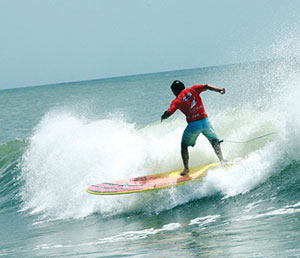
The Sri Lankan Tourism Development Authority is planning to capitalise on the reputation of Arugam Bay, in the East, as a world renowned tourism destination and is hoping to add 700 new rooms to the existing capacity of 850, which is the need of the hour according to the Regional Tourism Chamber. According to tourism officials two new hotel projects are awaiting approvals from the central authorities to develop star-class hotels of 75 and 60 rooms in Arugam Bay, which has been identified as a top 10 global surfing destination.

Sri Lanka Tourism Development Authority Head of Standards and Quality Assurance, Dileepa Mudadeniya told journalists thatArugamBayhas much potential, but needed more development to help the region grow and further enhance the livelihoods of its citizens. The two new hotel projects would give more life to the region, attracting more investment. He declined to elaborate further on the new investment due to the evaluation process currently underway. Continue reading

2 Comments

Filed under cultural transmission, island economy, Sinhala-Tamil Relations, world events & processes

Tamil Information Centre lists Urgent Steps required for Democratic Progress

The Tamil Information Centre (TIC) welcomes the 25 August announcement of President Mahinda Rajapaksa that the State of Emergency will not be extended when it comes up for renewal before the Sri Lankan Parliament in September 2011, resulting in the termination of all Emergency Regulations. The TIC, along with several civil and human rights agencies within and outsideSri Lanka, has been campaigning against this draconian national security legislation which was used to silence critics and dissenters.

Sri Lanka has been ruled under emergency for a considerable proportion of its modern history – more than 35 years out of 63 years of independence –  which has permitted serious  violations by successive governments  of the rights protected under the International Covenant on Civil and Political Rights (ICCPR) and other international human rights instruments. Emergency Regulations (ER) issued by the President, have the legal effect of overriding, amending or suspending any law, except the provisions of the Constitution. The declaration of Emergency cannot be called into question in any court and there is insufficient parliamentary control over the ER. The ER have been almost exclusively used against the Tamils. Thousands of Tamils were arrested each year and detained and a large number of Tamils are still in detention under the ER. Continue reading

Leave a comment

Filed under accountability, democratic measures, Rajapaksa regime, reconciliation, Sinhala-Tamil Relations, welfare & philanthophy, world events & processes

Anything goes: up-skirt pornography and the Sri Lankan conflict ….. in Sydney

Courtesy of The Australian where the title was “Fetish for underwear photos lands Sri Lankan born Sydney man in courts but avoids jail after claiming mental illness”

Note that a defence mounted on the basis of conflict in Sri Lanka or “Sri Lankan torture” seems an instrumental course deployed by some Tamils charged with crimes of all sorts in Australia. For the instance of thsoe accused of credit card frauds in Melbourne see, http://www.heraldsun.com.au/news/refugees-behind-40000-atm-scam/story-e6frf7jo-1226116693109 …. Web Editor

Continue reading

7 Comments

Filed under commoditification, cultural transmission, ethnicity, landscape wondrous, legal issues, life stories, migrant experiences, psychological urges, Sinhala-Tamil Relations, sri lankan society, Tamil migration, travelogue, unusual people

NATO hacked into by the infamous ANONYMOUS

SEE http://beforeitsnews.com/story/1020/684/NL/Anonymous_Hacks_NATO.html in BEFORE ITS NEWS

Leave a comment

Filed under unusual people, world events & processes

A “Negative Peace” for some Tamil Tiger families in Sri Lanka

Kate Mayberry for Al-Jazeera, 29 August 2011, with different title = In Sri Lanka, a ‘negative peace’ prevails

Seriously injured in a shell attack, his Tamil Tiger comrades dead, Mano (pseudonym) tried to end his own life by biting on the cyanide pill that, like all hardened fighters, he wore around his neck. But an elderly woman nearby rushed to give him water and he survived. Alone, he languished on the sand for six days, surrounded by the bodies of his friends and the ruins of war. “There wasn’t anybody there, not a drop of water. I was just lying there in the sun,” he said as he recalled the final days of the fighting between the Liberation Tigers of Tamil Eelam (LTTE) and the Sri Lankan military. “Then I heard voices and, 200m away, saw soldiers advancing. They took me away.”

More than 11,000 people were detained [1] by the Sri Lankan authorities at the end of the war on suspicion of being members of the Tamil Tigers, who fought a 26-year battle for an independent Tamil homeland. Some gave themselves up, but no detainees have access to lawyers and few are charged, their families left to find out for themselves the location of their loved ones. More than two-thirds have now been released, but amid a pervasive military presence many struggle to resume a normal life. “A sense of impunity and that the worst can happen is still prevalent,” said Jehan Perera, Executive Director of the National Peace Council in the Sri Lankan capital, Colombo. Continue reading

2 Comments

Filed under historical interpretation, IDP camps, life stories, LTTE, Rajapaksa regime, reconciliation, rehabilitation, Sinhala-Tamil Relations, Tamil civilians, Tamil Tiger fighters, terrorism, welfare & philanthophy