
Category Archives: politIcal discourse

Galle: Four Hundred Years Ago

Chandra R. De Silva

The political and military history of the port city of Galle, located on the southwestern coast of Sri Lanka, is well documented. This brief report is merely an effort to fill in a gap in the records relating to the history of this port in the half century between the 1580s and the 1630s.

The popular belief is that the name of the settlement comes from the Sinhala word Gaalla or cattle pen, but in his description of Galle in the Saragossa manuscript probably finalized in the 1630s Constantino de Sa de Miranda suggests that the name comes from the word Gal (stone) (Flores p. 130) of which there was plenty around Galle harbor. The Portuguese historian de Queyroz (p. 31), writing in the late seventeenth century, also suggests that the name comes from the word Gal (stone) or Galgue (stone house).
Continue reading

5 Comments

Filed under architects & architecture, centre-periphery relations, commoditification, cultural transmission, economic processes, heritage, historical interpretation, Indian Ocean politics, island economy, landscape wondrous, life stories, military expenditure, politIcal discourse, Portuguese in Indian Ocean, self-reflexivity, sri lankan society, transport and communications, travelogue, unusual people, war reportage, world events & processes

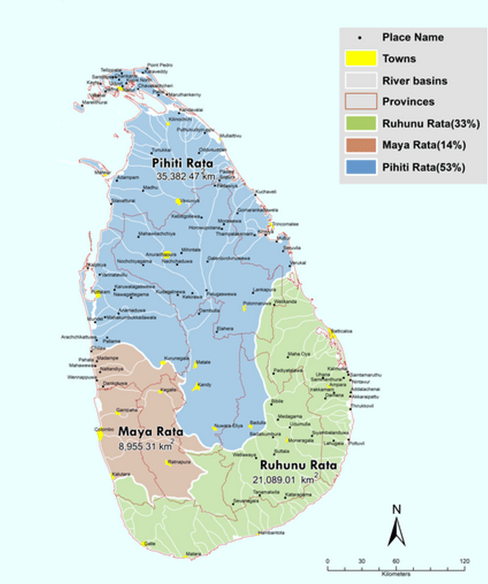
Reverting to Ruhunu, Maya and Pihiti as a Rational Scheme for Sustainable Regional Governance?

 C.M. Madduma Bandara**

Some Past Attempts: Since [securing] National Independence in 1948, there [have been] three Constitutions (including the present) that governed this Country. The First was the Soulbury (/Jennings) Constitution that lasted for less than 15 years, and then the Republican Constitution of 1972 during the regime of Prime Minister Sirimao Bandaranaike that had a similar life span until it was superseded by the present Constitution enacted during the early regime of President JR JayEwardena. The last one, despite numerous amendments from time to time, [has been in force for] nearly 40 years, despite the fact that it was referred to as “Bahubhhootha Vyawasthawa” (nonsensical or mad constitution) by President Chandrika Bandaranaike. However, the number of amendments effected over the years indicated that all was not well during its life span. It also perhaps reflects a general belief among the past politicians that the problem is with the dancing floor rather than with the dancer!.

Continue reading

3 Comments

Filed under accountability, ancient civilisations, communal relations, heritage, historical interpretation, Indian Ocean politics, landscape wondrous, politIcal discourse, power politics, security, self-reflexivity, Sinhala-Tamil Relations, sri lankan society, transport and communications, world events & processes

Snippets on the Fort of Galle … and Ashley’s Dire Warnings

A Question from one Sanjay Gunawardena, 12 February 2021:

“Thank you for this great article Dr Roberts.[i] Has anyone got a picture or a painting of the Old Windmill which has been in the Galle Fort. This has been mentioned E.F.C Ludowyk’s book Long Afternoons in Colonial Ceylon. If you can please share an image, it will be much appreciated. Thank you.

A Response from Hemantha Situge: “Lyn Ludo says the windmill was one of the five landmarks that crowned the Fort. It was erected during British times. I have seen two photographs which I have not copied.”[ii]

Continue reading

Leave a comment

Filed under accountability, ancient civilisations, architects & architecture, British colonialism, cultural transmission, education, ethnicity, governance, heritage, historical interpretation, island economy, landscape wondrous, legal issues, life stories, modernity & modernization, politIcal discourse, self-reflexivity, sri lankan society, taking the piss, tourism, travelogue, unusual people, welfare & philanthophy, world events & processes

Amity transcending Faiths and Nationalities: At Haputale and Canberra

Somasiri Skandakumar in Haputale

Rev Rahula, who once headed the Khemba Buddhist Vihara in Canberra during my tenure as High Commissioner, honoured me with a visit to  Haputale accompanied by his superior who  heads thirteen temples in various parts of the Island !

Continue reading

Leave a comment

Filed under accountability, Buddhism, charitable outreach, heritage, landscape wondrous, life stories, meditations, patriotism, pilgrimages, politIcal discourse, religiosity, self-reflexivity, sri lankan society, tolerance, travelogue, unusual people, welfare & philanthophy, world events & processes

The LANKA COURIER takes off …

https://www.lankacourier.com/

Sri Lanka’s Neutral Foreign Policy

LANKA COURIER   FEB 08, 2021

 The following article has been adapted from the address by the President Gotabaya Rajapaksa in the general debate of the 75th Session of the United…

Features  ….. Foreign Relations of Sri Lanka

Continue reading

Leave a comment

Filed under accountability, centre-periphery relations, citizen journalism, communal relations, cultural transmission, democratic measures, education, electoral structures, female empowerment, foreign policy, governance, heritage, historical interpretation, patriotism, politIcal discourse, power politics, press freedom, propaganda, Rajapaksa regime, reconciliation, security, self-reflexivity, Sinhala-Tamil Relations, Sri Lankan cricket, sri lankan society, Tamil civilians, Tamil migration, the imaginary and the real, tourism, transport and communications, welfare & philanthophy, women in ethnic conflcits, working class conditions, world events & processes

Trauma and Joy in Cricket …. and Abusive Lankan Aussies

Ajit Jayasekera — Email Memo to Michael Roberts, 15 February 2021

When we went to Australia for the Tri Nations tournament with England and Australia in December 2002/January 2003, the team was captained by Sanath Jayasuriya and the Coach was Dav Whatmore. We were after a rather disastrous tour of South Africa, where we were roundly beaten in both formats of the game and started this tournament in similar disastrous manner getting smashed by both England and Australia in the opening games.

Continue reading

Leave a comment

Filed under accountability, atrocities, disparagement, ethnicity, fundamentalism, heritage, historical interpretation, landscape wondrous, life stories, patriotism, performance, politIcal discourse, self-reflexivity, Sri Lankan cricket, sri lankan society, taking the piss, trauma, travelogue, truth as casualty of war, violence of language, world events & processes, zealotry

Facing the Central Bank Bomb on 31st January 1996

 Somasiri Skandakumar in Sunday Island, 7 February 2021

As the clock moved towards 10.50 am on January 31, 2021, my mind went back 25 years to that fateful day. It was a Wednesday, and having finished our weekly meeting of the Parent Board of Directors in the Board Room on the eighth floor of Steuart House around 10.30 am, we sat around to exchange views on matters of a non-official nature as was customary, before returning to our rooms.

Continue reading

5 Comments

Filed under accountability, atrocities, communal relations, economic processes, Eelam, governance, heritage, historical interpretation, island economy, landscape wondrous, life stories, LTTE, nationalism, patriotism, politIcal discourse, power politics, rehabilitation, security, self-reflexivity, Sinhala-Tamil Relations, sri lankan society, suicide bombing, Tamil Tiger fighters, terrorism, the imaginary and the real, trauma, unusual people, world events & processes

George Steuarts for Sri Lanka in Mid-March 1996: Moving Heaven and Earth

S. Skandakumar

The semi final was over around ten pm at Eden Garden in Calcutta. Unruly crowd behaviour when all was lost for India ended in the Match Referee Clive Lloyd awarding the game to Sri Lanka on that Tuesday night,   the 14 th of March.1996. I managed to get through to Cricket Board ‘s President Ana Punchihewa in the players dressing room, to convey congratulations and retired to bed truly happy !
We had qualified to play Australia in the Wills World Cup final, at Lahore on Friday 17 th. Just after midnight I had a knock on the door. Bernard Wijetunge and Channa Wijemanne, two of the Directors of our Travel  subsidiary had woken me up for a reason. “Boss we must do a charter for the Final.”

CALCUTTA, INDIA – MARCH 13: Sri Lanka captain and batsman Arjuna Ranatunga picks up some runs during his innings of 35 runs during the 1996 ICC Cricket World Cup semi final against India at Eden Gardens, Kolkata on March 13, 1996. (Photo by Mike Hewitt/Allsport/Getty Images)

Continue reading

Leave a comment

Filed under cricket for amity, cultural transmission, economic processes, historical interpretation, life stories, patriotism, performance, pilgrimages, politIcal discourse, self-reflexivity, Sri Lankan cricket, sri lankan society, transport and communications, travelogue, unusual people, world events & processes

In Appreciation of Malathi de Alwis: Such An Untimely Death

   ONE — A Letter in Sadness from Professor Veena Das to Pradeep Jeganathan, January 2021

First of all, I want to convey my sadness and my gratefulness and to some extent my rage that this has happened and that I will never see that radiant smile and that integrity and brilliance anymore. Any such death at my stage of life makes me angry and sorrowful as to why the young are being taken. The war undid so many of us in so many ways and why would it not do that? So what kind of miracle is it that Malathi let herself be deeply affected by the war but not be undone by it? You must know that I loved her work and her personality just as I love your work and know what struggles you have been through.

Continue reading

Leave a comment

Filed under cultural transmission, education, female empowerment, heritage, historical interpretation, Indian Ocean politics, language policies, Left politics, life stories, literary achievements, politIcal discourse, power politics, self-reflexivity, sri lankan society, tolerance, unusual people, welfare & philanthophy, women in ethnic conflcits, world events & processes

Joe Hoad’s Paintings in Celebration of Sri Lanka’s World Cup Triumph 1996

Michael Roberts

One day in 1996 our doorbell rang at Woodlark Grove in the suburb of Glenalta in Adelaide . …. And there was Joe Hoad with two paintings he had composed in celebration of Sri Lanka’s triumph at the World Cup earlier in the year. These products had not been commissioned. They were self-inspired and emanated from his profound joy at the manner in which a little island nation – one that was not unlike his own birthplace of Barbados – had tamed a powerful cricketing force that was a bullyboy in the cricketing politics of the 1990s.

This photograph taken there and then in our back garden marks the moment of the gifting ….. appropriately within an Australian backdrop of the bushfire danger kind. But, unlike that landscape, the paintings are unique. To my mind they are heirlooms. In conjunction with Verite Research and Shamara Wettimuny, I have approached the National Library Services Board in Colombo with the suggestion that they should be placed within its portals in public display with a suitable plaque.[1]

Continue reading

1 Comment

Filed under australian media, British colonialism, centre-periphery relations, cricket for amity, cultural transmission, discrimination, ethnicity, heritage, historical interpretation, landscape wondrous, life stories, paintings, patriotism, performance, politIcal discourse, power politics, self-reflexivity, Sri Lankan cricket, sri lankan society, travelogue, unusual people, world events & processes