Category Archives: LTTE

Disappearances and Torture in Lanka, 2009-16: A Bibliography

Michael Roberts

 a-z-torture  t-for-temperature

In reviewing the blog comments on my short memo on “Sinhala Mind-Set” during the years 2009-15,  I was induced to place a claim by one “Flloyd” before about eighty of friends and others in my email address list in order to evaluate his assertion in April 2013 that “the Tamils continue to be tortured, raped, and killed by the state.” Though reading this particular charge as far too sweeping, I set out to test my reading. In my thinking this claim gained weight from the fact that the rest of Flloyd’s commentary suggested that he was not an extremist.

Some 23 individuals – including 5 Tamils, 1 Irishman,1 Colombo Chetty and 2 Indians — have responded, albeit briefly in several instances (with a few endorsing  my suggestion that it is a sweeping exaggeration).. This item is now on web. One of those who commented, the Telugu Indian journalist Muralidhar Reddy has been kind enough to send me a private note from his location (now in India) that runs thus: “This turned out to be a very good exercise. Productive, useful and frankness from the heart of real people who were or are still on the ground.”

In pursuit of further value, I now present a BIBLIOGRAPHY on the topic of disappearances that amplifies previous efforts – one that has been assisted by the recent exercise. Note that I have not embraced items that focus specifically on rape in this exercise. Ii is a standard practice in agit-prop action from anti-state activists[1] as well as foreign reporters on brief excursions to the island to bracket “disappearances, torture and rape” together. Such an ‘alliance’ brings feminists on board and illuminates the halo around any writer’s head. Continue reading

6 Comments

Filed under accountability, communal relations, cultural transmission, disparagement, doctoring evidence, fundamentalism, governance, historical interpretation, human rights, legal issues, life stories, LTTE, NGOs, politIcal discourse, power politics, reconciliation, rehabilitation, self-reflexivity, Sinhala-Tamil Relations, slanted reportage, social justice, tamil refugees, Tamil Tiger fighters, the imaginary and the real, trauma, unusual people, war crimes, war reportage, world events & processes

Disappearances and Torture in Sri Lanka, 2011-13 … or Thereabouts: Soundings and Question-Marks

Michael Roberts

In studying the blog-comments on “Sinhala Mind-Set” and presenting the lot for public scrutiny a specific claim by a person identifying himself as “Flloyd” caught my attention. Whether Flloyd is a Tamil is of lesser moment than his allegation. It is the sort of claim that is widely peddled by reporters and VIPs who drop in and fly out after short stays and have the clout to reach a worldwide audience – for instance Roger Draper in the National Geographic and Greg Bearup in The Weekend Australian recently.   Thus prodded,  I took the initiative to test the degree of validity that we could attach to this type of assertion by approaching a selected body of personnel (mostly Sri Lankan) via a one-on-one letter presenting the QUESTION repeated here [in blue].

“I came across a blog comment from one “Flloyd” in April 2013 which adopted a reasonably moderate stance on the ethnic situation in the country but which also presented this assertion: “The presence of an organized rebel group is no more, but the Tamils continue to be tortured, raped, and killed by the state. Many still mention the brutality of the rebels, but in no way can that justify the current situation, as the rebel activity is gone.”

05-april-2009-exodus 09-yatawara-2figure-10a-tamil-people-at-the-last-redoubt-after-the-final-battles-2009 Continue reading

8 Comments

Filed under accountability, communal relations, disparagement, doctoring evidence, governance, historical interpretation, human rights, life stories, LTTE, politIcal discourse, Rajapaksa regime, reconciliation, rehabilitation, Sinhala-Tamil Relations, slanted reportage, social justice, sri lankan society, Tamil civilians, the imaginary and the real, truth as casualty of war, welfare & philanthophy, women in ethnic conflcits, working class conditions, world affairs

India & Lanka and the Devolution of Land Powers: Critical Comments

Gerald H. Peiris, courtesy of The Island , where the title is “Devolution of Land Powers – A Comment” … Note that emphasis via highlighting is the work of The Editor, Thuppahi

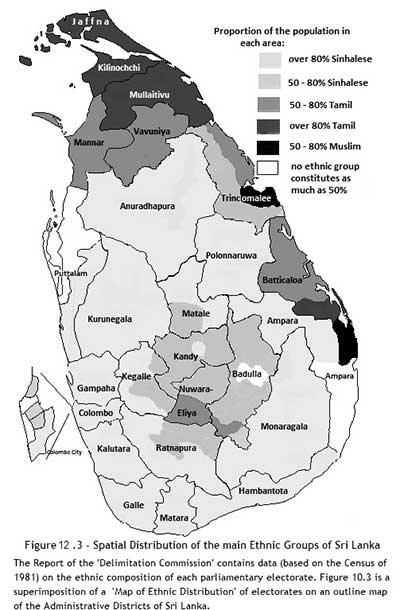
Among the writings published in the wake of release of the Report submitted to Parliament by the Constitutional Reform Sub-Committee on ‘Centre-Periphery Relations’ are those that appeared in recent issues of The Island – C. A. Chandraprema’s ‘Analysis’ of the report, and a more general piece titled ‘Constitutional reform and devolution of power’ by Harim Peiris. The former, needless to say, is an incisive critique written at a level of expertise which the ‘Panel of Experts’ that served the sub-committee appears to have lacked. The latter, I respectfully submit, is a feeble attempt that contains misrepresentations, intended no doubt to reinforce the recommendations made by the sub-committee on ‘devolution’.


aagp-devolution Figure 2

This paper is being written with the twin objective of supplementing Chandraprema’s criticisms with a few sets of information relevant to a study of ‘Centre-Periphery Relations’ in a multi-ethnic polity such as ours, and to highlight with special reference to Harim Peiris’ article, the superficiality typical of the on-going campaign intended to emaciate the unitary character of the nation-state of Sri Lanka. This campaign is also represented by recent publications such as the reports produced by the ‘Public Representations Committee on Constitutional Reform’ (chaired by Lal Wijenayake) and the ‘Constitutional Reform Sub-Committee’ referred to above, alongside the sustained literary efforts by self-professed “Sri Lanka experts” in India ̶for example those associated with the ‘Centre for South and Southeast Asian Studies’ of the University of Madras̶ whose barely concealed objective all along has been that of promoting the hegemonic interests of India in the South Asia Region.


Continue reading

1 Comment

Filed under accountability, democratic measures, devolution, economic processes, electoral structures, ethnicity, historical interpretation, Indian Ocean politics, island economy, LTTE, modernity & modernization, politIcal discourse, power politics, power sharing, security, Sinhala-Tamil Relations, world affairs

Gamage on USA’s Machinations in Support of the Tamil Tigers

daya-profile-pixDaya Gamage, via review notice in Asian Tribune with title New book discloses U.S. machinations that globally- revived Tamil Tigers”

Continue reading

Leave a comment

Filed under accountability, american imperialism, authoritarian regimes, historical interpretation, Indian Ocean politics, landscape wondrous, LTTE, military strategy, politIcal discourse, power politics, Rajapaksa regime, Sinhala-Tamil Relations, sri lankan society, Tamil Tiger fighters, the imaginary and the real, truth as casualty of war, vengeance, war reportage, world events & processes

Gems and Nuggets within the Commentary on SINHALA MINDSET: Reflections

Michael Roberts

A chance event led me to study the comments responding to “Sinhala Mind-Set,” one of the signature ‘tunes’ introducing my web-site thuppahi.wordpress.com – the other being WHY THUPPAHI. The present collection of responses has been cast in spasmodic fashion between 2009 and 2013. They are from Sri Lankans for the most part, with Mel Glickman, Jane Russell and one “Duque” being the only personnel outside this specific ‘embrace’ of nationality. Several facets of the information and thinking inscribed in these comments are pertinent to the situation facing Sri Lanka in the 2010s. I have therefore presented them again with significant segments highlighted to assist or stir readers, while proceeding to add reflections of my own in this companion piece. The aim is to promote provoke debate.

1364002696fea9-4 ssinhala-ness

Continue reading

1 Comment

Filed under British colonialism, communal relations, devolution, discrimination, economic processes, electoral structures, ethnicity, governance, historical interpretation, human rights, island economy, language policies, legal issues, life stories, LTTE, modernity & modernization, Muslims in Lanka, nationalism, politIcal discourse, power politics, racist thinking, Rajapaksa regime, reconciliation, rehabilitation, self-reflexivity, Sinhala-Tamil Relations, sri lankan society, Tamil civilians, tamil refugees, Tamil Tiger fighters, truth as casualty of war, world events & processes

A ‘Parachute History’ of the Sri Lankan War and the Island’s Circumstances Today

Robert Draper, courtesy of the National Geographic, November Issue, where the title runs thus: “Can Sri Lanka Hold On to Its Fragile Peace?” …with photographs by Ami Vitale … …. …. http://www.nationalgeographic.com/magazine/2016/11/sri-lanka-tamil-peace-civil-war/… with the title here being the Editor’s imposition – see Note below.

The photograph the young woman holds is barely the size of a postage stamp. But it is the only one of her husband she could find here in her parents’ house. They had not approved of her marriage, given that he was just a fisherman from the coastal town of Mannar, while her family has lived in Jaffna, the capital of Sri Lanka’s Northern Province, for generations. But as the photo attests, her husband, a Tamil like herself—is broad-faced and confident. Staring at the tiny image of the man who went missing a decade ago, her mahogany eyes brighten as she loses herself in memories.

draper-11 A military color guard lowers the national flag on Galle Face Green, a popular park in Colombo. The country’s largest city shows few signs of the strife that divided the Sinhalese and Tamils for 26 years.

They’d fallen in love at a refugee camp in southern India in 1999, when she was 17. Both had escaped Sri Lanka’s wantonly vicious civil war, pitting the army, controlled by the majority Sinhalese, against Tamil rebels. She had fled Jaffna with her family, leaping over the corpses of neighbors as the military’s bombs plummeted from the sky. He had escaped Mannar after he saw an army officer shoot his youngest sister to death in their home. They had married under the withering glare of her mother. Continue reading

3 Comments

Filed under accountability, american imperialism, atrocities, authoritarian regimes, discrimination, disparagement, doctoring evidence, economic processes, governance, historical interpretation, human rights, Indian Ocean politics, legal issues, life stories, LTTE, news fabrication, politIcal discourse, power politics, Rajapaksa regime, self-reflexivity, Sinhala-Tamil Relations, slanted reportage, sri lankan society, Tamil civilians, tamil refugees, Tamil Tiger fighters, the imaginary and the real, travelogue, truth as casualty of war, vengeance, war reportage, world events & processes

What Trump may bring to the US Table on Sri Lanka in contrast with Clinton’s ”Humanitarian Imperialist Cloak”

Daya Gamage, courtesy of Asian Tribune, where the title reads “Trump – Tamil Diaspora Eelam Activists & Sri Lanka Trajectory”

When asked about the implications of the ongoing purge – immediately following the abortive military coup in Turkey – Republican presidential candidate Donald Trump echoed: What right do we in the United States have to criticize the condition of human rights elsewhere? Here’s Trump: “I think right now when it comes to civil liberties, our country has a lot of problems, and I think it’s very hard for us to get involved in other countries when we don’t know what we are doing and we can’t see straight in our own country. We have tremendous problems when you have policemen being shot in the streets, when you have riots, when you have Ferguson. When you have Baltimore. When you have all of the things that are happening in this country — we have other problems, and I think we have to focus on those problems. When the world looks at how bad the United States is, and then we go and talk about civil liberties, I don’t think we’re a very good messenger.” donald-trump_3 hillary-11-business-indider

Continue reading

1 Comment

Filed under accountability, Al Qaeda, american imperialism, authoritarian regimes, Indian Ocean politics, Islamic fundamentalism, life stories, LTTE, military strategy, politIcal discourse, power politics, prabhakaran, Presidential elections, Rajapaksa regime, reconciliation, security, self-reflexivity, Sinhala-Tamil Relations, sri lankan society, Tamil migration, terrorism, truth as casualty of war, unusual people, vengeance, war crimes, war reportage, world events & processes

The Terrain of War: Ahmed and Thiranagama. From Outside and Inside

aa-bart-of-melbBart Klem, a Review Essay courtesy of South Asia Multidisciplinary Journal, at https://samaj.revues.org/3853 where the title is “Victory’s Categories, Contingent Histories: Re-visiting Sri Lanka’s Ethno-separatist War”  …the books under review being (A)  Ahmed Hashim (2013) When Counterinsurgency Wins: Sri Lanka’s Defeat of the Tamil Tigers, Philadelphia: University of Pennsylvania Press, 280 pages. (B) Sharika Thiranagama (2011) In my Mother’s House: Civil War in Sri Lanka, Philadelphia: University of Pennsylvania Press, 320 pages.

aa-ahmed aa-thiranagama

Ahmed Hashim’s When Counterinsurgency Wins (2013) and Sharika Thiranagama’s In my Mother’s House (2011) may appear similar at first sight. Both books look back on Sri Lanka’s ethno-separatist war; both pay close attention to the rise and fall of Tamil militancy; and both are published by the University of Pennsylvania Press. However, in crucial ways, they are opposites. Hashim’s book is a military analysis focusing on the Sri Lankan government’s victorious campaign against the Liberation Tigers of Tamil Eelam (LTTE). Thiranagama’s is an ethnographic account of how Sri Lanka’s Tamil and Muslim society were irreversibly transformed by the war.

Continue reading

2 Comments

Filed under accountability, atrocities, authoritarian regimes, ethnicity, historical interpretation, human rights, Indian Ocean politics, law of armed conflict, life stories, LTTE, military strategy, Muslims in Lanka, nationalism, politIcal discourse, power politics, prabhakaran, Rajapaksa regime, security, self-reflexivity, Sinhala-Tamil Relations, sri lankan society, Tamil civilians, Tamil Tiger fighters, terrorism, the imaginary and the real, truth as casualty of war, war crimes, war reportage, women in ethnic conflcits, world events & processes

Returned Tamil Asylum Seekers Today: A Jaundiced and Gullible Australian Reporter’s View

Greg Bearup, in The Australian, 31 October  2016, where the title isIn the Wash-Up Asylum Loser Wins” …. with emphasis in this presentation being t e work of The Editor, Thuppahi.

The crab-trapper of Jaffna is a happy man; he has a sturdy boat with a new Suzuki motor. Each morning he rises before dawn to motor out to a vast lagoon in his new auto rickshaw to fish for prawns and crabs — partly funded by the $5000 given to him by Australian taxpayers. In August 2012, when Marcus Pireesan fled Sri Lanka for ­Australia in search of a better life, Jaffna, the northern Tamil capital and his home town, was a very different place from what it is today.

marcus Pireesan with some of his childrenPic Greg Bearup

The long civil war against the Liberation Tigers of Tamil Eelam ended in 2009 – a UN report estimating that 40,000 people died in final months of the conflict, mainly civilians – but the Rajapaksa regime, which brutally obliterated the Tigers, was still in power; young Tamil men were still being bundled into government vans and never seen again. “We lived in constant fear,” Pireesan, 40, tells me, “just knowing information was dangerous. You could be stopped at a roadblock and kidnapped (by the government forces) and no one would ever know.” And fishermen like him were told where and on what days they could fish. Continue reading

1 Comment

Filed under asylum-seekers, Australian culture, australian media, authoritarian regimes, discrimination, economic processes, historical interpretation, human rights, landscape wondrous, life stories, LTTE, military strategy, people smugglers, politIcal discourse, population, power politics, Rajapaksa regime, Sinhala-Tamil Relations, slanted reportage, sri lankan society, Tamil migration, tamil refugees, the imaginary and the real, transport and communications, truth as casualty of war, welfare & philanthophy, world events & processes

Sinhala Buddhist Cosmology and Its Politics via Roshan de Silva Wijeyeratne

Kalana Senaratne. being a review article, entitled “The Politics of Sinhala-Buddhist Cosmology” from Polity Volume 7, Issue 1, pp.54-58 sent to Thuppahi by Senaratne and reproduced her with emphases (via highlighting) imposed by The Editor

Although Buddhism does not believe in a Creator-God, many Buddhists believe in a cosmology, made up of myriad realms of existence and world systems, a large number of heavenly beings, deities, and demonic spirits, and even a heaven and a hell.[1] In Theravada Buddhist countries, different gods – some local, some imported – play important roles in various rituals and practices: such as in the popular practice of transferring merit to good gods in exchange of protection.[2] These practices have been part of the life of the majority Sinhala-Buddhists too, with the origins of such practices being traceable to pre-Buddhist Sri Lanka.[3]

aa-roshan-pic Roshan aa-roshanbook aaa-kalana Kalana Continue reading

1 Comment

Filed under centre-periphery relations, cultural transmission, devolution, economic processes, governance, heritage, historical interpretation, Indian religions, legal issues, life stories, LTTE, modernity & modernization, politIcal discourse, power politics, Sinhala-Tamil Relations, sri lankan society, the imaginary and the real, tolerance, vengeance, world events & processes