Category Archives: heritage

The White Australia Policy, Ceylonese Burghers and Alice Nona

Earl Forbes, courtesy of The Ceylankan, vol. 59/3  August 2012

World War II (the War) ended in August 1945.  For nearly six years the world was thrown into hitherto unseen turmoil and carnage, culminating in decimation at Hiroshima and Nagasaki.  The United States of America emerged from the War relatively unscathed.  Other than the bombing of Pearl Harbour, the war was not fought in the United States or its Territories.  Europe was badly battle scarred and had to redraw its boundaries and reconstruct as a first priority.  But more so than anywhere else, the big picture was soon to change radically in Greater Asia.  In 1947, India gained Independence from Britain.  Very early in the next year, Sri Lanka followed attaining independent status on 4th February 1948.  Singapore and Malaysia were now free of Japanese occupation and moving towards greater self-government and independence from Britain.  Indonesia unilaterally declared independence after nearly 300 years of Dutch rule; and so history making events occurred, one after another.

Post World War II — Australia’s population strategy: Australia had just come out of the War and, despite being on the winning side, there was an air of apprehension about.  There was the realisation that a vast country, with a wealth of natural resources and a relatively small population, was an easy target for any predatory power.  The Japanese had displayed their imperialistic ambitions during the War.  They had been in Papua New Guinea; on Australia’s doorstep.  Also, home soil, (viz. Darwin) had been under air attack.  The Japanese were defeated but other predators in the region were about. The all important question was: “how was Australia to meet such a threat in the long term”? Continue reading

22 Comments

Filed under discrimination, ethnicity, heritage, historical interpretation, life stories, politIcal discourse, racist thinking, unusual people, world events & processes

Views of British Ceylon and Lanka

ONE: Video on Sri Lanka … with pulsating musical background ... http://www.youtube.com/embed/yFNSXFk1BYY?feature=player>www.youtube.com/embed/yFNSXFk1BYY?feature=player

a Hunting Party and A Coffee Planter and some labourers, mid 19th century  

TWO: Old Ceylon 1860s-1950s as collected by Rohan Edirimanne ….under title “Sri Lankan’s seen – Life of Sri Lankans, more than 100 years ago” Continue reading

Leave a comment

Filed under cultural transmission, heritage, historical interpretation, sri lankan society

Oru Paanai or One Pot, reaches out to Sri Lanka and its north

Web Editor’s Preamble: there are numerous private organisations involved in welfare and philanthropy in Sri Lanka. Some have a reconciliation edge and seek to bring people of different communities together. Some reach across to the people of the north and east in response to the suffering and the underdevelopment that these regions experienced over the past 29 years. Through interaction with the old Thomian mohan Samarasinghe who lives in UK I was fortunate to gain the opportunity to visit Kalmunai and the east in May 2010 in the company of Jezima Ismail and her women’s empowerment NGO, known as the Muslim Women’s
Research and Action Forum (MWRAF)
. She hails from that region and we witnessed first-hand the activities that assist women to acquire income-earning skills. It was a pleasure to sit in a crowded lounge of a post-tsunami house and to watch Tamil women of mostly Christian background in Akkaraipattu display their sewing work (products for sale) as one aspect of this Muslim organisation’s endeavours.

I also gained some exposure to Mohan’s many welfare outreach endeavours in the course of our conversations, one in the east and several in other aprts of the island –all run from UK and involving regular visits to the island.

About the same time I came across Jeremy Liyanage, an old Trinitian mostly educated in Australia and was introduced to Diaspora Lanka. This effort will be featured soon; but one of its offshoots in sponsoring cricket in Mannar is now featured in http://cricketique.wordpress.com. It was this endeavour that led me to introduce Jeremy to some cricketing pals…. And so, in typical fashion, one thing led to another.

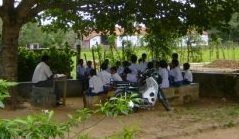
 an Oru Paanai class under a tree

Or, rather, Jeremy met Skanda — Royalist, cricketer, cricket-administrator in years past and, above all, a Sri Lankan patriot of the moderate kind. And SO, I was led to Oru Paanai or One Pot, which is the brainchild of Drs. Dan Muthuvaloe and Nandhabalan in England. This reconciliation philanthropy is best introduced via Skanda’s private clarification to Jeremy, a Note from Dr. Dan Muthvaloe and some extracts from their official website. Continue reading

2 Comments

Filed under heritage, life stories, patriotism, reconciliation, rehabilitation, tolerance, unusual people, welfare & philanthophy, women in ethnic conflcits

Duncan White: Trinitian, Olympian, Ceylonese

Anonymous Author **

This is the third occasion the Olympic Games will be held in the City of London. The first was in 1908 and the second was in 1948. The 1948 Games of the XIXth Olympiad was of significant importance to Sri Lanka as it was the year that Ceylon, as it was known then, obtained Independence from the British Empire. At this Games Ceylon was blessed with an Olympic Silver medal by Duncan White as a reward for this accomplishment of gaining Independence to the country.


Duncan had his early education at Trinity College, Kandy, where he received Trinity’s coveted ‘Lion’ even before gaining his school ‘colours’ for Duncan’s record breaking performances at the Public Schools Championships. He left Trinity College in 1937 and was commissioned to the Ceylon Light Infantry in 1942. Continue reading

5 Comments

Filed under heritage, life stories, sri lankan society, unusual people, world affairs

Two new book review essays, by Anoma Pieris and Asoka de Zoysa

Anoma Pieris: ‘Writing that Conquers’: A postcolonial study of Robert Knox,” reviewing Sarojini Jayawickrema, Writing that Conquers’: Re-reading Knox’s Historical Relation of the Island Ceylon,  (Colombo, Social Scientists’ Association, 2004, reprinted).

Asoka de Zoysa:Beyond Olcott and Dharmapala: Coming to terms with Buddhist ritual and tradition,” reviewing Anne M. Blackburn, Locations of Buddhism. Colonialism and Modernity in Sri Lanka,  (Colombo, Social Scientists’ Association, 2010).

SEE the BOOK REVIEWS section of thuppahi, courtesy of Polity, vol. 6. nos 3& 4.

Leave a comment

Filed under heritage, historical interpretation, nationalism, patriotism, politIcal discourse, religious nationalism, sri lankan society, world events & processes

Free Full-Text eBooks on British Ceylon

Benita Stambler, The John and Mable Ringling Museum of Art, Sarasota, Florida, USA, benita.stambler@ringling.org

Computers have changed our world and our lives in so many ways.  One improvement is the information explosion, putting huge amounts of information at our fingertips – literally.  Search engines such as Google have managed to structure that information so we can quickly and easily find what we need.  In many cases, it’s just a matter of knowing where to look. Google has created another service that provides even more information.  The company has digitized books from libraries around the world and put them online.  Some of these books can only be searched, while others that are beyond their copyright period are fully available as downloadable files, allowing you to read them or print them at your leisure.

This is particularly useful for books that are either out-of-print or expensive and difficult to locate.  Such is the case for books on the colonial period in Ceylon.  In my research on colonial-era Ceylonese photographs, I have come across several books that contain the photographs I’m interested in, those taken between 1850 and 1915.  The texts of the books may be considered quaint or offensive in their colonialist attitudes, but the photographs remain an incontrovertible testament to the historical Ceylon.  Continue reading

18 Comments

Filed under cultural transmission, heritage, historical interpretation, sri lankan society, world events & processes

Nissanka Seneviratne: a man in a million

Sarath Amarasiri, in The Sunday Island 29 July 2012

Dr. Nissanka Seneviratne, a household name among plant  pathologists in Sri Lanka, an indefatigable researcher of the Department of  Agriculture, a lone crusader against injustice as he perceived it, and a silent  philanthropist, passed away after a brief illness on June 15th 2012. He was 79  years old. Dr. Seneviratne was born to a wealthy family owning large  extents of lands and other properties in many parts of the country. He was  educated at St. Thomas’s College, Mount Lavinia, the school that his father and  grandfather attended. He entered the University of Ceylon, Colombo in 1955 and  earned a BSc degree specializing in Botany.

He had his own car, a new Vauxhall Wyvern, a rare possession at  that time for a university student. He used it sparingly though, often to  collect plant samples for student projects along with his batch mates. After  graduation he joined the Department of Agriculture (DOA) as a Research Officer  in Plant Pathology and continued working in this field until retirement. Continue reading

2 Comments

Filed under heritage, life stories, sri lankan society, unusual people

The Fort of Jaffna: renovation nears completion

Jaffna Fort circa 1910

Chamikara Weerasinghe in the Daily News, where the ttile reads:”Reconstructed Jaffna Fort to boost tourism”

The reconstruction of Jaffna Dutch Fort is nearing completion. The colonial-era fort has been restored to its former glory by the government to become a major tourist attraction in Jaffna. The government has spent Rs 104.5 million for the work concerned. The Netherlands has granted Rs 55 million for this purpose, said Economic Development Ministry sources. Continue reading

Comments Off on The Fort of Jaffna: renovation nears completion

Filed under heritage, patriotism, reconciliation, Sinhala-Tamil Relations, sri lankan society, world events & processes

A Treasure Trove on the South Asian Past

Routledge, Majumdar and Gooptu

We thought you would like to hear about an exciting and unique new digital archive, launching in 2013, which could help you break new ground in your research.
The Routledge South Asia Archive is a cutting-edge digital resource developed in response to growing demand for new online learning and teaching aids. Unrivalled in breadth and depth, the Archive will offer 5 million pages of interdisciplinary content from across the Indian Subcontinent, with documents covering the mid-18th to the mid-20th century. All documents have been carefully selected and catalogued by an expert editorial team, making the South Asia Archive a truly unique proposition. Continue reading

Leave a comment

Filed under heritage, historical interpretation, Indian Ocean politics, life stories, population, world events & processes

Skandakumar’s reflections on British influences in his life plus this and that

Speech by Guest of Honour, S. Skandakumar at Sri Lanka UK Society’s  Birthday Banquet for Her Majesty the Queen: Cinnamon Grand. 17th June   2012.

 Pics by Namal and BBC respectively

Your Excellency, John Rankin, High Commissioner for Britain in Sri Lanka, Eminent Excellencies of the International Diplomatic Corps,  distinguished Ladies and Gentlemen, When Carlo your President invited me  on behalf of his committee to this evening’s function, I said to him  “Carlo I am four years  into retirement, I have spent it all in relative hibernation in Haputale and many feel that soon I will be ready  for the Archives “… to which his response was ‘Ah That’s just the profile we are looking for!!”

Continue reading

Leave a comment

Filed under communal relations, heritage, historical interpretation, LTTE, unusual people, world affairs