
Bunchy Rahuman, whose preferred title is “Galle Fort, New York City and the Cartesian Legacy” ** … with the highlights being impositions by the Editor, who also had the privilege of being a resident within the Fort for twenty or so years from 1938-1960
ESSAY TWO
Do I exceed myself? Cartesian? The Big Apple? – surely not! But I insist, I am here, not to tweak the truth. In Essay One, I said, the street I lived [most of] my Galle, Fort life in was Lighthouse Street. Discerning readers [for a moment I thought to add if any – but my life insurance policy has lapsed!] would note that I said Lighthouse Street formed a ‘Y’ axis line for the [Galle] Fort. Now even math allergic types, have heard of X axis and Y axis as [perpendicular] lines that cross at right angles and sit in the middle of paper sheets populated by tiny squares arranged 10 x 10, within larger squares, all sitting above, below and at each other’s sides in sheets known as graph paper.

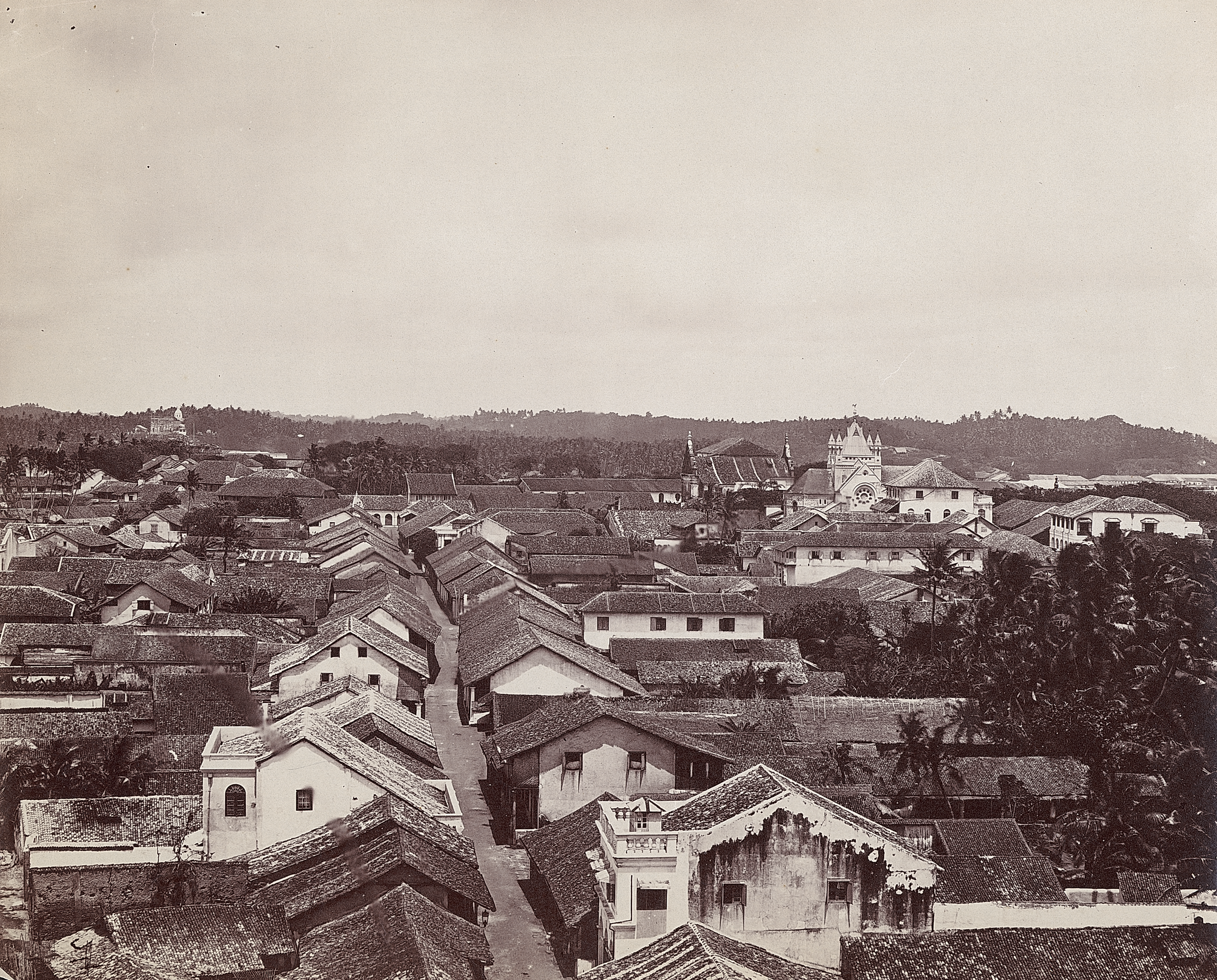
With Y axis deemed in Essay one as Lighthouse Street, [See map in Essay 1]. even math shunners can agree that, the X Axis for the Fort would then be Pedlar Street which cuts Lighthouse Street [the Y axis] at right angles or orthogonally [never mind the big word]. Alors! to define a point in the Fort with ease, one need only say how far east or west it was from Lighthouse Street and how far north or south from Pedlar Street [that the juvenile miscreant was hiding at]. Voila! Galle fort had its own version of a GPS! Long before the cellphones had it. Folks, it strikes me that a grid-wise perspective of the layout of Galle Fort makes for a very clear picture to store in one’s memory when touring the Fort.

looking down Lighthouse Street from the south … Pix from Roberts
The Cartesian legacy, is the clever feature of Dutch adopted Cartesian [orthogonal] grids in road laying in their colonies of south east India, coastal Sri Lanka, Indonesia and proximate territories. The basic grid was an offshoot of the surveying practice of setting out a straight line or base line composed of fixed and measured sections in a continuing dead straight line [As is Baseline Road in Colombo]. All points and formations of interest would be located by offsets measured at 90 degrees from this base line. This is a standard technique used in land surveying – one of the earliest exercises in defining and securing the bounds of any acquired tract of land within a district [or colony].
In New York City, around Times Square, a google map would show, one set of ‘parallel’ roads named in order, as 1st Street, 2nd St. etc. up to 193rd St. and another set of ‘parallel’ roads intersecting the earlier set at 90 degrees and named 1st Avenue, 2nd Ave. etc. up to 11th Ave. This pattern exists in Colombo as well, in the Pettah with 1st Cross Street, 2nd Cross St. etc. up to 5th Cross St. and crossed at ‘90 degrees’ by, Bankshall Street, Main Street, Keyzer Street, Prince Street and Maliban Street.
New York City’s grid having one set of roads intersecting another set at 90 degrees is seen also in Galle and other forts albeit as far as compatible with the lay of the land area, contours, structures and their specific formations. Roya-pettah in once Dutch ruled Chennai and other Dutch colonies presumably, show the same layout lending itself also to uniflow and smooth flow of traffic.
Now, to a crucial issue: To show that my imagination is not running riot in claiming an intimate link between Galle Fort and New York City. Also, to eliminate a loose end in this essay, by validating my digression into the meaning of Cartesian. Readers might well ask why I brought this Cartesian business into this essay in the first place – no problemo – it’s their right and I counter contend: it’s my wrong – I mean right [sorry for the Freudian slip] to get into an aside beside – nice vibe! Aside-Beside.
New York is a newer name replacing the original name of New Amsterdam, which was part of Dutch owned North America, [protected by Fort Amsterdam, at the tip of Manhattan Island]. Our Trincomalee Fort, very similar to Galle Fort was also built by the Durch. It was once captured by the British from Dutch forces who regrouped and won it back. Ironically, it had to almost immediately be handed back as the British and Dutch who were at war in Europe at this time resolved their quarrels and adopted a treaty requiring New Amsterdam and all Dutch forts – in Ceylon to be given back to the British. New Amsterdam thenceforth was renamed by the British as New York.
Now to explain Cartesian — a term derived from the name of French mathematician/philosopher Rene’ Descartes – [?? Math guys stray into philosophy like that Bertrand Russel chap who shamefully didn’t even grow a beard as excuse?]. Descartes famously said I think, therefore I am in five words being no shorter than his own French version: Je pense, donc je suis. In neat, brief, Latin it is Cogito ergo sum – just three words. Man! Latin is a great language! Thanks to Descartes, we identify locations or points by measuring and recording their distances in two perpendicular directions from two, X & Y axis lines at 90 degrees. The entire world [and especially of the surveyor] is greatly indebted to him for evolving the use of orthogonal = 90 degree, grids.
The X and Y axes of mathematics can be conveniently adapted to define bounds for land extents of houses, farms and commercial buildings. It would have logically suggested itself and led to evolving of a grid type of road network to provide access to these same buildings and homesteads etc.
Finally, a connected but brilliant feature of Dutch ingenuity, a sewer network built right below the roads in the Galle Fort to collect effluent from the buildings on either side of the roads. The ground floor levels were elevated to yield sufficient gradient for waste water to discharge into the sewers cleverly designed to discharge into sea at low tide by nightfall and to be flushed by the tides at high tide by day. [Await Essay 3 on waste water discharge system in Galle Fort]
This waste discharge feature of elevated ground [floor] levels seen at Galle, Fort, might also appear in the remaining few older parts of New York City. The newer areas all have tall buildings, that have displaced in numbers the old structures and old systems that are fading out, many fighting valiantly to the last perhaps supported by protective laws [as in Sri Lanka] that do not permit local bodies to acquire buildings whose ownership has passed down multiple generations!
** This essay was cast [and calibrated?] within this our world on 5 January 25

