Yearly Archives: 2012

A Search for Identity: Tomorrow’s Sri Lankan!

Kamaya Jayatissa, courtesy of The Island, 29 February 2012**

“If you wake up at a different time, in a different place, could you wake up as a different person?” – Chuck Palahniuk

Few are those who believe in the existence of what I would like to call a post-war Sri Lankan identity. Indeed, most of us will identify themselves according to their ethnicity, some according to their religion, beliefs and aspirations and some according to their country of birth. Yet, the fact is that we do not belong to just one category or another. We are different from each other and at the same time we carry diversity within ourselves. Each of us is a unique combination of various identifications that are not equally significant to us. So how does one define the schizophrenic notion of identity? Continue reading

Leave a comment

Filed under cultural transmission, historical interpretation, life stories, patriotism, politIcal discourse, reconciliation, Sinhala-Tamil Relations, Tamil civilians, unusual people, world events & processes

An Angry Tamil: Kathiravan confronts Roberts

Kathiravan, 21 February 2011 in http://colombotelegraph.com/2012/02/21/victor-rajakulendrans-tirade-at-the-exposure-of-pirapaharans-admiration-for-hitler/ ***

As a self claimed ‘Historian’, will Michael Roberts agree that the Tamil people of the island of Sri Lanka have a distinct language, culture, value system, customs different to those of the Sinhal people and that they have livend in the island as a sovereign people governing a defined terriory in the north-east of the island prior to the advent of cololonial powers? Will he agree that the Tamil people in Sri Lanka have been subject to violations of their individual and collective rights including thieir right to life by a permanent Sinhala majority since the island gained independence in 1948 from the British? Will he agree that Tamils were subject brutal violence by Sinhala goon squads and the almost all Sinhala security forces even before the rise of Tamil militancy? Will he agree that the successive Sinhala dominated governments in Sri Lanka signed pacts with Tamil leaders to gain political power and dishonour the pacts immediately after?

Will Michael Robers agree that the Sinhala political establishment in Sri Lanka has systematically denied the Tamil people of all civilised avenues to raise their grievance – democratic, constitutional, judicial and non-violet that led to the rise of armed resistance in self-defence and restore their statehood based on their right to self-determination? Will he agree that at every parliamentary elections held in the north-east of the island since 1977, the Tamil people in spite of coming under the occupation of an ‘alien’ army had demonstrated their political will to exercise their right to self-determination. Leaving a side the LTTE which is an inevitable outcome of the brutal nation oppression of the Tamil people, will Michael Roberts agree that the Tamil people as any people aroung the globe are entitled to have a political view about their identity and their right to decide their political, cultural, economical and social future? The Tamil Diaspora at large have been and will continue to speak up for the legitimate rights of the Tamil people in Sri Lanka and will be willing to invest in the Tamil homeland only when it regains the political authority to decide its own destiny.

Why should the ‘Historians’simply keep barking about terrorism and LTTE when the fundamental causes of the long drawn out conflict in Sri Lanka is yet to be resolved, the rule of law and true democracy for all in the island to be restored, alleged war crimes, crimes against humanity and genocide are independently investigated (not by the alleged perpetrators) and genuine reconciliation achieved to bring peace to the island and the region?

I only hope that as a ‘Historian’ you will positively contribute towards achieving this nobel 9sic) goal.

****

Courtesy of Colombo Telegraph: This is among the vibrant comments sparked by Michael Roberts: “Victor Rajakulendran’s Tirade at the Exposure of Pirapaharan’s Admiration for Hitler.” The latter cannot be comprehended without a reading of the folowing articles:

*  Ganeshan Iyer: “Military Training in the German Nazi Mould amidst Internal Dissension in the early LTTE, late 1970s,” trans by Parames Blacker, in http://thuppahi. wordpress.com/2012/01/30/military-training-in-the-german-nazi-mould-amidst-internal-dissension-in-the-early-ltte-late-1970s/.

* Michael Roberts: “Inspirations: Hero Figures and Hitler in Young Pirapāharan’s Thinking,” inhttp://thuppahis.com/2012/02/13/inspirations-hero-figures-and-hitler-in-young-pirapaharans-thinking/

7 Comments

Filed under cultural transmission, disparagement, Eelam, historical interpretation, Hitler, life stories, LTTE, martyrdom, politIcal discourse, propaganda, Rajapaksa regime, reconciliation, Sinhala-Tamil Relations, sri lankan society, Tamil civilians, tamil refugees, Tamil Tiger fighters, truth as casualty of war, world events & processes

An Angry Sinhalese: Mahinda Gunasekera’s Protest to the Canadian Houses of Parliament

Mahinda Gunasekera, 11 January 2012**

Submission to the House of Commons Sub-Committee on Human Rights re Sri Lanka

84 Tambrook Drive, Agincourt, Ontario,  M1W 3L9, Tel. (416)4980783

Mr. Scott Reid, MP for Lanark-Frontenac-Lennox and Assington, Chair of the House of Commons Sub-Committee on Human Rights of the Standing Committee on Foreign Affairs and International  Development,and the other members of the Sub-Committee on Human Rights

Honourable Members of the House of Commons Sub-Committee on Human Rights,

Submission on the Human Rights situation in Sri Lanka: Further to my letters e-mailed to Ms. Miriam Burke, Clerk to the Sub-Committee on Human Rights with copy to Mr. Scott Reid, MP, Chair of the House of Commons Sub-Committee on Human Rights on November 24, 2011, December 1, 2011 and December 12, 2011, seeking an opportunity to appear before the Sub-Committee especially due to the fact that I was proceeding on a six week holiday to Sri Lanka from January 12, 2012.  I am now submitting my views pertaining to the period of the conflict in Sri Lanka which was decisively ended by the military defeat of the fighting forces of the Liberation Tigers of Tamil Eelam (LTTE), an organization designated as an international terrorist movement banned by 32 countries including Canada, by the armed forces of the duly elected Government of Sri Lanka on May 18, 2009.

I am the President of the Sri Lanka United National Association of Canada, which is a Non-Profit Community Association which has functioned since 1983 bringing an alternative viewpoint on Sri Lankan affairs to the elected parliamentarians, media and general public of Canada.  Our association represents Canadians of Sri Lankan origin from all ethnic, religious and other backgrounds with the majority of the members coming from the Sinhalese community, who have made Canada their adopted homeland. Continue reading

1 Comment

Filed under accountability, atrocities, disparagement, Eelam, gordon weiss, historical interpretation, LTTE, mass conscription, military strategy, NGOs, politIcal discourse, power politics, prabhakaran, propaganda, Sinhala-Tamil Relations, Tamil migration, Tamil Tiger fighters, terrorism, violence of language, world events & processes

Government Census on War Deaths in 2009: Two Reports

Amal Jayasinghe:8,000 killed in last year of Sri Lanka war: census,”in http://www.dailystar.com.lb/News/International/2012/Feb-25/164619-8000-killed-in-last-year-of-sri-lanka-war-census.ashx#axzz1nS0juqu4, 25 Feb. 2012  ALSO SEE http://www.statistics.gov.lk/PopHouSat/VitalStatistics/EVE2011_FinalReport.pdf

Pic from AFP Pic from Island

Nearly 8,000 people, including 550 children below the age of 10, were killed in Sri Lanka’s war-torn north during a final offensive to crush Tamil rebels, the census department said Saturday. Another 6,350 people went missing after government forces finally crushed the separatist Liberation Tigers of Tamil Eelam (LTTE) in May 2009, the department said in an 80-page report. The figures are in stark contrast to estimates by international rights groups, which say up to 40,000 civilians perished in the final months of the civil war and have heavily criticized Sri Lanka’s treatment of civilians.

 Aerial Pic from Times journo with Ban ki moon, late May 2009 Continue reading

11 Comments

Filed under accountability, atrocities, historical interpretation, LTTE, mass conscription, military strategy, politIcal discourse, Rajapaksa regime, Sinhala-Tamil Relations, Tamil migration, Tamil Tiger fighters, terrorism, world events & processes

Renton, Indi, Pradeep: Three Perspectives for Lanka in THE NATION, 26 February 2012

Renton de Alwis: “When will we learn to think like Sri Lankans”

A plea to all Sri Lankans … regardless of race, cast or creed and to all leaders of nations who seek to take on what is ours to do. When will we learn to think like Sri Lankans and not as people belonging to different political parties, races or interest groups?
I know and agree that there had been and there still is much that needs to be made right in our political and social systems in many spheres. There is much wrong that I’m, like most of you longing to see corrected. There is still a lot of hurt, negative emotion, disappointment and even dismay in our midst. Yet, I believe that we need to protest and protest strongly, when other nations seek to interfere in what is basically our problem to solve. Continue reading

1 Comment

Filed under accountability, democratic measures, disparagement, historical interpretation, life stories, LTTE, patriotism, politIcal discourse, power politics, power sharing, Rajapaksa regime, Sinhala-Tamil Relations, sri lankan society, tolerance, truth as casualty of war, UN reports, world events & processes

Handy Perinpanayagam and the Jaffna Youth Congress

Rajan Philips, in the Sunday Island, 26 February 2012**

The coming week will be diplomatic high noon at the UNHRC session in Geneva.The Sri Lankan government has reportedly decided to take an ‘ethical stand’ against what it has described as “unethical distortion”, by interested parties, of Sri Lanka’s true position that “given the considerable progress that has been achieved in the implementation of the recommendations of the domestic mechanism from the release of the (LLRC) Report to date and the Road Map for further progress, any resolution (at UNHRC) of whatsoever nature is most unhelpful and highly unwarranted.” If hearing is believing, the assertion of “considerable progress … to date” and the assurance of a “Road Map for further progress” by our diplomatic champions in Geneva should indeed be believable! Continue reading

16 Comments

Filed under democratic measures, historical interpretation, Left politics, life stories, LTTE, patriotism, politIcal discourse, power politics, power sharing, reconciliation, Sinhala-Tamil Relations, sri lankan society, world events & processes

The Bridge on River Kwai

Courtesy of Lalin Fernando and Rohan Wijeyesekera

ONE: The Bridge on the River Kwai is a 1957 British World War II film by David Lean based on The Bridge over the River Kwai novel by French writer Pierre Boulle. The film is a work of fiction but borrows the construction of the Burma Railway in 1942–43 for its historical setting. It stars William Holden, Jack Hawkins, Alec Guinness and Sessue Hayakawa. The film was shot in Sri Lanka (credited as Ceylon, as it was known at the time). The bridge in the movie was located at Kitulgala, near Yatiyanthota , Sri Lanka .The Bridge over the River Kwai1(1)

The film achieved near universal critical acclaim, winning seven Academy Awards, and in 1997, this film was deemed “culturally, historically, or aesthetically significant” and selected for preservation in the United States Library of Congress National Film Registry

An outstanding presentation.– be sure to continue viewing after the music stops and catch the actual pictures taken during WW II. Continue reading

1 Comment

Filed under heritage, life stories, military strategy, unusual people, world events & processes

Spatial Twist: Map of Australia overlaid over European Countries/Nations

1 Comment

Filed under australian media, citizen journalism, population, trauma, world events & processes

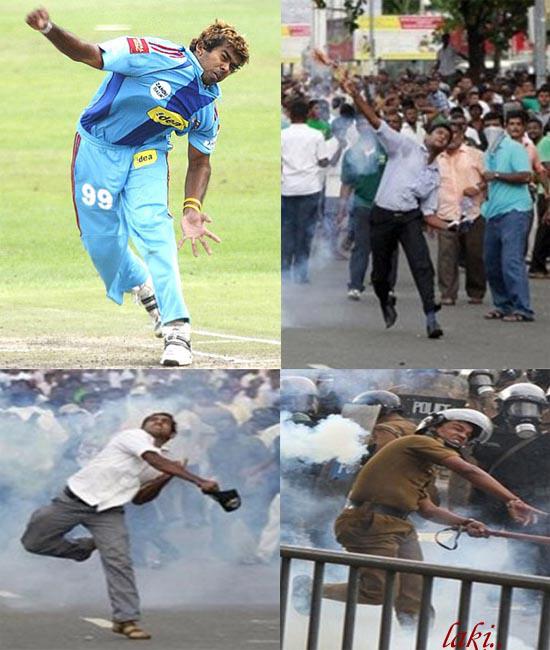
Lasith Malinga sparks copycats in the streets of Colombo … no stone unturned

1 Comment

Filed under democratic measures, historical interpretation, political demonstrations, politIcal discourse, Rajapaksa regime, sri lankan society

Tamil Tiger flag and verbal hot air from several quarters at SCG and beyond

Item in http://www.eelampress.com/2012/02/50119/  under this title: ” Youth’s opinion on raising the LTTE flag at the Sydney Cricket Grounds”

The cricket match between Australia and Sri Lanka was played in Sydney. Here we wanted to publicize that we are Tamils from Tamil Ealam, and with courage and endurance, we will fight anywhere, hence we are raising our Tamil ealam national flag. Several web sites have published that the Police have seized our flag. It did not happen that way inSydney. I raised our national flag among several thousands of Sinhalese. Those Sinhalese who noticed the flag informed the Police. Continue reading

2 Comments

Filed under accountability, life stories, LTTE, political demonstrations, politIcal discourse, power politics, Sinhala-Tamil Relations, Tamil civilians, world events & processes