Female Empowerment: Frontline Combat Roles for Aussie Women

Mark Dodd, in The Australian, 29 September 2011, under titleAccess to All Areas.”

HOURS after Defence Minister Stephen Smith announced the lifting of restrictions preventing women from serving in front-line combat units, navy captain Michele Miller was presented as the Australian Defence Force’s poster girl to support the plan.  Articulate, intelligent, ambitious, dedicated, unquestionably brave and now pregnant, Miller recounted how in 2004 as second-in-command of the frigate HMAS Stuart she led a recovery party to rescue wounded US servicemen after al-Qa’ida terrorists blew up an Iraqi oil terminal.

“I had my chance to see body bags and to deal with that distress and what happens when you get combat casualties,” she told reporters quietly. Miller is a strong supporter of the new deal for women to participate in close-quarters combat and Defence would sorely like more Millers. Less was said of her long haul to senior command since her graduation as a junior officer at the Australian Defence Force Academyin 1991. Ask anyone in Defence from the former chief, Peter Cosgrove, to the incumbent, David Hurley, and his deputy, Mark Binskin, and they’ll tell you that combat experience is a definite career enhancer. It was one reason Smith cites for the opening of the last 7 per cent of military jobs from which women have been barred solely because of sex. Continue reading

Leave a comment

Filed under Afghanistan, australian media, democratic measures, discrimination, female empowerment, military strategy, politIcal discourse, world events & processes

UK not monitoring safety of Tamils deported to Sri Lanka

Ian Cobain, in The Guardian, 28 September 2011

 Tamils at an IDP Camp — Pic by Eranga Jayawardena for AP [see end for Web Editor comment… and additional note]

The government has conceded that it is doing almost nothing to establish what is happening to scores of Tamils who are being forcibly removed from the UK, despite concerns for their safety in Sri Lanka. A flight chartered by the UK Border Agency was due to depart on Wednesday with up to 50 failed asylum applicants on board, 24 hours after several human rights groups warned that they could face detention without trial, torture or even death.

As lawyers for some of the individuals lodged last-minute appeals, the Home Office claimed that arrangements to monitor the welfare of the deportees had been sub-contracted to the International Organisation for Migration (IOM), an inter-governmental body. “They do it on our behalf,” a spokesman said. When the IOM denied this, the Border Agency conceded that the only measure being taken to ensure the safety of Tamils who are forcibly removed from the UK to Sri Lanka is to give them the telephone number and address of the British High Commission in Colombo. Continue reading

Leave a comment

Filed under accountability, asylum-seekers, authoritarian regimes, communal relations, discrimination, historical interpretation, IDP camps, life stories, LTTE, Rajapaksa regime, reconciliation, Sinhala-Tamil Relations, tamil refugees, welfare & philanthophy, world affairs, world events & processes

Military Memoirs as a Historical Genre

Yuval Noah Harari

FULL TITLE: Military Memoirs:  A Historical Overview of the Genre from the Middle Ages to the Late Modern Era


ABSTRACT of Article: The article surveys the history of military memoirs in the west from the Middle Ages to the late modern era. It examines the relation of military memoirs to other literary and historiographical genres, such as conversion narratives, service records, and oral life-stories. It focuses in particular on the rising visibility of memoirs composed by common soldiers and junior officers. The article then analyses the historiographical importance of this genre, and the unique contributions it can make to the study of military history.It emphasizes the genre’s relevance to the study of military command, of military culture, and of the experience of war.

This article can be found in War In History 2007; 14; 289. The online version of this article can be found at:
http://wih.sagepub.com/cgi/content/abstract/14/3/289

Leave a comment

Filed under military strategy, politIcal discourse, world affairs, world events & processes

Rohan de Soyza’s Conservation Gift — Kodigahakanda now a wild life sanctuary in Kalutara

Suraj A Bandara, in Daily News, 29 Sept 2011, under title “ Kalutara to have first wildlife sanctuary” 

The Kodigahakanda forest in the Olaboduwa North Grama Niladhari division in Horana will be declared a sanctuary in November under the Forest Conservation Department, K.Munagam (President of MEDEF, that is, the Mihithala Mithuro Environmental Development Foundation)told the Daily News. “This is the first wildlife sanctuary in the Kalutara district,” he said. Kodigahakanda bio-diversity centre at Gonapola was opened by Kalutara District Parliamentarian Vidura Wickramanayake on Sunday.

Kodigahakanda Conservation Society and Mihithala Mithuro Environmental Development Foundation (MEDEF) with the financial support of Global Environmental Foundation (GEF) through United Nation’s Development Program (UNDP), built this centre to conserve the biodiversity of the forest with the participation of the regional community. The initial financial allocation for the centre was Rs 1.5 million.

Kodigahakanda is an 18 acre secondary scrub jungle on top of a granite based hill rock, 378 feet above sea-level at its highest point. It is located in a 600 acre coconut plantation. Though the land belongs to philanthropist Rohan De Soyza, he has kept the forest without exploiting it for economic gains. He had wanted to keep the jungle unharmed for the benefit of diverse creatures living there. Continue reading

1 Comment

Filed under sri lankan society, Uncategorized, welfare & philanthophy, world events & processes

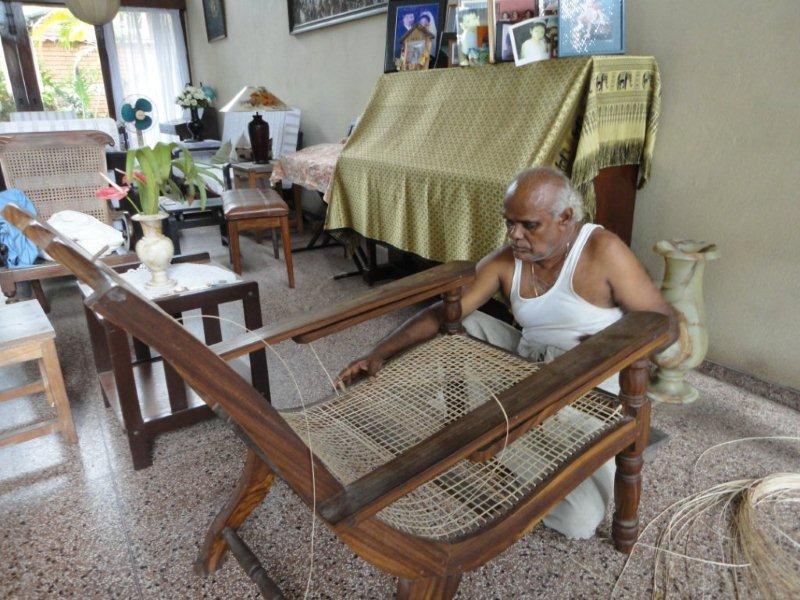
A Simple Man, A Common Man, A Contented Man is Carolis Singho of Ratgama

Susiri Weerasekera[i]

I have had the pleasure today of meeting a very average Sri Lankan man of the older type. He is a rattan weaver of 63 years from Ratgama a few miles north of Galle.[ii] Lives about 200 yds from the Galle Rd.  For the last 35 years, since the age of 18 he has toured this area at Nugegoda, weaving. His name is CAROLIS SINGHO.

He will weave our hansi putuva (easy chair) and the couch (kavitchiya) for Rs. 24,000/ taking over 5 days. (We bought the old couch in 1993 for Rs 6000/. It is worth 150,000/ today)

He is a calm and collected man whom I have seen going down our lane for years, doing the occasional weaving for us. He wears sarong and shirt. Slippers. Clean shaven, a bit grey haired. Very sturdy build.

I asked some direct questions from him as he weaved. I was lucky I was home.

 How is Ratgama? Not bad. Continue reading

Leave a comment

Filed under politIcal discourse, Rajapaksa regime, sri lankan society, unusual people, welfare & philanthophy, working class conditions, world events & processes

Rajasingham Narendran debates recent history with Ilaya Seran Seguttuwan

Courtesy of the Sri Lanka Guardian

Communal relations in independent Sri Lanka

I read with interest the response of Ilaya Seran Seguttuwan to my note titled, ‘A brief overview of post- independence history of communal relations in Sri Lanka’ (Sri Lanka Guardian of 19th Sept’2011). [article 01, article 02 ]  The criticism he directs at me is more valuable than the complements, in view of his erudition, experience and long involvement in Sri Lankan affairs. He has raised a couple of issues that require explanations from me.

1.“For reasons not clear, he is a strident critique of the TNA, the TULF and the Tamil leadership under Mr. Sambanthan and colleagues- bar a few instances he passes some complementary remarks on this grouping”.

 Yes, I am very critical, because throughout our post-independence history the Tamils have been led in a short sighted manner by their so-called leadership (I have used the pre-fix so-called to emphasize that leadership means something entirely different to me). This includes G.G.Ponnambalam’s Tamil Congress. Their politics has been emotive and reactive. They did Continue reading

1 Comment

Filed under accountability, citizen journalism, communal relations, discrimination, historical interpretation, island economy, language policies, Left politics, LTTE, politIcal discourse, power politics, power sharing, religious nationalism, Sinhala-Tamil Relations, sri lankan society, world events & processes

Perceptions of Racism in Australia: Indians and Lankans most victimized– says Kevin Dunn

Stuart Rintoul, in The Australian, 21 September 2011

 Professor Kevin Dunn

Kevin Dunn, lead researcher of the decade-long Challenging Racism Project, said new analysis suggested Indian and Sri Lankan-born Australians reported higher levels of racism in such areas as the workplace, in education, when renting or buying a house, at shops and at sporting or public events.

The findings suggested the 2009 attacks on Indian students in Melbourne were a sign of a wider problem, he said. The study found: Continue reading

4 Comments

Filed under accountability, australian media, cultural transmission, discrimination, disparagement, fundamentalism, immigration, life stories, politIcal discourse, racist thinking, violence of language, welfare & philanthophy, world events & processes

Terror cleric Abdul Nacer Benbrika headed twin cells

Cameron Stewart, in The Australian, 21 September 2011

THE nation’s two largest terror cells were linked by a common spiritual leader, joint terror training camps and close friendships between extremists in Melbourne and Sydney. After a Victorian judge yesterday threw out a second round of charges against convicted terrorists, it can be revealed that self-proclaimed Muslim cleric Abdul Nacer Benbrika was considered the central figure and the driving force behind both cells in Melbourne and Sydney. The groups’ targets were to have included a terrorist strike on the 2005 AFL grand final between the Sydney Swans and the West Coast Eagles, Melbourne’s Crown casino during Grand Prix weekend in 2006 and Sydney’s Lucas Heights nuclear reactor.

Benbrika, who is currently serving a minimum 12 years in jail for leading a terrorist organisation, was recorded telling one of his followers: “If we want to die for jihad, we have to have maximum damage. Maximum damage. Damage their buildings, everything. Damage their lives. To show them, we’ll have to be careful.”

Continue reading

Leave a comment

Filed under accountability, atrocities, australian media, democratic measures, disparagement, fundamentalism, life stories, politIcal discourse, religious nationalism, terrorism, violence of language, world events & processes

Shaping Our Future: A Few Rays of Hope

Renton de Alwis in Daily News, 21 September 2011

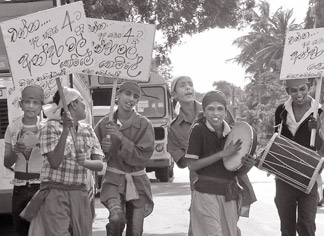
In the village of Kiula in the Deep South, 21 kids and one adult formed a new theatre group called ‘Kiula Warna Ranga Players’ this week. That was the culmination of a six weeks free theatre workshop they had during the school holidays. Turning part of the Kiula Junior School ground into their stage or karaliya, their performance was much better than any of us expected, proving how skills and talent combined with rigorous practice and rehearsal can do wonders for children in learning.

Manjula Ranasinghe of Janakaraliya of whom I wrote about in an earlier column, gave his know-how and skills to make the workshop an educational experience for the kids. They went through physical exercises, breathing exercises, meditation sessions, drama exercises and games, voice training, team building efforts and the like during the workshop sessions. Continue reading

Leave a comment

Filed under accountability, citizen journalism, cultural transmission, life stories, reconciliation, rehabilitation, Sinhala-Tamil Relations, welfare & philanthophy

Asylum-Seekers and Migration to Australia — A Timeline

IRIN News

BANGKOK, 20 September 2011 (IRIN) – Australia’s resumed push to swap asylum-seekers arriving by boat with refugees from Malaysia is the government’s most recent policy response to an issue that has preoccupied officials and the public for years.  Under the so-called “Malaysia Solution”, Australia would exchange the next 800 refugees to arrive by boat for 4,000 mostly Burmese, in Malaysia. On 31 August, the High Court ruled against it, declaring the proposal invalid, a decision welcomed by rights groups such as the Refugee Council of Australia. According to government figures, since 1976, more than 27,000 people have boarded boats and attempted to emigrate to Australia, a signatory to the 1951 UN Refugee Convention
IRIN considers how the debate has developed:

27 April 1976: The first boat arrivals – five refugees from Vietnam – land in Darwin. Over the next five years, more than 2,000 Vietnamese boat arrivals are reported and the term “boat people” enters the Australian vernacular; Continue reading

Leave a comment

Filed under accountability, asylum-seekers, australian media, disparagement, life stories, people smugglers, Tamil migration, welfare & philanthophy, world affairs, world events & processes