Thugs who roam the internet

Quotation of the month from Padraig Colman within a subsection entitled ‘Moderation in All Things”

PADRAIG However, most reputable websites have a moderation policy which forbids author abuse, obscene or offensive language and off-topic discussions. Only extreme libertarians would object to a website policing itself to eliminate hate speech that stirs up racial animosities. Whether a comment falls into any of those categories is determined by editorial judgement. Where do you draw the line between moderating and censorship?

The price paid for freedom of speech is that gangs of thugs, whose malevolence towards their fellow human beings is pathological, pseudonymously prowl the precincts of the internet. The people who moderate do not always  know the difference and are, allegedly, sometimes part of the gangs. Someone has privately suggested to me that many of the pseudonymous trolls are actually fakes manufactured by the editors to drum up interest.  An analysis of the UK Guardian’s on-line community by digital consultant Martin Belam suggests that debate is dominated by a tiny minority. (He estimated that a fifth of comments were left by just 0.0037% of the paper’s declared monthly audience.) Continue reading

Leave a comment

Filed under accountability, historical interpretation, life stories, LTTE, news fabrication, politIcal discourse, Sinhala-Tamil Relations, sri lankan society, terrorism, tolerance, unusual people, world events & processes, zealotry

In search of indigenous artists

R. K. de Silva, courtesy of Art Sri Lanka

Most of the indigenous artists appears to have been restricted to temple murals and drawings on cloth, such as flags and banners.  Of the few of these artists who painted in the water colour medium, the traditions of temple art have been maintained, the colours being generally confined to white, red, yellow, black and more rarely, blue.  The lack of perspective is also very evident. Ananda Commaraswamy in his erudite work “Mediaeval Sinhalese Art” says that there are no drawings on Sinhalese paper, which was very coarse and rough.  The only drawings and manuscripts which have been preserved, are on Dutch, and late, English paper. Coomaraswamy mentions that he was acquainted with only two paper manuscripts, one written on 158 leaves of Dutch paper and containing a selection of discourses of the Buddha and said to have been used by King Narendra Singha as a prayer book, another, on 150 leaves, written in 1811 by Iruyagama Dharmadassi and affording and interesting side-light into Kandyan court life.Both these books are illustrated, the painting being typical examples of the Kandyan style of the 18th century. Continue reading

2 Comments

Filed under cultural transmission, heritage, historical interpretation, life stories, sri lankan society, world affairs

The Colombo Chetties of Sri Lanka : Three Essays

I. The Colombo Chetties of Sri Lanka by Shirley Pulle Tissera

The Colombo Chetties form an integral part of Sri Lankan society. They are a separate ethnic group different from the Tamils, Moors, Malays, Burghers, and the majority Sinhalese community. In the census of 1946 (Vol I Para I) the Superintendent of Census, Mr. A.G. Ranasinghe, states that the Colombo Chetties must receive mention in a racial distinction of Ceylon. The term does not include the Nattukottu Chetties who have formed themselves into a guild for carrying on business in Ceylon and are only temporary residents of the Island.

3b-C'bo Chetty -- SylvafColombo Chetty –a representation painted by Hippolyte Silvaf  in the 1840s or so ** Continue reading

12 Comments

Filed under ethnicity, heritage, historical interpretation, life stories, sri lankan society, world affairs

Numbers Game reviewed by Kath Noble: the full monty

kathnoble Kath Noble

Part 1: Published in The Island on July 3rd

Some months ago, my attention was drawn to a report on civilian deaths in the final phase of the war. The author – as yet unnamed – claimed to have something important to add to the debate that began in 2009 as the Army closed in on the LTTE in Mullaitivu. I must admit that I didn’t feel very inclined to read it. Of course it is disturbing that estimates of the number of people killed between January and May that year vary from almost zero to 147,000. But there are many things to be disturbed about in Sri Lanka – the Government is pursuing a thoroughly regressive agenda on just about every front. Should we ignore its failure to tackle extremist groups, even if only for a moment? What about its effort to roll back the 13th Amendment? How could we justify focusing on a subject that is clearly no longer urgent? In 2009, the LTTE had surrounded itself with an unknown number of people, and the question of how the Army was responding was of obvious importance – lives were at risk.08_05_09_mullivaykkaal_0201_05_09_vanni_04 Pics from Tamilnet-May 2009 60c-april 2009 exodus 60b-Tamil stram refugees-Island Continue reading

58 Comments

Filed under accountability, historical interpretation, LTTE, mass conscription, news fabrication, population, power politics, Rajapaksa regime, Sinhala-Tamil Relations, sri lankan society, Tamil civilians, tamil refugees, Tamil Tiger fighters, war crimes, world events & processes

An Elephantine ACT OF UNION

ELEPHANTINE FUCK Continue reading

Leave a comment

Filed under accountability, taking the piss, terrorism, trauma, unusual people, war crimes, wikileaks, world events & processes

Michelle de Kretser’s “Questions Of Travel” secures Miles Franklin Award

Courtesy of ABC News, 19 June 2013

michelle de kretser[As announced in mid-June] Michelle de Kretser won the 2013 Miles Franklin Award, Australia’s most prestigious literary prize. De Kretser won the $60,000 prize for her novel Questions Of Travel, a story drawn around two disparate characters that explores belonging and questions of home and distance. Judges announced the award at the National Library of Australia in Canberra this afternoon, praising the novel as “witty and poignant”. The chair of the judging panel, Richard Neville, says it was difficult to choose a winner from the first all-female shortlist in the award’s history.

“The judging process itself is exhaustive and exhausting… this year there was intense discussion on the winner,” he said. “Michelle’s novel is a novel of great ambition and great wisdom. It’s dealing with all, so many issues that Australian society’s talking about and it’s just a wonderfully written, engaging novel.” Continue reading

Leave a comment

Filed under Australian culture, australian media, cultural transmission, heritage, life stories, literary achievements, self-reflexivity, unusual people, world affairs

The serene smiling face of Ashton Agar highlights multi-cultural Australia

Chip Le Grand and Pia Akerman, in The Weekend Australian, 13 July 2013, where the title readsCricket’s new face, Ashton Agar, has a serene smile.”

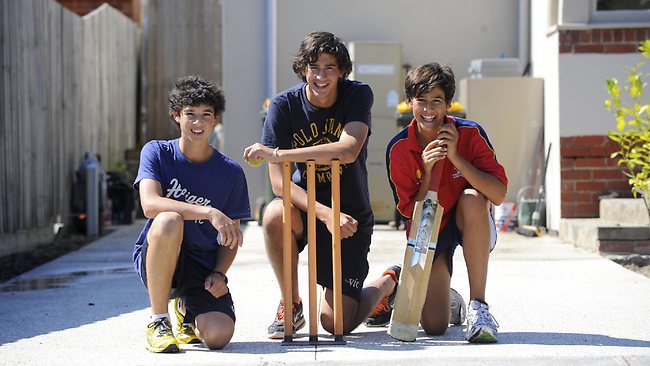
AGARs threeTHE face of Australian cricket has always been hard set. Ricky Ponting’s furrowed brow. Steve Waugh’s defiant stare. Allan Border’s stubborn resolve. The Chappells and their killer gleam. The new face of Australian cricket wears a broad smile that has captured the hearts of a sleep-deprived nation. That it shone as brightly in the moments after Ashton Agar got out for 98 as it did when he was chasing an improbable century on debut evokes Kipling’s famous line about triumph and disaster and treating those two imposters just the same. Back home in Melbourne, it reminded Agar’s high school maths teacher and cricket coach of the advice he gives every kid that takes block for De La Salle College. “You want the opposition to walk off the ground wanting to hate you but not having a reason,” says Marty Rhoden, a teacher and coach to all three Agar brothers. “He is so level-headed and grounded. You notice the first thing he did when he ran back on to the ground after taking off his pads was to go up to (his brothers) Will and Wes and apologise for getting out.” Continue reading

5 Comments

Filed under Australian culture, cultural transmission, ethnicity, immigration, life stories, sri lankan society, unusual people, world affairs

Willa Wickramasinghe and the SSC Pamphlets: An Appreciation

Michael Roberts

WillaWilfred Wickramasinghe, “Willa” to his pals, was born on 12th December 1932 and was educated at S. Thomas’ College, Mount Lavinia. He thereafter joined the Sri Lanka Air Force and passed out first in his batch at Diyatalawa. The government of that day said they had no money to send him to Cranwell in UK for his officer training, so he promptly resigned his commission and set off for England in order to study insurance. While in London he became President of the Sri Lanka Students’ Union during the late 1950s over two successive years, succeeding Ratnasiri Wickramanayake (subsequently a Prime Minister). Wilfred became a Communist while a student in England and travelled widely in Russia and other Communist countries. Continue reading

7 Comments

Filed under cultural transmission, heritage, historical interpretation, life stories, literary achievements, nationalism, politIcal discourse, sri lankan society, unusual people, welfare & philanthophy

Selfless Service to All — Appreciating D. P. M. Weerakkody

Fr Egerton Perera sj in the Island, 2 July 2013, where the title is “Emeritus Prof. D. P. M. Weerakkody – ‘He gave himself selflessly’

WeerackkodyD. P. M. Weerakkody, Emeritus Professor of Classical Languages  of the University of Peradeniya, passed away on June 26, after a brief illness.  On Friday, his body lay-in-state at the Arts Theatre of the University for  faculty members, students, and friends to pay their respects to a distinguished  and dedicated teacher. This was followed by a Thanksgiving Mass at the Catholic  Chaplaincy of the University to honour a selflessly committed Catholic, who  inspired the teachers, chaplains, alumni and students of the University, by  being for several years, both the Senior Treasurer and Director of the choir of  the Newman Society – the Catholic Students’ Movement of the University. Continue reading

Leave a comment

Filed under heritage, historical interpretation, sri lankan society, teaching profession, unusual people

Bikes for Life and Cricket towards Reconciliation at Kilinochchi via FOG

Skandakumar

Kushil Kili 02I have just back from Killinochchi ……at 4 am Tuesday morning after having left at 8 am on Sunday!! It was a  rewarding trip that allowed a group of us to visit an orphanage of 330 children, and see the work a retired GA in charge, Rasanayagam, is doing for them and for 6000 widows in that area. We also visited a Harmony Centre constructed by the Army that  will soon provide access to IT, English, et cetera — a centre that also has a badminton court and modest gym facilities . Continue reading

1 Comment

Filed under cultural transmission, life stories, patriotism, performance, Sinhala-Tamil Relations, sri lankan society, Tamil civilians, unusual people, welfare & philanthophy, world events & processes