Knee-Jerk Idiocy in Foreign Policy: The Present Government and its Vengeance-cum-Patronage Politics

Nanda Godagewith a title imposed by the Editor

India is without doubt the most important country to us not only because of her proximity and our blood relationship but also because she is developing into becoming a Super Power and because of her capacity to do us harm. Our security and development are our foremost national interests and, therefore, India is indeed the most important country to us on the planet. SSThe Island on Sunday carried a front page report filed in an Indian newspaper to the effect that our High Commissioner described as ‘India friendly’ had been recalled. When the new administration took over we expected a professional approach to the management of our external relations, but some actions such as this are similar to those indulged in by the previous administration. We saw our foreign relations mismanaged in recent years with ‘relations of the rulers’ who had neither the qualifications nor the temperament nor knowledge nor understanding of diplomacy and international relations being appointed to promote our national interests; but there were indeed a few exceptions and one such was the appointment of Prof. Sudarshan Seneviratne as our High Commissioner to India. He obtained a doctorate from a prestigious Indian University and is a much respected man in Delhi and, above all, that had close friends in high places in the administration which is a tremendous asset and advantage to us; removing him merely because he was appointed by the previous administration is undoubtedly a stupid act and against the interests of the country. Continue reading

2 Comments

Filed under authoritarian regimes, disparagement, governance, historical interpretation, Indian Ocean politics, life stories, politIcal discourse, Rajapaksa regime, self-reflexivity, sri lankan society, vengeance, world affairs

Sri Lanka’s Intelligentsia: A Clarion Call in 2015

Ranjith Senaratne, courtesy of The Island, 10 June 2015, http://www.island.lk/index.php?page_cat=article-details&page=article-details&code_title=126212

“All reasonable men adapt themselves to the world. Only a few unreasonable ones persist in trying to adapt the world to themselves. All progress in the world depends on these unreasonable men and their innovative and often non-conformist action”. George Bernard Shaw.

During the last presidential election, among the political parties and pressure groups, professionals and intellectuals made an impact in changing and moulding public thinking and swaying public opinion, which resulted in a regime change. An important feature in this scenario was that the public accorded hearing and recognition to what the intellectuals said. This healthy, emerging trend has to be managed properly for the benefit of the country and its people, without allowing it be exploited for narrow political and personal ends. In the current political context, the public has only scant regard for the most of politicians because of their misdeeds, misconduct and/or poor educational./professional background. In my previous article titled “Civic Responsibilities and Moral Obligation of Intellectuals and Professionals in National Development” in the Island on the 21st / 22nd April, 2015, it was clearly shown that the proportion of ministers in our cabinet with a Bachelor’s degree or equivalent qualification is much less than that even in Pakistan, India and Uganda. The situation could be still worse when it comes to our parliament. This is in spite of the fact that Sri Lanka possesses a much higher literacy rate than those countries, which is truly ironic.

SIRISENA 11 SIRISENA at pooja Continue reading

Leave a comment

Filed under authoritarian regimes, cultural transmission, democratic measures, economic processes, historical interpretation, language policies, legal issues, life stories, modernity & modernization, politIcal discourse, power politics, Presidential elections, press freedom & censorship, propaganda, sri lankan society, world affairs

Reflections on Ondaatje’s WOOLF IN CEYLON

 Gamini Seneviratne, reviewing Christopher Ondaatje: Woolf in Ceylon. An Imperial Journey in the Shadow of Leonard Woolf-1904-1911 (2006)

 woolfceylonThis book runs to over 300 pages – room enough for Christopher Ondaatje to touch on virtually every aspect of Leonard Woolf’s life and work. It would of course be possible to pursue each of them towards a clearer understanding of both (author and subject). In a review of this kind, though, a consideration of what appears to be the author’s view of what Woolf experienced here and in England must suffice. Note that Ondaatje’s account is embellished by many photographs, some of them truly excellent. Some have been drawn from the archives of the Royal Geographical Society and the University of Sussex, many are of Ondaatje’s own making.

The author has been to a great deal of trouble researching the people and places mentioned by Woolf in his writings on / from Ceylon: ‘The Village in the Jungle’, ‘Stories from the East’, his letters and ‘Growing’ the segment of his autobiography that covers his stay here in the early 1900s, and his official Diaries as Assistant Government Agent, Hambantota. Ondaatje’s writing is lively and lucid, perhaps less so here than in ‘The Man-eater of Punani’. A selection of the photographs in both books merits publication in a separate portfolio.

CHRIS O--11 Continue reading

Leave a comment

Filed under British colonialism, centre-periphery relations, cultural transmission, discrimination, economic processes, heritage, historical interpretation, island economy, landscape wondrous, life stories, literary achievements, meditations, modernity & modernization, pilgrimages, politIcal discourse, self-reflexivity, sri lankan society, the imaginary and the real, world affairs

Nationalism, the past and the present: The case of Sri Lanka

Michael Roberts

This review article was drafted in 1991 and should therefore be assessed in the light of the literature available then. In those days it took at least two years for an article to be refereed and published. The essay  discussesthe following three books: Jonathan Spencer, A Sinhala Village in a Time of Trouble.  Politics and Change in Rural Sri Lanka, Delhi: Oxford University Press, 1990, 285pp; Jonathan Spencer (ed.), Sri Lanka.  History and the Roots of Conflict, London: Routledge, 1990, 253pp; Manning NashThe Cauldron of Ethnicity in the Modern World, Chicago: The University of Chicago Press, 1989, 142pp. It was originally printed in Ethnic and Racial Studies, 1993, 16: 133-161. Emphasis has since been added in red.

spencer--www.sasnet.lu.se Spencer  leslie g- Gunawardana 

Benedict Anderson and Dr. Niall î Dochartaigh at NUI Galway Photograph by Aengus McMahon

Benedict Anderson and Dr. Niall î Dochartaigh at NUI Galway
Photograph by Aengus McMahon

The ongoing ethnic conflict in Sri Lanka has aroused interest in both the reasons for the breakdown of its polity and the roots of Tamil and Sinhala identities. The resurgence of nationalism in Eastern Europe will encourage studies in the broader implications of the Sri Lankan data for social science theory. As a result of the excesses of the Nazi upsurge, Western scholars have tended to regard nationalism as retrograde and potentially patho­logical (e.g. Kedourie 1960) or reprehensibly atavistic.  In South Asia, in contrast, ever since the decolonization process got under way, nationalism has been viewed positively—as long as its goals were framed in terms of the existing (colonial) political boundaries. The recent upsurge of violence has encouraged Asian scholars to question this perspective.  Such questioning is sometimes embodied in the term ‘chauvinism’ (e.g. Coomaraswamy 1987: 74-81). This term is not a novel addition to the Asian English lexicon. It was used in British Ceylon in the 1920s and 1930s to describe those who pressed for Tamil and Sinhalese sectional interests: these spokesmen were reviled as “communalists”, “chauvinists” and “tribalists” by both the moderates and radicals who espoused a Ceylonese nationalism.[1] Continue reading

1 Comment

Filed under historical interpretation, Indian Ocean politics, life stories, nationalism, patriotism, politIcal discourse, Portuguese in Indian Ocean, self-reflexivity, Sinhala-Tamil Relations, sri lankan society, the imaginary and the real, violence of language, world events & processes

CPA launches web book on Presidentialism

Reforming Sri Lankan Presidentialism – Provenance, Problems and Prospects is a collection of scholarly essays edited by Asanga Welikala.

Download the entire contents of the book, by Volume or by individual contribution, here.

Bala-VannamaThe cover of the book …Chandraguptha Thenuwara

Continue reading

1 Comment

Filed under accountability, authoritarian regimes, economic processes, governance, historical interpretation, Indian Ocean politics, legal issues, life stories, LTTE, modernity & modernization, nationalism, politIcal discourse, power politics, power sharing, prabhakaran, Presidential elections, Rajapaksa regime, reconciliation, self-reflexivity, Sinhala-Tamil Relations, sri lankan society, world events & processes

An Aussie Bloke’s Reflections on the Warring Mentality of Humankind, 1914 -2015

Walter Steensby

Hello Michael, At last I’ve read the entire paper.[1] Good analysis. Some comments follow, in no particular order.

Regarding Monis, recent reports of his mental health paint the picture of a man who was a lunatic rather than a terrorist. Some might ask, is there a difference? What annoys and saddens me about the whole episode is that Monis’ actions got the maximum possible media exposure, while the tragedy in Cairns at almost the same time, where that woman killed seven of her own children plus one other, was largely ignored. One doesn’t like to rank tragedies, but I would have thought that eight child murders are just as newsworthy as two adult murders. I cynically suggest that the Monis affair was emphasised to continue keeping the people afraid of infidels.

Recently I went to a musical (re)presentation of the International Congress of Women held in 1915 in The Hague….international_congress_women_560

Continue reading

Leave a comment

Filed under accountability, Australian culture, australian media, authoritarian regimes, British imperialism, Fascism, female empowerment, Islamic fundamentalism, jihad, landscape wondrous, Left politics, life stories, political demonstrations, politIcal discourse, power politics, self-reflexivity, the imaginary and the real, truth as casualty of war, violence of language, women in ethnic conflcits, world events & processes, World War One

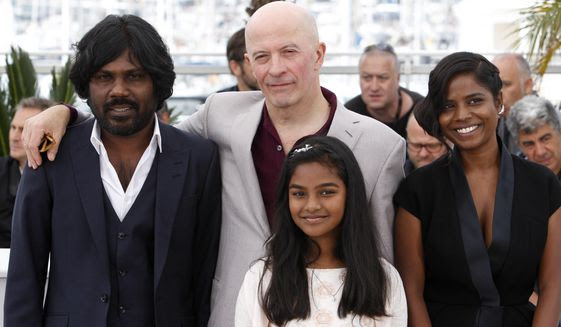
DHEEPAN: A Fictional Tale of Tamil Tiger Asylum Seeker – Now in the Cannes spotlight

“Dheepan” is one of 19 films in competition for the Cannes Film Festival’s Palme d’Or top prize,  to be awarded on Sunday. The story of Dheepan is that of  a former fighter in the Sri Lankan civil war trying to make a new life in France with a fake family.

“Dheepan” by one of France’s most acclaimed film directors, Jacques Audiard, tells the story of the  war-scarred title character meeting a young woman and a nine-year-old girl in a refugee camp. In order to win passage to France, they assume the identities of a dead family to use their travel papers. The Film appears to have received wide acclaim and is featured in several media reports, including the Guardian, Washington Times and The Daily Mail
London’s Evening Standard newspaper called it an “intense thriller that goes to the heart of the immigrant crisis”. And cinema trade magazine Screen International said the picture offers “the pleasures of captivating storytelling with an irresistible human pulse”
Sri Lankan immigrant drama ‘Dheepan’ finds a home at Cannes
From left, actor Jesuthasan Antonythasan, director Jacques Audiard, actress Claudine Vincent Rottiers and actress Kalieaswari Srinivasan pose for photographers during a photo call for the film Dheepan, at the 68th international film festival, Cannes, southern France, Thursday, May 21, 2015. (AP Photo/Lionel Cironneau)

From left, actor Jesuthasan Antonythasan, director Jacques Audiard, actress Claudine Vincent Rottiers and actress Kalieaswari Srinivasan pose for photographers during a photo call for the film Dheepan, at the 68th international film festival, Cannes, southern France, Thursday, May 21, 2015. ..by JAKE COYLE – Associated Press – Thursday, May 21, 2015

Continue reading

1 Comment

Filed under Uncategorized

Muslim Aussie Protest Action Drowned out by Irreverent Aussie Aetheists

SEE https://www.facebook.com/video.php?v=937981969546403&set=vb.100000038277260&type=2&theater …..

Nattie Goldberg Nameri
Muslim protester’s gather in Melbourne then get the shock of their life when Patriotic Aussies surround them and show them who’s boss. this is the way they should be silenced everywhere they open their mouths! SHARE
מפגינים מוסלמים מקבלים את שוק חייהם כשפטריוטים אוסטרלים מקיפים ומראים להם מי הבוס! כך צריך להשתיק אותם בכל העולם! שתפו

Leave a comment

Filed under australian media, Islamic fundamentalism, modernity & modernization, political demonstrations, politIcal discourse, tolerance, world affairs

The Spirit of Emperor Ashoka in Remembrance Day, 19th May … and thus A Step towards Rapprochement

Gnana Moonesinghe, courtesy of The Sunday Island, 24 May 2015, where the title runs “Remembrance Day for Victory Day deflects from triumph to rapprochement”

                                 “It is the gentle law of men

                                  To change water into light

                                  Dreams into reality

                                 Enemies into brothers” …….  Paul Eluard

The name change from Victory Day to Remembrance Day to commemorate the same event reflects a change in approach towards May 19 2009, that is the end of the three decade war. Remembrance Day evokes a sense of pathos and perhaps a desire to reflect even as Emperor Asoka did at Kalinga. His victory gave him no joy; he could only see the disarray on the battlefield; the dead and the mangled. It made him reflect; it changed him and made him look up to the Buddha’s teachings for solace. It gave this country Buddhism through the children of Emperor Asoka who brought the word of the Buddha to this country.  A 11 Sri-Lankas-Tamil-natives-commemorate-civil-war-anniversary-as-Remembrance-Day 

Sri Lankan women police officers march during a Victory Day parade in Matara, about 165 kilometers (103 miles) south of Colombo, Sri Lanka, Tuesday, May 19, 2015. Sri Lanka's government Tuesday marked the sixth anniversary of the civil war victory over ethnic Tamil separatists. (AP Photo/Nishan Priyantha)

Sri Lankan women police officers march during a Victory Day parade in Matara, about 165 kilometers (103 miles) south of Colombo, Sri Lanka, Tuesday, May 19, 2015. Sri Lanka’s government Tuesday marked the sixth anniversary of the civil war victory over ethnic Tamil separatists. (AP Photo/Nishan Priyantha)

A33 Continue reading

Leave a comment

Filed under cultural transmission, patriotism, politIcal discourse, power politics, Rajapaksa regime, reconciliation, self-reflexivity, Sinhala-Tamil Relations, sri lankan society, the imaginary and the real, truth as casualty of war, world affairs

The sheer Galle of it: ‘Regaling’ Sri Lanka

Freddy Halliday, courtesy of  http://www.dailymail.co.uk/travel/article-3086195/The-sheer-Galle-Turtles-notch-accommodation-total-relaxation-Sri-Lanka-finds-new-boho-chic-atmosphere.html where the title runs “The sheer Galle of it: Turtles, top-notch accommodation and total relaxation as Sri Lanka finds a new boho-chic atmosphere

GALLE 11 A place awash with history: Galle’s colonial heritage is visible on all corners of the city’s Old Town

We are sitting in a balcony restaurant in the Old Town, with views over the ramparts to the becalmed Indian Ocean beyond.It is our first night. ‘Ah, wonderful,’ says an Englishwoman, emerging from the stairs below. ‘I was up at 5am swimming with sea turtles just off Galle Fort. You should try it. A place awash with history: Galle’s colonial heritage is visible on all corners of the city’s Old Town What a way to see the sun come up. Continue reading

3 Comments

Filed under economic processes, landscape wondrous, life stories, modernity & modernization, propaganda, slanted reportage, sri lankan society, the imaginary and the real, tourism, travelogue, world affairs