
Waleed Aly’s Violent Misreadings of the Sri Lankan Scenario on DISPLAY

Waleed Aly, in The Age,  25 April 2019, entitled “The Sri Lankan attacks are uniquely senseless”

Every terrorist attack in which innocent people are killed is devastatingly tragic. Every one of them is heinous. But what we’ve seen in Sri Lanka this week exists on a rarefied level of depravity. Of course, there’s the supreme violation of slaughtering people in worship – now an established feature of terrorism and particularly Islamic State’s violence in places like Egypt or the Philippines. Then there’s the nauseating symbolism of the day itself. Easter Sunday: perhaps the holiest day on the Christian calendar, but more than that, the day Christians mark the resurrection. The very idea of life’s triumph over death deformed into a day of death above all else.
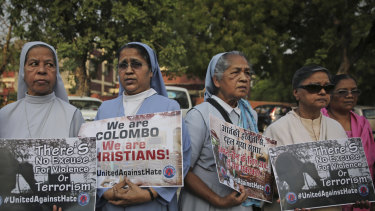
Catholic nuns and others participate in a vigil outside Sacred Heart Cathedral in remembrance of victims.
Catholic nuns and others participate in a vigil outside Sacred Heart Cathedral in remembrance of victims.CREDIT:AP

Continue reading

2 Comments

Filed under accountability, australian media, economic processes, historical interpretation, life stories, news fabrication, politIcal discourse, power politics, self-reflexivity, Sinhala-Tamil Relations, slanted reportage, sri lankan society, truth as casualty of war, world events & processes, zealotry

Indian Alerts Just Before: An Indian TV Discussion of Some Value

Courtesy of Ranga Wimalasuriya on Facebook ….

Leave a comment

Filed under Islamic fundamentalism, life stories, security, self-reflexivity, sri lankan society, suicide bombing, unusual people, world events & processes, zealotry

Suicide Bomber Abdul Latheef Jamal Mohamed: His Transformation Abroad –in UK and Australia

Paul Maley & Primrose Riordan, in The Australian, 26 May 2019, with this title “Sri Lankan bomber in Aussie terror net”

The Sri Lankan suicide bomber who studied at a Melbourne university was one of the subjects of a ­terrorism investigation by Australian security authorities after ­intelligence emerged linking him to ­Islamic State operative Neil Prakash.The Australian can reveal that Abdul Lathief Jameel Mohamed, one of nine suicide bombers ­responsible for a string of attacks across Sri Lanka on Easter Sunday, was investigated by the Joint Counter Terrorism Team in 2014

The Australian can reveal that Abdul Lathief Jameel Mohamed, one of nine suicide bombers ­responsible for a string of attacks across Sri Lanka on Easter Sunday, was investigated by the Joint Counter Terrorism Team in 2014. The investigation was triggered by intelligence that linked ­Mohamed to several counter-terrorism targets, including Prakash. Continue reading

Leave a comment

Filed under accountability, australian media, cultural transmission, education, heritage, historical interpretation, Islamic fundamentalism, jihad, landscape wondrous, life stories, Muslims in Lanka, politIcal discourse, power politics, security, sri lankan society, suicide bombing, terrorism, tourism, trauma, vengeance, world events & processes

The Wahhabi Islamic Killers in Sri Lanka in Pictures

Jake Wallis Simons in Daily Mail, 25 April 2019 …..

  • Wealthy brothers Inshaf and Ilham Ibrahim bombed the luxury Shangri-La and Cinnamon Grand hotels in Sri Lanka’s Easter Sunday terror attack
  • Suicide bomber brothers were the sons of a millionaire spice trader and were privately educated in Colombo
  • Their attacks claimed the lives of at least 41 foreigners, including eight British holidaymakers – three of whom were children
  • As police raided their £1m mansion in an exclusive neighbourhood of Colombo, Ilham’s pregnant wife Fatima blew herself up, killing her three children and three officers
  • Inshaf, a successful businessman, owned a copper factory thought to be where the suicide bombs were made
  • At least 321 people were murdered in the massacre, 45 of them children, while more than 500 were injured
  • Chilling footage shows Ilham and an accomplice bomber attack the Shangri-La while guests had breakfast
  • Second clip earlier showed different bomber patting a girl on the head before launching attack on a church
  • ISIS has claimed responsibility and released footage of the fighters swearing allegiance to the jihadist grou

Suicide bomber brothers Inshaf Ibrahim (left) and Ilham Ibrahim (right) calmly walked into the luxury Shangri-La and Cinnamon Grand hotels on Easter Sunday morning and detonated their vests, killing guests having their breakfast

Continue reading

Leave a comment

Filed under accountability, atrocities, historical interpretation, Islamic fundamentalism, life stories, martyrdom, Muslims in Lanka, politIcal discourse, power politics, religiosity, self-reflexivity, sri lankan society, suicide bombing, tourism, transport and communications, trauma, world events & processes

Security and Governance Failures Everywhere: A Concise Review by Gus Mathews

EMAIL NOTE  from Gus Mathews in London, 25 March 2019 commending the Article by Rajeewa Jayaweera (see below)

Rajeewa,

Thank you for this incisive analysis. Irrespective of the atrocities committed on Easter Sunday I am afraid the blame lies entirely with the government of the day. This government is slipshod, non-functional and above all complacent. While many will indicate the toxic relationship between the President and PM as the main fault it is much more than this simple issue. The security apparatus has been run down deliberately since the end of the Eelam war to appease the minorities and the West. Is it any wonder that it took the horrific murder of 359 innocents and the wounding of over 500 for this government to come to its senses. When it came down to security the last regime was on the ball and the security services would have heeded not only the International warnings but acted on it swiftly.

in Feb 2019- AP Photo/Eranga Jayawardena

Continue reading

1 Comment

Filed under accountability, american imperialism, atrocities, disparagement, governance, historical interpretation, jihad, life stories, Muslims in Lanka, politIcal discourse, power politics, security, self-reflexivity, Sinhala-Tamil Relations, sri lankan society, suicide bombing, unusual people, world events & processes

A Sri Lankan Patriot’s Clarion Call

Anonymous

Yet, the faint thump of a rhythm of a heartbeat

Screams “Rise up! There’s a lot to be done”.

And while that beat still beats in us

We will not give up the fight,

The fight that a thousand warriors fought

To quell darkness with peace and light.

This land is NEVER to be divided.

This land is NEVER to be burned.

This land is NEVER to be terrorized.

Let this be heard across the world.

For every attempt to tear us apart

Will be a waste, will be in vain,

‘Cause in this home that we call Sri Lanka

We are all one, and all the same.

Our churches have been ravaged,

Hundreds of innocents slain,

We weep as one community,

Our tears know no religion, only pain.

This pain will only fuel us

To unite as one strong voice,

The voice of a peace-loving nation

Drowning out the Extremists’ noise.

Watch how we all rally together,

Casting caste and creed aside,

This land of harmonious Humans

Will tame any threatening tide.

Continue reading

Leave a comment

Filed under patriotism, politIcal discourse, Rajapaksa regime, self-reflexivity, Sinhala-Tamil Relations, sri lankan society, the imaginary and the real, tolerance, unusual people

Hanging Israel Folau: Corporate Power in ‘Marriage’ with the Bigotry of Progressives

Steven Chavura, in The Australian, 25 April 2019, with this title “Beware the Choke Tackle of Diversity”

In the seminal textbook of liberalism, On Liberty (1859), John Stuart Mill depicted a Victorian England full of prudishness and prejudice, describing social convention, rather than the government, as the greatest threat to freedom of speech. In some ways little has changed, for it is not the government that has sought to punish Israel Folau for his public Christianity. Yet at the same time it is not society either, at least not in the sense of a grassroots movement to see his contract terminated. Indeed, many fans in lower-middle-class multicultural suburbs would find nothing offensive about the sentiments on homosexuality that he expressed in his infamous tweets.

Continue reading

Leave a comment

Filed under accountability, Australian culture, australian media, citizen journalism, cultural transmission, democratic measures, fundamentalism, heritage, historical interpretation, legal issues, life stories, meditations, politIcal discourse, press freedom, self-reflexivity, unusual people, world events & processes

“Stay Resolute. Visit Lanka” says Juliet from Galle

Juliet Coombe … SRI LANKA NEEDS YOU! 

If you really want to make a difference in the world right now, book or support someone else who was planning a trip to go to Sri Lanka or extend  your stay if already in the country. By this act of solidarity with other peace loving people, you will be breaking the cycle of global violence, showing the terrorists, whoever they may be affiliated to, that they have totally failed to create fear, hatred and far wider spiritual destruction than the bombs themselves. As someone who has faced fear since early childhood as an Old Bailey Judge’s daughter and having the honour of marrying into the Sri Lankan Muslim Community during the civil war years, I can honestly say, hand on heart, that these people had nothing to do with this. However, it is easy to raise a red flag and blame them, playing directly into the invisible bully’s megalomaniac plans, which are to create maximum chaos, blow lots of innocent people up and blame others, so the real ‘extremist monsters’ get away with it, repeatedly, as they fool us with their clever deceptions.

Continue reading

Leave a comment

Filed under authoritarian regimes, communal relations, cultural transmission, heritage, Islamic fundamentalism, island economy, life stories, Muslims in Lanka, politIcal discourse, security, self-reflexivity, sri lankan society, terrorism, tourism, unusual people, world events & processes

Security Failures and Security Implications from the Jihadist Terror in Sri Lanka, Easter Sunday 2019

Jeffrey GettlemanMujib Mashal and Dharisha Bastians, in New York Times, 22 April 2019, where  the title is  “Sri Lanka Was Warned of Possible Attacks. Why Didn’t It Stop Them?

The confidential security memo laid it all out: names, addresses, phone numbers, even the times in the middle of the night that one suspect would visit his wife.In the days leading up to Easter Sunday’s devastating suicide bombings that killed at least 321 people in Sri Lanka, the country’s security agencies had been closely watching a secretive cell of the National Thowheeth Jama’ath, a little-known radical Islamist organization that security officials in Sri Lanka now say carried out the attacks and may have received help from abroad.

Arrests made

Continue reading

1 Comment

Filed under accountability, communal relations, conspiracies, fundamentalism, governance, historical interpretation, Islamic fundamentalism, jihad, law of armed conflict, life stories, martyrdom, politIcal discourse, power politics, religiosity, security, self-reflexivity, sri lankan society, suicide bombing, terrorism, the imaginary and the real, tourism, trauma, world events & processes, zealotry

Same ID utilized by Jihadist Outfit behind Hotel Terror Attacks in Colombo

Daily FT News Item, 22 April 2019, with this title Guest checking in with same name and NIC number at three hotels”

The three hotels which were subject to the terror attack yesterday each had a guest with an identical name and National Identity Card number.  Daily FT learns this information had been revealed during a high level industry meeting with Tourism Minister John Amaratunga yesterday. The meeting also discussed other findings via CCTV in the respective hotels.  An AFP report quoted one of the hotels saying that a man by the name Mohamed Azzam Mohamed had registered.

hotels 113

Continue reading

Leave a comment

Filed under accountability, historical interpretation, Islamic fundamentalism, jihad, life stories, Muslims in Lanka, politIcal discourse, power politics, security, self-reflexivity, sri lankan society, suicide bombing, terrorism, trauma, world events & processes, zealotry