Foregone Conclusions from the UNHRC’s Forthcoming Charade in Geneva

Chandre Dharma-wardana – responding to a vibrant EMAIL DISCUSSION among Sri Lankans re what should be done at the forthcoming human rights charade at the UNHRC in Geneva

I personally think it doesn’t matter who Sri Lanka sends to Geneva. This whole thing is NOT based on facts. It is NOT based on what was said, is said or will be said. They KNOW the facts. The UNHRC’s commissioner is not a fool, but a seasoned politician. If she wants, she can get at the facts.

Continue reading

6 Comments

Filed under accountability, British imperialism, centre-periphery relations, disparagement, doctoring evidence, foreign policy, governance, historical interpretation, Indian Ocean politics, legal issues, life stories, LTTE, news fabrication, political demonstrations, politIcal discourse, propaganda, security, self-reflexivity, Sinhala-Tamil Relations, sri lankan society, Tamil civilians, truth as casualty of war, UN reports, world events & processes

Looming Struggles in Sri Lanka and Geneva Today

Rajan Philips, in Colombo Telegraph, 14 February 2021, where his chosen ttitle is “Geneva Odyssey: More Confrontation Or New Approach?”

Prime Minister Mahinda Rajapaksa who made the surprising call for the government cancelling the ECT deal with India and Japan, has made another surprising and really a gallant announcement giving the green light for allowing burials for Muslim and Christian victims of Covid-19. If the Ministry of Health has been caught unawares by the PM’s statement in parliament, well, they had better get used to it. But no sooner had the government appeared to have cremated the burial issue than Cardinal Malcom Ranjith raised a new headache for the government – threatening to take his case for justice for the victims of the 2019 Easter Sunday attacks to international courts, if there is no assurance of justice through domestic investigations. That is a shocker even though it is no more than a threat for now.

Continue reading

1 Comment

Filed under accountability, authoritarian regimes, communal relations, democratic measures, doctoring evidence, economic processes, governance, historical interpretation, Indian Ocean politics, legal issues, life stories, Muslims in Lanka, politIcal discourse, power politics, Rajapaksa regime, reconciliation, self-reflexivity, Sinhala-Tamil Relations, social justice, sri lankan society, taking the piss, Tamil civilians, the imaginary and the real, tolerance, unusual people, vengeance, world events & processes

Port Cities of Asia surveyed by Frank Broeeze et al in 1989

Frank Broeze from the University of Western Australia organised a wide-ranging study of port cities in Asia which should not be neglected in exploring the background bearing upon the ongoing politico-economic manoeuvres in the Indian Ocean and the Pacific today.

.

Continue reading

Leave a comment

Filed under centre-periphery relations, commoditification, economic processes, export issues, foreign policy, historical interpretation, Indian Ocean politics, landscape wondrous, life stories, modernity & modernization, politIcal discourse, population, power politics, transport and communications, travelogue, world events & processes

Murugappan Asylum-Seeker Family on Verge of Legal Victory and A Return to Biloela

Nick Pearson in 9news, 16 February 2021, where the title reads Biloela family spared deportation for now, but remain on Christmas Island”
The Federal Court has stopped the deportation of a family from the Queensland town of Biloela, upholding a decision made in April 2020 which the Department of Home Affairs had sought to have overturned. But Priya and Nades Murugappan and their two young children will remain in Christmas Island Detention Centre for now. The Murugappan family’s lawyer Carina Ford are now considering an appeal to get the family back to their home in Biloela.

Continue reading

Leave a comment

Filed under accountability, Australian culture, australian media, charitable outreach, economic processes, historical interpretation, immigration, legal issues, life stories, performance, politIcal discourse, press freedom, refugees, self-reflexivity, slanted reportage, sri lankan society, Tamil migration, tamil refugees, trauma, travelogue, truth as casualty of war, unusual people, welfare & philanthophy, world events & processes

The Ramifications behind Philanthropy in Colombo

Kalinga Tudor Silva, ** whose original title reads thus: “Ethnicity and Religion as – beinga chapyDrivers of Charity and Philanthropy in Colombo: Implications for Social Harmony in Sri Lanka” – being achapter in Taejong Kim and Anthea Malakala (eds.): Social Mobility: Experiences and Lessons from Asia. Seoul: Asia Foundation and Korean Development Institute, 2015. pp. 151-174.

(http://asiafoundation.org/wp-content/uploads/2016/06/KDI-TAF-2014Social-Mobility-Experiences-and-Lessons-from-Asia.pdf)

1 — Introduction: Charity and philanthropy act as important welfare mechanisms in all societies. Charity is defined as the impulse toward disinterested private giving (Bornstein 2009), while organized philanthropy reflects notions such as corporate social responsibility, humanitarian values, and concerns about the efficacy of assistance (Fontaine 2007). Both charity and philanthropy (CP) complement and supplement the welfare services of the state, mobilizing the reservoir of goodwill and mutual caring in society. While both may involve universal human values and emotions, such as compassion and sympathy towards those in distress, research has highlighted ethnicity and religion as important drivers of CP in various societies (Bornstein 2007, 2009; Korf 2006).

Continue reading

2 Comments

Filed under accountability, centre-periphery relations, charitable outreach, communal relations, cultural transmission, economic processes, governance, historical interpretation, island economy, life stories, politIcal discourse, power politics, religiosity, self-reflexivity, sri lankan society, unusual people, working class conditions, world events & processes

Split in Black Lives Matter Protest Movement?

VISIT https://leftoutmag.com/2021/02/04/breaking/

Today Black Lives Matter Inland Empire announced its departure from the Black Lives Matter Global Network, highlighting several grievances, and perhaps, calling attention to the need for movement leaders and members of movement organizations to have broader conversations of transparency, Collective organizing and accountability. The following is a statement from Black Lives Matter Inland Empire.

Ethiopia Berta, an activist and educator who has been fighting for a change for many years, marches in Washington, D.C., on June 6. Last year she worked to keep Democracy Prep Public Charter School in southeast Washington, D.C., from closing…. Pix by Dee Dwyer

Continue reading

Leave a comment

Filed under accountability, communal relations, cultural transmission, discrimination, disparagement, ethnicity, European history, heritage, historical interpretation, human rights, landscape wondrous, life stories, the imaginary and the real, unusual people, violence of language, world events & processes

Galle: Four Hundred Years Ago

Chandra R. De Silva

The political and military history of the port city of Galle, located on the southwestern coast of Sri Lanka, is well documented. This brief report is merely an effort to fill in a gap in the records relating to the history of this port in the half century between the 1580s and the 1630s.

The popular belief is that the name of the settlement comes from the Sinhala word Gaalla or cattle pen, but in his description of Galle in the Saragossa manuscript probably finalized in the 1630s Constantino de Sa de Miranda suggests that the name comes from the word Gal (stone) (Flores p. 130) of which there was plenty around Galle harbor. The Portuguese historian de Queyroz (p. 31), writing in the late seventeenth century, also suggests that the name comes from the word Gal (stone) or Galgue (stone house).

Continue reading

5 Comments

Filed under architects & architecture, centre-periphery relations, commoditification, cultural transmission, economic processes, heritage, historical interpretation, Indian Ocean politics, island economy, landscape wondrous, life stories, military expenditure, politIcal discourse, Portuguese in Indian Ocean, self-reflexivity, sri lankan society, transport and communications, travelogue, unusual people, war reportage, world events & processes

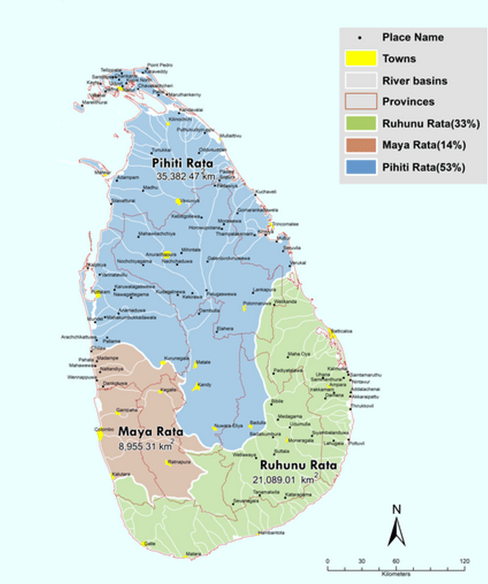
Reverting to Ruhunu, Maya and Pihiti as a Rational Scheme for Sustainable Regional Governance?

 C.M. Madduma Bandara**

Some Past Attempts: Since [securing] National Independence in 1948, there [have been] three Constitutions (including the present) that governed this Country. The First was the Soulbury (/Jennings) Constitution that lasted for less than 15 years, and then the Republican Constitution of 1972 during the regime of Prime Minister Sirimao Bandaranaike that had a similar life span until it was superseded by the present Constitution enacted during the early regime of President JR JayEwardena. The last one, despite numerous amendments from time to time, [has been in force for] nearly 40 years, despite the fact that it was referred to as “Bahubhhootha Vyawasthawa” (nonsensical or mad constitution) by President Chandrika Bandaranaike. However, the number of amendments effected over the years indicated that all was not well during its life span. It also perhaps reflects a general belief among the past politicians that the problem is with the dancing floor rather than with the dancer!.

Continue reading

3 Comments

Filed under accountability, ancient civilisations, communal relations, heritage, historical interpretation, Indian Ocean politics, landscape wondrous, politIcal discourse, power politics, security, self-reflexivity, Sinhala-Tamil Relations, sri lankan society, transport and communications, world events & processes

Snippets on the Fort of Galle … and Ashley’s Dire Warnings

A Question from one Sanjay Gunawardena, 12 February 2021:

“Thank you for this great article Dr Roberts.[i] Has anyone got a picture or a painting of the Old Windmill which has been in the Galle Fort. This has been mentioned E.F.C Ludowyk’s book Long Afternoons in Colonial Ceylon. If you can please share an image, it will be much appreciated. Thank you.

A Response from Hemantha Situge: “Lyn Ludo says the windmill was one of the five landmarks that crowned the Fort. It was erected during British times. I have seen two photographs which I have not copied.”[ii]

Continue reading

Leave a comment

Filed under accountability, ancient civilisations, architects & architecture, British colonialism, cultural transmission, education, ethnicity, governance, heritage, historical interpretation, island economy, landscape wondrous, legal issues, life stories, modernity & modernization, politIcal discourse, self-reflexivity, sri lankan society, taking the piss, tourism, travelogue, unusual people, welfare & philanthophy, world events & processes

Amity transcending Faiths and Nationalities: At Haputale and Canberra

Somasiri Skandakumar in Haputale

Rev Rahula, who once headed the Khemba Buddhist Vihara in Canberra during my tenure as High Commissioner, honoured me with a visit to  Haputale accompanied by his superior who  heads thirteen temples in various parts of the Island !

Continue reading

Leave a comment

Filed under accountability, Buddhism, charitable outreach, heritage, landscape wondrous, life stories, meditations, patriotism, pilgrimages, politIcal discourse, religiosity, self-reflexivity, sri lankan society, tolerance, travelogue, unusual people, welfare & philanthophy, world events & processes