
HEADLINES Everywhere
- “Players Exodus from the IPL” —The Australian, 27 April 2021
- “Million-dollar Aussies begin mad dash to safety as Indian exodus looms” –– 7newscom.au
- “Australia’s Tye tips IPL exodus from COVID-hit India” – Reuters in The Hindu

HEADLINES Everywhere

Item in https://sydneyanglicans.net/news/four-in-line-for-archbishops-election …. referred to Thuppahi by Leon Keegal of Adelaide
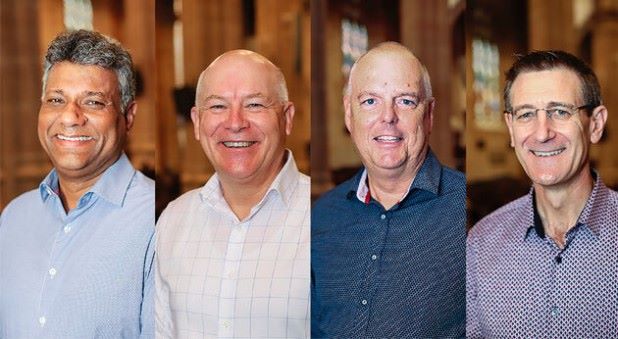
When nominations closed on Tuesday, March 23, three bishops and the Dean of Sydney, Kanishka Raffel, had been entered in the nomination process for the post of Archbishop of Sydney.The bishops are Chris Edwards, Peter Hayward and Michael Stead.
An Email Note from S. Skandakumar, 25 April 2021


Filed under Uncategorized
Steve Waterton, in The AUSTRALIAN, Special Magazine Edition, 31 March 2021

Stella Bowen, one of the few Australian women to be appointed an official war artist, began her preliminary pencil sketches for the painting on this magazine’s cover on April 27, 1944. Her subjects were the crew of a Lancaster bomber of 460 Squadron, six Australians and their English flight engineer. That night their raid took them over Friedrichshafen, an important German industrial centre; the next morning they were reported missing, presumed dead.
Gideon Haigh, in The Weekend Australian, 23/24 April 2021, where the title runs: “Forget About India’s Covid Chaos, There’s Cricket to be Played”
In the Indian city of Nashik on Wednesday, 22 COVID patients in a hospital ward perished when the oxygen tanker on which their ventilators depended sprung a leak. Perhaps you saw the footage — scores of workers running ineffectually in all directions through swirling clouds of vapour, representative of the chaos and futility enveloping India as its second, steepling pandemic wave bears down.


Tony Donaldson, with underlining emphasis inserted bt The Editor, Thuppahi
On 1 October 1949, the People’s Republic of China was proclaimed by Mao Zedong. Two months later, on 6 January 1950 the Ceylon government recognised Red China– one of the first countries to do so. Seven years later, in early 1957, the Premier of China, Zhou Enlai, made an historic five-day visit to the island, which paved the way for the establishing of diplomatic relations between Ceylon and China. Before exploring Zhou’s visit to Ceylon, it is worth diverting for a moment to briefly sketch the key events that led to his historic visit.
 Zhou Enlai in China relaxing at the Huairou Reservoir, Beijing, in August 1960 … Photo by Du Xiu Xian Continue reading
Filed under accountability, american imperialism, British imperialism, centre-periphery relations, China and Chinese influences, economic processes, governance, historical interpretation, Indian Ocean politics, island economy, landscape wondrous, life stories, modernity & modernization, patriotism, politIcal discourse, power politics, self-reflexivity, sri lankan society, transport and communications, truth as casualty of war, unusual people, world events & processes
Michael Roberts
An ABSTRACT of an article that appeared in print in Ethnos, 1989, vol 54: 1 & 2, pp. 69-82…. available online for payment to Taylor & Francis.
This essay decodes a sixteenth century folktale which records the Sinhalese reaction to the arrival of the first Portuguese. Where the historiography has interpreted this tale as benign wonderment in the face of exotica, a piecemeal deconstruction of the allegorical clues in the ‘story is utilised to reveal how the Sinhalese linked the Portuguese with demons and with Vasavarti Mārayā, the arch enemy of the Buddha. In this fashion the Portuguese and the Christian sacrament of communion were represented as dangerous, disordering forces.

Filed under accountability, ancient civilisations, cultural transmission, disparagement, economic processes, ethnicity, hatan kavi, heritage, historical interpretation, Indian Ocean politics, landscape wondrous, life stories, patriotism, politIcal discourse, Portuguese in Indian Ocean, power politics, security, self-reflexivity, sri lankan society, the imaginary and the real, travelogue, unusual people, war reportage, world events & processes
From Raja de Silva’S book Sigiriya — as excerpted in the Island, 18 April 2021, with the title “Dangerous and meticulous work copying Sigiriya frescoes in Bell era (1896)
The village of Sigiriya is mentioned in the 16th century book of Sinhala verse titled Mandarampura-puvata. From then on, the site seems to have disappeared from the public record until its rediscovery in the 19th century. Major Forbes of the 78th Highlanders and two companions rode from Polonnaruva through Minneriya and Peikkulam in search of Sigiriya, and reached the site early in the morning of a day in April 1831 (Forbes 1841).


Filed under american imperialism, architects & architecture, art & allure bewitching, British colonialism, heritage, historical interpretation, life stories, paintings, performance, photography, rehabilitation, self-reflexivity, sri lankan society, Tamil civilians, travelogue, unusual people, world events & processes
Chandra R. de Silva,* whose original title runs thus: “Portugal and Sri Lanka: Recent Trends in Historiography”[1] … an article that was originally published in Re-exploring the Links: History and Constructed Histories between Portugal and Sri Lanka, ed. Jorge Flores, Wiesbaden: Harrassowitz Verlag, 2007, pp. 3-26
In a recent article entitled ‘Theoretical Approaches to Sri Lankan History and the Early Portuguese period,’ Alan Strathern points out that although historical writing in Sri Lanka has become ‘the site of vibrant controversy’ due partly to the ethnic conflict, by and large, it has contributed little to wider debates on post-colonialism and the nature of historical thinking.’[2] I would agree with this broad proposition. What I intend to do in this paper is to extend my gaze beyond the sixteenth century to which Alan consciously limits himself and look critically at the extent to which historical writing in the past half century has enhanced our understanding of the complex connections between Portugal and Sri Lanka in the sixteenth and seventeenth centuries. However, … I will concentrate largely on the area of social interaction and leave the other areas — political, economic and cultural – for detailed consideration at a later time.

Filed under economic processes, hatan kavi, heritage, historical interpretation, Indian Ocean politics, insurrections, landscape wondrous, life stories, military strategy, patriotism, Portuguese imperialism, Portuguese in Indian Ocean, power politics, religiosity, revenue registers, sri lankan society, teaching profession, the imaginary and the real, transport and communications, unusual people, world events & processes
Thuppahi’s recent presentation of a striking photograph unearthed by Gerald Peiris which depicts world-famous dignitaries on their way to formally declare the University of Peradeniya open for the business of study and play has attracted pleasure as well as information on the hands that may have been at work on this design. The debate on the choice of site for a new University branch is a separate and complicated issue. The focus here is on the architectural and landscaping designs. As I indicated, Shirley De Alwis [also spelt D’Alwis?] was the principal architect (and we require bio-data on this man). But, what else can we gather? Here are some preliminary responses. The Editor, Thuppahi


Filed under architects & architecture, art & allure bewitching, British colonialism, centre-periphery relations, cultural transmission, education, education policy, governance, heritage, historical interpretation, landscape wondrous, life stories, performance, photography, politIcal discourse, self-reflexivity, sri lankan society, teaching profession, the imaginary and the real, travelogue, unusual people, welfare & philanthophy, world events & processes
 thuppahi