
Category Archives: social justice

Lionel Rose: Aboriginal Boxer who united Australia

Will Swanton, in The Weekend Australian, 3-4 July 2021, where the title runs “Lionel Rose: battler who united Australia” 

Lionel Rose unified the nation more powerfully than Bradman, if more briefly — Bradman never had 250,000 cheering him through the streets.

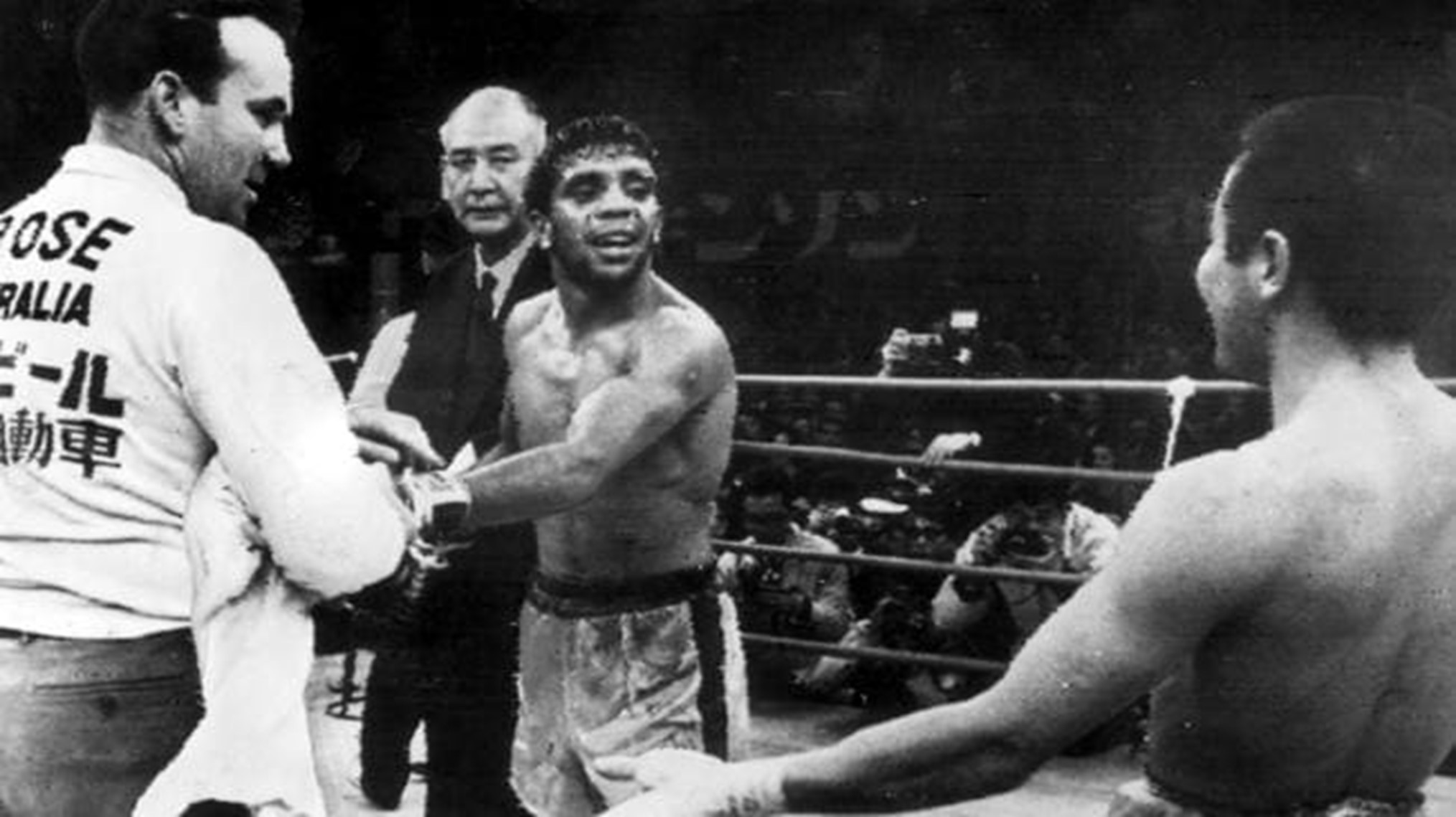
Lionel Rose turns to embrace Fighting Harada … after he is pronounced the winner 

Lionel Rose met Paul Keating. Snipped him for a hundred. The Prime Minister reckoned he never carried any cash. Rose persisted. Did him slowly. Come on, mate. Can’t you spare a lousy hundred for a battler? Larrikinism abounded in Australia’s sporting stars of the 1960s and 1970s. Rose, Dawn Fraser, John Newcombe, larger than-life characters. It was the 1990s by the time Rose hit Keating where it hurt. The hip-pocket. Mischievousness was alive and kicking in Rose, and part of the reason for the request, but he needed the dough, too.

Continue reading

2 Comments

Filed under accountability, art & allure bewitching, Australian culture, australian media, communal relations, cultural transmission, democratic measures, discrimination, economic processes, education, ethnicity, heritage, historical interpretation, landscape wondrous, life stories, patriotism, performance, politIcal discourse, self-reflexivity, social justice, the imaginary and the real, unusual people, world events & processes

Industrialization in Lanka!! Searing Comments on Athukorale’s Article

ONE: A NOTE from Mevan Pieris in Colombo, 1 July 2021[i]

The underlining in bold Black is HSM Pieris’s work; that in red has been imposed by the Editor, Thuppahi….. and so, too, any red underlining in Vinod Moonesinghe’s intervention. Both sets of Comments were sent by Email in response to my invitation to a cluster of personnel.

Thanks Michael. Read with interest Premachandra Atukorala’s paper…. [viz. https://thuppahis.com/2021/07/01/an-appraisal-of-sri-lankas-industrialization-strategy/#more-52644%5D

The platform JR Jayawardene Government laid starting in 1977 for an industrial revolution supported by availability of adequate hydroelectric power, was dashed on the ground by the LTTE war with Indian interference, which was beyond even for JRJ to manage in his second term of office. Thereafter the assassinations of strong political successors to JRJ too diluted the leadership of our country. An industrial revolution can only be sustained by a continuity of strong leadership; but with the assassination of Lalith Athulathmudali and Gamini Dissanayake we lost all of it. Leave alone policy making, not even the Central Bank could be protected. So why waste time trying to figure out what went wrong in industrial policy.

Continue reading

4 Comments

Filed under accountability, centre-periphery relations, economic processes, governance, historical interpretation, island economy, life stories, modernity & modernization, performance, power politics, self-reflexivity, social justice, sri lankan society, taking the piss, the imaginary and the real, truth as casualty of war, welfare & philanthophy, working class conditions, world events & processes

Ernest Macintyre’s SILINDU of BADDEGAMA

A play in five acts derived and adapted from LEONARD WOOLF’S novel THE VILLAGE IN THE JUNGLE.

 SILUNDU OF BADDEGAMA, by Ernest Macintyre, was first performed at the Erindale Theatre Canberra on 16 April 1994

Continue reading

6 Comments

Filed under accountability, art & allure bewitching, atrocities, British colonialism, centre-periphery relations, chauvinism, communal relations, discrimination, ethnicity, heritage, historical interpretation, landscape wondrous, life stories, literary achievements, meditations, performance, politIcal discourse, self-reflexivity, social justice, sri lankan society, the imaginary and the real, travelogue, unusual people, working class conditions

High Noon in Mid-Air, August 2019: For the Murugappans of Biloela

ABC Account on 30 August 2019, with this title “Who are the Tamil family from Biloela and why are they being deported?” ……  https://www.abc.net.au/news/2019-08-30/who-are-tamil-family-from-biloela-why-are-they-being-deported/11463276

Last-minute injunctions have stalled the deportation of a Tamil family who have spent years fighting to stay in Australia. The plane carrying the Sri Lankan couple and their Australian-born daughters had already left the tarmac at Melbourne Airport when a judge granted a reprieve over the phone. Here’s what we know about the family’s case:

Dozens of people rushed to Melbourne Airport in a bid to stop the family being deported on Thursday night..   … Supplied: @HometoBilo)

Continue reading

Leave a comment

Filed under accountability, asylum-seekers, Australian culture, australian media, centre-periphery relations, charitable outreach, communal relations, democratic measures, discrimination, disparagement, economic processes, ethnicity, governance, historical interpretation, human rights, immigration, landscape wondrous, legal issues, life stories, meditations, performance, political demonstrations, politIcal discourse, security, self-reflexivity, Sinhala-Tamil Relations, slanted reportage, social justice, sri lankan society, taking the piss, Tamil civilians, Tamil migration, tamil refugees, tolerance, transport and communications, trauma, travelogue, truth as casualty of war, unusual people, welfare & philanthophy, women in ethnic conflcits, world events & processes

Dujuan’s History Lesson for Non-Aboriginal Australians All

Vibeke Venema of BBC News, 6 May 2021, where the title reads “The ‘smart and cheeky’ Aboriginal boy teaching Australia a lesson”

A documentary about a 10-year-old Aboriginal boy’s experience in school, In My Blood It Runs, has reignited a debate about Australia’s failure to give indigenous children a good education and a fair start in life.

Continue reading

2 Comments

Filed under accountability, atrocities, Australian culture, australian media, British imperialism, centre-periphery relations, chauvinism, cultural transmission, discrimination, disparagement, economic processes, education, education policy, governance, heritage, historical interpretation, landscape wondrous, language policies, life stories, modernity & modernization, politIcal discourse, power politics, racist thinking, religiosity, self-reflexivity, social justice, taking the piss, teaching profession, trauma, unusual people, welfare & philanthophy, working class conditions, world events & processes

Sustaining Memory as a Central Facet of Transitional Justice

Gehan Gunatilleke: “The Right to Memory: The Forgotten Facet of Transitional Justice* with highlighting emphasis imposed by The Editor, Thuppahi

The struggle of man against power is the struggle of memory against forgetting — Milan  Kundera, The Book of Laughter and Forgetting (1979)

Introduction

Memory does not explicitly feature among the four pillars of transitional justice: truth, justice, reparations and guarantees of non-recurrence. Hence the precise role memory plays within a transitional justice process is often left to those negotiating the contours of the process. Memory is a vital ingredient in ascertaining the truth and in securing evidence to ensure justice for victims and survivors. Moreover, memorialisation of loss has a place in the symbolic initiatives owed to victims and survivors under the reparations pillar. Meanwhile, public memorials commemorating man-made tragedies contribute towards a society’s collective commitment to non-recurrence. Thus memory often becomes the lifeblood that preserves and binds the traditional pillars of transitional justice.

Continue reading

Leave a comment

Filed under accountability, atrocities, centre-periphery relations, cultural transmission, democratic measures, education, European history, heritage, historical interpretation, landscape wondrous, life stories, meditations, nationalism, patriotism, politIcal discourse, power politics, Rajapaksa regime, security, self-reflexivity, Sinhala-Tamil Relations, slanted reportage, social justice, sri lankan society, Tamil civilians, Tamil Tiger fighters, the imaginary and the real, trauma, truth as casualty of war, UN reports, unusual people, war crimes, war reportage, welfare & philanthophy, world events & processes

Randolph Ranjith Alwis of Sri Lanka & Adelaide: Epitaphs in Depth

ONE: from Victor Rebikoff OAM, and Former FECCA Chair 1992-96

I am deeply honored to have been asked by the Alwis family to provide this personal eulogy on my close friend Randolph Alwis AM whom I have known for over 35 years since we became the Presidents of our respective State and Territory Multicultural Communities Councils in the early 1980’s and as a consequence Deputy Chairs of Australia’s peak community body FECCA – viz, -the Federation of Ethnic Communities Councils of Australia. At that time both of us were the ‘young guns’ at the forefront of Australia’s multicultural movement and became closely involved in working with Commonwealth, State and Territory governments in the initial introduction of culturally and linguistically appropriate services for migrants and refugees Australia wide.

Continue reading

Leave a comment

Filed under accountability, architects & architecture, charitable outreach, communal relations, cultural transmission, democratic measures, education, ethnicity, governance, heritage, language policies, life stories, performance, politIcal discourse, reconciliation, self-reflexivity, social justice, sri lankan society, tolerance, truth as casualty of war, unusual people, world events & processes

Addressing Diversity. Six Sri Lankan Scholars in ICES Webinair Lecture Series

A WEBINAR SERIES,  18 November to 9 December 2020
These six webinars explored the challenges that we face in learning about and engagingwith the past in multi-religious, multi-ethnic contexts. This webinar series was presented in collaboration with the Rosa Luxembourg Stiftung…….
…. Herstory-History-Ourstory  ….. Click here to watch all the webinars, or on each topic to watch the individual webinars.

Continue reading

Leave a comment

Filed under ancient civilisations, centre-periphery relations, charitable outreach, communal relations, cultural transmission, democratic measures, economic processes, education, ethnicity, fundamentalism, governance, historical interpretation, Indian Ocean politics, language policies, Left politics, legal issues, life stories, religiosity, security, self-reflexivity, Sinhala-Tamil Relations, social justice, sri lankan society, teaching profession, the imaginary and the real, truth as casualty of war, unusual people, vengeance, world events & processes

Remembrance: Marking 21/4 Jihadist Zealotry in Sri Lanka

Pictures by Raymond Aponsu and Sulochana Gamage

Churches observed Black Sunday yesterday in protest over the terror attacks on 2019 Easter Sunday, calling on the government to deliver justice by prosecuting those responsible for the attacks. Protestors led by the two Colombo Auxiliary Bishops Rt.Rev. Anthony Jayakody and Rt.Rev.Maxwell Silva held placards pleading for justice in Negombo in front of the Katuwapitiya Church which was bombed on April 20, 2019 while others led by Malcolm Cardinal Ranjith gathered in front of the Kochchikade St. Anthony’s Church yesterday.

Continue reading

Leave a comment

Filed under accountability, atrocities, cultural transmission, discrimination, ethnicity, heritage, historical interpretation, Islamic fundamentalism, jihad, life stories, Middle Eastern Politics, photography, politIcal discourse, power politics, religiosity, self-reflexivity, social justice, sri lankan society, suicide bombing, trauma, violence of language, world events & processes, zealotry

Lord Naseby targets Adele Balasingham …. and Lord Tariq Ahmad

Lord Michael Naseby, in Island, 5 March 2021, where the title is “Lord Naseby asks why Adele not prosecuted in UK for child recruitment”

Lord Naseby President of the UK all party British-Sri Lanka Parliamentary group, has questioned the failure on the part of the UK to prosecute senior LTTE leader Adela Balasingham, wife of the outfit’s late theoretician Anton Balasingham. Lord Naseby said that Adele, who had been involved with the LTTE for several decades, was responsible for recruitment and deployment of child soldiers.

Continue reading

Leave a comment

Filed under accountability, atrocities, centre-periphery relations, discrimination, Eelam, historical interpretation, legal issues, life stories, LTTE, military strategy, politIcal discourse, prabhakaran, self-reflexivity, Sinhala-Tamil Relations, social justice, sri lankan society, Tamil Tiger fighters, war crimes, women in ethnic conflcits