Category Archives: reconciliation

Incorrigible Watch-Dogs of the Human Rights World

Michael Roberts, an original article drafted initially on 16 October 2011… and thereby hangs a tale**

On the 30th September 2011 a grandiose function at the presidential residence in Colombo displayed to the world one step in the Sri Lankan government’s programme towards the rehabilitation of former LTTE personnel captured and/or arrested during the last stages of Eelam War IV and its immediate aftermath. On this occasion 1800 were released in the presence of foreign dignitaries, while some ambassadors handed out certificates to some “rehabilitees’ as the government calls them.

Kathy Klugman, the High Commissioner for Australia, was among those who presented certificates documenting skills training in such fields as carpentry and agriculture. As reported in major Australian newspapers Klugman was promptly hauled over the coals by John Dowd on behalf of the International Commission of Jurists in Australia (ICJ). He disparaged the programme as one of “re-education not rehabilitation;” and insisted that “Australia[should not lend] legitimacy to a regime that refuses to allow an investigation of alleged war crimes during the country’s vicious civil war.” Continue reading

3 Comments

Filed under accountability, atrocities, discrimination, Eelam, historical interpretation, IDP camps, life stories, LTTE, power politics, power sharing, reconciliation, rehabilitation, Sinhala-Tamil Relations, Tamil civilians, Tamil Tiger fighters, truth as casualty of war, war crimes, world events & processes

Sisira Jayasuriya on “The Lionel Bopage Story”

This is a book that documents the life story of Lionel Bopage, who was one of the highest ranking leaders of the Janatha Vimukthi Peramuna (JVP- the Peoples’ Liberation Front) and a major figure in the JVP led youth insurrection of 1971 in Sri Lanka, drawing on a series of personal interviews with him. After migrating to Australia two decades ago, he has remained active not only in Sri Lanka related political activities but in the broader Australian political movements for social justice. The book tracks Lionel’s personal and political evolution over the subsequent four decades, placed in the wider socio-political context of this tumultuous period in Sri Lanka…….

SEE http://groundviews.org/2011/11/28/rebellion-repression-and-the-struggle-for-justice-in-sri-lanka-the-lionel-bopage-story/

Leave a comment

Filed under historical interpretation, Left politics, life stories, LTTE, politIcal discourse, power sharing, Rajapaksa regime, reconciliation, Sinhala-Tamil Relations, truth as casualty of war, working class conditions, world events & processes

The Rajapaksa Government and the Tamil Diaspora: will the twain ever reconcile?

Rajan Philips, courtesy of the Sunday Island, 27 November 2011

On Nov. 13 I wrote about the intersecting trajectories of the Commonwealth and Sri Lanka. The Tamil Diaspora is entangled with both. Although the Diaspora is of recent origin, the Sri Lankan Tamil problem is as old as Sri Lanka’s independence and its association with the post-colonial Commonwealth. Early days, as I said last week, were halcyon days. The Tamil problem seemed permanently settled, at least going by the results of the 1952 election, when the UNP and the Tamil Congress, both part of the incumbent government, won spectacularly in their respective domains.

“The UNP is good enough for the country for twenty five years and that is good enough for me,” G.G. Ponnambalam had earlier told Colvin R. de Silva. “Many a plan of men and mice go astray”, rued Colvin and he would be proved right, not for the last time! Colvin’s more ominous prophesy came later: Two languages, one country; one language, two countries. Again, he was not heeded and again he was proved right. Continue reading

Leave a comment

Filed under democratic measures, historical interpretation, power politics, power sharing, racist thinking, Rajapaksa regime, reconciliation, Sinhala-Tamil Relations, sri lankan society, tolerance

A lopsided conference on RECONCILIATION fails to address tasks not accomplished

Ranga Jayasuriya, courtesy of Lakbima News, 27 November 2011

The inaugural conference on national reconciliation held last week at the Lakshman Kadirgamar Institute of International Relations and Strategic Studies was pretty much a feel good affair. Precious little was spoken of political reforms or political engagement with Tamil political parties, and a question about ‘uncovering and acknowledging’ the past was responded to with an assurance that a list of civilian deaths that occurred during the conflict is forthcoming. Perhaps, too little, too late. The conference was expected to showcase the government’s achievements in post conflict transformation. But, it was a reference which was relegated to the latter end of the keynote address of defence secretary Gotabaya Rajapaksa that caught the attention of the media. He said that the government was preparing a list of people who died during the conflict. “The approach the government took in this regard was a very professional one. The Department of Census and Statistics, which is the official government arm for these matters, conducted a complete census of the concerned area,” Rajapaksa said. Continue reading

1 Comment

Filed under accountability, discrimination, historical interpretation, LTTE, military strategy, politIcal discourse, power politics, power sharing, Rajapaksa regime, reconciliation, rehabilitation, Sinhala-Tamil Relations, sri lankan society, Tamil civilians, truth as casualty of war, world events & processes

Sheridan on skewed perspectives that ignore LTTE threat then and now

Greg Sheridan, courtesy of the Australian Weekend, 5-6 November 2011, under a different title

THE criticism of Sri Lanka’s President Mahinda Rajapaksa, when he visited Australia for the Commonwealth Heads of Government Meeting in Perth, left the key Sri Lankan villain out of the story. The criticism was that the Sri Lankan government engaged in serious human rights abuses, shelling areas where civilians were present, at the end of its civil war with the Liberation Tigers of Tamil Eelam, in May last year. Both sides committed atrocities in this war, but the defeat of the Tamil Tigers was a decisive defeat of perhaps the bloodiest and most murderous terrorist group the world has seen. Alexander Downer, Australia’s foreign minister for 11 years of the war, tells me: “I know the Sri Lankan government played very hard ball and committed some human rights abuses, but it’s a wonderful thing the Sri Lankan government won that war. I have always regarded the Tamil Tigers as absolutely a terrorist organisation.”

It is easy to forget how bloody the Tamil Tigers were. In their 2 1/2-decade campaign, perhaps 70,000 people died. The Tamil Tigers pioneered the suicide bomber, conducting hundreds of such attacks and using a woman with a suicide vest to murder India’s prime minister Rajiv Gandhi in 1991. They also murdered a Sri Lankan president. Rohan Gunaratna, an authority on terrorism based in Singapore, tells me the Tamil Tigers also pioneered suicide attacks at sea. The sinking of the USS Cole was an imitation of a Tiger operation.

 Garlanding with the suicide vial at passing out ceremony for Tiger fighters– from BBC documentary 1991 in web editor’s possession courtesy of Chris Morris

The Tigers were authoritarian under the leadership of Vellupillai Prabakaran. They murdered Tamil and Sinhalese civilians, within the areas they controlled and within Sri Lanka generally. They used civilians as human shields, engaged in forced recruitment, routinely bombed civilian targets, used child soldiers and refused to let civilians leave the combat zone. They also engaged in sectarian attacks against Muslims.

Continue reading

Leave a comment

Filed under accountability, asylum-seekers, australian media, authoritarian regimes, fundamentalism, historical interpretation, LTTE, politIcal discourse, reconciliation, Sinhala-Tamil Relations, tamil refugees, Tamil Tiger fighters, terrorism, world events & processes

Turning Tiger Personnel into Lankan Citizens?

 Michael Roberts, courtesy of Groundviewswhere it was presented on  28 October 2011, and where some blog comments will be found 

Whatever the death toll during the last stages of Eelam War IV in 2009 the official government data in that year acknowledged that 11,696 (9078 male and 2024 female)[1] of those who survived had identified themselves or been identified as members of the LTTE — whether combatants or active functionaries. There were others who had been arrested elsewhere in the island (that is beyond the battlefields), often on flimsy evidence, in the years 2006-09. Muralidhar Reddy stresses that “once bracketed in the category of a combatant, irrespective of the degree of their involvement in the war, there was no mechanism for those detained to prove their innocence.”[2]

 Distribution of Certificates-30 Oct 2011–Pic by BCGR

In parenthesis let me add that grapevine information from Tamil sources indicate that in April-May 2009 quite a few Tigers seem to have successfully merged themselves with the population that was deemed civilian and placed in the IDP camps in Menik Farm and elsewhere. Several commentators with some familiarity with the IDP camps have indicated that these detention centres were like the proverbial colander and that a significant number – estimates vary widely from 1,000 to 10,000 — slipped out of the IDP camps in mid-2009 and found their way abroad. It is alleged that at least 500 of this lot were “hardcore LTTE.”[3] Continue reading

8 Comments

Filed under citizen journalism, IDP camps, liberation tigers of tamil eelam, life stories, Rajapaksa regime, reconciliation, rehabilitation, Sinhala-Tamil Relations, Tamil civilians, Tamil Tiger fighters, welfare & philanthophy

Sheridan challenges Jegan Waran’s attempt to universalise rights and McClelland trumps it

ONE: Universalizing rights does no justice” by Greg Sheridan, in The Australian, 26 Otober 2011.

 THE trend for private citizens in Western nations to launch prosecutions against international government figures for alleged human rights abuses or war crimes is a bad trend. It does not serve the cause of justice and it militates against effective international relations, on which peace, stability and prosperity ultimately depend. There is little doubt that both sides in the Sri Lankan civil war committed atrocities at different times. This is not remotely a matter on which Australian courts can or should adjudicate. Nor should it remotely be up to private citizens to initiate such prosecutions.

The charges brought against Sri Lankan President Mahinda Rajapaksa by an Australian citizen who was formerly a Sri Lankan would have failed, even had Attorney-General Robert McClelland not quashed them yesterday. This is because Australian law has not yet reached the absurdist stages of European law.

However, the increasing role of loosely worded UN conventions in Australian law, as in the recent High Court decision outlawing the Gillard government’s proposed Malaysian people swap, suggests our law is heading broadly in that direction. It is a direction the Liberals under Tony Abbott have foolishly reinforced, both by their refusal to pass government legislation overcoming the High Court’s ruling, and by their attempt to include the UN refugee convention as an element of Australian law. This is an extremely bad trend that is anti-democratic, by usurping the normal role of parliament, and does not serve justice. Continue reading

14 Comments

Filed under accountability, power politics, Rajapaksa regime, reconciliation, Sinhala-Tamil Relations, Tamil civilians, UN reports, war crimes, world events & processes

Being Tamil in Colombo, 1992: false testimony & the travails of Reggie David and family

Ben Bavinck’s Diary Entries — This is the third in the series. It differs from the other thematic entries in being one single episode retailed serially. Serendipitously, it fits in with one of the cultural traits highlighted by Pradeep Jeganathan and provides a wake-up call to those well-meaning individuals (especially foreigners) who think that judicial trials draw forth “truth” like some magic wand. Where accusation is based on  fabrication or non-truth because of petty jealousies or deeper machinations, then judicial action is likely to deepen bitterness and generate feud. Web Editor.

14th April 1992, Colombo: Today I heard from a friend that Reggie David, a Tamil girl from Jaffna well-known to both of us, suddenly had been arrested in Colombo together with her whole family. We went to see them at the police station together with two other friends. We were able to help them with some of their practical problems and also encourage them. It seemed that the police was treating them reasonably well. We hoped they would be released in a day or two. Continue reading

2 Comments

Filed under accountability, communal relations, reconciliation, Sinhala-Tamil Relations, sri lankan society, Tamil civilians, truth as casualty of war

Incorrigible Watch-Dogs of the Human Rights World

Michael Roberts, an original article, 24 October 2011**

On the 30th September 2011 a grandiose function at the presidential residence in Colombo displayed to the world one step in the Sri Lankan

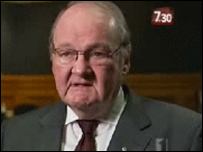
John Dowd

government’s programme towards the rehabilitation of former LTTE personnel captured and/or arrested during the last stages of Eelam War IV and its immediate aftermath. On this occasion 1800 were released in the presence of foreign dignitaries, while some ambassadors handed out certificates to some “rehabilitees’ as the government calls them.

 Kathy Klugman presents certificates — Pic from BCGR site

Kathy Klugman, the High Commissioner for Australia, was among those who presented certificates documenting skills training in such fields as carpentry and agriculture. As reported in major Australian newspapers Klugman was promptly hauled over the coals by John Dowd on behalf of the International Commission of Jurists in Australia (ICJ). He disparaged the programme as one of “re-education not rehabilitation;” and insisted that “Australia[should not lend] legitimacy to a regime that refuses to allow an investigation of alleged war crimes during the country’s vicious civil war.”

   The ICJ, Amnesty International and Human Rights Watch, are among the agencies in the West that can be depicted as “watch dog organizations” devoted to civil liberties. In recent years virtually all these agencies have blacklistedSri Lankaas an incorrigible offender of the same order asBurma. They are fixated on the ethical path of truth and justice withinSri Lanka. This lobby draws some of its information from a Tamil nationalist network that is motivated by vengeance (a motivational force with a potential for dubious ethics). Continue reading

3 Comments

Filed under accountability, australian media, citizen journalism, disparagement, life stories, LTTE, politIcal discourse, Rajapaksa regime, reconciliation, rehabilitation, Sinhala-Tamil Relations, Tamil civilians, truth as casualty of war, welfare & philanthophy

A bilateral approach to reconciliation

Somapala Gunadheera, in The Island, 19 October 2011

I had despaired of writing on national reconciliation due to lethargy, prevarication and lack of vision on the part of protagonists of the ethnic conflict. But I could not help reverting to the subject after reading the following articles published in the Island over the last few days, two of them on the same day.

1.   If 13th Amendment is implemented: Subliminal proclivities of communal exclusivity bound to find undisguised expression, Demos, October 11,

2.   Land reforms in the North and East of Sri Lanka, Sebastian Rasalingam of Toronto, Canada (October 14)

3.   Could the TNA learn from the Catholics? Arjuna Hulugalle, (Oct. 1). Continue reading

Leave a comment

Filed under accountability, authoritarian regimes, communal relations, discrimination, power sharing, Rajapaksa regime, reconciliation, Sinhala-Tamil Relations, tolerance