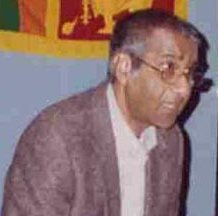
Chandra R. de Silva: “Report on Amarnath Amarasingam’s Pain, Pride and Politics: Sri Lankan Tamil Activism in Canada“ — being a Reader’s Confidential Review of a Book Mss sent in response toa request from the publishers …. a book that has since appeared in print as under the imprint of the University of Georgia Press (2015)
Category Archives: press freedom
CR de Silva’s Appraisal & Report on Amarasingam’s Study of Tamil Activists in Canada
Filed under accountability, asylum-seekers, atrocities, authoritarian regimes, centre-periphery relations, communal relations, cultural transmission, discrimination, disparagement, education, Eelam, ethnicity, foreign policy, heritage, historical interpretation, human rights, Indian Ocean politics, legal issues, life stories, LTTE, nationalism, patriotism, politIcal discourse, power politics, prabhakaran, press freedom, propaganda, Rajapaksa regime, refugees, self-reflexivity, Sinhala-Tamil Relations, slanted reportage, sri lankan society, Tamil migration, tamil refugees, terrorism, the imaginary and the real, truth as casualty of war, unusual people, vengeance, war reportage, world events & processes
Cricketing Assassins of the CRICKET AGE
Michael Roberts
I receive news items from the web-site CRICKET AGE on a pop-up basis and am therefore a witness to their propensity towards muckraking. This has been a consistent dimension of their reportage and commentary – to the point where one can suspect that it is a policy that goes beyond commonplace news sensationalism.
Share this:
Celebrating Anne Abayasekara’s Mighty Pen and Lifetime
Uvin Dassanayake in Daily News, 14 February 2019, where the title is “The pen PROVED MIGHTY INDEED!”
On Saturday February 9, Cinnamon Gardens Baptist Church was host to a celebration of the work of the late Anne Abayasekara, Sri Lanka’s first woman to become a staff journalist and a much beloved writer over her career of nearly 70 years. The evening proceeded with each of her seven children speaking about their mother, recounting fond memories of the sounds of her typewriter in the family home and sharing poetry she had written for her grandchildren; all to an audience of family, friends and people who had been, in some way, affected by Abayasekara’s work.
![]() |
| Anne with her husband Earle |
Share this:
Filed under art & allure bewitching, cultural transmission, democratic measures, education, female empowerment, heritage, historical interpretation, life stories, literary achievements, meditations, patriotism, politIcal discourse, press freedom, religiosity, self-reflexivity, sri lankan society, tolerance, unusual people, world affairs
In Memory of Richard de Zoysa
Anurang Singh, in Sunday Observer, 17 February 2019, where the title is Remembering Richard, a multifaceted personality””
At three in the morning on February 18 1990, Arjuna Ranawana, a news producer for Rupavahini woke up to a call at his residence. Wondering as to who it could be, he answered the phone to hear Kenneth Honter’s voice at the other end. “What is Richard’s address,” he asked and Ranawana said that he didn’t in fact know of an address but gave directions. The line was then disconnected. Ranawana was baffled as to what was going on when he got a second call just 10 minutes later.It was Honter agian. Explaining what had happened Honter told Ranawana that the police had come to his residence asking for Richard’s address and to warn Richard immediately of it. Continue reading →
Share this:
Filed under accountability, atrocities, authoritarian regimes, democratic measures, governance, historical interpretation, human rights, landscape wondrous, legal issues, life stories, meditations, politIcal discourse, power politics, press freedom, security, self-reflexivity, sri lankan society, unusual people, vengeance
The Political Struggle in Sri Lanka: Three Pugilists … Hattotuwa … Chandraprema … Philips
ONE. Sanjana Hattotuwa: “Musical Chairs,” Island, 12 January 2019
The appointment of a new Army Chief of Staff. A fresh denial around the use of chemical weapons. The denunciation of a civil society protest against mainstream media supportive of the constitutional coup, not by members of the SLPP, but by those in the UNP and government. A photograph of a former President, the incumbent and the Prime Minister, comfortably seated next to each other, enjoying or at least at a musical show. Newspaper headlines and reports framing dire warnings by the former President, who true to form, relies on the capture of emotions over fact or principle. In just the second week of January, we are presented with the template for what the year ahead holds. It is not looking good, but despite the obvious anxiety, I continue to maintain, is counter-intuitively rather beneficial. The greatest contribution of the constitutional coup to conversations around the grasp of Sri Lanka’s democratic potential was to place in the open and very clearly, who stood for what and where. This endures.
Share this:
Filed under accountability, american imperialism, authoritarian regimes, conspiracies, constitutional amendments, cultural transmission, democratic measures, disparagement, foreign policy, governance, historical interpretation, Indian Ocean politics, legal issues, life stories, military strategy, modernity & modernization, patriotism, politIcal discourse, power politics, Presidential elections, press freedom, Rajapaksa regime, self-reflexivity, Sinhala-Tamil Relations, slanted reportage, sri lankan society, truth as casualty of war, unusual people, war reportage, world events & processes
Kussi-Amma Sara and Citizen Silva in the Present Political Situation: Arun confronts Chandre
Arun Dias Bandaranaike … being an Email Memorandum to Michael Roberts.,19 December 2o18 in response to a Comment in Thuppahi from Chandre Dharmawardena …. presented here with highlighting imposed **
Dear Michael, thank you very much for sharing the reply or response from Prof. Chandre Dharmarwardana, which apparently is a quickly drafted return, and does not betray the same careful thought and penmanship as was discernible in the prose composed by Sam. He does however include some salient points for consideration, and directs a question that has some validity viz. “What is your yardstick?”
Share this:
Sharmini’s Appeal: Stand Up for Democracy on December 6th
Sharmini Serasinghe
My dear fellow Sri Lankans, please share this post as widely as possible for the sake of Democracy in our Sri Lanka
An appeal from me to all my fellow Sri Lankans who wish to see Democracy restored in our country…… On 6th December, 2018 at 3.30 pm, many of us apolitical journalists, writers, artistes including musicians, film stars and other’s in diverse professions are gathering at the Open Air Theatre at the Viharamahadevi Park to “Stand Up for Democracy” in peace. I appeal to all my countrymen and women to join us in our mission.
Continue reading →
Share this:
Lessons from Lord Naseby and Sangakkara on the Tales of War highlighted by Ferdinando
Shamindra Ferdinando, Island, 20 November 2018, commenting on the BRISLA AWARDS
Lord Naseby (Michael Wolfgang Laurence Morris) on Oct 13, 2018, received the BRISLA (British Sri Lanka Association) award for being an Outstanding Friend to the British-Sri Lankan community from British High Commissioner to Sri Lanka and Ambassador to Maldives, James Dauris. Non-profit organization BRISLA recognizes achievements and contributions made in the spheres of Healthcare, Literary Arts, Performing Arts and Entrepreneurship.
The Grow Traffic Limited sponsored the award at the fourth edition of the BRISLA awards, at the Long Room, Lord’s Cricket Ground. The inaugural BRISLA awards ceremony was held on Nov 15, 2015 at Grange St Paul’s Hotel in London. Sri Lanka cricket great Kumar Sangakkara was also among those honoured at the inaugural event. The Sirisena-Wickremesinghe government was represented at the recently concluded event by Sugeeshwara Gunaratna, the Acting Sri Lankan High Commissioner in the UK.
Share this:
Filed under accountability, american imperialism, governance, historical interpretation, landscape wondrous, life stories, LTTE, military strategy, patriotism, politIcal discourse, power politics, press freedom, security, self-reflexivity, Sinhala-Tamil Relations, sri lankan society, the imaginary and the real, truth as casualty of war, UN reports, unusual people, vengeance, war reportage, world events & processes
Fake News from the BBC
Nupur J. Sharma, in Independent, 15 November 2018 where the title is “The BBC research on ‘fake news’ is shoddy, unethical, dishonest, and actually an example of fake news”
The British Broadcasting Corporation (BBC) has published a report [pdf] that talks about the fake news industry in India. In their report titled “Beyond Fake News”, BBC has reached certain outlandish conclusions like ‘Nationalism is driving the spread of fake news” based on dubious data, incorrect interpretations, bias sample selection and selective information. It was almost as if BBC decided the conclusion of their research and then reverse worked their data to suit their conclusion.
Share this:
Filed under accountability, centre-periphery relations, governance, Indian Ocean politics, landscape wondrous, Left politics, legal issues, life stories, modernity & modernization, news fabrication, politIcal discourse, press freedom, self-reflexivity, slanted reportage, the imaginary and the real, truth as casualty of war, world events & processes
Illegal! Sirisena’s Coup Indefensible insists Welikala
Asanga Welikala, in Groundviews, 1 November 2018, where the title reads “Nailing Canards: Why President Sirisena’s Actions Remain Illegal, Unconstitutional, And Illegitimate””
There have been intense public debates over the meaning and interpretation of the Constitution, and especially the far-reaching changes introduced by the Nineteenth Amendment in 2015, since the dramatic and ongoing attempt at an unconstitutional transfer power that began on the evening of Friday 26th October. Unfortunately, the discussion has been clouded by the attempts of those who are trying to uphold the approach taken by Maithripala Sirisena and Mahinda Rajapaksa, to present arguments that are – at best – simply wrong, without any valid legal basis, or based on a lack of understanding of the Constitution – or at worst – motivated by a deliberate desire to lie, dissimulate, distort, and misinform the public.
Share this:
Filed under accountability, authoritarian regimes, constitutional amendments, disparagement, electoral structures, governance, heritage, historical interpretation, Indian Ocean politics, landscape wondrous, legal issues, life stories, patriotism, politIcal discourse, power politics, Presidential elections, press freedom, Rajapaksa regime, security, self-reflexivity, sri lankan society, the imaginary and the real, trauma, truth as casualty of war, unusual people, vengeance, world events & processes