Category Archives: political demonstrations

THE CEYLON JOURNAL is launched: Seeking to Elucidate the Past & the Present

The Ceylon Journal is finally out

On August 2, 2024, the inaugural volume of The Ceylon Journal was launched at the Sri Lanka Medical Association Auditorium. This new publication by Heritage Publications is spearheaded by young historian Avishka Mario Senewiratne, features 15 articles exploring various facets of Sri Lankan history, including politics, architecture, folklore, and more. Inspired by Charles Ambrose Lorenz’s Young Ceylon, the journal aims to deepen understanding of Sri Lanka’s heritage and inspire progress.


Continue reading

5 Comments

Filed under accountability, art & allure bewitching, cultural transmission, democratic measures, economic processes, education, ethnicity, heritage, historical interpretation, human rights, language policies, Left politics, legal issues, life stories, literary achievements, modernity & modernization, nationalism, parliamentary elections, patriotism, pilgrimages, plantations, plural society, political demonstrations, politIcal discourse, power politics, press freedom & censorship, reconciliation, refugees, religiosity, self-reflexivity, social justice, Sri Lankan cricket, Sri Lankan scoiety, Tamil migration, tamil refugees, teaching profession, theatre world, tourism, transport and communications, welfare & philanthophy

USA kow-tows to Natanyahu: ‘Ehemai Hamu’ on the World Stage

John Whitbeck in COUNTERPUNCH where the title reads “American Obeisance” … & the highlighting emphasis is the work of The Editor, Thuppahi

 I have just witnessed the most pathetic and humiliating hour which I, as an American, have experienced in my lifetime.

Netanyahu sketches vague outline for post-war Gaza _ Reuters

Continue reading

1 Comment

Filed under accountability, american imperialism, atrocities, centre-periphery relations, disparagement, ethnicity, Fascism, fundamentalism, historical interpretation, human rights, landscape wondrous, life stories, performance, political demonstrations, politIcal discourse, power politics, self-reflexivity, taking the piss, truth as casualty of war, world events & processes, zealotry

Michael Roberts Mss stored at Adelaide University

Michael Roberts

The library at Adelaide Univeristy is known as the BARR-SMITH LIBRARY.  The staff in the “Special Collections” within the library over the years have been especially helpful over a long period and were hands-on central in organising the Roberts Oral History Project from the 1980s and subsequently (see https://www.adelaide.edu.au/library/special/mss/roberts/).

But it is by pure chance that I came across a document penned in my hand detailing the stock of manuscripts and photocopied material that I had placed within the Special Collections –maybe because our home is adjacent to a National Park and within a high fire-risk arena.

Let me assure all ye readers that I have been stunned by some of the items that I have collected –some of them original Mss items; with the others being copies. but the main point is that some of these copies reproduce very rare items.  Moreover, I find that the range and type of items placed within the realm of the Barr-Smith are quite astonishing. It remains to be seen whether readers and investigators of the past accept that evaluation. I should add that I will be among the personnel delving into some of the data within this stock; but I do not have long to live…..and this stock is there for posterity.

Continue reading

Leave a comment

Filed under accountability, British colonialism, Buddhism, Colombo and Its Spaces, colonisation schemes, commoditification, communal relations, cultural transmission, Dutch colonialism, economic processes, Eelam, electoral structures, Empire loyalism, ethnicity, fundamentalism, governance, growth pole, historical interpretation, Indian Ocean politics, insurrections, irrigation, island economy, land policies, language policies, Left politics, life stories, modernity & modernization, Muslims in Lanka, nationalism, parliamentary elections, patriotism, plantations, plural society, political demonstrations, politIcal discourse, population, power politics, prabhakaran, Sinhala-Tamil Relations, Sri Lankan cricket, sri lankan society, Tamil civilians, transport and communications, vengeance, world events & processes, zealotry

Appreciating Kumari Jayawardena’s Scholarship

Uditha Devapriya … in The Island, 28 June 2024, where the title reads:  “A Tribute to Kumari Jayawardena” … while the presentation here includes highlights imposed by The Editor

Last month the Collective for Historical Dialogue & Memory (CHDM) organised a screening of Conversations with Kumari, a documentary on Kumari Jayawardena. Last week Jayawardena turned 93. Yesterday I reflected on her and the generation she represented. That generation is leaving us, but it remains as influential as ever.


Continue reading

1 Comment

Filed under anti-racism, art & allure bewitching, British colonialism, caste issues, centre-periphery relations, commoditification, communal relations, democratic measures, discrimination, economic processes, ethnicity, governance, historical interpretation, Indian Ocean politics, Indian traditions, island economy, landscape wondrous, language policies, Left politics, life stories, modernity & modernization, nationalism, parliamentary elections, plural society, political demonstrations, politIcal discourse, racist thinking, religious nationalism, self-reflexivity, Sinhala-Tamil Relations, social justice, Sri Lankan scoiety, unusual people, welfare & philanthophy, working class conditions, world events & processes

The Work of Anthropologists from Sri Lanka: Reviewing the World Scenario in 1987

Presenting an academic article published in Contributions to  Indian Sociology , n.s, Vol 21, 1-25 also reproduced subsequently in Sri Lanka in 1989 as No, 10 within the SSC Pamphlet Series marshalled by the late Ana Chittambalam, Willa Wickremasinghe , Hari hulugalle and Michael Roberts

Elizabeth Nissan: “The work of Sri Lankan anthropologists: A bibliographic survey”

 Introduction: Although many of the studies included in this essay are concerned with Sri Lanka, this is not a bibliographic essay on the anthropology of that country. It is, instead, a survey of the work of Sri Lankan anthropologists, wherever they may have carried out their research.

Continue reading

Leave a comment

Filed under Aboriginality, accountability, art & allure bewitching, authoritarian regimes, British colonialism, Buddhism, caste issues, centre-periphery relations, Colombo and Its Spaces, colonisation schemes, commoditification, communal relations, cultural transmission, democratic measures, demography, discrimination, disparagement, Dutch colonialism, economic processes, education, ethnicity, fundamentalism, governance, hatan kavi, heritage, historical interpretation, immigration, Indian Ocean politics, Indian traditions, irrigation, Islamic fundamentalism, island economy, landscape wondrous, language policies, Left politics, life stories, literary achievements, modernity & modernization, nationalism, performance, pilgrimages, plantations, plural society, political demonstrations, politIcal discourse, Portuguese in Indian Ocean, power politics, racism, religiosity, religious nationalism, riots and pogroms, self-reflexivity, Sinhala-Tamil Relations, social justice, sri lankan society, Tamil civilians, terrorism, the imaginary and the real, travelogue, vengeance, violence of language, welfare & philanthophy, working class conditions, world events & processes, zealotry

ITIHAS Launched …. and Spreads Its Wings

Go to …. https://itihas.lk/contact/    … Note that the presentation here is a re-cast selection by The Editor of Thuppahi who has also imposed his colourings on the text

Mission:  What we hope to achieve

Itihas aims to equip Sri Lankan youth with the ability to think critically about their past, present, and future. It specifically aims to debunk mythological understandings of history that afford to particular ethno-religious groups a sense of superiority or authenticity over others. Rather than acting as a gatekeeper of knowledge, Itihas seeks to empower future generations of students, scholars, practitioners, and policymakers to learn about, research, and make informed decisions on divisive issues such as conflict, discrimination and violence in a manner that advances a more inclusive Sri Lanka.

Photo by Tashiya De Mel

Itihas – Advancing history education reform in Sri Lanka


Continue reading

Leave a comment

Filed under accountability, anti-racism, art & allure bewitching, British colonialism, British imperialism, Buddhism, caste issues, centre-periphery relations, Colombo and Its Spaces, communal relations, constitutional amendments, cultural transmission, democratic measures, Dutch colonialism, economic processes, education, education policy, ethnicity, European history, female empowerment, foreign policy, gender norms, governance, heritage, historical interpretation, human rights, Indian Ocean politics, insurrections, Islamic fundamentalism, island economy, land policies, landscape wondrous, language policies, law of armed conflict, Left politics, legal issues, life stories, literary achievements, LTTE, medical marvels, military strategy, modernity & modernization, Muslims in Lanka, nationalism, parliamentary elections, patriotism, photography & its history, pilgrimages, plantations, plural society, political demonstrations, politIcal discourse, population, Portuguese imperialism, power politics, power sharing, prabhakaran, Presidential elections, press freedom & censorship, racist thinking, Rajapaksa regime, refugees, religiosity, riots and pogroms, security, self-reflexivity, Sinhala-Tamil Relations, social justice, Sri Lankan cricket, sri lankan society, suicide bombing, Tamil civilians, Tamil migration, tamil refugees, teaching profession, transport and communications, truth as casualty of war, vengeance, war crimes, war reportage, working class conditions, world events & processes, World War II and Ceylon, zealotry

Ranil Wickremasinghe’s Dilemma

Jehan Perera in Colombo Telegraph, May 2024 where the title reads “President’s Commitment for Economic Reform is Model for Reconciliation” … & is reproduced here with underlining imposed by the Editor, Thuppahi

On numerous occasions President Ranil Wickremesinghe has said he was elected president to get Sri Lanka out of its economic morass and will do his utmost to fulfill that obligation. This has led to much speculation regarding the president’s intentions with regard to conducting presidential elections prior to achieving economic success. The truth of the president’s utterances with regard to his commitment to resolving the economic crisis is to be plainly seen in his determination to push ahead with unpopular economic policies. He has been unrelenting in sticking to higher tax rates than the masses of people can afford and to the privatization of state-owned enterprises. Both of these policies are unpopular to the point of jeopardising his bid to be re-elected at the forthcoming presidential election, but the president has stuck by his convictions.

Continue reading

3 Comments

Filed under accountability, anti-racism, centre-periphery relations, charitable outreach, communal relations, democratic measures, doctoring evidence, ethnicity, governance, historical interpretation, Indian Ocean politics, law of armed conflict, legal issues, life stories, news fabrication, NGOs, parliamentary elections, plural society, political demonstrations, politIcal discourse, power politics, propaganda, reconciliation, self-reflexivity, Sinhala-Tamil Relations, slanted reportage, social justice, sri lankan society, Tamil civilians, tamil refugees, truth as casualty of war, war crimes, war reportage, world events & processes

A Lament: Biased US Media Coverage of the Pro-Palestinian Protests at Columbia University

Mobashra Tazamal’s LAMENT from The Campus at Columbia University

“I am left with the understanding that to be Muslim at Columbia is to face extreme censorship of your language to appease an audience that doesn’t represent nor respect you. To be Muslim at Columbia is to be racially profiled and doxxed, beg for administrative resources and support, and still receive none. To be Muslim at Columbia is to face Islamophobia on campus—to be spat on and called “terrorists”—and receive no University acknowledgment or recognition. Instead, our experiences are interrogated, as administrators try to poke holes in our narratives, questioning whether they even happened, while others get seats at the table with the University President and the governor of New York, dedicated to making sure they feel seen, heard, and valued.

To be Muslim at Columbia is to have your community and peers be suspended, arrested, and brutalized by the New York Police Department for peacefully protesting the genocide of those who widely look and practice like us, and still being made out to be the aggressors.”

Continue reading

1 Comment

Filed under accountability, centre-periphery relations, discrimination, disparagement, education, ethnicity, governance, Islamic fundamentalism, landscape wondrous, life stories, Middle Eastern Politics, Palestine, political demonstrations, politIcal discourse, power politics, racism, religious nationalism, self-reflexivity, slanted reportage, trauma, truth as casualty of war, unusual people, war reportage, world events & processes

A Lifetime Addressing Nationalist Political Currents & Zealotry

Michael Roberts

As I attend a friend’s funeral every now and then in Adelaide or receive mail conveying sad tidings re good friends and other acquaintances, I am reminded that I will disappear into the dust in due course relatively soon. So be it.

However there has been a lifetime of endeavour in various fields. One range of activity has been in the academic realm investigating socio-political events and processes in the world …. with particular attention directed towards my home-country Sri Lanka’s affairs.

Continue reading

1 Comment

Filed under accountability, anti-racism, atrocities, authoritarian regimes, British colonialism, Buddhism, centre-periphery relations, communal relations, cultural transmission, discrimination, disparagement, economic processes, electoral structures, ethnicity, governance, hatan kavi, historical interpretation, insurrections, Islamic fundamentalism, island economy, language policies, Left politics, legal issues, life stories, LTTE, martyrdom, modernity & modernization, Muslims in Lanka, nationalism, parliamentary elections, patriotism, political demonstrations, politIcal discourse, power politics, racism, religious nationalism, self-reflexivity, Sinhala-Tamil Relations, sri lankan society, suicide bombing, Tamil civilians, Tamil Tiger fighters, terrorism, truth as casualty of war, unusual people, vengeance, violence of language, war reportage, world events & processes, zealotry

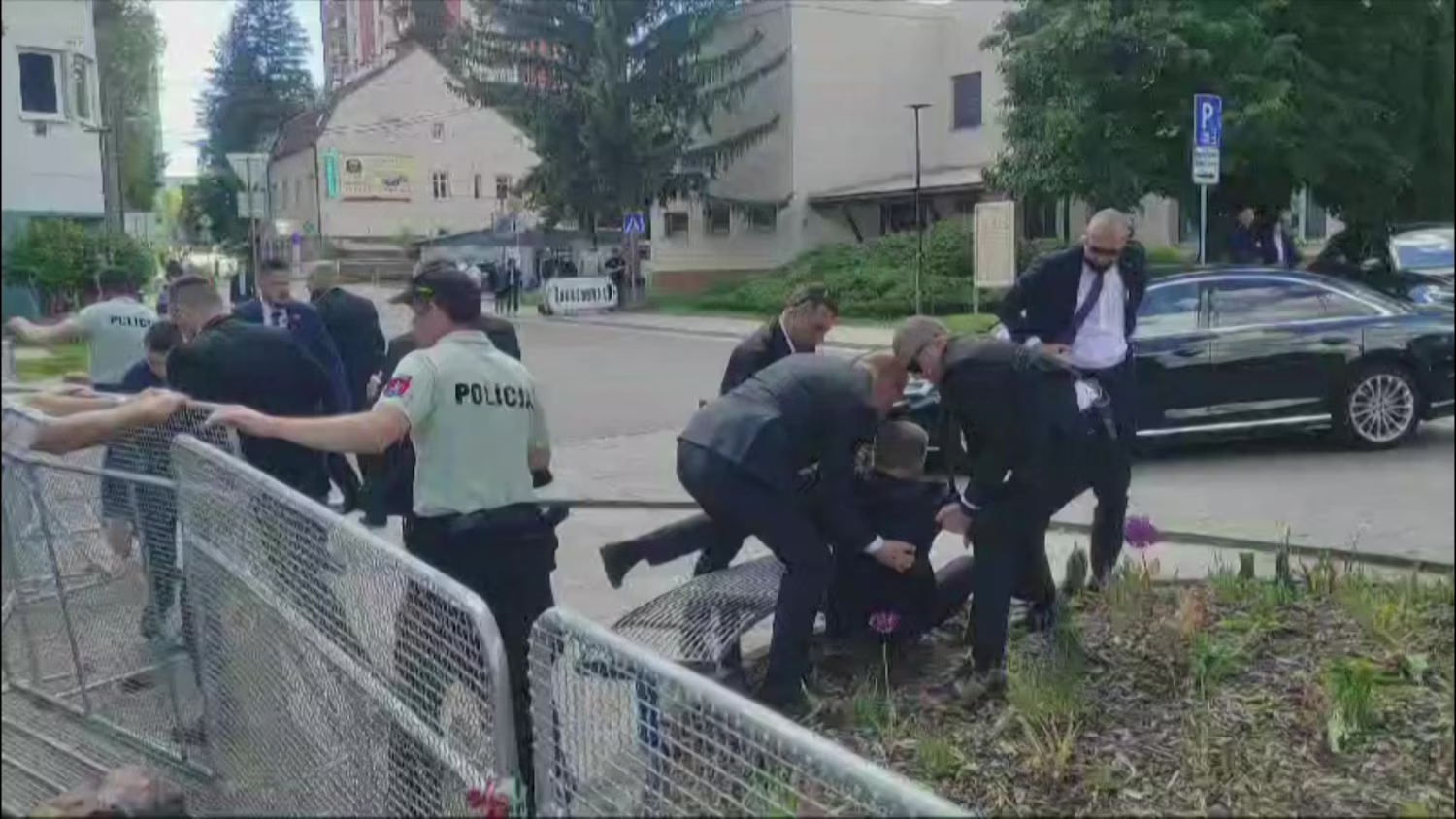
An Insane World: Fico shot …. Blinken in Discoland

An Observer in a Black Sea Town  … with highlights being impositions by Thuppahi

Slovakian Prime Minister Robert Fico has been shot and is in hospital. His condition is serious. Interestingly, Sky News, without any evidence, suggested the assassination attempt on Fico was because he was good friends with Putin,  and because he was opposed to sending weapons to Ukraine, and was therefore “supporting autocracies against democracies”.

Continue reading

1 Comment

Filed under accountability, american imperialism, authoritarian regimes, centre-periphery relations, disparagement, European history, historical interpretation, life stories, military strategy, nationalism, political demonstrations, politIcal discourse, power politics, security, self-reflexivity, truth as casualty of war, unusual people, world events & processes