Category Archives: NGOs

Relief Work in Aid of Mothers and Babies among the IDPs in 2009: Myrna Setunga’s Reports to Her Donor Pals THEN in 2009

Michael Roberts, 28 September 2012

Myrna Setunga attended Southlands College in the Galle Fort at one point in her upbringing and was known to me then. Our friendship continued during her subsequent undergraduate studies at Peradeniya University when I was also in the same boat so to speak. We lost touch though I was aware that she had moved to Australia.

From Australia she moved into work in the NGO world and served in the Philippines, Indonesia and West Africa before moving back as a Director for Plan International in Uva District. She retired and moved to the Colombo locality to look after her ailing father. Her pater had passed away by the time the tsunami struck on 26th December 2004.

This image of packs being assembled at Setunga’s home has been extracted by the Web Editor from a Power-Point presentation delivered by Setunga in Brisbane

Myrna Setunga then moved into relief work in her characteristic manner, a veritable dynamo. She mustered support in kind and money from friends in Lanka and donations from friends abroad. She discovered a particular realm where special needs had to be fulfilled, namely, refugee and IDP mothers with babies. She devised a mother and baby pack for delivery to such unfortunates and purchased the baby basinets, nappies, baby clothes, sanitary pads, panties, et cetera in bulk from retailers in the city with aid from local friends. Continue reading

12 Comments

Filed under accountability, disaster relief team, IDP camps, NGOs, politIcal discourse, propaganda, reconciliation, rehabilitation, Sinhala-Tamil Relations, sri lankan society, Tamil civilians, tamil refugees, truth as casualty of war, unusual people, welfare & philanthophy, world events & processes

The LLRC and the Encirclement of Sri Lanka

Kumar Rupesinghe, courtesy of Asian Tribune

The much abused word “civil society” must be deeply engaged in the reconciliation process. Civil Society, is not the handful of NGO”s financed by external funds, but the large and varied numbers of organizations such as trade unions, women’s organizations, the business community, the professionals, to name a few. As a first step the LLRC must be translated into all three languages and widely distributed.. Civil society must engage with the Lalith Weeratunge Commission, to improve and add quality to the implementation plan, and show ways and means of creatively expanding the reconciliation process. After all, much of the work will be done on the ground, amongst and within communities, and they must be brought into the process through a process of widespread consultations. There are many examples internationally, such as the process developed by South Africa, to name just one country which transformed a deeply divided society to one where all stakeholders were involved in the process of reconciliation. There are many such examples which we must study. Continue reading

Leave a comment

Filed under historical interpretation, NGOs, politIcal discourse, power politics, power sharing, Rajapaksa regime, reconciliation, Sinhala-Tamil Relations, sri lankan society, truth as casualty of war, war crimes, world events & processes

A Flourishing Bibliographical Tree: Tamil Migration, Asylum-Seekers and Australia

 Alex Kuhendrarajah of Merak notoriety –courtesy of Australian  courtesy of aus.com.au

NOTE that I am constantly augmenting this listing and adding new items so readers would do well to come back to the fresher editions: Web Editor.

Allard, Tom 2009Asylum seekers stage snap hunger strike,” 16 October 2009, http://www.smh.com.au/world/asylum-seekers-stage-snap-hunger-strike-20091015-gz93.html

Allard, Tom 2010 “Tamils’ spokesman Alex jumps ship,” SMH, 2 March 2010, http://www.smh.com.au/world/tamils-spokesman-alex-jumps-ship-20100301-pdju.html.

Amunugama, Sarath [quoted in news item] 2011 foreign remittances the lifeline of Sri Lanka’s economy,” Sunday Observer, 30 January 2011, http://thuppahis.com/2011/01/30/foreign-remittances-the-lifeline-of-sri-lankas-economy-says-sarath-amunugama/

BBC 2012 “[Lost at Sea! Some Missing Tamils]” 23 April 2012, reprint in http://thuppahis.com/2012/04/23/lost-at-sea-some-missing-tamils/

Bell, Stewart 2011 [“Sun Sea– one of its journalist Tamil migrants granted entry into Canada,”] 5 February 2011, http://thuppahis.com/2011/02/05/sun-sea-one-of-its-journalist-tamil-migrants-granted-entry-into-canada/.

Black, Sophie 2009 “Meet Alex and Brindha: a media savvy bunch of boat people,”http://www.crikey.com.au/2009/10/16/meet-alex-and-brindha-a-media-savvy-bunch-of-boat-people/.

Bolt, Andrew 2009 “How the Greens deceive on boat people,” 2 November 2009, http://blogs.news.com.au/heraldsun/andrewbolt/index.php/heraldsun/comments/hew_the_greens_deceive_on_boat_people.

Bolt, Andrew 2009 “It’s Rudd’s fatal shore,” Herald Sun, 6 November 2009, http://heraldsun.com.au/opinion/it’s-rudd’s-fatal-shore/story-e6frfhgf-1225794867198

Brown, Bernardo 2012 “Bernardo Brown’s brief note on migration networks in the Negombo region, 1980s-2012,” http://thuppahis.com/2012/07/25/bernardo-browns-brief-note-on-migration-networks-in-the-negombo-region-1980s-2012/.

Burnside, Julian “Australian leader Abbott ignorant on boat arrivals,” The Age, 9 April 2010, http://www.theage.com.au/opinion/politics/abbott-ignorant-on-boat-arrivals-20100408-ruyl.html.

Callick, Rowan 2010 “Sri Lanka urges hard line on Tamil asylum-seekers,” Australian, 18 Oct. 2010. Continue reading

22 Comments

Filed under asylum-seekers, australian media, discrimination, ethnicity, IDP camps, immigration, Indian Ocean politics, island economy, life stories, LTTE, NGOs, people smugglers, politIcal discourse, population, propaganda, Rajapaksa regime, Sinhala-Tamil Relations, sri lankan society, Tamil civilians, Tamil migration, tamil refugees, truth as casualty of war, world events & processes

Remembering Neelan Tiruchelvam’s intellectual Legacy

Asanga Welikala, courtesy of the Sunday Island, 22 July 2012

Sunday 29th July 2012 is the thirteenth death anniversary of Dr Neelan Tiruchelvam, which will be commemorated, as is now customary, with the annual Neelan Tiruchelvam Memorial Lecture. An old friend, Professor Sujit Choudhry of the New York University School of Law, will deliver the lecture this year. I have been asked to write a few words of remembrance and reflection to mark the occasion, an invitation I take up here with both pleasure and sadness, as well as a measure of trepidation. Continue reading

2 Comments

Filed under accountability, atrocities, historical interpretation, life stories, LTTE, nationalism, NGOs, politIcal discourse, power politics, prabhakaran, Sinhala-Tamil Relations, sri lankan society, terrorism, tolerance, unusual people, war crimes, world affairs

Effective tri-lingual services in government offices: the immediate way forward

Chandre Dharmawardana…. “Providing Tamil-Language resources where needed, and building Ethnic reconciliation”

Sebastian Rasalingam (SR), writing in the Island newspaper of July 5th, has discussed the topic  “Administering justice to Tamils, 13A+, and the issueof ethnic reconciliation‘. SR was responding  to an article by Mr.Hemantha Warnakulasuriya (published also in D. B. S. Jeyraj’s electronic journal).

The language barrier and jailing innocents on suspicion : Hemantha Warnakulasuriya (HW) has narrated the harsh treatment faced by  a group of exclusively Tamil-speaking citizens of Sri Lanka  (described as “Estate Tamils”) Continue reading

2 Comments

Filed under communal relations, cultural transmission, democratic measures, discrimination, language policies, life stories, NGOs, politIcal discourse, population, reconciliation, Sinhala-Tamil Relations, sri lankan society, world events & processes

Misreading and Distorting the Sri Lankan War, 2009-2012

Michael Roberts 25 May 2012

The recent UNHRC resolution sponsored by USA and directed at the government of Sri Lanka was the culmination of a campaign that began during the last stages of Eelam War IV. Since 2010 articulate circles in the West have been convinced that there had been “40,000 civilian deaths” during this phase. In contrast Rohan Gunaratna asserted that there were 1400 civilian deaths, of which 200 were inflicted by the LTTE. Both calculations are erroneous. Estimates provided by three moderate Tamils who have had regular access to the Tamil personnel who were on the ground indicate that the death toll, inclusive of Tamil Tiger personnel, was in the range 10,000 to 16,000, in circumstances where it was impossible to differentiate in all cases between those Tiger, those recently conscripted as auxiliaries and those truly civilian.

 Tamils streaming across Nandikadal Lagoon probably late April–Pic by AFP

It is towards the clarification of these specific circumstances and a criticism of the claims presented by a variety of human rights agencies, moral crusaders and media engines that this essay is directed. The campaign has been sustained by a mixture of lies and half-truths amidst truths, compounded further by a wilful blindness to the manner in which the LTTE utilised the Tamil populace in its domain as labour pool, protective shield and bargaining chip meant to induce a ”humanitarian intervention.” The massaging of death toll figures, therefore, is just one facet of a massive propaganda heist.

Continue reading

24 Comments

Filed under accountability, atrocities, australian media, authoritarian regimes, Eelam, gordon weiss, historical interpretation, life stories, LTTE, mass conscription, military strategy, nationalism, news fabrication, NGOs, politIcal discourse, power politics, prabhakaran, propaganda, reconciliation, Sinhala-Tamil Relations, tamil refugees, Tamil Tiger fighters, truth as casualty of war, violence of language, war crimes, world events & processes

The case of a missing young Tamil, Kerbert Morino Leon Roxy highlighted by Mano Ganeshan, Radhakrishnan and Haviland

This story has first published by COLOMBO TELEGRAPH = http://www.colombotelegraph.com/index.php/three-rehabilitated-youths-gone-missing-not-reached-homes-from-temple-trees/ – SEE PICs

SEE ADDENDUMat the end of tis essay — SAROJA DEVI changes her mind — she was mistaken. 20 May 2012

I: “A mother searches for her son, with a photograph that appeared in The Hindu” by RK Radhakrishnan

Saroja Devi of Mullaitivu last saw her son, Kerbert Morino Leon Roxy, on July 7, 2008. That day, from the Northeastern coastal town, Roxy took a boat out of Tamil Tiger-held territory. His parents, eager to see him leave, had paid for the trip — it was expensive to smuggle out able-bodied youngsters past the LTTE, which was on a constant recruitment drive for fighters.

Continue reading

3 Comments

Filed under accountability, asylum-seekers, life stories, LTTE, NGOs, propaganda, Rajapaksa regime, reconciliation, rehabilitation, Tamil civilians, Tamil migration, tamil refugees, Tamil Tiger fighters, truth as casualty of war

Blackmail during the Endgame in Eelam War IV

Michael Roberts,13 April 2012 … courtesy Eurasia Review, where you will find blog comments. Also see Colombo Telegraph for a different set of comments. The essay here has some embellishments and refinements.

Blackmailing Sri Lanka, 2009

The long and episodic war between the Government of Sri Lanka (GSL) and the Tamil liberation forces commanded by the LTTE from the 1980s to 2009 involved numerous atrocities on both sides, notably those in the Eastern Province in 1990. It is puzzling why, today, certain Western states and the human rights lobby (HR) are concentrating solely on the crunch situation in 2009 at the end of Eelam War IV in pressing alleged war crimes charges against the Sri Lankan government; and why symbolic LTTE figures such as V. Rudrakumaran and Adele Balasingham are also not being placed within the bars of moral justice.

 David Miliband with Tamils for Labour

he puzzle serves as a backdrop for my argument that the Western nations, both individually and collectively, were sucked into and thus complicit in one of the most outstanding acts of political blackmail the world has seen in recent centuries.[i] This was when the LTTE utilised its own people, some 320-350,000 citizens of Thamilīlam as a hostage-bargaining chip that would enable them to pursue their fight another day.

Guided by their well-placed connections in media and other circles in the West, the LTTE had read the international scene well. Strands of secular fundamentalism had prominent voice and humanitarian impulses[ii] could be persuaded Continue reading

30 Comments

Filed under discrimination, historical interpretation, Hitler, Indian Ocean politics, law of armed conflict, life stories, LTTE, mass conscription, military strategy, NGOs, politIcal discourse, population, power politics, prabhakaran, propaganda, Rajapaksa regime, reconciliation, Sinhala-Tamil Relations, sri lankan society, Tamil civilians, Tamil migration, truth as casualty of war, unusual people, war crimes, world events & processes

Two Contrasting Statements on the Northern Province: ICG and Narendran

International Crisis Group:  Sri Lanka’s North: Recipe for Renewed Conflict

Colombo/Brussels, 16 March 2012: The Sri Lankan military’s control over the political and economic life of the Northern Province is deepening the alienation and anger of northern Tamils and threatening sustainable peace.

Sri Lanka’s North I: The Denial of Minority Rights and
Sri Lanka’s North II: Rebuilding under the Military
, the two latest reports from the International Crisis Group, examine how de facto military rule and various forms of government-sponsored “Sinhalisation” of the Tamil-majority region are impeding international humanitarian efforts, reigniting a sense of grievance among Tamils, and weakening chances for a real political settlement to devolve power.

“The construction of large and permanent military cantonments, the seizure of private and state land, and the military-led cultural and demographic changes – all threaten Sri Lanka’s fragile peace”, says Alan Keenan, Crisis Group’s Senior Analyst and Sri Lanka Project Director. “Instead of giving way to a process of inclusive, accountable development, the military is increasing its economic role, controlling land and seemingly establishing itself as a permanent presence”. Continue reading

1 Comment

Filed under NGOs, politIcal discourse, propaganda, Rajapaksa regime, reconciliation, rehabilitation, Sinhala-Tamil Relations, sri lankan society, Tamil civilians, welfare & philanthophy, world events & processes

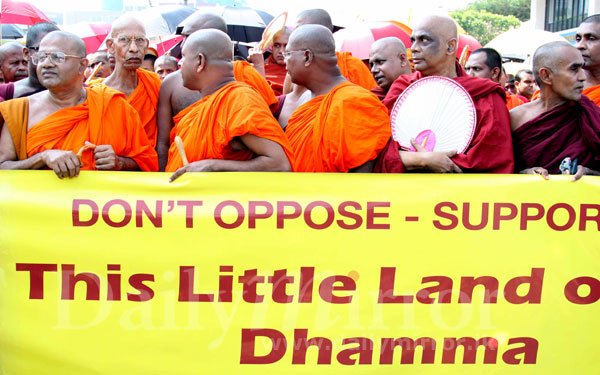
Fundamentalisms Face-to-face as the Dhammadīpa concept is re-affirmed in Sri Lanka

Michael Roberts, 15 March 2012

There are many forces promoting the campaign to haul the Sri Lankan government – and implicitly Sri Lankan society – before the coals through a condemnatory resolution at the UNHCR sessions in Geneva this month. That big power interests (inclusive of their manifest double standards) power this drive is undoubted. That the Sri Lankan governmental agencies over the years 1977-2012 have much to answer for is also clear – though WHO should administer such a process of monitoring and/or accusation, and how practical & useful such a project would be, is far from clear in my mind.

Apart from Tamils seeking vengeance, in my reading it is equally evident that strands of secular fundamentalism centred in INGOs, Western political moralists and Tamil and Sri Lankan activists have also inspired such Continue reading

Leave a comment

Filed under american imperialism, australian media, fundamentalism, historical interpretation, NGOs, patriotism, political demonstrations, politIcal discourse, power politics, Rajapaksa regime, reconciliation, religious nationalism, Sinhala-Tamil Relations, sri lankan society, truth as casualty of war, world events & processes