Michael Roberts **
“I must reduce myself to zero” (Mahatma Gandhi)
 Gandhi
  Godse
Godse  Pirapaharan
I am indebted to Dennis Hudson for the insights via Gandhi which inspire this article: “Gandhi was a martyr to satya, which is ‘truth’ or ‘true being,’ or ‘being true,’ …. Truth’s power radiates through the person who participates in it by eliminating the personal ego-centered passion that distorts it. Truth is God whom Gandhi called Ram. To serve Ram as a conduit for his gracious power in the middle of India’s violent political life, Gandhi had tried for years to reduce himself to “zero” [as he himself expressed matters]” (Hudson 2002: 132).
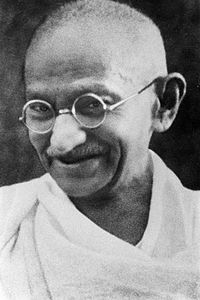 This transcendental orientation guided many of the Mahatma’s interventions in the tumultuous era of Indian nationalist politics. During the course of one such intervention, as he walked to an evening prayer meeting at a friend’s house in New Delhi on 30 January 1948, his life in this world was viciously terminated by an assassin named Nathuram Godse.[1] Paradoxically, both Godse and Gandhi were inspired by the Bhagavad Gīta (Jaffrelot 2003). The Gīta was a foundational inspiration for a long line of nationalist or fundamentalist thinking beginning with Tilak and extending into the Hindu fundamentalist stream of thinking associated with Savarkar who “invok[ed] the motif of Hindu religious sacrifice.” Already a member of the Hindu Maha Sabha, when Savarkar founded an offshoot called the Hindu Rashtra Dal in 1942, Godse became the editor-in-chief of its newspaper (Jaffrelot 2003:300-11, quotation from p. 304).[2] Continue reading →
Like this:
Like Loading...

 I thought it might be useful to share this list of articles and books relating to suicide attacks. This is an ongoing effort and is by no means comprehensive and is fairly narrowly focused – I have no intention of trying to catalogue all materials related to terrorism and insurgency. I’ll be updating the bibliography as I go along. If you notice any glaring omissions or have suggestions for new material, please comment below or email me at pmsmartbomb at gmail dot com.
 Black Tigers marching


