Category Archives: landscape wondrous

Introducing ECSAT and the World of Disabled People around Galle

Michael Roberts

 In late 2018 I met Roshan Samarawickrema at Flinders University via my daughter Maya who is a senior staff officer there. Roshan had arrived to further studies in Disability Teaching. Via the vagaries of the covid endemic both of us found ourselves in good old Lanka in the second quarter of the year. A visit to my home beat of Galle Fort[1] in July-August enabled me to explore and ‘experience’ the work of ECSAT at its HQ in the old “Serasinghe Walauwwa” building at Wackwella [albeit in covid circumstances whereby school attendance was drastically low]. My readings via picture and tale will follow. I begin here with Roshan’s introduction to ECSAT with due emphasis on the initial impetus provided by Catherine Liyanage (nee Mole become Macleod).[2] …. Michael Roberts

ECSAT staff in 2020

Continue reading

Leave a comment

Filed under accountability, charitable outreach, cultural transmission, democratic measures, education, female empowerment, historical interpretation, human rights, landscape wondrous, life stories, meditations, NGOs, rehabilitation, self-reflexivity, social justice, sri lankan society, welfare & philanthophy, world events & processes

Encountering and Experiencing ESCAT in August 2020

Michael Roberts

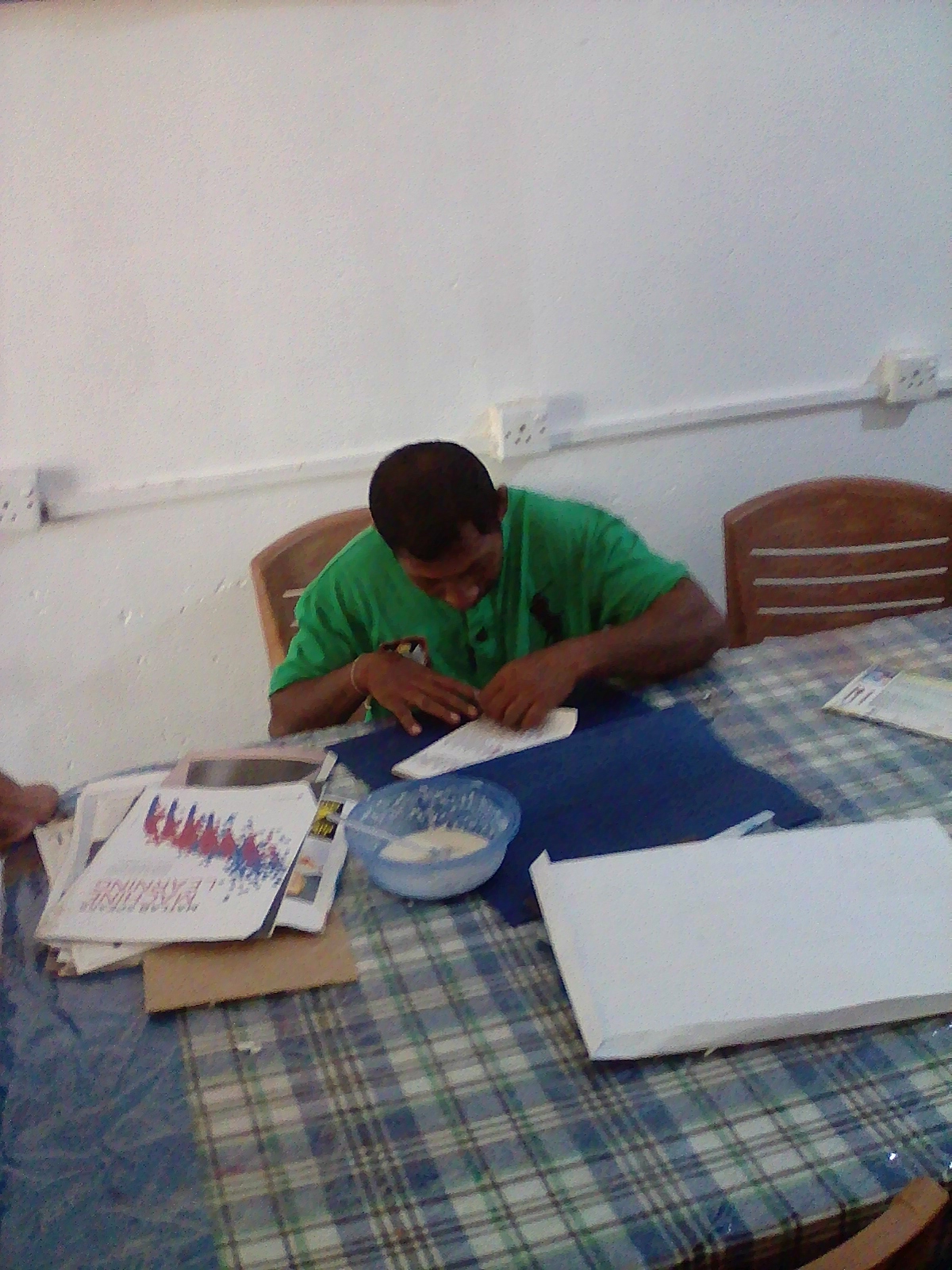
Apart from experiencing life in my old beats of Galle Fort when I sojourned there in late July-early August 2020, I took in the work at ECSAT. This was during an abnormal period when the handicapped personnel attending classes at the ECSAT centre in Wackwella, Galle, were miniscule because of the covid-pandemic and government regulations. My amateur photographs (some in other Thuppahi postings) will nevertheless provide readers with some sense of place, scale and personnel.

A teaching session (which happened to have as many teachers as students) displayed the practiced vigour and unison with which the teaching staff engaged the students with lessons via song. Elsewhere there were one-on-one teaching processes. I was particularly impressed by the totally engaged joy with which an autistic young man (a tinker by trade as I gathered) was pursuing his tasks at a table whenever I visited that arena.

Continue reading

Leave a comment

Filed under charitable outreach, economic processes, education, human rights, landscape wondrous, life stories, performance, rehabilitation, self-reflexivity, sri lankan society, teaching profession, the imaginary and the real, tolerance, unusual people, welfare & philanthophy, world events & processes

Michael Sandel’s Pursuit of Civic Virtues in USA and the World

Julian Coman, in The Observer, 6 September 2020, …. https://www.theguardian.com/books/2020/sep/06/michael-sandel-the-populist-backlash-has-been-a-revolt-against-the-tyranny-of-merit?CMP=Share_iOSApp_Other

The philosopher believes the liberal left’s pursuit of meritocracy has betrayed the working classes. His new book argues for a politics centred on dignity.

Michael Sandel photographed last month in the grounds of Harvard, Cambridge, Massachusetts. Photograph: Webb Chappell

Michael Sandel was 18 years old when he received his first significant lesson in the art of politics. The future philosopher was president of the student body at Palisades high school, California, at a time when Ronald Reagan, then governor of the state, lived in the same town. Never short of confidence, in 1971 Sandel challenged him to a debate in front of 2,400 left-leaning teenagers. It was the height of the Vietnam war, which had radicalised a generation, and student campuses of any description were hostile territory for a conservative. Somewhat to Sandel’s surprise, Reagan took up the gauntlet that had been thrown down, arriving at the school in style in a black limousine. The subsequent encounter confounded the expectations of his youthful interlocutor.

Continue reading

Leave a comment

Filed under accountability, cultural transmission, democratic measures, education, governance, heritage, historical interpretation, landscape wondrous, life stories, literary achievements, meditations, politIcal discourse, self-reflexivity, teaching profession, unusual people, welfare & philanthophy, world events & processes

Experiencing Denigration in Sri Lanka: The Muslims Yesterday and Today

Shamara Wettimuny, in History Workshop, 7 September 2020, where the title runs “The Colonial History of Islamophobic Slurs in Sri Lanka”**

Sri Lanka is a multi-ethnic, multi-faith island. Yet despite centuries of physical coexistence, ethnic, religious and linguistic differences continue to bring communities into conflict. Muslims in Sri Lanka (comprising around 9.7% of the population) are often vilified by both the Sinhalese majority (who are either Buddhist or Christian) and Tamil minority (either Hindu or Christian) for their religious beliefs, practices, and dress. Following the Easter Sunday suicide attacks in April 2019 – carried out by a group of extremists linked to the Islamist group, the National Thowheed Jamaat – the wider Muslim community faced a discriminatory and sometimes violent backlash. In 2020, as COVID-19 spread in Sri Lanka, Muslims were blamed for ‘spreading the disease’, and for wanting to bury their dead in line with traditional Islamic burial practices (as opposed to cremation as stipulated by the Sri Lankan government).

Continue reading

1 Comment

Filed under accountability, atrocities, British colonialism, centre-periphery relations, chauvinism, communal relations, cultural transmission, discrimination, disparagement, economic processes, fundamentalism, heritage, historical interpretation, island economy, landscape wondrous, legal issues, life stories, Muslims in Lanka, politIcal discourse, religiosity, riots and pogroms, self-reflexivity, sri lankan society, the imaginary and the real, unusual people, world events & processes, zealotry

Foreign Secretary Columbage faces Kelum Bandara in Q and A

Newly appointed Foreign Secretary Admiral Prof. Jayanath Colombage spells out the foreign policy of the Government of Sri Lanka (GoSL). He spells out how the Government will reconcile competing interests of China and India, and how Sri Lanka can have healthy ties with other countries including Pakistan and Bangladesh.


  …. http://www.dailymirror.lk/opinion/Time-ripe-for-deviation-from-Western-oriented-foreign-policy/231-194504

Continue reading

Leave a comment

Filed under accountability, american imperialism, centre-periphery relations, China and Chinese influences, economic processes, foreign policy, governance, historical interpretation, Indian Ocean politics, island economy, landscape wondrous, life stories, LTTE, military strategy, modernity & modernization, patriotism, politIcal discourse, power politics, Rajapaksa regime, security, self-reflexivity, sri lankan society, transport and communications, world events & processes

Treasures Big and Small around Galle Fort and Port

Admiral Ravindra C Wijegunaratne,* in Island, 5 September 2020, where the title runs “From the tallest clock tower to smallest sand clock in Sri Lanka”

Galle is a fascinating place to work in. I was the Commander Southern Naval Area (Comsouth) from 3rd August 2008 to 10th August 2009. For me nothing was more refreshing than the early morning beach run on the world famous Unawatuna beach as well as the one-kilometer swim (before tourists invaded the beach).

Continue reading

Leave a comment

Filed under accountability, charitable outreach, cricket for amity, economic processes, education, heritage, historical interpretation, landscape wondrous, life stories, performance, self-reflexivity, Sri Lankan cricket, sri lankan society, tourism, travelogue, unusual people, world events & processes

The Insidious and False Dimensions of the “Traditional Homeland” Thesis

Gerald Peiris 

The concept of the ‘Traditional Tamil Homeland’ as promulgated by its exponents is based on the notion that, from the distant past, the island of Sri Lanka comprised the territories of two distinct nationalities that were arbitrarily unified in the formation of British Ceylon in the early 19th century.  My survey, which draws from several authoritative writings, some of which have been authored by reputed Tamil scholars, shows that such a notion does not conform to known facts and unbiased interpretations of the country’s history.

Continue reading

Leave a comment

Filed under accountability, British colonialism, centre-periphery relations, communal relations, conspiracies, cultural transmission, devolution, doctoring evidence, economic processes, Eelam, ethnicity, heritage, historical interpretation, irrigation, island economy, land policies, landscape wondrous, language policies, legal issues, literary achievements, nationalism, politIcal discourse, population, power politics, power sharing, prabhakaran, Sinhala-Tamil Relations, sri lankan society, Tamil migration, the imaginary and the real, transport and communications, travelogue, truth as casualty of war, unusual people, world events & processes

Isa Guha as the Leading ‘Face’ of BBC Sports ….Hallelujah!

Alan Gardner interviews Isa Guha, 29 August 2020 …………. ………. https://www.espncricinfo.com/story/_/id/29764563/isa-guha-there-young-girl-boy-there-see-tv-feel-do-similar

Having taken on the role of lead presenter for the BBC’s return to televised cricket coverage this summer, Isa Guha has spent the majority of the last two months in bio-secure environments, helping to bring England’s behind-closed-doors internationals to those following at home on TV and radio. Ahead of Sunday’s second men’s T20I between England and Pakistan, the first live game free-to-air on the BBC for 21 years, Guha discusses life in the bubble, her status as a role model and hopes for the women’s game in the UK.

Continue reading

1 Comment

Filed under accountability, coronavirus, female empowerment, landscape wondrous, life stories, security, self-reflexivity, the imaginary and the real, travelogue, unusual people, world events & processes

Dunkirk Different! Migrants penetrate England by Small Boat

Sophia Sleigh & April Roach in Evening Standrard 10 August 2020, where the title is RAF plane patrols English Channel after nearly 700 migrants cross”

Continue reading

Leave a comment

Filed under accountability, asylum-seekers, communal relations, discrimination, disparagement, economic processes, historical interpretation, human rights, immigration, landscape wondrous, legal issues, life stories, the imaginary and the real, transport and communications, trauma, travelogue, unusual people, working class conditions, world events & processes

Modernist Fundamentalism: Missing the Force of Walk, Talk and Majesty in Sinhaladom

Michael Roberts

Asanga Welikala edited an important book entitled The Republic at Forty in 2012 in which I participated (CPA, 2012). Both Welikala and Roshan de Silva-Wijeyeratne have formidable curriculum-vitae behind them. Their recent intervention in criticism of the Rajapaksa state today[1] also happens to rely heavily on SJ Tambiah’s work on the mandala state,[2] a topic which also informed my concept of the “Asokan Persona,” which is developed within four chapters in my book Exploring Confrontation (1994).

Continue reading

Leave a comment

Filed under accountability, authoritarian regimes, British imperialism, centre-periphery relations, chauvinism, communal relations, cultural transmission, fundamentalism, governance, heritage, historical interpretation, Indian traditions, island economy, Kandyan kingdom, landscape wondrous, life stories, parliamentary elections, performance, politIcal discourse, power politics, Rajapaksa regime, self-reflexivity, sri lankan society, the imaginary and the real, world events & processes