Category Archives: Indian Ocean politics

“Paraya” & “Parayo” as Vicious Epithets in the Sri Lankan ‘Circuit’

Michael Roberts

I came across an old article of mine entitled “Confronting Charlie Ponnadurai: Clarifying The Context Of Disparaging Ethnic Epithets In Sri Lanka Over The Last 180 Years.” Charlie happens to be a batchmate at Ramanathan Hall in Peradeniya University in 1957, but we had not encountered each other for decades before this verbal contretemps occurred in the year  2013.  SEE ………………………………………………… https://thuppahis.com/2013/08/18/confronting-charlie-ponnadurai-clarifying-the-context-of-disparaging-ethnic-epithets-in-sri-lanka-over-the-last-180-years/. 

Continue reading

Leave a comment

Filed under accountability, anti-racism, caste issues, centre-periphery relations, chauvinism, communal relations, cultural transmission, democratic measures, disparagement, economic processes, education, ethnicity, heritage, historical interpretation, Indian Ocean politics, Indian traditions, life stories, politIcal discourse, racism, racist thinking, self-reflexivity, Sinhala-Tamil Relations, sri lankan society, Tamil civilians, world events & processes

CR De Silva: Basic Sources on the Advent of the Karava & Salagama Castes in Sri Lanka

CR De Silva in Memo responding to a Query from Shihan De Silva in UK

The evidence as to from what parts of India the KSD (Karava, Salagama, Durawa) castes arrived in Sri Lanka is not totally clear, but there are some indications in Portuguese sources. I have no data on the origins of the Durava.

However, here is what I have traced on the Salagamas. It suggests that the Salagamas came from the South Indian Malabar or Kerala coast and that the Karavas migrated from the eastern shores of the South Indian coast (currently Tamilnadu). Given that caste identity was connected to occupation, we should note that changes in occupation could have enabled some individuals to move from their caste identities especially during migration.

Continue reading

2 Comments

Filed under accountability, caste issues, commoditification, communal relations, cultural transmission, demography, economic processes, ethnicity, heritage, historical interpretation, Indian Ocean politics, life stories, migrant experiences, politIcal discourse, religiosity, sri lankan society, Tamil civilians, transport and communications, working class conditions, world events & processes

Sri Lanka’s Precarious Political Economy ….. Yesterday & Today

Mick Moore, whose chosen title is  It’s the Party, Stupid: Sri Lanka’s Political Turnaround – Part 1” ….. while the highlighting in this version with a different title has been imposed by The Editor, Thuppahi

Photo courtesy of BBC

It is not quite a miracle. But it is certainly a very impressive turnaround. From around 1970 until 2021, Sri Lanka seemed to be on an irreversible track toward steadily worsening governance: grand corruption, disregard of the law, ethnic and religious conflict, state violence and (non-military) government incapacity and incompetence. Today, by contrast, following the September 2024 presidential and the November 2024 parliamentary elections, the prospects for more substantive democracy and better governance seem bright. The old political elite and the broader politician class have been replaced almost completely through the most peaceful and fair elections that the country has seen for a long time. The prospect of military intervention in politics has entirely faded. The female proportion of MPs doubled from a very low 5 percent in a year when the global trend was in the other direction.

Continue reading

1 Comment

Filed under accountability, authoritarian regimes, centre-periphery relations, democratic measures, disparagement, economic processes, ethnicity, governance, historical interpretation, human rights, IMF, Indian Ocean politics, island economy, Left politics, legal issues, life stories, modernity & modernization, parliamentary elections, performance, politIcal discourse, power politics, self-reflexivity, Sinhala-Tamil Relations, sri lankan society, taking the piss, working class conditions, world events & processes

The Maaveerar Dead as A Perpetual Inspiration For Eelam

Mario Arulthas, in Al-Jazeera,  9 January 2025 …. with highlightinging emphasia imposed by The Editor, Thuppahi

The Maaveerar Dead as A Perpetual Inspiration For Eelam

The nationwide electoral success of the anti-establishment NPP does not mean Tamil nationalism is on the decline.

An election official holding a ballot box gets off the bus outside a vote counting centre after the voting ended for the parliamentary election in Colombo, Sri Lanka, November 14, 2024 [Thilina Kaluthotage/Reuters]

“They’re trampling on our graves with their boots,” said Kavitha, a Tamil woman, as the torrential rain lashing our faces washed away her tears. Standing barefoot and ankle-deep in mud at the site of a former cemetery in Visuvamadu, Sri Lanka, she was lamenting the adjacent military base built on the graves of fallen Liberation Tigers of Tamil Eelam (LTTE) fighters, including that of her brother.

Continue reading

Leave a comment

Filed under accountability, anti-racism, authoritarian regimes, centre-periphery relations, chauvinism, communal relations, cultural transmission, democratic measures, disparagement, economic processes, education, Eelam, electoral structures, ethnicity, fundamentalism, governance, heritage, historical interpretation, Indian Ocean politics, insurrections, language policies, legal issues, life stories, LTTE, military strategy, parliamentary elections, patriotism, political demonstrations, politIcal discourse, power politics, power sharing, prabhakaran, propaganda, racist thinking, religiosity, self-reflexivity, Sinhala-Tamil Relations, slanted reportage, sri lankan society, Tamil civilians, Tamil migration, Tamil Tiger fighters, terrorism, the imaginary and the real, trauma, truth as casualty of war, unusual people, vengeance, war reportage, world events & processes, zealotry

When Extremists Feed Off Each Other …. Pertinent Reflections from 2012

Michael Roberts

Just today I came across an old political essay of mine, one entitled “Prejudice and Hate in Pluralist Settings: The Kingdom of Kandy.” While the essay is of continued relevance today for Sri Lankan as well as world politics, let me bring readers face-to-face with several insights reposing within two of the COMMENTS which the article attracted, one from Dr Jane Russell and the other from Professor Chandre Dharmawardena.

Continue reading

Leave a comment

Filed under accountability, anti-racism, centre-periphery relations, chauvinism, communal relations, cultural transmission, economic processes, education, Eelam, ethnicity, historical interpretation, Indian Ocean politics, language policies, life stories, LTTE, nationalism, politIcal discourse, power sharing, self-reflexivity, Sinhala-Tamil Relations, sri lankan society, Tamil civilians, tamil refugees, Tamil Tiger fighters, truth as casualty of war, world events & processes

Gamini Seneviratne’s Critical Readings of the Sri Lankan Scenario

Gamini Seneviratne, in The Island, 23 December 2024, where the title runs What AKD and NPP should bear in mind” … reproduced here with highlighting imposed by The Editor, Thuppahi

This is to thank you [the ISLAND newspaper] for drawing attention to the dangers posed by India to our society and its culture and other basic resources as well as its on-going exertions towards encroaching on our maritime territory.

Continue reading

2 Comments

Filed under accountability, authoritarian regimes, centre-periphery relations, Colombo and Its Spaces, disparagement, economic processes, electoral structures, foreign policy, governance, historical interpretation, Indian Ocean politics, island economy, Left politics, life stories, parliamentary elections, political demonstrations, politIcal discourse, power politics, Rajapaksa regime, security, self-reflexivity, sri lankan society, truth as casualty of war, unusual people, world events & processes

Facing A Corpse: Asia vs The West …. A Fundamental Difference & Its Political Implications

  Michael Roberts    

The sharp warring conflict in Syria today amidst the ongoing war in Ukraine and that in Gaza underlines stories and ‘pictures’ of battlefield dead (both civilians and soldiers). These in their turn highlight the fundamental differences in the manner in which some Asian countries conduct funerals and face the issue of death embodied in a corpse (in some cases that of a loved one or kinsperson).

This fundamental difference has equally fundamental political consequences. For this reason, I take my Thuppahi-readers (no offence meant) to a segment in one of my past presentations when I presented thoughts relating to the official display of Velupillai Pirapaharan as a corpse in May 2009.

THIS from https://thuppahis.com/2011/06/29/death-and-eternal-life-contrasting-sensibilities-in-the-face-of-corpses/ Continue reading

Leave a comment

Filed under accountability, authoritarian regimes, cultural transmission, ethnicity, governance, heritage, Indian Ocean politics, landscape wondrous, life stories, LTTE, martyrdom, meditations, nationalism, performance, photography, politIcal discourse, power politics, propaganda, Rajapaksa regime, self-reflexivity, Sinhala-Tamil Relations, sri lankan society, Tamil Tiger fighters, trauma, truth as casualty of war, war reportage, world events & processes

Politics of Identity in Lanka: Mithran Tiruchelvam’s Introduction in 1997 to his Book

Introduction by Mithran Tiruchelvam …. a son of Neelan Tiruchelvam of the ICES [who was tragically assassinated by the LTTE in front of the ICES offices one year later]

The present collection of essays arose out of a symposium held at the International Centre for Ethnic Studies (ICES), Colombo from 13-15 March 1997, where researchers and scholars presented some of their recent research interests. This volume seeks to gather the threads of a hybrid collection of essays and weave them together in their shared historical moment. An anthology of this nature seeks organizational cohesion based on the papers’ common origins at the symposium, thereby sacrificing some degree of thematic or disciplinary unity. It is intended that such a collection make available to the general reader and to the scholar alike, a sense of the variety of social science pursuits being undertaken in Sri Lanka today. As such its purpose is to flavour as much as to nourish the reader’s palate, providing a sampling of the eclectic diversity of topics, methodologies and critical perspectives. engaging the social scientist today.

Continue reading

Leave a comment

Filed under accountability, anti-racism, authoritarian regimes, British colonialism, centre-periphery relations, chauvinism, commoditification, communal relations, cultural transmission, democratic measures, economic processes, education, Eelam, electoral structures, ethnicity, historical interpretation, Indian Ocean politics, language policies, Left politics, legal issues, life stories, modernity & modernization, nationalism, parliamentary elections, politIcal discourse, power politics, prabhakaran, self-reflexivity, Sinhala-Tamil Relations, sri lankan society, Tamil civilians, Tamil migration, Tamil Tiger fighters, terrorism, truth as casualty of war, vengeance, war reportage, welfare & philanthophy, world events & processes, zealotry

Tilvin Silva in Q and A – Sri Lanka’s Issues Today

Kelum Bandara in the Daily Mirror, 29 November 2024

Tilvin Silva, the General Secretary of Janatha Vimukthi Peramuna (JVP), the core base of National People’s Power (NPP), shares his views on the government’s way forward and responds to social media criticism on his participation at ABBA Tribute Concert during an interview with the Daily Mirror. … with blue-cloured highlights imposed by The Editor, Thuppahi

Q: At the press conference conducted in the immediate aftermath of the general election, you talked about the seriousness of the mammoth mandate your party received.  Did you panic because you received such a large mandate?

It is not that we panicked due to the mandate. Ours is a political force different to others.  We did not seek a mandate to realise our individual interests. We do not want to be arrogant with power.  We only want to resuscitate this country. Whenever an overwhelming majority of people place their trust in us,  we have to take it with due seriousness. Then only, we can position ourselves for realization of their aspirations.  We have to grasp the true, serious message of this large mandate which is meant to rebuild the country.

“Our mission was to create a just and fair society for the people. We engaged in politics for it.  In the wake of past attempts to crush our party, we resorted to different means to press ahead with our struggle. Since then, society has evolved and we also adjusted ourselves accordingly.  Still, we did not deviate from our founding principles and objectives. We changed our strategies and reorganised ourselves.”

You got this mandate in the month of November when your party is commemorating its past leaders, including founder leader Rohana Wijeweera, who were assassinated. What do you feel about this victory at such a moment of time?

It is only a coincidence. No matter what, we feel happy that we received this electoral victory came just after the 35th anniversary of our fallen comrades. Our victory has been destined and timed accordingly. Yes, we feel happy over this victory 35 years after our party was crushed.

You have been through thick and thin during this period. Can you comment?

Yes I joined the party in 1978.

In today’s context, is there any practical possibility to realise founding principles and objectives of the party?

Our mission was to create a just and fair society for the people. We engaged in politics for it.  In the wake of past attempts to crush our party, we resorted to different means to press ahead with our struggle. Since then, society has evolved and we also adjusted ourselves accordingly.  Still, we did not deviate from our founding principles and objectives.  We changed our strategies and reorganised ourselves, though.

How do you specify it?

In one era, armed struggles were considered in the world as a way of capturing power. In our movement, we resorted to it as and when the situation demanded.  Later, it became a method disregarded in the world. After that, we turned to building a public movement. There were many transformations in the world. Technology evolved and lifestyles altered.  People’s necessities have changed since 1965, when we formed the party.   We harboured the idea right from the beginning that we should secure public support first to gain political power. We tried from the beginning to expand ourselves into public movements. We did it under different terminologies. It did not succeed initially. Yet, in 2018, it became successful. It is a public movement, not a coalition.  We chose slogans in terms of public needs.

“There is no individual staking claims for this (NPP) victory.   There is a limit to what I can do as an individual.  This is the end result of a collective effort.  I worked for it. Likewise others such as comrade Anura Kumara Dissanayake worked for it.  Besides, a whole lot of others who are lesser known to the country worked tirelessly at grassroots level. They call me Loku Ayya because I am the eldest within the party structure

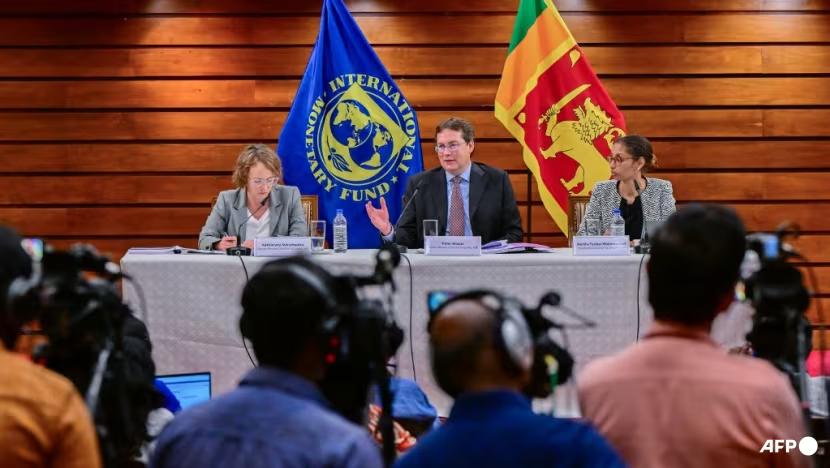
Yours is a party that was opposed to the involvement of the International Monetary Fund (IMF) right from the beginning. Now, your party, which is in power, has vowed to proceed with the IMF programme.   Isn’t it ironic?

What we see are nothing but challenges. We did not inherit a country that was in good shape to be governed.  We inherited a country that is bankrupt and finds it difficult to settle huge debts accumulated over the years. It is a country that struck a deal with the IMF on disadvantageous terms. It would have been better had we not struck a deal with the IMF to get out of the current abyss.  Now, there is nothing we can do because the agreement has already been signed. It is an agreement between Sri Lanka and the IMF. Whichever party is in power, the agreement has to be honoured. We cannot unilaterally abrogate it. If we do so, we will face serious repercussions.

Now, we have to deal with the IMF in accordance with the mandate exploring flexibility in areas where changes can be done. 

Do you have any plan in the future to come out of this IMF programme?

We have not given mind to it. That cannot be done now.  We have to move ahead with this agreement with some amendments if possible.  There is some form of economic stability now. We have to build on that.  Depending on its success in terms of expected economic growth, indigenous economic strengths and our debt sustainability, we can think of the next step in the future.

Now the National People’s Power (NPP) has formed the Government. The JVP is its core force.  How does the government’s role differ from that of the party?

The party only ensured the electoral victory.  Now, there is a government formed after an electoral victory. Both the party and the government are geared for the same objective.  However, the entire party machinery has not become part of the government.  It means there is one segment of the NPP not being aligned with the government.  They continue to engage in political work such as educational activities, organizational activities etc.  The JVP is also involved in its drive to increase membership.  It is absolutely essential for us.  The party machinery is needed to link the government with people.  The party’s role is important in ensuring public support to the government’s initiatives. The government needs human resources in discharging its functions.  The party has a role in building this human resource. The government and the party are not merged, but interlinked.

“In this region, India is our neighbour. It is difficult for us to forge ahead without friendly ties with India.  In our region, China is one of the most developed countries. We need help from China.  Then, problems may crop up because of rivalry between India and China. We are not party to it.  Ours is a free and open foreign policy. We are not aligned to anyone 

There were reports about the formation of a new mechanism to monitor and guide the government. How official is it?

It is not an official mechanism, but a voluntary initiative. It will involve a large number of MPs who do not hold ministerial responsibilities in our government.  Among them are MPs with different talents and interests.  Earlier, we had ten committees that formulated policies covering areas such as economy, environment, education etc.  All of them who served in these committees are not in the government.  Some of them are not MPs. They too can be involved in this mechanism. That is a mechanism to ensure knowledge and expertise of others in running the government.  In parallel to the government, the party’s structure will operate from grassroots level to the top. 

In countries such as China, we find it. Yours is also party based on socialist policies. Is this a replication of the same?

This is based on socialist model for sure. Such systems exist in countries such as China and Vietnam.  We had it in Sri Lanka in the past.  For example, once Sri Lanka Podujana Peramuna (SLPP) won elections, the party and the government got merged and became inseparable.  The party lost its organizational structure that should otherwise remain independent of the government.  Once the government collapsed, it lost everything.  For us, power originates from people.  In the execution of power, there has to be a nexus between its centre and periphery.  The government’s structure, as usual, runs down to the level of Grama Niladhari. The political authority runs down to the local authorities. Simultaneously, we should have the party structure operating right down to grassroots level.

 In social media groups, you are referred to as Loku Ayya (Big Brother) by the party cadre.  You are also cited as the pioneer of this electoral victory. Are you the key figure behind success?

They may be doing so with affection towards me. There are exaggerations too. There is no individual staking claims for this (NPP) victory.   There is a limit to what I can do as an individual.  This is the end result of a collective effort.  I worked for it. Likewise others such as comrade Anura Kumara Dissanayake worked for it.  Besides, a whole lot of others who are lesser known to the country worked tirelessly at grassroots level.  They call me Loku Ayya because I am the eldest within the party structure.

 It means you are the senior most comrade?

No. Comrade Jinadasa Kitulegoda is there in the Central Committee of the party.  He has been there since 1971.  In the board of office bearers, I am the seniormost. All comrades call me Ayya. For them, I am more like the eldest brother of their family.  They lovingly call me Loku Ayya. Otherwise, I am not the sole spiritual leader-like figure.

As far as the foreign policy is concerned, there are concerns raised. Some countries believe whether yours will be following eftist policies.  There are concerns raised that you will lean more towards China and compromise ties with neighbouring India.  What is the actual policy?

Earlier, those who raise such concerns said that our party had no understanding of geopolitics and world politics. They now talk with a different tone in this manner. It is a twist of destiny for them. We are a party reading on and learning politics. We have an understanding of world politics and its contradictions. Ours is not a party relying on business deals with countries. In this region, India is our neighbour. It is difficult for us to forge ahead without friendly ties with India. In our region, China is one of the most developed countries. We need help from China. Then, problems may crop up because of rivalry between India and China. We are not party to it. Ours is a free and open foreign policy. We are not aligned to anyone. We are not servile to anyone. Therefore, we can have balanced ties with both India and China.  We seek to foster ties with Japan, Vietnam, the Middle-East and Europe. Likewise, we plan for ties with Africa. We have started bringing about changes in Foreign Service. Ours is not a leftist government, but a government of leftist, progressive, democratic forces.  

 There is a huge social media outcry about your participation in the ABBA Tribute Show at the Mount Lavonia Hotel recently. What is your response?

Actually, I am not keen on talking about it.  The forces that were defeated seek to cling to something or another. The Mount Lavinia Hotel handled it. The event was organised to promote tourism.  I, along with Prime Minister Harini Amarasuriya and Tourism Minister Vijitha Herath, was invited. There were others in the party who were invited. They came here to this office and handed it over to us.

If there is an invitation from an organization for an event, we are duty bound to attend it. If there is an invitation for a wedding, you participate in it. There was a table reserved for us. It is true that the ticket had been priced at Rs.50,000.  There had been tickets priced Rs.30,000, 15,000 and 7,500 too. We attended it. We enjoyed it. We are people with a palate for enjoyment.

There is speculation that you will step down as the party’s General Secretary to make way for Mr. Bimal Ratnayake to take charge. Is it true?

We have not taken such a decision. We are not here to be in positions forever. There is no need to change this position in a hurry. There is a tussle among social media groups running pages to increase views. They publish sensational news stories like this to gain attraction.

////////////////////////////////

ALSO NOTE

* https://en.wikipedia.org/wiki/Bimal_Rathnayake

Leave a comment

Filed under accountability, centre-periphery relations, democratic measures, economic processes, electoral structures, foreign policy, governance, historical interpretation, IMF, Indian Ocean politics, island economy, JVP, landscape wondrous, Left politics, life stories, parliamentary elections, patriotism, politIcal discourse, power politics, self-reflexivity, sri lankan society, world events & processes

A Reading of the Sri Lankan Elections from THE ECONOMIST

Item in The Economist, 23 Nov 2024: “Sri Lanka’s Left Turn: Sri Lanka’s president with Marxist roots now dominates parliament too” .… with highlighting emphasis imposed by the Editor, Thuppahi

SRI LANKA was once a pioneer of free-market capitalism in South Asia. After J.R. Jayewardene took power with a super-majority in 1977, he introduced a French-style executive presidency and economic reforms that overturned the left-wing orthodoxy of the previous two decades. Cheered on by Western governments concerned about Soviet influence, Sri Lanka became the first country in the region to liberalise its economy.

Continue reading

Leave a comment

Filed under accountability, centre-periphery relations, chauvinism, debt restructuring, economic processes, export issues, foreign policy, governance, IMF, Indian Ocean politics, island economy, Left politics, legal issues, life stories, parliamentary elections, patriotism, performance, politIcal discourse, power politics, rehabilitation, security, self-reflexivity, sri lankan society, working class conditions, world affairs, world events & processes