Category Archives: European history

Britain’s SAS Under Threat From HR Legal Beagles

Paul Wood: “The SAS have been betrayed in the name of human rights” … in The Spectator, magazine, 30 November 2024

The SAS are worried. Britain’s most elite military unit have come face to face with the IRA, the Taliban and Isis. But the enemy that really concerns them doesn’t carry a gun or wear a suicide belt. It’s the phalanx of lawyers they think are coming for them, armed with a deadly weapon: the European Convention on Human Rights (ECHR). Many SAS soldiers now believe that if they pull the trigger during an operation and kill a terrorist, they’ll spend decades being hounded through the courts. They don’t trust the chain of command to look after them. They accuse politicians of a ‘betrayal’. That’s hurting morale and may eventually hit recruitment. We may all end up being less safe because of it.

Continue reading

Leave a comment

Filed under accountability, centre-periphery relations, counter-insurgency, disparagement, ethnicity, European history, foreign policy, fundamentalism, landscape wondrous, law of armed conflict, legal issues, life stories, military strategy, performance, politIcal discourse, power politics, security, self-reflexivity, unusual people, world events & processes

Muslims in Netherlands in Anti-Jewish Rampages

Henry Ergas in The Australian, 15 November 2024 with this title: “Jew hatred festers amid multicultural malaise”  …. 

“Barbarians on scooters are riding through our capital city hunting Israelis and Jews,” David van Weel, the Dutch Minister of Justice and Security, wrote on X late last week as a violent, largely Muslim, mob rampaged through Amsterdam’s streets.

The attacks, which followed a soccer game between a Dutch and an Israeli team, appear to have been premeditated and well-organised. Nor were they an isolated incident.

Continue reading

4 Comments

Filed under accountability, atrocities, centre-periphery relations, chauvinism, communal relations, cultural transmission, democratic measures, demography, disparagement, economic processes, ethnicity, European history, governance, historical interpretation, life stories, political demonstrations, politIcal discourse, power politics, racism, religiosity, self-reflexivity, trauma, truth as casualty of war, vengeance, world events & processes, zealotry

Democratic Processes Worldwide and Sri Lanka Today

 Ever since he addressed the failed coup of 1962 in a book-length stud,y Donald L. Horowitz has kept an eye on Sri Lankan affairs and has now unveiled a new book tackling central issues in the democratic process on a worldwide scale –with one chapter devoted to the problems TODAY in Sri Lanka ….. Editor, Thuppahi 

Donald L. Horowitz, James B. Duke Professor of Law and Political Science Emeritus, Duke University

Continue reading

1 Comment

Filed under accountability, authoritarian regimes, British colonialism, Buddhism, centre-periphery relations, chauvinism, communal relations, conspiracies, democratic measures, demography, economic processes, electoral structures, ethnicity, European history, Fascism, foreign policy, fundamentalism, governance, historical interpretation, human rights, Indian Ocean politics, insurrections, language policies, Left politics, legal issues, life stories, modernity & modernization, nationalism, parliamentary elections, political demonstrations, politIcal discourse, power politics, power sharing, religious nationalism, self-reflexivity, Sinhala-Tamil Relations, sri lankan society, terrorism, truth as casualty of war, Uncategorized, vengeance, world events & processes

Articles by Michael Roberts presented in Edited Books

ITEM presented in reverse chronological order by Sophia Corfield …  a postgrad at Adelaide University when this list was compiled, circa 2012

  1. Sri Lanka: The power of cricket and the power in cricket. In S. Wagg (Ed.), Cricket and National Identity in the Post-Colonial Age: Following On (pp. 132-158). London: Routledge.

  1. Submerging the People? Post-Orientalism and the Construction of Communalism. In G. Berkemer (Ed.), Explorations in South Asian History. Festschrift for Dietmar Rothermund on the Occasion of his 65th Birthday (pp. 311-323). New Delhi: Manohar.

Continue reading

Leave a comment

Filed under accountability, authoritarian regimes, British colonialism, demography, devolution, economic processes, ethnicity, European history, governance, heritage, historical interpretation, insurrections, island economy, Kandyan kingdom, landscape wondrous, language policies, Left politics, life stories, modernity & modernization, nationalism, plantations, plural society, politIcal discourse, power politics, racist thinking, self-reflexivity, Sinhala-Tamil Relations, sri lankan society, welfare & philanthophy, world events & processes

Totalizing “Control Rooms” in Every Western State …. Skewing ‘Democracy’

Observer in a Black Sea Port

At 6:02 Judge Napolitano asks Crooke “Is a wider war in the Middle East inevitable?”  ….. Crooke answers this question and then explains why.

He articulates the change that has taken place in Western politics, particularly in the democratic area which has become a “control room” that we don’t see, that is behind it. Even the President or the leader of any Western nation is just a figurehead and is not important any longer.  One figurehead can be removed and then another figurehead is elevated by the media and becomes the new figurehead.  But behind it lies “the control room” which is operating this in a new form of politics which Crooke calls “the whole of state politics” which means there has to be ideological alignment, not just across the party, but among NGOs, the financial world, all of the state apparatus,  the media — all of this has to be the same.

Continue reading

1 Comment

Filed under accountability, american imperialism, authoritarian regimes, British imperialism, centre-periphery relations, disparagement, European history, foreign policy, historical interpretation, legal issues, life stories, nationalism, news fabrication, politIcal discourse, power politics, security, self-reflexivity, truth as casualty of war, world events & processes

Launch of “Lawmaking in Dutch Sri Lanka” by Dr. Nadeera Rupesinghe

Tambapanni Academic Publishers invites the public for the launch of ‘Lawmaking in Dutch Sri Lanka: Navigating Pluralities in a Colonial Society, written by Dr. Nadeera Rupesinghe. 

Prof. Dinesha Samararatne and Dr. Gehan Goonetilleke will discuss the book with Dr. Rupesinghe, at an event to be held at the auditorium of the National Archives, No. 7, Philip Gunewardena Mawatha on 22 July at 4 p.m. All are welcome.


Continue reading

Leave a comment

Filed under authoritarian regimes, centre-periphery relations, constitutional amendments, cultural transmission, Dutch colonialism, economic processes, ethnicity, European history, governance, heritage, historical interpretation, island economy, landscape wondrous, legal issues, life stories, politIcal discourse, power politics, Uncategorized, VOC, world events & processes

ITIHAS Launched …. and Spreads Its Wings

Go to …. https://itihas.lk/contact/    … Note that the presentation here is a re-cast selection by The Editor of Thuppahi who has also imposed his colourings on the text

Mission:  What we hope to achieve

Itihas aims to equip Sri Lankan youth with the ability to think critically about their past, present, and future. It specifically aims to debunk mythological understandings of history that afford to particular ethno-religious groups a sense of superiority or authenticity over others. Rather than acting as a gatekeeper of knowledge, Itihas seeks to empower future generations of students, scholars, practitioners, and policymakers to learn about, research, and make informed decisions on divisive issues such as conflict, discrimination and violence in a manner that advances a more inclusive Sri Lanka.

Photo by Tashiya De Mel

Itihas – Advancing history education reform in Sri Lanka


Continue reading

Leave a comment

Filed under accountability, anti-racism, art & allure bewitching, British colonialism, British imperialism, Buddhism, caste issues, centre-periphery relations, Colombo and Its Spaces, communal relations, constitutional amendments, cultural transmission, democratic measures, Dutch colonialism, economic processes, education, education policy, ethnicity, European history, female empowerment, foreign policy, gender norms, governance, heritage, historical interpretation, human rights, Indian Ocean politics, insurrections, Islamic fundamentalism, island economy, land policies, landscape wondrous, language policies, law of armed conflict, Left politics, legal issues, life stories, literary achievements, LTTE, medical marvels, military strategy, modernity & modernization, Muslims in Lanka, nationalism, parliamentary elections, patriotism, photography & its history, pilgrimages, plantations, plural society, political demonstrations, politIcal discourse, population, Portuguese imperialism, power politics, power sharing, prabhakaran, Presidential elections, press freedom & censorship, racist thinking, Rajapaksa regime, refugees, religiosity, riots and pogroms, security, self-reflexivity, Sinhala-Tamil Relations, social justice, Sri Lankan cricket, sri lankan society, suicide bombing, Tamil civilians, Tamil migration, tamil refugees, teaching profession, transport and communications, truth as casualty of war, vengeance, war crimes, war reportage, working class conditions, world events & processes, World War II and Ceylon, zealotry

Commemorating D-DAY in Normandy, 2024

Item in The Economist, 30 May 2024 …. with highlighting imposed by The Editor, Thuppahi

Bob Fagan was a 21-year-old private from Texas when he plunged from his assault craft into the cold sea off Utah Beach in Normandy, under the rattle of Nazi machinegun fire and air bombardment. “The water was red with blood,” he later recalled. “There were bodies floating all around us.” A fellow member of the 299th combat battalion landing on Omaha Beach had a simpler description: “Hell.”

A beach landing by the Royal Marines of 47 Commando and civilians at Asnelles before their annual ‘yomp’ to Port-en-Bessin, in Normandy, France, to commemorate the 80th anniversary of the D-Day landings. Picture date: Thursday June 6, 2024. PA Photo. See PA story MEMORIAL DDay. Photo credit should read: Aaron Chown/PA Wire

Continue reading

3 Comments

Filed under accountability, cultural transmission, education, ethnicity, European history, heritage, historical interpretation, landscape wondrous, life stories, martyrdom, meditations, military strategy, patriotism, performance, photography, pilgrimages, politIcal discourse, sea warfare, the imaginary and the real, trauma, world events & processes, World War II

Eric Clapton’s Discerning Appraisal of Russia and China within World Politics Today

Observer in a Black Sea Resort

Wonderful to see the great Eric Clapton, now aged 79, talking about Russia, Gaza, Roger Waters and being anti-Western, while giving concerts each night at the Royal Albert Hall.

https://youtu.be/keBw11UZfEs?si=0vOhd6q1eGKTb2Y6 

Continue reading

6 Comments

Filed under accountability, american imperialism, art & allure bewitching, authoritarian regimes, Britain's politics, European history, foreign policy, historical interpretation, life stories, nationalism, Palestine, performance, politIcal discourse, power politics, Russian history, Ukraine & Its Ramifications, unusual people, world events & processes

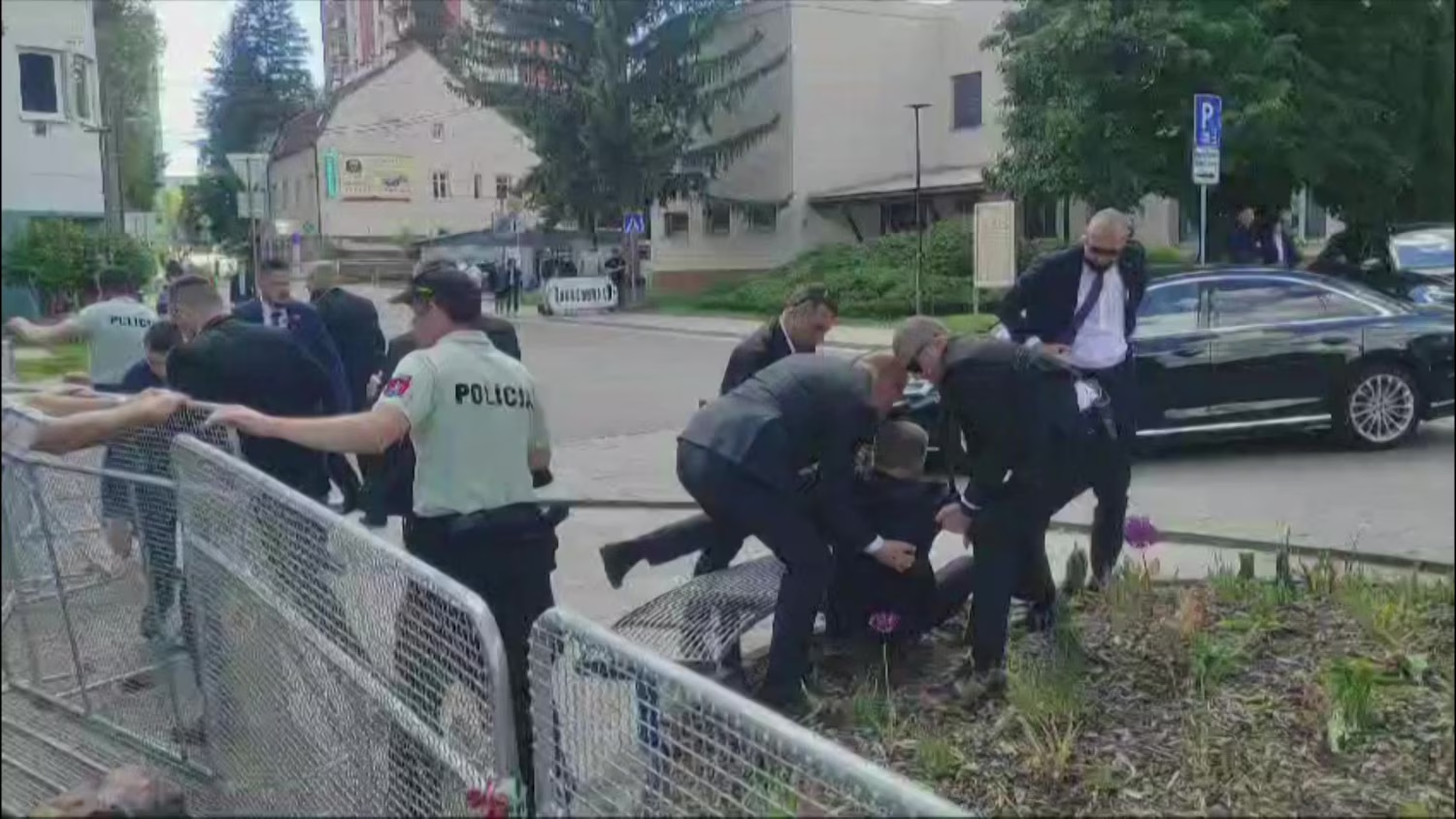
An Insane World: Fico shot …. Blinken in Discoland

An Observer in a Black Sea Town  … with highlights being impositions by Thuppahi

Slovakian Prime Minister Robert Fico has been shot and is in hospital. His condition is serious. Interestingly, Sky News, without any evidence, suggested the assassination attempt on Fico was because he was good friends with Putin,  and because he was opposed to sending weapons to Ukraine, and was therefore “supporting autocracies against democracies”.

Continue reading

1 Comment

Filed under accountability, american imperialism, authoritarian regimes, centre-periphery relations, disparagement, European history, historical interpretation, life stories, military strategy, nationalism, political demonstrations, politIcal discourse, power politics, security, self-reflexivity, truth as casualty of war, unusual people, world events & processes