
Juliet Coombe
Sri Lanka’s Tea Country Trail. 582 likes · 9 talking about this. The Tea Country Trail is a proposed 310 km long-distance hiking trail through the Sri Lankan Tea Country. The trail winds its way…

Juliet Coombe
Sri Lanka’s Tea Country Trail. 582 likes · 9 talking about this. The Tea Country Trail is a proposed 310 km long-distance hiking trail through the Sri Lankan Tea Country. The trail winds its way…
Filed under art & allure bewitching, British colonialism, cultural transmission, economic processes, education, ethnicity, female empowerment, heritage, historical interpretation, island economy, landscape wondrous, life stories, literary achievements, meditations, photography, pilgrimages, self-reflexivity, sri lankan society, the imaginary and the real, travelogue, unusual people, working class conditions, world events & processes
Telling It Like It Is …. is a compilation of a few of the journalistic writings of Anne Abayasekara.
She was born Annette Aurelia Ameresekere in April 1925. In the field of journalism, she was a Sri Lankan pioneer, entering what was a male dominated profession in the early 1940s. At Lake House, before reaching 22 years of age, she was appointed Editress of the Women’s Pages in the Ceylon Daily News and Sunday Observer, being the only female in the Editorial Department.
Filed under charitable outreach, citizen journalism, cultural transmission, education, female empowerment, governance, heritage, historical interpretation, language policies, life stories, literary achievements, patriotism, performance, politIcal discourse, press freedom & censorship, reconciliation, self-reflexivity, Sinhala-Tamil Relations, sri lankan society, tolerance, unusual people, welfare & philanthophy, women in ethnic conflcits, world events & processes
Chandre Dharmawardana

The word stub “ket,”, கேத, in the place name: Tiru-k-keteeswaram, திருக்கேதீசுவரம்
In finding a meaning for the component –ket– in Tiru-ket-heesvaram, well known Engineer Thiru Arumugam has quoted an interpretation given in 1849 by Pridham which leans on a mythological tale of Vishnu’s exlir of mortality that fell into the hands of a demon. The demon was said to be cut into two and became Rahu and Ketu (.இராகு கேது) recognized in astrology. Predham stretches his imagination very far to convert the Tamil -கேத- sound to கேது in finding an “explanation” or rationalization for the stub -கேத- found in the place name.
Filed under ancient civilisations, architects & architecture, art & allure bewitching, centre-periphery relations, cultural transmission, demography, economic processes, ethnicity, heritage, Hinduism, historical interpretation, Indian religions, Indian traditions, island economy, landscape wondrous, life stories, literary achievements, pilgrimages, religiosity, self-reflexivity, Sinhala-Tamil Relations, sri lankan society, Tamil migration, the imaginary and the real, transport and communications, travelogue, world events & processes
Chandre Dharmawardana
Cholas, Pandyas, and Cheras, are mentioned in the Ashokasthamba (Asoka-Pillar) inscriptions (3rd century BC although some historians think the pillar inscriptions may have been even earlier). When did Vijaya come to Tambrapanni? Is Vijaya even a real person?
I believe there have been many invasions (basically, not necessarily invasions, but people coming in even to farm, fish or trade, and by boats and settling down). Even Vijaya’s landing as described in the Pali chronicles was accidental.

Filed under Aboriginality, ancient civilisations, art & allure bewitching, cultural transmission, heritage, historical interpretation, Indian religions, Indian traditions, landscape wondrous, life stories, literary achievements, politIcal discourse, self-reflexivity, Sinhala-Tamil Relations, sri lankan society, Tamil migration, the imaginary and the real, transport and communications, travelogue, unusual people, world events & processes
F. C. De Saram, Cricketer Extraordinary
 FC de Saram pulling during he course of his century for Oxford University against the touring Australian team at “The Parks” in Oxford in the mi-1930s
Thiru Arumugam, being an article presented recently in The CEYLANKAN, Journal of the Ceylon Society of Australia. No. 3, August 2021
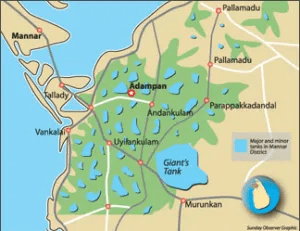
Thiruketheeswaram is located about eight km north of Mannar Town. It is on the coastal mainland of Ceylon, near the seashore on the direct coast road from Mannar to Jaffna. It has been the site of a Temple dedicated to Siva from pre-historic times. The place name of Thiru-Kethu-Iswaram has been devised as follows. ‘Thiru’ means sacred or holy and “Iswaran” is another name for Siva. As regards ‘Kethu’, Charles Pridham in his 1849 book A Historical, Political and Statistical account of Ceylon and its Dependencies describes how the gods asked Vishnu to prepare an elixir which would make them immortal. The elixir was prepared by churning the oceans but a demon who was a bystander also managed to drink the elixir. When Vishnu realised this, he cut off the demon’s head, but he was too late as the elixir had already made him immortal. The two parts became Rahu and Kethu, which are significant planets in the Hindu astrological system. In order to propitiate his sin, Kethu (Fig. 1) wandered from place to place and ultimately reached the shores of Lanka. He performed severe penances and he was ultimately blessed with the Lord’s vision and the place where this occurred was named Thiru-Kethu-Iswaram or Thiruketheeswaram.

Filed under ancient civilisations, architects & architecture, art & allure bewitching, cultural transmission, economic processes, heritage, Hinduism, historical interpretation, Indian religions, Indian traditions, landscape wondrous, life stories, literary achievements, meditations, photography, pilgrimages, politIcal discourse, religiosity, self-reflexivity, Sinhala-Tamil Relations, sri lankan society, tolerance, travelogue, world events & processes
SEE https://www.youtube.com/watch?v=qJOJ8F7bxDI

 The Bridge On The River Kwai location: the military hospital: Mount Lavinia Hotel, Hotel Road, Colombo, Sri Lanka | Photograph: Mount Lavinia Hotel
Uditha Devapriya, in The Island 12th & 19th August in two parts, with this title “Early 20th Century Buddhist Revival” …. https://ceylontoday.lk/news/a-short-note-part-1-early-20th-century-buddhist-revival AND https://ceylontoday.lk/news/a-short-note-part-2-early-20th-century-buddhist-revival
The colonial bourgeoisie in Sri Lanka did not form a monolithic class. They were divided horizontally as well as vertically: horizontally on the basis of income and inheritance, and vertically on the basis of primordial attachments such as caste ideology. Various factors, mainly economic conspired as much to unify the bourgeoisie as they did to divide them, distinguishing them by their homogeneity as well as by their heterogeneity.

Filed under art & allure bewitching, British colonialism, Buddhism, commoditification, cultural transmission, economic processes, education, ethnicity, heritage, historical interpretation, island economy, landscape wondrous, language policies, life stories, literary achievements, modernity & modernization, paintings, politIcal discourse, sri lankan society, transport and communications, unusual people, world events & processes
Tony Donaldson
I can remember a time back in the early years of this century when the age of cosmopolitanism was in fashion. It was a beautiful time. One of the great benefits of cosmopolitanism is that it allowed us to throw off the shackles of nationalism. We could take on different identities of our own choosing at any time in our lives with an absolute sense of freedom.[1] We could travel anywhere and engage with cultures and peoples around the world without political interference. We could build partnerships in business and trade that benefited all of us. Nationalism was in decline, and it was a positive direction for humanity.

Filed under accountability, Afghanistan, american imperialism, Australian culture, australian media, cultural transmission, economic processes, education, governance, historical interpretation, legal issues, modernity & modernization, politIcal discourse, power politics, self-reflexivity, world events & processes
Geoff Wijesinghe, in Faz, 2 March 2002 where the title is “George Siegertsz: Once again to those days” …. kindly sent to Thuppahi by Clare Marie White from out of the blue skies.
George Siegertsz, who passed away in London last week at the age of 82, was one of the last of a generation of post-World War Two musicians. George was a regular at Lion House at the Bambalapitiya Junction. He was one of the motley group of young men who visited the popular eatery, which served more as a “cup tea punt” (a cup of tea and a fag) club where these youth chatted for long hours of this, that and the other.
Although the group comprised many toughs who walked around like pocket editions of Humphrey Bogart, George Raft and Spencer Tracy, the tough guys at the time of the silver screen, George Siergertsz was more interested in chatting and in music. He was the country’s number one whistler, a fine art and often his friends at Lion House, would gather round a table and listen to him whistling the popular tunes at the time.

 Erin De Selfa
 thuppahi

