Category Archives: anti-racism

Sinhalese & Tamils Locked in Prejudice?

Michael Roberts 

An interesting chat with Mark LaBrooy in Melbourne on the phoe today induced me to re-visit my old SIGNATURE PIECE on “The Sinhala Mindset” in my Thuppahi site ….. Some of the commentary is as enlightening today as refreshing. That inserted by Jane Russell on 1 March 2012 and Chandre Dharmawardena’s  response  should continue to stimulate our thinking TODAY.

The problems of YESTERDAY still persist today.

Note that Jane is an Oxford graduate who secured her Ph.D in History at Peradeniya under KM de Silva’s supervision in Peradeniya in the 1970s. She has lived for lengthy spells in Sri Lanka since then because of her deep commitment to individuals and places within the land.

Continue reading

2 Comments

Filed under accountability, anti-racism, centre-periphery relations, chauvinism, communal relations, cultural transmission, demography, discrimination, economic processes, education, electoral structures, ethnicity, governance, heritage, historical interpretation, Indian Ocean politics, insurrections, language policies, legal issues, life stories, LTTE, nationalism, patriotism, performance, politIcal discourse, power politics, prabhakaran, security, self-reflexivity, Sinhala-Tamil Relations, sri lankan society, terrorism, the imaginary and the real, truth as casualty of war, war reportage, world events & processes, zealotry

The Expulsion of Muslims from the North by the LTTE in October 1990: Raison Détre

DBS Jeyaraj, whose chosen title is “How and Why the LTTE Evicted Muslims from the Northern Province in “Black October 1990,” when placed in DBSJeyaraj.com on 22 October 2020, …… This article was written in 2015 to mark the Twenty–Fifth Anniversary of Muslim Mass Expulsion From North by the LTTE. It is being re-posted without any changes to denote the 32nd annivrsary of the tragic event.

The Investigation launched by the office of the United Nations High Commissioner for Human Rights has in accordance with its terms of reference probed the period of time from the 2002 February ceasefire until the end of the war in May 2009 to ascertain whether war crimes, crimes against humanity and human rights violations occurred in Sri Lanka during the final phase of the war as alleged. The focus on these particular years has naturally led to the overlooking of many other terrible incidents which happened in the years preceding 2002. Notable among these horrors is the mass expulsion of Muslims from the North by the Liberation Tigers of Tamil Eelam(LTTE).

Continue reading

1 Comment

Filed under accountability, anti-racism, atrocities, centre-periphery relations, charitable outreach, communal relations, discrimination, ethnicity, governance, historical interpretation, human rights, legal issues, life stories, LTTE, Muslims in Lanka, politIcal discourse, power politics, rehabilitation, self-reflexivity, sri lankan society, terrorism, trauma, truth as casualty of war, vengeance, welfare & philanthophy

Study, Fellowship & Sport at Peradeniya Campus, 1956-60

Michael Roberts

PERADENIYA CAMPUS and UNIVERSITY is etched deeply into my soul: with diverse memories of places, events and personnel.  Many of the friends I met within its spaces have, alas, passed away; but remain as alive as afresh in my mind.

I had been placed in Ramanathan Hall as a freshman in mid-year 1957 and shared a room with Ranjit Samaraweera. His conviviality aided my adjustments to the new ‘terrain’.  So did my interest in sport. The skills in cricket, soccer and athletics that I had developed at St. Aloysius in Galle were now expanded to encompass rugger, while the indoor facilities at Peradeniya also encouraged my participation in basketball, table tennis and badminton on the odd occasion.

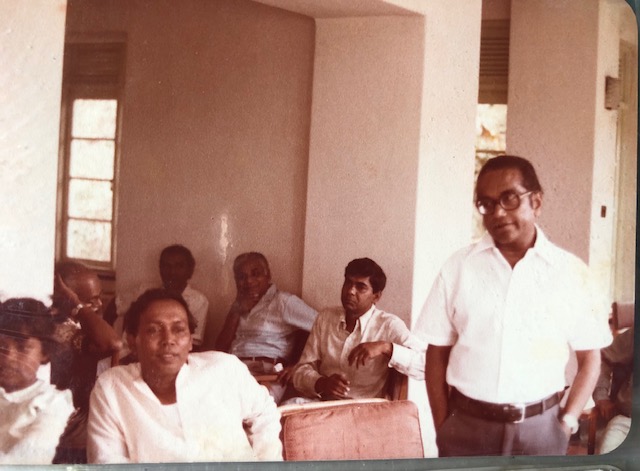
 Karl Goonewardena & Hussain Miyya in left pix& Sirima Kiribamune, CR De Silva & KM De Silva iamong the lot in the right pix

Continue reading

5 Comments

Filed under accountability, anti-racism, architects & architecture, art & allure bewitching, cricket for amity, cultural transmission, education, heritage, historical interpretation, life stories, meditations, patriotism, politIcal discourse, riots and pogroms, self-reflexivity, Sinhala-Tamil Relations, sri lankan society, teaching profession, unusual people

Debating Australian Aboriginal Lifeways Past

Gillian Cowlishaw, at John Menadue’s Public Policy Journal 15 August 2023 where her title is “Misreading Dark Emu”** …with highlighting emphasis imposed by Thuppahi


Criticisms of the book Dark Emu and its author, Bruce Pascoe, continue to appear, and to become more puzzling. It is as if the overwhelming popularity of Pascoe and his message have disturbed comfortable convictions about Australian history shared across a wide segment of Australian society.

Continue reading

1 Comment

Filed under Aboriginality, accountability, ancient civilisations, anti-racism, art & allure bewitching, British colonialism, centre-periphery relations, commoditification, cultural transmission, disparagement, economic processes, ethnicity, evolution of languages(s), heritage, historical interpretation, landscape wondrous, legal issues, life stories, photography & its history, politIcal discourse, racism, religiosity, self-reflexivity, travelogue, unusual people, world events & processes

Reflections: My Engagement with the Pogrom of July 1983 in Sri Lanka

Michael Roberts

The attacks on Tamils living and/or working in the southern and central parts of island Sri Lanka by elements of the Sinhala population were indefensible, horrible and disastrous for the country.  It is not adequate to depict them as “riots.” They constituted a “pogrom” – with all the pejorative colourings attached to that concept.[1]

Continue reading

1 Comment

Filed under accountability, anti-racism, atrocities, chauvinism, Colombo and Its Spaces, discrimination, economic processes, ethnicity, historical interpretation, life stories, LTTE, photography, politIcal discourse, power politics, racist thinking, self-reflexivity, Sinhala-Tamil Relations, sri lankan society, Tamil civilians, the imaginary and the real, trauma, unusual people, vengeance, world events & processes, zealotry

The Agony and Ecstasy of A Pogrom: Southern Lanka, July 1983

Michael Roberts … reproducing an article that appeared initially in a collection of my essays in 1994 under the title above in EXPLORING CONFRONTATION, Readng, Harwood Academic Publishers, 1994,  pp. 317-27. It was subsequently reproduced in Nethra, vol. 6, 199-213.  …. and then placed on web  in Groundviews (without its footnotes) .https://ground views.org/2019/03/28/the-case-for-foreign-judges-in-a-judicial-mechanism-in-sri-lanka-countering-falsehoods/


Bystanders after the burning and assaulting: also at Borella Junction area, 24-25th July 1983, picture by Chandragupta Amarasinghe. There is a suggestion here that popular participation in attacks were also initiated and/or facilitated by state functionaries. It is also likely that some of those described as ‘bystanders’ were perpetrators of some of the destruction, burning and killing. I had not discovered whom the photographer was when Exploring Confrontation went to press in 1994. Let me use this occasion to record my greatest respect for the bravery and ingenuity revealed by Chandragupta Amarasinghe in extremely dangerous and trying circumstances. 

Continue reading

2 Comments

Filed under anti-racism, atrocities, centre-periphery relations, Colombo and Its Spaces, communal relations, cultural transmission, disparagement, ethnicity, fundamentalism, heritage, historical interpretation, life stories, performance, photography, politIcal discourse, power politics, racism, riots and pogroms, self-reflexivity, Sinhala-Tamil Relations, sri lankan society, Tamil civilians, trauma, unusual people, vengeance, violence of language, world events & processes, zealotry

Philip Gunawardena, The “Lion of Boralugoda”

Sugeeswara Senadhira, in Daily News, 26 March 2021, where the title reads “The Relevance of Philip Gunawardena’s social nationalism”

Philip Gunawardena was a born leader who instinctively understood the hopes and aspirations of the people, a man close to the heartbeat of the nation. Today (26) is the 49th death anniversary of Philip Gunawardena, who earned the sobriquet ‘Lion of Boralugoda’.

Continue reading

3 Comments

Filed under accountability, anti-racism, British colonialism, communal relations, democratic measures, disparagement, economic processes, education, governance, heritage, historical interpretation, landscape wondrous, Left politics, life stories, modernity & modernization, patriotism, politIcal discourse, power politics, social justice, sri lankan society, unusual people, world events & processes

Cricket Pitch Invasions: Contrasting Reactions in Different Times

Michael Roberts 

If memory serves me right Terry Alderman injured himself when he tackled a lone Aussie pitch-invader on one occasion. Johnny Baisow isa sturdy Yorkshireman and he had no problems carting off …..yes “carting off” …. a slim intruder at the holy-of-holies ground known as “The Lords.”


Continue reading

1 Comment

Filed under accountability, anti-racism, centre-periphery relations, communal relations, cricket for amity, cricket selections, cultural transmission, discrimination, disparagement, ethnicity, historical interpretation, landscape wondrous, life stories, nationalism, patriotism, performance, self-reflexivity, Sri Lankan cricket, taking the piss, Tamil civilians, Tamil migration, trauma, travelogue, unusual people, world events & processes

Sexism & Male Chauvinism in English Cricket

Rob Harris & Tyrone Francis, in  SkyNews  27 June 2023, where the title reads English cricket condemned as racist, sexist and classist in damning new report

A Report by the Independent Commission for Equity in Cricket says racism is “entrenched” in English cricket; women are marginalised and there is no focus on addressing class barriers; more than 4,000 provided evidence.

The Independent Commission for Equity in Cricket chair Cindy Butts says English cricket needs to ‘accept the stark realities’ revealed in her report. English cricket is deep-rooted with widespread institutional racism, sexism and class-based discrimination, a report has found.

Continue reading

Leave a comment

Filed under accountability, anti-racism, centre-periphery relations, chauvinism, cultural transmission, discrimination, disparagement, ethnicity, life stories, politIcal discourse

Kochi: A Jewish Town without Jews

Christabel Lobo, in  Times of Israel,  20 December 2020 ,where the title reads thus: “India’s Jew Town only has a few Jews left, but traditions and landmarks remain”A sign denotes Kochi's 'Jew street,' as it is known locally, which once was a hub of Indian Jewish life. (Christabel Lobo/ via JTA)

  • A sign denotes Kochi’s ‘Jew street,’ as it is known locally, which once was a hub of Indian Jewish life. (Christabel Lobo/ via JTA)

KOCHI, India (JTA) …………Take a walk down this coastal city’s “Jew street” today and you’ll find bustling Kasmiri storefronts selling Persian antiques, pashmina shawls and traditional Islamic handicrafts — a stark contrast to the neighborhood’s heyday when every household was Jewish.

“There are only two people left in Jew Town. One very old, who spends most of her time in Los Angeles, and one other,” said Shalva Weil, a senior researcher at the Seymour Fox School of Education at the Hebrew University of Jerusalem and a leading figure on the Jewish communities of India.

Once a vibrant community of approximately 3,000 at its peak in the 1950s, only a handful of elderly Jews now remain in a city of some 677,000. According to Weil, there really is no community in Kochi anymore

“You won’t find more than five or 10 Jews,” she said.

Unlike other dwindling Jewish communities around the world, the Jews of Kochi did not leave their country due to persecution or hardship. Rather, it was the creation of the State of Israel in 1948 that attracted many from the mostly Orthodox community to emigrate and start a new life in the Jewish homeland.

1 Comment

Filed under accountability, anti-racism, art & allure bewitching, centre-periphery relations, communal relations, cultural transmission, demography, economic processes, ethnicity, heritage, historical interpretation, Indian Ocean politics, Indian religions, Jews in Asia, landscape wondrous, life stories, plural society, religiosity, self-reflexivity, travelogue, unusual people, world events & processes