Author Archives: thuppahi

About thuppahi

Sri Lankan and Australian nationality; student of Sri Lankan society and politics; sociology of cricket;

Raj Sivanathan Challenges the Catholic Diocese of Jaffna and Senator Lee Rhiannon

A point by point response from Raj Sivanathan to a Memorandum from the  Commission for Justice and Peace of the Diocese of Jaffna, Sri Lanka entitled “External Face-lift Given to North does not Correspond with Reality Deep down in hearts of the People”

Sivanathan’s ripostes are in bold and italics and will be converted to purple in due course

 Report issued as statement by the Commission for Justice and Peace of the Diocese of Jaffna, Sri Lanka

The widely advertised ‘war for peace’ came to an end more than three years ago. Yet the fruits of this peace are yet to be enjoyed by the people in the North, who were most affected mentally, physically and economically.

Response:  The ‘War for peace’ waged by the government of Sri Lanka was in response to the ‘war for an independent state of Tamil Eelam’ waged by the Liberation Tigers of Tamil Eelam (LTTE), supported by the Tamil National Alliance (TNA). It was a war fought by both contenders to a bitter end, ruthlessly.  The Éelam war # 4, was instigated and precipitated by the LTTE, while the Norway sponsored ceasefire agreement was in force.  The Scandinavian Monitoring Mission reported thousands of violations by the LTTE compared to a few hundred by the Government of Sri Lanka. Continue reading

2 Comments

Filed under accountability, australian media, historical interpretation, island economy, LTTE, politIcal discourse, power politics, propaganda, Rajapaksa regime, reconciliation, rehabilitation, Sinhala-Tamil Relations, sri lankan society, Tamil civilians, tolerance, truth as casualty of war, unusual people, world events & processes

Views of British Ceylon and Lanka

ONE: Video on Sri Lanka … with pulsating musical background ... http://www.youtube.com/embed/yFNSXFk1BYY?feature=player>www.youtube.com/embed/yFNSXFk1BYY?feature=player

a Hunting Party and A Coffee Planter and some labourers, mid 19th century  

TWO: Old Ceylon 1860s-1950s as collected by Rohan Edirimanne ….under title “Sri Lankan’s seen – Life of Sri Lankans, more than 100 years ago” Continue reading

Leave a comment

Filed under cultural transmission, heritage, historical interpretation, sri lankan society

The LLRC and the Encirclement of Sri Lanka

Kumar Rupesinghe, courtesy of Asian Tribune

The much abused word “civil society” must be deeply engaged in the reconciliation process. Civil Society, is not the handful of NGO”s financed by external funds, but the large and varied numbers of organizations such as trade unions, women’s organizations, the business community, the professionals, to name a few. As a first step the LLRC must be translated into all three languages and widely distributed.. Civil society must engage with the Lalith Weeratunge Commission, to improve and add quality to the implementation plan, and show ways and means of creatively expanding the reconciliation process. After all, much of the work will be done on the ground, amongst and within communities, and they must be brought into the process through a process of widespread consultations. There are many examples internationally, such as the process developed by South Africa, to name just one country which transformed a deeply divided society to one where all stakeholders were involved in the process of reconciliation. There are many such examples which we must study. Continue reading

Leave a comment

Filed under historical interpretation, NGOs, politIcal discourse, power politics, power sharing, Rajapaksa regime, reconciliation, Sinhala-Tamil Relations, sri lankan society, truth as casualty of war, war crimes, world events & processes

From ‘Immolation’ to my Epitaph for Neelan Tiruchelvam

Michael Roberts … This article was originally printed in the Lanka Monthly Digest, September 1999, vol 6:2, pp. 56-57. It was then expanded significantly in some places, while citations and footnotes were added, for its re-printing within the book Fire and Storm. Essays in Sri Lankan Politics, Colombo: Vijitha Yapa Publications, 2011, pp. 123-30 — ISBN 978-955665–134-8.

I: In February 1999 a Kurdish nationalist leader, Abdullah Ocalan, was caught by the Turkish authorities. Kurdish refugees in the Western world erupted in protest. In London a young girl Neila Kanteper set herself alight. In Sydney a young lad was caught on camera with petrol can and cigarette lighter as he threatened similar action. As I walked into the local news-agency in Adelaide that week the proprietor[1] waved the picture of Kanteper in flames in front of me and in considerable alarm inquired how anyone could take such an extreme measure. He could not ever take such a step, he said. His remarks gain in significance from the fact that they were unsolicited and had not been preceded by prior conversation. I was in a hurry and did not explore matters further, but I conjecture that his bewilderment stemmed not only from the method of death by fire, but also from such terminal commitment to a collective cause. The question, therefore, is whether in similar circumstances an act of martyrdom involving death by hand-gun would produce the same level of astonishment. Relatively speaking, death by gun seems to be so much more acceptable to the Western world than death by flame. Continue reading

3 Comments

Filed under life stories, LTTE, politIcal discourse, power politics, racist thinking, reconciliation, Sinhala-Tamil Relations, sri lankan society, suicide bombing, terrorism, unusual people, war crimes, world events & processes

Symbolic Violence Most Nīca, Wholly Foul – the Defacement of the Neelan Tiruchelvam Memorial Mural

Michael Roberts

This picture speaks volumes, but it will be even more horrendous to those who see the tarred vandalism in the raw so to speak. The indelible painted epitaph- on-road at the corner of Rosmead Place and Kynsey Road, the spot where an LTTE suicide bomber blasted the car in which Neelan Tiruchelvam was travelling to work late in July 1999, served as a reminder of the horrors of the ethnic conflict in Sri Lanka. As it happens, late July also marks the awful moment in the past where Sinhala chauvinist thugs, some state functionaries and others part of the populace assaulted, killed and terrorized so many Tamils in the southern parts of the island in the year 1983 – an act of punishment, or “teaching those #!!* Tamils a lesson” that was quite the contrary and wholly counter-productive. Continue reading

4 Comments

Filed under communal relations, cultural transmission, disparagement, historical interpretation, life stories, LTTE, patriotism, politIcal discourse, power politics, prabhakaran, Sinhala-Tamil Relations

Charles Haviland in Wonderland

Michael Roberts

See http://www.bbc.co.uk/news/world-asia-19298496# with its title “Beached Sri Lanka ship an extraordinary sight”

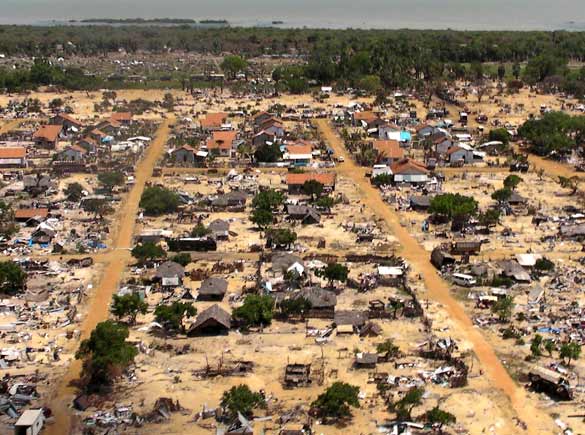
With the aid of BBC footage (and Tamilnet agitprop from the year 2009) Charles Haviland has placed his sensationalist spin on the last stages of the Eelam War IV and the battle for the Vanni pocket in this video – which readers should certainly view. His verbal presentation is prefaced by the written introduction to the site which runs thus: “Charles Haviland has been travelling in some of the places devastated in the final stages of the war in northern Sri Lanka three years ago. On a visit to the still-deserted village of Mullivaikkal, he came face to face with a huge ocean-going vessel captured by the defeated Tamil Tigers and later seized by the Sri Lankan military as they overran the last stretch of previously rebel-held coast in May 2009.”  the FARAH – Pic by Kanchan Prasad …cf those on the BBC video

However, I recommend that readers, especially younger generations, should…

A: re-visit the scenes of Western Europe and Germany in 1944 and 1945 during World War II and, more vitally,

B: study the image of SS Farah in the Times series of late May 2009…

C: and the whole series of photographs taken by Kanchan Prasad on the same strip of the Nandikadal foreshore between 14th and 18th May 2009 – especially those of Mullivaikkal hospital.

 a Times aerial image –but one must not rely on just one–see the series

These pictures will restore some balance to the Haviland-BBC slants. With my familiarity in WW Two scenarios, what struck me was the degree to which so many buildings – several of them newly-built red-roof buildings constructed after the tsunami of 2004 had wiped the area desolate clean — remained standing. Young Charles needs to improve his reading skills.

 Pics by Kanchan Prasad, with one showing Muralidhar Reddy in front of an LTTE building

Leave a comment

Filed under accountability, LTTE, politIcal discourse, propaganda, Rajapaksa regime, Sinhala-Tamil Relations, Tamil Tiger fighters, truth as casualty of war, world events & processes

Alex Kuhendrarajah, where are you? Lessons to be learnt by Australian media

Michael Roberts, courtesy of Eurasia Review, 19 August 2012

Alex! Alex! Where art thou? We need you. Australia needs you. As a tale of “high drama” and alleged “piracy” surrounds the Wallenius Wilhelmsen and its detour to unload 67 male asylum-seekers at Christmas Island[i] hits the Australian headlines your experience and grandstanding would be beneficial to all sides. RECALL how you bestrode the Australian media waves during the last quarter of the year 2009 after the Jaya Lastari, with its 256 Tamil asylum seekers, was impounded at Merak off Java and all of you attempted to blackmail your way to Australia! Now, in August 2012 as another clutch of asylum-seekersrescued by the Wallenius Wilhelmsen has “threatened to harm themselves” and secured a passage to Christmas Island, thereby raising Scott Morrison’s ire (on behalf of the Liberal Party and Australia at large),[ii] your inside knowledge would be pretty handy. Continue reading

5 Comments

Filed under accountability, asylum-seekers, australian media, life stories, news fabrication, people smugglers, politIcal discourse, propaganda, pulling the leg, Sinhala-Tamil Relations, sri lankan society, tamil refugees, truth as casualty of war, unusual people, world events & processes

Aussies-in-a-Tizz, III: A new tougher offshore regime?

Chris Merritt and Lauren Wilson, in The Australian, 18 August 2012 with title “New offshore processing regime bars appeal on asylum.”

 Asylum-seekers arriving at Christmas Island this week. Source: Supplied

JULIA Gillard’s new offshore processing regime has effectively locked asylum-seekers out of Australian court appeals, legal experts declared yesterday, as four boats arrived in 24 hours in a rush to beat the new laws. Human rights lawyers said the new offshore processing regime had stripped back the capacity for judicial review of government decisions and eliminated many of the grounds for legal challenges by boatpeople. Continue reading

Leave a comment

Filed under accountability, asylum-seekers, australian media, historical interpretation, life stories, people smugglers, politIcal discourse, population, power politics, Tamil migration, tamil refugees, tolerance, welfare & philanthophy, world events & processes

Aussies-in-a-Tizz, II: Moral crusaders and their myths

Chris Kenny, in The Australian, 18 August 2012, with title “The onus on moral posturers is to say why they persist with their disingenuous myths

THE report of the expert panel on asylum-seekers has exposed some long-denied realities, not only demolishing arguments used against tough border control measures but dispelling myths that have been patronising to mainstream Australians. This week’s policy reversal might slow the boats – given time and a resolve not seen to this point – but because of the about-face on what has been framed as a moral stand, it is impossible to envisage Labor escaping a political reckoning.

 Paris Aristotle, left, Angus Houston and Michael L’Estrange face the media after the release of their report. Picture: Ray Strange Source: The Australian

Ineptitude, leading to needless trauma, tragedy and expense, will play a role in public assessments, but so will the way the progressive political class has insulted voters over this for more than a decade. One of the myths exploded by the expert panel is the fanciful notion that there is no queue. The commonsense claim that asylum-seekers arriving by boat win residency ahead of those applying through orderly processes has been haughtily rejected by the moral progressives. “Political leaders used arguments against asylum-seekers which were mean, petty and false,” former Liberal prime minister Malcolm Fraser said. “How can you join a queue when there is no queue?” Continue reading

Leave a comment

Filed under accountability, Afghanistan, asylum-seekers, australian media, ethnicity, historical interpretation, immigration, Left politics, life stories, politIcal discourse, racist thinking, Tamil migration, world events & processes

Aussies-in-a-Tizz, I: “Finger in the dyke can hold only so long”

Cameron Stewart, in The Australian, 18 August 2012

 A crowded asylum-seeker boat arrives at Christmas Island last month. The desire to stop the relentless flow of boats has elevated pragmatism over principle, utility over law and head over hearts. Picture: Stephen Cooper Source: The Australian .. note the name = Ineshgey Putha

THE initial euphoria in some quarters about a breakthrough in asylum-seeker policy is being tempered by the realisation that the grand plan unveiled this week by the Houston panel faces a series of potentially fatal obstacles.The devil in the detail is always less compelling than the grand vision, but it is the detail of the Houston plan that poses the greatest threat to its ambition of providing a historic circuit-breaker to the asylum-seeker crisis. The immediate risk to the plan – now enshrined as Labor policy – is that it was conceived as a complete package but only parts of it have any hope of being implemented in the short term.

While the new offshore asylum-seeker holding centres of Nauru and Manus Island in Papua New Guinea will be reopened quickly to provide an instant deterrent to boat arrivals, the second key plank of the plan – the pursuit of a rejigged Malaysia Solution, along with greater regional co-operation on asylum-seekers – is only a diplomatic dream. Continue reading

Leave a comment

Filed under asylum-seekers, australian media, authoritarian regimes, historical interpretation, life stories, people smugglers, politIcal discourse, population, Tamil migration, tamil refugees, tolerance, world events & processes