
Sanjeewa Jayaweera, whose Vale is entitled “The day my father climbed a tree to watch Sir Garfield Sobers bat – The Island”
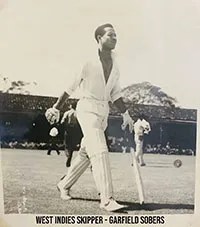 Picture depicting Sir Garfield coming out to bat at the Sara Oval
He was forty years old, a respected public servant, and the father of four children at the time. Yet, when he discovered that tickets for the third day’s play of the West Indies versus Ceylon match at the P. Sara Oval had sold out, he accepted the offer of a group of younger spectators to help him climb a tree overlooking the ground so that he could watch his hero perched on a branch. (cf . the PIX in Roberts: Incursions & Excursions in …. SL Cricket, 2011, which presents a stunning photo of the crowd under and within the trees of the Colombo Oval watching the Aussies on 30 March 1938).

When young Sobers met his hero Sathasivam in Colombo earlier
My father had earlier declined the offer of a complimentary VIP pass from his brother, Neville Jayaweera, then Chairman and Director-General of the Ceylon Broadcasting Corporation. At the time, my father was in strife with the UNP government, which had interdicted him for political reasons without ever laying charges against him. My uncle was probably relieved, as my father was quite capable of directing a few chosen words about his treatment towards Prime Minister Dudley Senanayake, who would have been seated in the row immediately in front of him.
Instead, he chose the tree.
My mother was less than impressed that he had risked life and limb simply to watch Sir Gary bat. My brother and I, however, together with perhaps millions of cricket lovers around the world, completely understood the risk-reward calculation. Some cricketers inspired admiration. Sir Garfield Sobers inspired devotion.
When he came home, he took my brother and me aside and described to us in great detail the century (115) scored by Sir Gary. He was enthralled, and I remember him showing some of the strokes played by Sir Gary with such enthusiasm that, even as a seven-year-old, I could sense I had missed something truly extraordinary. According to him, some of Sobers’ stroke play was unbelievable. It had been an innings full of artistry and sheer class. Sri Lankan paceman Sarath Wimalaratne nearly bowled Sobers out before he had scored any runs. However, after that, it was all one-way traffic with Sobers in full flow. He was a languid cricketer with loose limbs, a delight to watch. His cover drives and square drives were exquisite.
That episode has remained etched in my memory for almost sixty years. It illustrates better than anything else the extraordinary hold Sir Garfield Sobers had over cricket lovers across the world. The news of his passing brought all those memories flooding back.
Growing Up in a Simpler Era
For those of us (males) who grew up in the fifties and sixties, the only activity outside school was cricket and befriending a girl, probably in the same order! There were no smartphones, computer games, social media, television, drugs and whatnot that seem to preoccupy the lives of youngsters growing up these days. Although Ceylon had many exciting cricketers, at the time we had not attained test status, and it was the performances of the foreign players that caught our imagination and were our heroes.
Television was yet to arrive, and our connection to our foreign cricketing heroes was through pictures and reports in local newspapers. Those of us fortunate enough to have a shortwave radio at home would try to follow the matches played in England and Australia on either the BBC or the ABC amid constant static, making most of the commentary difficult to decipher. If a sponsor were forthcoming, Ceylon Broadcasting Corporation (CBC) would broadcast a daily 30-minute segment. The quality of the CBC broadcast was far superior.
My brother, Rajeewa and I used to play cricket on a tiny strip no more than 10 feet wide on the side of our house every afternoon and for most of the day during school holidays! We played make-believe “Test” matches, the only form of cricket played at the time. Invariably, my brother, being older, would decide to represent Ceylon or England. Therefore, I represented either Australia or the West Indies. Since Sir Garfield Sobers was my hero, leading the West Indies was a pleasurable exercise.
The exploits of the West Indian players with their exotic stroke play and their cavalier approach caught the imagination of many of us, both my father’s generation and that of mine. My father was approaching his forties whilst I was only about five years old. It was therefore unsurprising that for many Sir Garfield Sobers, then known simply as Gary Sobers, was our ultimate cricketing hero. The fact that he was a coloured player challenging the supremacy of a predominantly Anglo-Saxon game played some part in the minds of both my father and me. However, I believe that the exceptional talent and performances of Sir Garfield transcended the cultural and colour barriers.
Sobers’ world record score of 365
In 1958, aged only 21 years, he posted the highest individual test innings, scoring 365 against Pakistan. Incidentally, this was his maiden test century. His contribution with both the bat and the ball during the famous series between West Indies and Australia in 1960-61, when the first-ever tied test took place, established his preeminence as a batsman of the highest class and an outstanding all-rounder who could bowl fast as well as orthodox spin as well as wrist spin. He was an outstanding fielder as well.
In 1966, touring England under his captaincy, the West Indies beat England 3-1 in the five-test series. He led by example, scoring 722 runs at a Bradmanesque average of 103 runs per innings and took 20 wickets and held 10 catches. It was a sensational performance. Sir Gary was at his peak.
West Indies Tour of Ceylon in 1967
One of my fondest and most precious memories was the encounter between West Indies and Ceylon played at the P. Saravanamuttu Stadium in Colombo, then known simply as ‘Oval.’ The three-day match was played between 21 and 23 January 1967.
In those days, most international teams would stop over in Colombo and play a two or three-day game. We used to wait for the arrival of a visiting team eagerly.
The indomitable Sir Garfield Sobers captained the all-conquering West Indian team. Michael Tissera, another hero of mine, led the Ceylon team.
My brother and I were the lucky recipients of two VIP passes courtesy of Uncle Neville. I was seven years old, and my brother was ten. Our instructions were to be on our best behaviour as Prime Minister Dudley Senanayake sat in the row before us!
My brother and I, accompanied by another uncle, made our way to the Oval on January 22. We were deliriously happy about being able to watch our heroes in action. That, too, from the comfort of the VIP enclosure! The “Oval” was packed to the rafters as the saying goes!
Our batsmen had done quite well on day one to post a score of 290 for nine wickets. David Heyn, a pugnacious left-hander, scored 69. Other useful contributors were Captain Tissera 52, Lionel Fernando 48, and Dr. H I K Fernando 42.
On Day 2, my brother and I witnessed a grand display of power batting as our No 10 and No 11 batsmen. Neil Chanmugam (72 runs) and P I Pieris (46 runs) added 110 runs for the last wicket in about 70 minutes of exquisite stroke play. Although I was too young to remember every detail of that partnership, it set the ground alight. One of the sixers clobbered by Chanmugam saw the ball wedged between the tiles of the pavilion roof. A groundsman had to climb up to fetch the ball. Ceylon scored exactly 400 runs in their first innings;
It was then the turn of the West Indians to entertain the crowd. Despite our bowlers claiming a couple of early wickets, we were to witness a grand exhibition of power-hitting by Clive Lloyd. He scored 138 and along the way belted several sixes, many of which landed and broke the roof tiles! I found it fascinating to watch him clear the boundary with such ease. On the opposite side was Basil Butcher, who scored 152 runs with a lot of grace and timing. However, I was heartbroken; my hero Sir Garfield Sobers did not get the opportunity to bat on day 2. My Uncle had informed us that he would be utilising both his passes on day 3. On the final day of the match, I decided to fall sick and skip school so that I could listen to the commentary of the game over CBC!
Simply the Greatest Cricketer
Sir Garfield was to dominate world cricket for another ten years or so before he retired from Test cricket. In 1968, playing county cricket, he was the first ever batsman to score six sixes in an over. He scored a sensational 254 against Australia for the Rest of the World team in 1972, hailed by Sir Don Bradman as the greatest exhibition of batting seen in Australia.
Runs scored, wickets taken and catches held by Sir Gary during his illustrious career are proof of his cricketing genius. However, one must not underestimate the impact his performances had on other West Indians and coloured cricketers in establishing that coloured players are equally good or even better and can compete with the Englishmen and Australians.
Sir Garfield’s passing was not simply the loss of one of cricket’s greatest players. It marked the passing of a sporting giant who had shaped the childhood dreams of an entire generation. For my father, for millions across the cricketing world, and for the little boy who once pretended to captain the West Indies on a ten-foot strip beside our house, Sir Garfield Sobers was simply the greatest. He always will be. Rest in peace, Sir Garfield.

