
From the Sunday Times (Sri Lanka), 2 August 2026, where the title reads “In search of Charles Ambrose Lorenz: Nick van der Hoeven traces his vanishing legacy” … reproduced here with highlights and title imposed by The Editor, Thuppahi
There is a particular kind of disappointment that comes not from finding nothing, but from finding almost everything – locked, boxed, boarded up and quietly out of view.
Over two trips to Sri Lanka in the last three years, I set out to find what remains of Charles Ambrose Lorenz: lawyer, journalist, legislator and, by most credible historical accounts, one of the most eminent people of European or part-European descent to emerge from four and a half centuries of Ceylonese colonisation.
 What I found was a man who is, in the most literal sense, still there. His house stands. His bust survives. His portrait remains. His final home is maintained. And yet he is almost entirely absent from public memory.
 To understand Lorenz, it helps to start with his family. His father, Johan Frederick Lorenz, was born in Prussia in 1772 and arrived in Ceylon as a young man with little money and few prospects. He eventually became a magistrate in Matara and married into an established Dutch Burgher family. Charles, born in 1829, was the youngest of nine children – part of a community whose identity was already a mixture of Prussian, Dutch and Ceylonese influences.
The family lived at Lodge Harmony, a large house on the banks of the Nilwala River and, by all accounts, a lively centre of Matara’s social and intellectual life. Recognising the opportunities created by educational reform, his father sent Charles to the Colombo Academy, today Royal College, where in 1846 he shared the Turnour Prize, one of the school’s most prestigious honours.
What followed was a career of almost bewildering range for a man who would die before his 43rd birthday.
Called to the profession in 1849, Lorenz became a barrister of Lincoln’s Inn in 1855 and served as District Judge of Chilaw before returning to private practice. In 1856, he was appointed a non-official Burgher member of the Legislative Council of Ceylon. He was the first non-official member to secure the right to introduce a private bill – a small but significant assertion of local voice within a colonial institution designed to give it very little.
In 1860, he was among the first elected members of the newly formed Colombo Municipal Council, a body he had campaigned to establish.
Lorenz was as much a newspaperman as a lawyer. In 1859, he led a syndicate that purchased The Examiner, transforming it into The Ceylon Examiner, which he edited and largely wrote until his death.
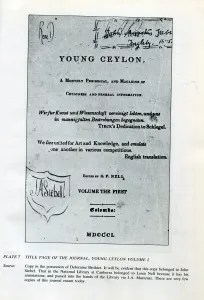
Earlier, in 1850, he had co-founded Young Ceylon with fellow Burgher intellectuals. The journal became an early expression of local political consciousness, influenced by the currents of European liberal nationalism then reshaping Italy and Germany.
It was from this circle, sometimes called the Young Ceylon movement, that Lorenz is credited with coining the term “Ceylonese” – an identity that asserted belonging to the island rather than to any single ancestral homeland.
His practical achievements were equally significant. He was the architect of the ordinance through which Ceylon adopted its own currency of rupees in place of the British pound sterling. He played a central role in the campaign to nationalise the island’s railway, arguing that it should serve the country as a whole rather than primarily plantation interests.
He also worked on the reform and codification of Ceylon’s laws, championed education and used The Ceylon Examiner to criticise the colonial Governor and Executive Council when he believed they had failed the people of the island.
But it was his character that appears to have earned him his most enduring reputation.
Though a Burgher by ancestry, he was known as “Lorenz Hâmuduruwwô” – a term of considerable respect. He was seen as someone who stood for the Ceylonese people regardless of race, caste or creed, at a time when such an outlook was neither expected nor common among the island’s European-descended elite.
Contemporaries described him as extraordinarily generous, freely giving his legal counsel and personal resources to those who could afford neither. When he died of tuberculosis in 1871, still in his early forties, it is said that the streets of Colombo fell into mourning.
Matara: Lodge Harmony
My search began in Matara. Lodge Harmony, the house in which Lorenz was born and spent his early childhood still stands on the Old Matara Road, on the far bank of the Nilwala River from the old Dutch fort. What I found was a building in serious disrepair. Wire fencing surrounded the perimeter. Plywood had been nailed over windows that would once have looked out across the river. The whole structure was padlocked and apparently untouched by any programme of restoration or maintenance.
Colombo: A bust in storage
My next destination was the Royal Asiatic Society’s library in Colombo, of which Lorenz had been a proud and active member in the mid-nineteenth century. I had read of a bust made of Lorenz after his death – a memorial intended to ensure that something of him endured.
Having paid the subscription required to access the library, I found the bust where I least expected it: in a back storage room, away from the reading room and from public view.
Why the bust of one of the Society’s most celebrated former members sits in storage, I could not establish. No one I asked seemed to have an answer.
The Pettah: A portrait on the floor
The most elusive object of my search was a portrait of Lorenz, apparently commissioned after his death in 1871 and unveiled with considerable ceremony in the Colombo municipal offices in 1874.
I visited the National Archives, the old Town Hall and the newer Town Hall in turn, coming away empty-handed. Almost as a last resort, I arrived at the Old Town Hall Museum in the heart of the Pettah.
After some searching, I was shown into a padlocked room. There, propped on the floor in a far corner, was the portrait. A century and a half old, it is not in good condition. But it is there.
Karlsruhe: The one place time has been kind
Lorenz’s last home, a bungalow he named Karlsruhe, has served for more than a century as the residence of the Principal of Wesley College in Colombo. The school was gracious enough to allow me to photograph it.
Though the eleven acres of land that once surrounded the house have long since been absorbed into the school, the bungalow itself remains in excellent condition. It still carries something of the grandeur it must have possessed when Lorenz, lived out the last chapter of his remarkable life before succumbing to tuberculosis.
Does it matter?
It would be easy to read this simply as a story of decline — another entry in the long ledger of things that independence, modernisation and demographic change have swept away.
But I do not think that is quite right. Nothing here has been destroyed.
Lodge Harmony has not been demolished. The bust has not been discarded. The portrait has not been lost. His final home is still in use.
But he has been left behind.
The reasons are not mysterious. The Dutch Burgher community went into steep decline in Sri Lanka after independence, accelerated sharply by the Sinhala Only Act of 1956. This contributed to the closure of many of the professions in which Burghers had specialised and prompted largescale emigration to Australia, the United Kingdom and elsewhere.
A shrinking community loses, along with its numbers, the informal apparatus of memory: the descendants who visit, the societies that lobby, the families who tell the stories.
Beyond the work of scholars such as Michael Roberts, Lorenz’s legacy now survives mainly in a handful of academic prizes awarded in his name and a minor Colombo street bearing his surname – virtually unknown to the wider Sri Lankan public he spent his life trying to serve.
And yet the case for remembering him is remarkably strong.
This was not a colonial administrator who governed briefly and returned home. Lorenz was born on the island, died on the island and spent his career trying to give the island a voice, a currency, a railway answerable to its own interests and a newspaper willing to speak plainly to and about its government.
In coining the word “Ceylonese”, he also helped articulate an identity that transcended race and ancestry in favour of shared belonging.
Few figures from that era can claim as concrete and public-spirited a record.
That is why a bust sitting in a storage room and a portrait propped against a museum floor seem to me to matter.
What is missing is the decision to bring those fragments of memory into public view — to give them a proper, dignified home where people can see not only who Charles Ambrose Lorenz was, but why he mattered.
I do not know if this article will change that. But it seemed worth writing down what I found, and where, in case someone reading it – in Colombo, in Matara, or in the Burgher diaspora scattered across Australia and London – might be moved to ask the same question I kept asking on both of my visits:
Why is he not where we can see him?
&&&&&&&&&&&&&&&&&&
NB: The writer is a shipbroker and academic based in Melbourne, Australia, currently writing a novel of historical fiction based on the life of Johan Frederick.


Dear Nick,
Interesting article. There is a book written about Lorenz:
AUTHOR: Blaze, Benjamin.
TITLE: The Life of Lorenz.
Best wishes,
Yvette Paulusz
Hi Yvette. Thank you and yes I managed to read that at the national library in Canberra along with ‘people in between’. I would love to buy either / both books but they are difficult to find.
Of course, Charles Ambrose Lorenz needs to be recognized and remembered.