
Earlson Forbes
Regarding your recent Thuppahi article titled:“Post Second World War Sri Lankan Migration to Australia…..1946’: I found your article very interesting. However, I could not compare figures in one of my articles with figures supplied in your article as the formatting of tables was user unfriendly.
The first point I wish to make is that due recognition has not been attributed to The Colombo Plan as an instrument that contributed to a change of attitude in Australian Migration Policy. The Colombo Plan was established in 1951 to enable post war recovery in the British Commonwealth of Nations, (somewhat like a mini Marshal Plan). The Colombo Plan sought not only to foster infrastructure development, but to focus on education at both the institutional and individual levels. Australian bureaucrats and policy makers who came into direct contact with their counterparts in India, (including present day Pakistan and Bangladesh), Ceylon and Malaysia realised that there was a sizeable body of highly qualified personnel capable of satisfying Australia’s future developmental needs.[1]

The second point I wish to make is that the Liberal/Country Party (Liberal/National Coalition today) is in most instances not given due credit for substantial dismantling of The White Australia Policy. One of the pillars on which The White Australia Policy was formulated was the Immigration Restriction Act 1901. This Act remained in force largely unchanged until 1958. In 1958 new legislation was passed (The Immigration Act 1958) which replaced the 1901 legislation. The new Act did away with the Dictation Test and other discriminatory measures and established a Visa system for entry to Australia. The Visa system altered in many ways still stands as the system for admission to the country be it for Permanent Residence or any other period of stay. It was the Liberal/Country party which was in Government when this legislation was passed.
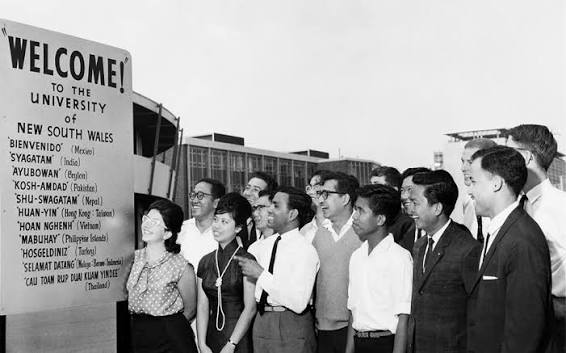
Although the Visa system was a major advancement in migration policy it took another nine years for significant change to come about. As mentioned above The Colombo Plan and many other events and occurrences opened Australia to Asia and the rest of the world. Australian Bureaucrats and policy makers were moving towards the realisation that there was a pool of qualified talent (albeit non-white) which could meet Australia’s need at the time for technically and professionally qualified personnel. And so once again it was in 1966 that the Liberal/Country Party made a change to Immigration policy. A Department of Immigration communication dated 19th September 1967 stated: –
‘Following the Government’s review of policy in March1966, provision exists for the entry of other persons wishing to settle here on the basis of their general suitability, their ability to integrate readily and their having qualifications which are positively useful to Australia’ ….. [See figure 1]
The years following saw a marked increase in non-European and mixed-race migration to Australia. In 1966/67 the number entering Australia from these 2 categories was 3868 and in the next five years the number entering was nearly 27,000. {3}
Note that in the 26 years from 1949 to 1975 the Liberal/ Country Party was in power for 23 years (1949 to 1971) and the Labor Party for 3 years of these years (1972 to 1975). Dismantling of The White Australia Policy was undertaken in a cautious and considered manner by the Liberal/Country Party. The Labor Party completed the process by driving the last nail into the coffin of The White Australia Policy.
END NOTES
[1] David Lowe – 2010 Deakin University. The Colombo Plan and ‘soft ’Regionalism in the Asia Pacific.
[2] Figure 1 National Archives of Australia.
[3] Various Australian Government Fact Sheets (Immigration).

Two articles authored by me have more on these issues
$ Sir John Kotalawala’s visit to Australia and New Zealand.
$ Fortress White Australia.
&&&&&&&&&&&&&&&&&

