

Michelle de Kretser’s “Questions Of Travel” secures Miles Franklin Award
Courtesy of ABC News, 19 June 2013
 [As announced in mid-June] Michelle de Kretser won the 2013 Miles Franklin Award, Australia’s most prestigious literary prize. De Kretser won the $60,000 prize for her novel Questions Of Travel, a story drawn around two disparate characters that explores belonging and questions of home and distance. Judges announced the award at the National Library of Australia in Canberra this afternoon, praising the novel as “witty and poignant”. The chair of the judging panel, Richard Neville, says it was difficult to choose a winner from the first all-female shortlist in the award’s history.
“The judging process itself is exhaustive and exhausting… this year there was intense discussion on the winner,” he said. “Michelle’s novel is a novel of great ambition and great wisdom. It’s dealing with all, so many issues that Australian society’s talking about and it’s just a wonderfully written, engaging novel.” Continue reading
The serene smiling face of Ashton Agar highlights multi-cultural Australia
Chip Le Grand and Pia Akerman, in The Weekend Australian, 13 July 2013, where the title reads “Cricket’s new face, Ashton Agar, has a serene smile.”
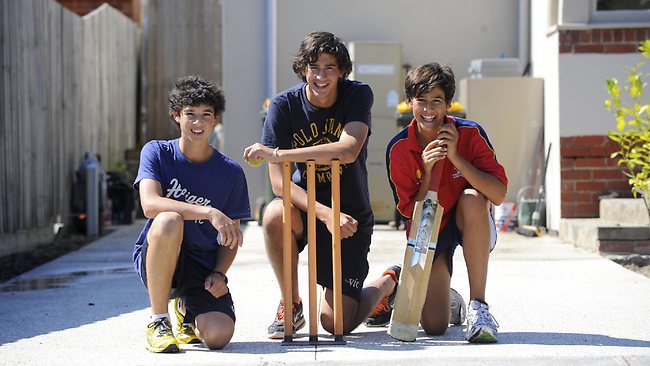 THE face of Australian cricket has always been hard set. Ricky Ponting’s furrowed brow. Steve Waugh’s defiant stare. Allan Border’s stubborn resolve. The Chappells and their killer gleam. The new face of Australian cricket wears a broad smile that has captured the hearts of a sleep-deprived nation. That it shone as brightly in the moments after Ashton Agar got out for 98 as it did when he was chasing an improbable century on debut evokes Kipling’s famous line about triumph and disaster and treating those two imposters just the same. Back home in Melbourne, it reminded Agar’s high school maths teacher and cricket coach of the advice he gives every kid that takes block for De La Salle College. “You want the opposition to walk off the ground wanting to hate you but not having a reason,” says Marty Rhoden, a teacher and coach to all three Agar brothers. “He is so level-headed and grounded. You notice the first thing he did when he ran back on to the ground after taking off his pads was to go up to (his brothers) Will and Wes and apologise for getting out.” Continue reading
Willa Wickramasinghe and the SSC Pamphlets: An Appreciation
Michael Roberts
 Wilfred Wickramasinghe, “Willa” to his pals, was born on 12th December 1932 and was educated at S. Thomas’ College, Mount Lavinia. He thereafter joined the Sri Lanka Air Force and passed out first in his batch at Diyatalawa. The government of that day said they had no money to send him to Cranwell in UK for his officer training, so he promptly resigned his commission and set off for England in order to study insurance. While in London he became President of the Sri Lanka Students’ Union during the late 1950s over two successive years, succeeding Ratnasiri Wickramanayake (subsequently a Prime Minister). Wilfred became a Communist while a student in England and travelled widely in Russia and other Communist countries. Continue reading
Selfless Service to All — Appreciating D. P. M. Weerakkody
Fr Egerton Perera sj in the Island, 2 July 2013, where the title is “Emeritus Prof. D. P. M. Weerakkody – ‘He gave himself selflessly’
 D. P. M. Weerakkody, Emeritus Professor of Classical Languages of the University of Peradeniya, passed away on June 26, after a brief illness. On Friday, his body lay-in-state at the Arts Theatre of the University for faculty members, students, and friends to pay their respects to a distinguished and dedicated teacher. This was followed by a Thanksgiving Mass at the Catholic Chaplaincy of the University to honour a selflessly committed Catholic, who inspired the teachers, chaplains, alumni and students of the University, by being for several years, both the Senior Treasurer and Director of the choir of the Newman Society – the Catholic Students’ Movement of the University. Continue reading
Bikes for Life and Cricket towards Reconciliation at Kilinochchi via FOG
Skandakumar
 I have just back from Killinochchi ……at 4 am Tuesday morning after having left at 8 am on Sunday!! It was a rewarding trip that allowed a group of us to visit an orphanage of 330 children, and see the work a retired GA in charge, Rasanayagam, is doing for them and for 6000 widows in that area. We also visited a Harmony Centre constructed by the Army that will soon provide access to IT, English, et cetera — a centre that also has a badminton court and modest gym facilities . Continue reading
Remembering G. C. Mendis as Pioneer Historian of Sri Lanka
An Obituary Appreciation by WJF Labrooy, reprint from Daily News, 26 October 1976
 Dr. G. C. Mendis, 1893-1976
Dr. Mendis’s contribution to the advancement of the teaching of Sri Lanka history at University level was a major factor in establishing new standards and achieving higher levels of scholarship and research in many institutions of higher learning in the island. Garrett Mendis received most of his elementary and secondary education at Kingswood College. Kandy,. founded by Mr. L. E- Blaze, himself a pioneer in promoting the teaching of Sri Lanka history in schools. Dr. Mendis Mcndis wrote two excellent text books for the purpose, assisted by the three books written earlier by Mr. L E. Blaze (1900), Mr. Donald Obeyesekere (1911). and Mr. H.W Codrington (1926). Continue reading
Lamenting the Literary Terrorist
Richard Jackson, 25 June 2013, courtesy of academia.com,


Why have novelists so far failed to write a believable terrorist character, one that reflects actual people in the real world? Why do literary terrorists instead mostly conform to propagandistic stereotypes and widespread cultural myths? I must have read a hundred novels both popular and serious literary fiction with central terrorist characters, and I have yet to be satisfied with one which I feel represents a real person in the real world. Here, I am not referring to offbeat characters accused of terrorism (such as Paul Auster’s Leviathan), terrorists who are dead and their motivations have to be reconstructed retrospectively (such as Yasmina Khadra’s The Attack), or characters accused of terrorism who are really not terrorists in any reasonable sense (such as Heinrich Boll’s The Lost Honour of Katharina Blum). Continue reading
Figuring the Death Toll during the LTTE’s Endgame: Issues at Stake, I
Kath Noble, in the Island, 3 July 2013, where the title reads “This is no Game“
Some months ago, my attention was drawn to a report on civilian deaths in the final phase of the war. The author – as yet unnamed – claimed to have something important to add to the debate that began in 2009 as the Army closed in on the LTTE in Mullaitivu.
 I must admit that I didn’t feel very inclined to read it. Of course it is disturbing that estimates of the number of people killed between January and May that year vary from almost zero to 147,000. But there are many things to be disturbed about in Sri Lanka – the Government is pursuing a thoroughly regressive agenda on just about every front. Should we ignore its failure to tackle extremist groups, even if only for a moment? What about its effort to roll back the 13th Amendment? How could we justify focusing on a subject that is clearly no longer urgent? In 2009, the LTTE had surrounded itself with an unknown number of people, and the question of how the Army was responding was of obvious importance – lives were at risk.
Today, taking time to uncover the truth of that painful episode seems like a luxury. That alone is a tragedy. When the report is called ‘The Numbers Game’, it is even more difficult to persuade oneself to proceed. Whatever the body count, we are talking about the violent end of somebody’s relatives. Continue reading
Filed under historical interpretation, life stories, LTTE, military strategy, news fabrication, politIcal discourse, power politics, prabhakaran, propaganda, Rajapaksa regime, reconciliation, Sinhala-Tamil Relations, slanted reportage, sri lankan society, Tamil civilians, Tamil Tiger fighters, truth as casualty of war, UN reports, world events & processes
Tamil Demonstrations target Sri Lanka at the Champions Trophy at Cardiff


ALSO SEE “Colombo’s Interpol Warrant for Cardiff Killjoy” http://www.dailynews.lk/2013/07/04/sec01.asp Continue reading
Filed under accountability, disparagement, LTTE, nationalism, performance, political demonstrations, politIcal discourse, propaganda, Rajapaksa regime, Sinhala-Tamil Relations, slanted reportage, sri lankan society, taking the piss, Tamil migration, tamil refugees, truth as casualty of war, world affairs

