


Vijitha Yapa: Journalist, Editor, Bookseller, Publisher
Ishara Jayawardane, courtesy of The Daily News, 22 January 2013
 From the most humble of beginnings ending up as one of the most influential people in Sri Lanka, Vijitha Yapa’s is a success story. He has been a leading journalist and editor and is now a publisher. Vijitha Yapa is a well known name in Sri Lanka being the Founder, Chairman, and Managing Director of the largest English bookstore chain in the country. Reminiscences of Gold spoke to Vijitha Yapa about his life experiences and achievements. “I was born in a small village called ‘Waralla’ which is in the Southern Province; a little village between Kotapala and Morawaka on the Akursssa-Deniyaya road. My father was a tea planter and he was also Chairman of the Village Council. One of the things that he insisted was that we all go to school in the village and that is an experience I treasure very much. He had 10 children and all of us went to this school and the early part of our childhood was spent there. The whole school had only one building and all the classes were held there. We had long desks and benches and next to me was a boy whose father was the peon in my father’s office. It gave us a tremendous introduction to life and an ability to understand people. My father said that we should never forget our roots in the village. Continue reading
Thugs who roam the internet
Quotation of the month from Padraig Colman within a subsection entitled ‘Moderation in All Things”
 However, most reputable websites have a moderation policy which forbids author abuse, obscene or offensive language and off-topic discussions. Only extreme libertarians would object to a website policing itself to eliminate hate speech that stirs up racial animosities. Whether a comment falls into any of those categories is determined by editorial judgement. Where do you draw the line between moderating and censorship?
The price paid for freedom of speech is that gangs of thugs, whose malevolence towards their fellow human beings is pathological, pseudonymously prowl the precincts of the internet. The people who moderate do not always know the difference and are, allegedly, sometimes part of the gangs. Someone has privately suggested to me that many of the pseudonymous trolls are actually fakes manufactured by the editors to drum up interest. An analysis of the UK Guardian’s on-line community by digital consultant Martin Belam suggests that debate is dominated by a tiny minority. (He estimated that a fifth of comments were left by just 0.0037% of the paper’s declared monthly audience.) Continue reading
The Colombo Chetties of Sri Lanka : Three Essays
I. The Colombo Chetties of Sri Lanka by Shirley Pulle Tissera
The Colombo Chetties form an integral part of Sri Lankan society. They are a separate ethnic group different from the Tamils, Moors, Malays, Burghers, and the majority Sinhalese community. In the census of 1946 (Vol I Para I) the Superintendent of Census, Mr. A.G. Ranasinghe, states that the Colombo Chetties must receive mention in a racial distinction of Ceylon. The term does not include the Nattukottu Chetties who have formed themselves into a guild for carrying on business in Ceylon and are only temporary residents of the Island.
 Colombo Chetty –a representation painted by Hippolyte Silvaf in the 1840s or so ** Continue reading
Numbers Game reviewed by Kath Noble: the full monty
 Kath Noble
Part 1: Published in The Island on July 3rd
Some months ago, my attention was drawn to a report on civilian deaths in the final phase of the war. The author – as yet unnamed – claimed to have something important to add to the debate that began in 2009 as the Army closed in on the LTTE in Mullaitivu. I must admit that I didn’t feel very inclined to read it. Of course it is disturbing that estimates of the number of people killed between January and May that year vary from almost zero to 147,000. But there are many things to be disturbed about in Sri Lanka – the Government is pursuing a thoroughly regressive agenda on just about every front. Should we ignore its failure to tackle extremist groups, even if only for a moment? What about its effort to roll back the 13th Amendment? How could we justify focusing on a subject that is clearly no longer urgent? In 2009, the LTTE had surrounded itself with an unknown number of people, and the question of how the Army was responding was of obvious importance – lives were at risk.
 Pics from Tamilnet-May 2009
 Continue reading

Michelle de Kretser’s “Questions Of Travel” secures Miles Franklin Award
Courtesy of ABC News, 19 June 2013
 [As announced in mid-June] Michelle de Kretser won the 2013 Miles Franklin Award, Australia’s most prestigious literary prize. De Kretser won the $60,000 prize for her novel Questions Of Travel, a story drawn around two disparate characters that explores belonging and questions of home and distance. Judges announced the award at the National Library of Australia in Canberra this afternoon, praising the novel as “witty and poignant”. The chair of the judging panel, Richard Neville, says it was difficult to choose a winner from the first all-female shortlist in the award’s history.
“The judging process itself is exhaustive and exhausting… this year there was intense discussion on the winner,” he said. “Michelle’s novel is a novel of great ambition and great wisdom. It’s dealing with all, so many issues that Australian society’s talking about and it’s just a wonderfully written, engaging novel.” Continue reading
The serene smiling face of Ashton Agar highlights multi-cultural Australia
Chip Le Grand and Pia Akerman, in The Weekend Australian, 13 July 2013, where the title reads “Cricket’s new face, Ashton Agar, has a serene smile.”
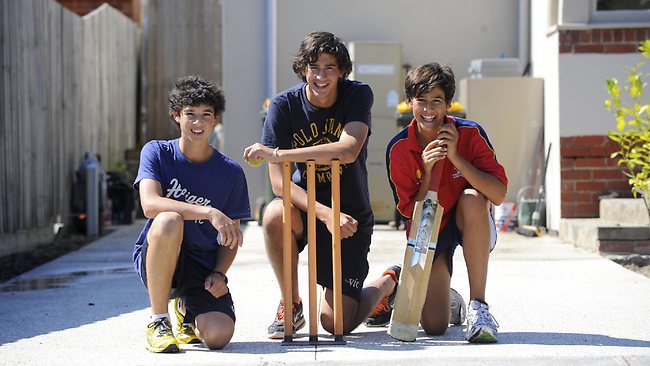 THE face of Australian cricket has always been hard set. Ricky Ponting’s furrowed brow. Steve Waugh’s defiant stare. Allan Border’s stubborn resolve. The Chappells and their killer gleam. The new face of Australian cricket wears a broad smile that has captured the hearts of a sleep-deprived nation. That it shone as brightly in the moments after Ashton Agar got out for 98 as it did when he was chasing an improbable century on debut evokes Kipling’s famous line about triumph and disaster and treating those two imposters just the same. Back home in Melbourne, it reminded Agar’s high school maths teacher and cricket coach of the advice he gives every kid that takes block for De La Salle College. “You want the opposition to walk off the ground wanting to hate you but not having a reason,” says Marty Rhoden, a teacher and coach to all three Agar brothers. “He is so level-headed and grounded. You notice the first thing he did when he ran back on to the ground after taking off his pads was to go up to (his brothers) Will and Wes and apologise for getting out.” Continue reading

