I am batticaloa … Margaret Ootschorn and kaffrinha wedding brought to life

Kannan Arunasalam

I AM BATTI WOMANAt 92, Margaret Ootschorn is very likely the oldest living member of the Portuguese Burgher community in Batticaloa. Displaced from the Dutch Bar after the 2004 Tsunami, she now lives with her daughter in Thiraaimadu, a new settlement developed especially for the displaced community. She said she still misses her life in the Dutch Bar. We talked about the disappearing language and traditions, and how the younger generation no longer speak the language. Afterwards I walked around the small village, met members of the community who were sitting by the roadside and the beautiful new church that was being built for them. A few months later, she invited me along to celebrate the wedding of her grandniece in the unique Portugese Burgher style, with the special blend of Kaffirinha music, dancing and importantly, wine. The Burgher hospitality is legendary and while Margaret felt that modern Burgher weddings are nothing like in the old days, everyone had a lot of fun.

SEE http://iam.lk/the-matriarch/ for a Portuguese Burgher wedding with kaffrinha music … and what is best of all Margaret Ooutschorn’s, reflections in Tamil. Continue reading

Leave a comment

Filed under cultural transmission, heritage, performance, self-reflexivity, sri lankan society, Tamil civilians, unusual people, women in ethnic conflcits

Rajapaksa government fighting to win the peace

Amanda Hodge, in The Australian, 13 November 2013

JAMES Packer had not long finished his defence of why a high-end casino resort would be a boon for Sri Lanka, a country recovering from 26 years of civil war, in Colombo this week when an audience member stood to complain about the country’s persistently “bad press”. “What would be your advice about how to change the perception of Sri Lanka in Western countries like Australia?” he asked the casino tycoon, during an interactive session at the Commonwealth Heads of Government Meeting business forum.

It is an excellent question. HODGE PIC OF MR Continue reading

1 Comment

Filed under accountability, asylum-seekers, australian media, authoritarian regimes, governance, historical interpretation, legal issues, life stories, performance, politIcal discourse, power politics, Rajapaksa regime, reconciliation, rehabilitation, Sinhala-Tamil Relations, sri lankan society, Tamil civilians, transport and communications, truth as casualty of war, welfare & philanthophy, world events & processes

Rule of Law continues to decline during the Rajapaksa Regime

Kishali Pinto-Jayawardena, in The Australian 15 November 2013, where the title is “Post-war the rule of law does not exist in Sri Lanka,

KISHALI P JIT has been four years since the Liberation Tigers of Tamil Eelam were defeated by Sri Lankan government troops following nearly three decades of civil war. Today, the absence of the rule of law in Sri Lanka has made the holding of the Commonwealth Heads of Government Meeting an exercise in barely concealed cynicism for ordinary Sri Lankans.  In many respects, the protection of basic liberties for all Sri Lankans – Sinhalese (the majority community) and the minority Tamils and Muslims – is worse off than when the war was on. Tamil people continue to be subjected to arrests, detentions and abductions. Those who lost family members during the war still vainly search for the “missing” with no answers from the authorities. Continue reading

2 Comments

Filed under accountability, authoritarian regimes, citizen journalism, democratic measures, governance, life stories, LTTE, political demonstrations, politIcal discourse, power politics, Rajapaksa regime, reconciliation, Sinhala-Tamil Relations, truth as casualty of war, women in ethnic conflcits, world affairs

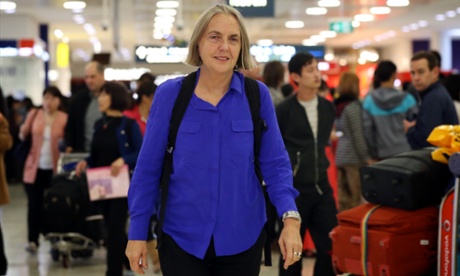
Senator Rhiannon blasts Sri Lanka after being evicted in insurrectionary triumph

Lee Rhiannon, courtesy of the Guardian, where the title is “My detention highlights why Australia should boycott CHOGM”

SENATOR RHIANNON “I went to Sri Lanka to be the voice the Australian government has refused to be. The voice that speaks of the human rights abuses that the Sri Lankan government is allegedly involved in. The voice that is part of a growing international call for an independent investigation into war crimes allegations following a brutal civil war in which more than approximately 40,000 Tamils were killed over five months in 2009. The voice of leadership that says Australia will not reward Sri Lanka for cracking down on journalistshuman rights activistsminority ethnic and religious groups. What I saw in Sri Lanka has convinced me that Australia needs to show courage and boycott the Commonwealth Heads of Government Meeting (Chogm), as the prime ministers of Canada and India are doing. Continue reading

3 Comments

Filed under accountability, asylum-seekers, atrocities, Australian culture, australian media, authoritarian regimes, disparagement, Eelam, female empowerment, fundamentalism, governance, historical interpretation, legal issues, life stories, LTTE, politIcal discourse, power politics, Rajapaksa regime, Sinhala-Tamil Relations, slanted reportage, sri lankan society, Tamil civilians, Tamil migration, the imaginary and the real, truth as casualty of war, women in ethnic conflcits, world affairs

James Packer and Crown Casino Project batting in Sri Lanka FOR Sri Lanka

I: Projected Crown Casino Resort in Colombo: see Crown Sri Lanka Video at http://vimeo.com/74177676

II: “Sri Lanka among greatest nations in world for investment,” – Packer … HDH Seneviratne in Daily News, 14 November 2013

JAMES PACKERSri Lanka could be turned into a leading tourist mecca for the rising middle class of India, China and the rest of Asia, Australian business tycoon James Packer said. He said he was committed to providing an opportunity to develop the country as a base and destination for mass, luxury and business tourism through his company Crown Resorts and his “plans to establish an integrated resort right here in Colombo on the Beira Lake”. “Sri Lanka is among the greatest in the world for foreign investments and tourism with the dawn of peace and tranquility in the country, Packer, Chairman of Crown Limited Australia, said at the Commonwealth Business Forum. Continue reading

3 Comments

Filed under accountability, Australian culture, cultural transmission, economic processes, education, Indian Ocean politics, island economy, landscape wondrous, life stories, performance, politIcal discourse, Sinhala-Tamil Relations, slanted reportage, sri lankan society, the imaginary and the real, travelogue, unusual people, world events & processes

Jaffna Managers Forum on Finances and Economic Development for the Northern Provincial Council

veg market- north -S-Observer M. Sooriasegaram, for the Jaffna Managers’ Forum, 13 November 2013

In light of the opening created by the provincial elections after twenty five years in the North and the urgent need to address the continuing economic problems after the war, the Jaffna Managers Forum held the first in a series of public discussions on 10th November 2013. The discussion titled, ‘Northern Provincial Council: Finances and Economic Development’, was well attended by people from various professions and perspectives. The Jaffna Managers Forum and the participants decided to convey the salient points of the discussion to the Chief Minister and Councillors of the Northern Provincial Council (NPC) and the public at large. Continue reading

Leave a comment

Filed under accountability, democratic measures, economic processes, historical interpretation, life stories, performance, politIcal discourse, population, Rajapaksa regime, rehabilitation, Sinhala-Tamil Relations, sri lankan society, welfare & philanthophy

G. C. Mendis: A Sound Historian of the Old School

Kalasuri Wilfred Gunasekara, reprinted from Daily News, 28 October 1999, where the title is “Dr. G. C.Mendis – one  of Sri Lanka’s pioneer scientific historians”

GC MENDISTwenty three years ago on October 26, 1976 passed away a great pioneer in Sri Lanka’s history. I was associated with Dr. Mendis for 43 years and more closer when he was a livewire of the Ceylon Branch of the Royal Asiatic Society (now Royal Asiatic Society (SL). There was a time when Dr. Colvin R de Silva wrote a book, Ceylon Under the British Occupation 1795-1833; its political, administrative and economic development. It was written when he was in prison. Reading its proofs was entrusted to Dr .G.C. Mendis. He sought my assistance to go through the proofs. It was an intellectual pleasure when we went through the proofs. Continue reading

13 Comments

Filed under cultural transmission, heritage, historical interpretation, Indian Ocean politics, Indian traditions, life stories, politIcal discourse, Sinhala-Tamil Relations, sri lankan society

An evening with Leonard Woolf in 1960 … with further reflections

Neville's photoNeville Jayaweera, reprinted from Sunday Island, 7 August 2005

Obsequious ceremonial: Upon Woolf’s arrival in Ceylon in early 1960 (he was 80 years old then) the Home Ministry arranged for him to tour the districts in which he had served as a Civil Servant. One leg of the tour took him through Hambantota, Tanamalwila, Wellawaya, Bandarawela, Welimada and Nuwara Eliya. At that time I was the AGA of the Badulla District which covered the entire route, and my GA was V. A. J. Senaratne  (Vicky) one of the most brilliant minds of the Civil Service — Physics First Class, and first in the CCS exam in his year, but for all that, utterly self effacing and therefore little known to the public.

leonard woolf 11Shelton Fernando, Permanent Secretary Home Affairs, sent Senaratne an exuberant missive instructing him and his AGA (myself) to meet Leonard Woolf at the boundary of the Badulla District, which was near Tissamaharama, a hundred and four miles away, escort him through the district and after a stopover at Bandarawela for the night, hand him over to the GA of Nuwara Eliya District. Though self effacing, Senaratne  did not take kindly to obsequious ceremonial, and showing me Shelton Fernando’s letter, said that he was not prepared to sit out in his car on the roadside waiting for Woolf or for anyone else and inquired whether I would do the honours. Much to my GA’s chagrin I assured him that neither was I inclined to be honoured in that fashion. So, eventually we compromised and agreed that we would both meet Woolf halfway at the Koslanda Rest House and accompany him to Bandarawela. Continue reading

1 Comment

Filed under British colonialism, cultural transmission, governance, life stories, literary achievements, politIcal discourse, self-reflexivity, sri lankan society, unusual people

Our Leaders at the Foreign Front over the Years

Chandra Wickramasinghe, courtesy of the Island, 6 November 2013, where the title is “Some historical perspectives in the interface between Sri Lanka and its Asian neighbours and the wider international community”

With a historic CHOGM just round the corner, it may perhaps be apposite to reflect on the rather crucial manner in which the interpersonal  relationships between Heads of State, political leaders of countries in the Asian Region as well as in the West, affected the history and the destiny of this little Island of ours. Very few realize how crucially portentous these  inter-personal interactions  have been in forming individual views based often on personal likes and dislikes and cross- perceptions. These have in turn, led to the eventual evolution and the progressive hardening of mutually proffered generalized attitudes of cordiality/hostility as the case may be, which find reflection at every conceivable level, formal/informal, in the relationships between the  countries concerned. In our own case, it is well exemplified by the extreme cordiality which marked  our one time relationship with India, based on the close friendship that existed over the years, between the Nehru and the Bandaranaike families. Continue reading

Leave a comment

Filed under accountability, historical interpretation, language policies, legal issues, life stories, Rajapaksa regime, Rajiv Gandhi, sri lankan society, unusual people, world affairs

President Rajapaksa must rethink his strategic vision

Neville Jayaweera, courtesy of Colombo Telegraph, with different title

Expanding Horizons: Prime Minister S.W.R.D .Bandaranaike (SWRD) expanded the horizons of the Sinhala people in 1956 but simultaneously drew in the horizons of the Tamils and diminished them as a people. For nearly 60 years thereafter, amidst bloodshed and tears, Sri Lanka has been trying to restore the balance but has not got it right yet. Apart from the tentative attempts of SWRD (BC Pact of 1958) of Dudley Senanayake (DC Agreement of 1965) JR’s Accord with India (13th Amendment 1987) and CBK’s valiant efforts in 1995, 1997 and 2000, the first effective initiative at restoring the balance has been President Rajapaksa’s decision to call for elections under the 13th Amendment of 1987 and set up the Northern Provincial Council (NPC).

Almost 50 years ago to the day, when I was Government Agent of Jaffna (1963-1966) at a person to person interview I had with the Prime Minister Mrs Sirima Bandaranaike at Temple Trees (but attended by her formidable Perm. Sec. Mr. N.Q.Dias) I asked her, “Madame, don’t you think that we should start healing the wounds inflicted on the Tamil people”. Continue reading

1 Comment

Filed under accountability, authoritarian regimes, British colonialism, constitutional amendments, democratic measures, economic processes, education policy, governance, historical interpretation, island economy, language policies, life stories, LTTE, politIcal discourse, power politics, power sharing, prabhakaran, Rajapaksa regime, reconciliation, rehabilitation, Sinhala-Tamil Relations, sri lankan society, unusual people