
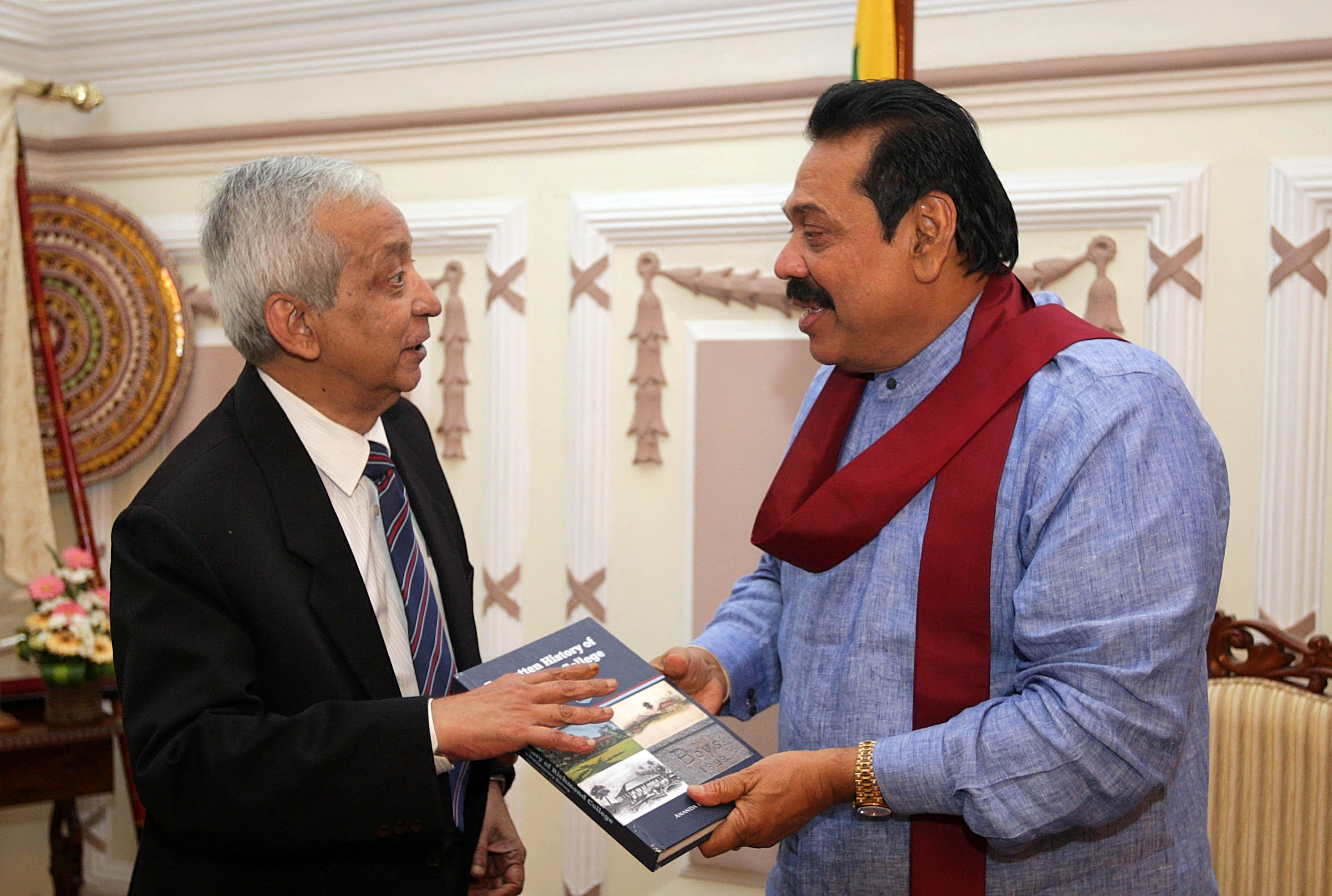
 Presentation of the first copy of a new publication “Forgotten History of Richmond College – A documentary survey“, to HE the President Mr. Mahinda Rajapaksa and the Hon. Speaker Mr. Chamal Rajapaksa two distinguish old boys of Richmond by the author Ananda Dias-Jayasinha, marking the bicentenary (200 years) falling on 25th July 2014, of the first Methodist Mission School in Sri Lanka and Asia now known as Richmond College, Galle. Continue reading
Ruki Fernando apprehended: many issues … and unfolding events
 Ruki Fernando has been an assiduous researcher and civil rights worker for several years. Associated formally with the National Peace Council and often publishing citizen articles in Groundviews, the web site of the Centre for Policy Alternatives, he has used the Catholic networks and circuits to range beyond the bourgeois lounges of Colombo and unearthed data of both social and political relevance. Needless to say, all such ventures involve interpretations and weightages and should be subject to critical review (as indeed, they are in blog commentary of varying perceptiveness). I note some illustrative examples of his investigative work.
Ruki Fernando, 2012, “Sri Lanka: When one goes missing every five days,” http://www.jdslanka.org/index.php/2012-01-30-09-31-17/human-rights/212-sri-lanka-when-one-…
Croos, Fr. J., Deanne Uyangoda & Ruki Fernando 2011 “Threats, Harassments and Restrictions on Former Detainees and Their Families in Vanni,” 11 May 2011, http://www.globalpeacesupport.com/ globalpeacesupport. com/post/2011/05/14
Ruki [Fernando] 2o10 “Vanni in the year after war: Tears of despair and fear,” 26 May 2010, http://groundviews.org/2010/05/26/vanni-in-the-year-after-war-tears-of-despair-and-fear/
Ruki [Fernando] 2o10 “Menik Farm: The tragic end of a bitter saga, from detention to forced relocation,” 2 October 2012, http://groundviews.org/2012/10/02/menik-farm-the-tragic-end-of-a-bitter-saga-from-detention-to-forced-relocation/
Music as Fusion … crossing bundaries, linking people
I — WOMAD …. standing for World Music at Adelaide was held from the 7-10 March at the Botanic Gardens and saw and HEARD numerous artistes from all over the world … bringing Adelaideians and Australians from all ethnicities together in a relaxed family atmosphere …. absorbing the vibes from many lands and cultures … and sometimes gyrating in cross-cultural mood. If only powerbrokers pay heed and use MUSIC as a bridge in strife-torn contexts.


Filed under cultural transmission, tolerance, unusual people
Savage suicide mission at Kunming station: Xinjiang Muslim extremists and their netherworld
I: The Kun Ming attack, 1 March 2014 as in Wikipedia
 The 2014 Kunming attack (also called the Kunming massacre[3][4][5]) was a terrorist attack[6][7][8] in the Chinese city of Kunming, Yunnan, on 1 March 2014. The incident, targeted against civilians, left 29 civilians and 4 perpetrators[1] dead with more than 140 others injured.[7][9] At around 9:20 pm local time, a group of eight knife-wielding men and women attacked passengers at the city’s railway station.[10] Both male and female attackers were seen to pull out long-bladed knives and proceed to stab and slash passengers. At the scene, police killed four assailants[11][12] and captured one injured female. In the afternoon of 3 March, police announced that the six-man two-woman group had been neutralized after the arrest of three remaining suspects.[1][4] No group or individual stepped forward to claim responsibility for the attack.[13] China’s official news service, Xinhua, announced within hours of the incident that it was carried out by Xinjiang separatist terrorists.[6][14] The government of Kunming also said the attack had been linked to Xinjiang militants.[10][15] Police said they had confiscated a black, hand-painted East Turkestan flag at the scene.[16][17]
II: A Comment, by Michael Roberts, 13 March 2014
By chance my chain mail circuit brought the exchange between Michael Tan and LSL into my orbit (see below). Having met Michael Tan briefly when I was on a research spell in Singapore way back I weigh his thoughts seriously. They indicate that this has not been the first such venture into terror attacks by Xinjiang zealots, while placing them within the machinations of power politics — more specifically the dirty wars promoted by USA. While wary of conspiracy theories targeting the CIA and USA in this instance I believe we must give serious consideration to this allegation as a probability. Continue reading
Boat People: cannot flee, cannot stay?
Courtesy of Emily Howie
A new report has found that Australia’s cooperation with Sri Lanka to prevent would-be-refugees from seeking protection is riddled with human rights risks and should be stopped immediately. The report, Can’t flee, can’t stay: Australia’s interception and return of Sri Lankan asylum seekers, which is based on interviews with government officials, information obtained through freedom of information requests and statements from the public record, reveals a deeply flawed suite of policy measures and practices. 
People of Sri Lankan origin in Australia: Census Data
 Sri Lankan cricketers celebrate their downing of Australia
Historical Background: In the late nineteenth century, the first Sri Lankan immigrants to Australia were recruited to work on the cane plantations of northern Queensland. There are also reports of Sri Lankans working in goldfields in New South Wales and Victoria, and as pearlers in Broome, north-western Australia. By 1901, there were 609 Sri Lanka-born people recorded in Australia.
 Following Sri Lanka’s independence in 1948 and the introduction of the Sinhala Only Act (Official Language Act No.33 of 1956), which mandated Sinhalese as the only official language replacing English, many Tamils and Burghers (of mixed European descent) felt disenfranchised. This resulted in significant numbers migrating to other countries including Australia. During the 1960s, Burghers comprised the largest proportion of Sri Lankan migrants to Australia.
In the late 1960s and early 1970s following the easing of Australia’s migration policies, Asian migrants, including Sri Lankan, were admitted to Australia. Sri Lankan migrants at this time included Tamils, Sinhalese, as well as Burghers. Continue reading
Galle Together with Music and through Music
Ruwani Jayawardana in Daily News, 12 March 2014
 The third Galle Music Festival (GMF), organized by the Sevalanka Foundation, Royal Norwegian Embassy Rikskonsertene and Arul Sri Art Theatre, being the message of together via tunes irrespective of colour, race, religion, ethnicity, physical ability or disabilities. The aim of the festival, which is the sister festival to the Jaffna Music Festival (JMF), is to link the north with the south and to set a platform for national and international musicians to showcase their talents and to interact with each other.
 Under the concept ‘Music is for all’, the Children’s Festival will take off this year, emphasizing that musical is a universal language which can be experienced and enjoyed by all. It shows that despite cultural diversities, music as an art form encompasses the power of healing. “We will be showcasing a range of music genres: folk, contemporary, classical and fusion. Artistes will be able to experience new techniques which have been practiced in other countries. Continue reading
Tamil and Sinhalese politics in Britain today

 Inside Downing Street Continue reading
Defenders of the Faith? or Voices of Intolerance?
Courtesy of Foreign Policy … taking a leaf from the work of International Crisis Group … http://www.crisisgroup.org/~/media/Files/asia/south-asia/sri-lanka/253-sri-lankas-potemkin-peace-democracy-under-fire.pdf
 Galagoda Atte Gnanasara and Ashin Wirathu exchange symbolic gifts
The photo of the two monks above looks innocent enough. One of the men presents the other with a birthday present. It’s difficult to make out, but it looks to be some sort of gold figurine on a red velvet base. In fact, the photo would be totally uninteresting if it weren’t for the fact that these men are two of the world’s most important leaders of a dangerously radical brand of Buddhism. Continue reading

