

Bosoms Galore

Filed under fundamentalism, landscape wondrous, world affairs
Appreciative Assessments of Fidel Castro: Wight and Jayatilleka
ONE: John Wight: “Breaking the Chains of Empire: the Enduring Legacy of Fidel Castro,” in Counter Punch, 28 November 2016,
Fidel Castro dedicated his life to the resistance of empire and the ocean of injustice and oppression inflicted in its name. Though his death may mark the end of the man, it gives birth to a legend that will endure for centuries to come. Such is the legacy that Fidel leaves behind it is impossible to fully comprehend the sheer magnitude of the role he played in breaking the chains of millions across the Third World, both literally and figuratively, in defiance of the racist conceit of apologists for imperialism. From leading a revolution that succeeded against the odds in toppling the pro-Washington dictator, Fulgencio Batista in 1959, he went on to not only make history but mold and shape it thereafter.


The Union of Pakistan and India: An Unique Moment in Cricket and Politics
Abhishek Mukherjee, in Cricket Country, 13 February 2016, where the title is “World Cup 1996: India and Pakistan combine to beat Sri Lanka
“This is the first time that India and Pakistan are playing as one team its history.”
 We have all speculated what would have happened had these two played together. It happened that day © Getty Images
February 13, 1996. Australia and West Indies cited security reasons and declined to visit Sri Lanka for their league matches. India and Pakistan, co-hosts of World Cup 1996, sent a combined team to Sri Lanka to play against the hosts, thereby sending a message to the sceptics. Abhishek Mukherjee looks back at a surreal day of cricket when India and Pakistan took the field alongside each other. Continue reading
The Muslims in Sri Lanka: Trends, Dangers, Failures
 ACL Ameer Ali, courtesy of Colombo Telegraph where the title is “Paranoia & Paralysis: The Buddhist-Muslim Tragicomedy” … Note that the highlighting emphasis below is that of the Editor, Thuppahi
The military victory led by an overwhelmingly Sinhala-Buddhist army over the tyrannous LTTE in 2009 has, among other things, injected in the minds of certain sections of the Buddhist community that Sri Lanka belongs only to the Sinhala Buddhists and others are permitted to live here only at the behest of the Buddhists. This twisted ideology which is now developing into an anti-Muslim, anti-Christian and anti-Tamil paranoia is totally contradictory not only to the noble teachings of the Enlightened Buddha but also and more significantly to the millennial historical tradition of ethnic and religious tolerance indelibly engraved in the long legacy of the island’s Buddhist monarchs. To deny this historical truth is to court intellectual dishonesty.


Filed under historical interpretation, Islamic fundamentalism, life stories, Muslims in Lanka, plural society, politIcal discourse, power politics, reconciliation, religiosity, riots and pogroms, security, self-reflexivity, Sinhala-Tamil Relations, sri lankan society, the imaginary and the real, tolerance, violence of language, women in ethnic conflcits, world events & processes, zealotry
Disappearances and Torture in Sri Lanka, 2011-13 … or Thereabouts: Soundings and Question-Marks
Michael Roberts
In studying the blog-comments on “Sinhala Mind-Set” and presenting the lot for public scrutiny a specific claim by a person identifying himself as “Flloyd” caught my attention. Whether Flloyd is a Tamil is of lesser moment than his allegation. It is the sort of claim that is widely peddled by reporters and VIPs who drop in and fly out after short stays and have the clout to reach a worldwide audience – for instance Roger Draper in the National Geographic and Greg Bearup in The Weekend Australian recently. Thus prodded, I took the initiative to test the degree of validity that we could attach to this type of assertion by approaching a selected body of personnel (mostly Sri Lankan) via a one-on-one letter presenting the QUESTION repeated here [in blue].
“I came across a blog comment from one “Flloyd” in April 2013 which adopted a reasonably moderate stance on the ethnic situation in the country but which also presented this assertion: “The presence of an organized rebel group is no more, but the Tamils continue to be tortured, raped, and killed by the state. Many still mention the brutality of the rebels, but in no way can that justify the current situation, as the rebel activity is gone.”


Filed under accountability, communal relations, disparagement, doctoring evidence, governance, historical interpretation, human rights, life stories, LTTE, politIcal discourse, Rajapaksa regime, reconciliation, rehabilitation, Sinhala-Tamil Relations, slanted reportage, social justice, sri lankan society, Tamil civilians, the imaginary and the real, truth as casualty of war, welfare & philanthophy, women in ethnic conflcits, working class conditions, world affairs
India & Lanka and the Devolution of Land Powers: Critical Comments
Gerald H. Peiris, courtesy of The Island , where the title is “Devolution of Land Powers – A Comment” … Note that emphasis via highlighting is the work of The Editor, Thuppahi
Among the writings published in the wake of release of the Report submitted to Parliament by the Constitutional Reform Sub-Committee on ‘Centre-Periphery Relations’ are those that appeared in recent issues of The Island – C. A. Chandraprema’s ‘Analysis’ of the report, and a more general piece titled ‘Constitutional reform and devolution of power’ by Harim Peiris. The former, needless to say, is an incisive critique written at a level of expertise which the ‘Panel of Experts’ that served the sub-committee appears to have lacked. The latter, I respectfully submit, is a feeble attempt that contains misrepresentations, intended no doubt to reinforce the recommendations made by the sub-committee on ‘devolution’.
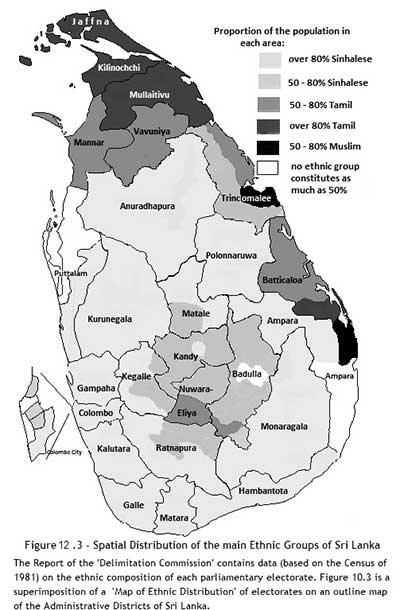 Figure 2
This paper is being written with the twin objective of supplementing Chandraprema’s criticisms with a few sets of information relevant to a study of ‘Centre-Periphery Relations’ in a multi-ethnic polity such as ours, and to highlight with special reference to Harim Peiris’ article, the superficiality typical of the on-going campaign intended to emaciate the unitary character of the nation-state of Sri Lanka. This campaign is also represented by recent publications such as the reports produced by the ‘Public Representations Committee on Constitutional Reform’ (chaired by Lal Wijenayake) and the ‘Constitutional Reform Sub-Committee’ referred to above, alongside the sustained literary efforts by self-professed “Sri Lanka experts” in India ̶for example those associated with the ‘Centre for South and Southeast Asian Studies’ of the University of Madras̶ whose barely concealed objective all along has been that of promoting the hegemonic interests of India in the South Asia Region.
Filed under accountability, democratic measures, devolution, economic processes, electoral structures, ethnicity, historical interpretation, Indian Ocean politics, island economy, LTTE, modernity & modernization, politIcal discourse, power politics, power sharing, security, Sinhala-Tamil Relations, world affairs
Sins And Kills: The Rajapaksa Clan And Their Messy Cupboard
Greg Bearup in The Weekend Australian, 26/27 November 2016, where the title is “Phantoms of Sri Lanka’s Reign of Terror”
Mahinda Rajapaksa sits at a desk in his party office beneath a photo of himself. He’s not especially tall but solid in the chest and arms; like an old rugby prop, his head seems to rest on his shoulders without much need for a neck. He’s never seen in public without his brown scarf, supposedly signifying the sweaty rags of Sri Lanka’s hard-toiling farmers. On his fingers this man of the people wears three chunky gold rings and on his wrist a bracelet of jade balls. Everyone here still calls him Mr President.
 Public Protest on bhalf of Thajudeen
 Photo by Jefteris Pitakaris
The photo hanging over him was shot a few years ago, back when he was Mr President, and back when things were very different for the Rajapaksa clan. His rule was absolute. The Rajapaksas controlled the treasury and Sri Lanka became one of the most expensive places on the planet to “build” a road. He and his family ran the country as if they owned it. They acted with impunity. His sons, ordinary footballers by all accounts, were selected to play rugby for Sri Lanka. Foreign coaches who dropped them were deported. They were lucky; others who displeased the clan disappeared. Continue reading
Filed under accountability, australian media, discrimination, disparagement, doctoring evidence, governance, historical interpretation, human rights, Indian Ocean politics, landscape wondrous, legal issues, life stories, politIcal discourse, power politics, self-reflexivity, sri lankan society, the imaginary and the real, truth as casualty of war, vengeance, world events & processes
Creeping Self-Determination: Committee on Centre-Periphery Relations paves that road
CA Chandraprema, in The Island, 23 & 24 November 2016,
“The purpose of the Subcommittee on Centre Periphery Relations appears to be to empower the provinces to such an extent that the central government is rendered irrelevant. What they envisage is a nominal central government with nine virtually independent provinces.” (Analyses of the other subcommittee reports will appear from Monday onwards.)


Part ONE: Constitutional Assembly: Analysis of Centre-Periphery Relations Report
The Provincial Governor: The report submitted to the Constitutional Assembly by its Subcommittee on Centre-Periphery Relations focuses on several areas such as the role of the provincial Governor, and the fiscal, administrative, land and police powers of the provincial councils. What the subcommittee report says about the institution of the provincial governor is plain and direct as follows: “The present powers of the Governors are excessive and should be curtailed. The Thirteenth Amendment and the Provincial Councils Act No. 42 of 1987 vests a multitude of powers to the unelected Governor to intervene, control and regulate the executive and legislative functions of the provinces. The position of the Governor with such powers represents central dominance in the province…”
Gamage on USA’s Machinations in Support of the Tamil Tigers
 Daya Gamage, via review notice in Asian Tribune with title “New book discloses U.S. machinations that globally- revived Tamil Tigers”
An investigative-research-analyses which discloses Washington’s playbook and machinations that revived Sri Lanka’s domestically-annihilated Tamil Tigers in the global arena as an influential diplomatic-political force is well documented in a book – Tamil Tigers’ Debt To America: US Foreign-policy Adventurism & Sri Lanka’s Dilemma – written by a professional who worked within the United States system for 25 years, released last week in the U.S. by the publishing house of Amazon.
The most revealing observation in this book is: One cannot recall in recent memory how a totally annihilated lethal terrorist movement along with its superior military power was resurrected and emerged as a global political movement with a determination to achieve the same objective – a separate state for the minority ethnic Tamils in the north-east region of Sri Lanka.
Filed under accountability, american imperialism, authoritarian regimes, historical interpretation, Indian Ocean politics, landscape wondrous, LTTE, military strategy, politIcal discourse, power politics, Rajapaksa regime, Sinhala-Tamil Relations, sri lankan society, Tamil Tiger fighters, the imaginary and the real, truth as casualty of war, vengeance, war reportage, world events & processes
Two Sri Lankan Tamil Voices from the North Today
Frances Bulathsinghala, courtesy of Daily FT, 5 August 2016, where the title reads “Post-war voices from the north.” The emphases in highlighted colours, however, are additions by The Editor, Thuppahi
Jaffna, Kilinochchi, Mullaitivu: Rajini is 46 years old and an ex-LTTE Commander with a 10-year-old daughter. She is a widow. She has few visitors. Tamil politicians are rarely among them. Occasionally she chases off military officers who enter her premises in her absence and make themselves at home for hours in her garden. She flies into a rage at them. She informs them that they have no right to enter her garden in her absence. They accept, grin, make some lame excuses and good-naturedly lope off after the cursory examination of the military reference documentation that is as important for ex-militants in post-war times as it was for civilians in peace times.
It is peace. At least there is no gunfire now. Of the memories of fire that continue to burn in hearts and minds we do not know.

Filed under accountability, authoritarian regimes, communal relations, cultural transmission, economic processes, Eelam, ethnicity, female empowerment, governance, historical interpretation, human rights, IDP camps, landscape wondrous, legal issues, life stories, literary achievements, nationalism, politIcal discourse, power politics, Rajapaksa regime, self-reflexivity, Sinhala-Tamil Relations, sri lankan society, Tamil civilians, Tamil Tiger fighters, tolerance, trauma, truth as casualty of war, war crimes, war reportage

