

THIS QUESTION was raised three months ago in February or so ….
THIS QUESTION was raised three months ago in February or so ….

I first heard of the BBK Partnership Sri Lanka in 2015. I first spoke with its co-founder Anandan Arnold in 2018, and finally met him in March 2020 at a hospital in Manipay Jaffna. He was dressed rather informally for a Partner of London’s BBK Partnership of Chartered Accountants. Anandan (pictured below on the right) greeted me wearing an aerodynamic lycra bicycling outfit, having put away his suit and tie for a couple of weeks. He was there with about 50 other cyclists including his brother Chris who had just finished their 435km four day Colombo-Jaffna bike ride. The trip was organized by Ride For Ceylon in aid of the Green Memorial Hospital in Manipay. Founded in 1848 by the American medical missionary Dr Samuel Fisk Green, the hospital was the first medical school in Ceylon. Now it is run as a charity, with patients paying what they can afford which is often nothing at all.
Richard Koenigsberg
Wars are fought–soldiers die–to testify to the truth of a society’s sacred ideal. If so many people die for an ideology—it must be real.

Filed under accountability, Al Qaeda, american imperialism, fundamentalism, life stories, LTTE, mass conscription, meditations, military strategy, nationalism, patriotism, power politics, prabhakaran, propaganda, psychological urges, security, self-reflexivity, suicide bombing, Tamil Tiger fighters, unusual people, vengeance, war reportage, world events & processes, World War II, World War One, zealotry, Zen at war
Michael Roberts, being an abridged version of an old article presented in the Library of Social Science run by Richard Koenigsberg and others.
Addressing the practices of remembrance in Australia, Richard Koenigsberg has noted the irony that a battlefield defeat at Gallipoli in World War One, 1915, served a people as an emblem of nationhood: the “Australian nation, came into being on the foundations provided by the slaughter of its young men.”
There is more irony. The commemoration of Australian courage, sacrifice and manliness at Gallipoli (and subsequently on the Somme) was threaded by tropes of youthful innocence that drew on classical Hellenic motifs. While the monuments and epitaphs that were crafted in Australia to mark this event were manifestly Greek in form. The gendered masculine metaphor, in turn, was often embodied in the seminal image of a full-bodied blonde young man. “Archie Hamilton” in Peter Weir’s classic film Gallipoli was/is one such trope (and he died of course).
 “Archie”
Filed under accountability, Australian culture, australian media, British colonialism, cultural transmission, education, ethnicity, European history, gender norms, heritage, historical interpretation, landscape wondrous, law of armed conflict, life stories, martyrdom, mass conscription, military strategy, nationalism, patriotism, politIcal discourse, power politics, self-reflexivity, the imaginary and the real, truth as casualty of war, unusual people, war reportage, world events & processes
Michael Roberts
Tears rolled down my eyes in profound sorrow and joy as the news media on TV and computer-script dwelt on the VE commemorations in Britain — Yesterday and Today 8th and 9th May 2020. Perhaps that may surprise some readers. So …… let me clarify.


Yes, I was only seven years old or thereabouts then in 1945. Yes, I was resident in the Fort area within the town of Galle in the island of Ceylon …. not in Britain or Europe. So, how is that event so meaningful …. and so profound in my thinking-mould. Continue reading
Filed under authoritarian regimes, British colonialism, British imperialism, centre-periphery relations, cultural transmission, economic processes, education, heritage, historical interpretation, Indian Ocean politics, island economy, landscape wondrous, law of armed conflict, life stories, photography, politIcal discourse, power politics, security, self-reflexivity, sri lankan society, travelogue, unusual people, world events & processes, World War II

The King and Queen of Britain with Winston Churchill in between and Princess Elizabeth nd Princess Margaret on the flanks
 Churchill waves to the crowds below
Hassina Leelarathna

Filed under accountability, communal relations, disparagement, historical interpretation, Indian Ocean politics, language policies, life stories, LTTE, patriotism, performance, politIcal discourse, power politics, press freedom & censorship, Rajiv Gandhi, religiosity, security, self-reflexivity, Sinhala-Tamil Relations, sri lankan society, Tamil Tiger fighters, travelogue, unusual people, war reportage, welfare & philanthophy, world events & processes, zealotry
Kalani Kumarasinghe, in Daily Mirror, 1 May 2020, … where the title is “The Debrief”

The leaders of Sri Lanka’s battle against Covid-19 came together for a panel discussion at Wijerama House, headquarters of Sri Lanka Medical Association to review Sri Lanka’s journey in containing the coronavirus outbreak. Head of the National Operation Centre for Prevention of COVID-19 Outbreak (NOCPCO), Army Commander Lieutenant General Shavendra Silva, Director General Health Services Dr. Anil Jasinghe and Chief Physician at the National Infectious Diseases Institute Dr. Ananda Wijewickrama discussed Sri Lanka’s unique approach to tackling the disease and made important notes on challenges ahead. Moderated by Prof. Indika Karunathilake, President of the Sri Lanka Medical Association, the discussion was a part of the Asia-Pacific Academic Consortium for Public Health international webinar on Covid-19.
Filed under accountability, authoritarian regimes, biotechnology, centre-periphery relations, charitable outreach, coronavirus, economic processes, governance, historical interpretation, island economy, performance, politIcal discourse, power politics, security, self-reflexivity, sri lankan society, transport and communications, unusual people, world events & processes
Patrick Hatch, in The Age, 8 May 2020, with this title “Masks or eye-watering fares? Airlines prepare for COVID-19 flying”
Face masks could be mandatory for passengers on all flights within Australia, but a reprieve from planes’ dreaded “middle seat” could be short-lived as airlines prepare for interstate travel restrictions to ease.
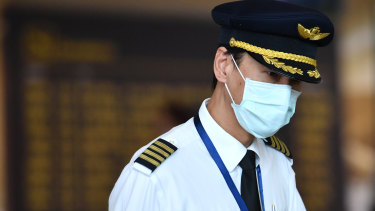 A pilot wearing a mask at Brisbane International Airport in January. Airlines are working out what precautions to put in place as travel demand slowly returns. CREDIT:AAP
Malinda Seneviratne, in Daily News, 8 May 2020, where the title is “The Story of an aththamma and an aththa” ….
Dane Street. Somerville. Cambrige. Massachusetts. The United States of America. It was in the Spring of 1991. There were several Sri Lankans living in that apartment. None of us were very good at cooking. It was trial and error, but sometimes things turned out well, more by accident than design. When this happened, we called all our Sri Lankan friends for dinner. On this occasion, however, it was a planned dinner and the invitees had to chance it.

 thuppahi