Deadly Covid Abyss looms in Si Lanka: Two Grounded Essays by Peiris versus Peiris

The recent article presented by medical specialists Malik Peiris and Kamini Mendis  has led to informed ethnographic set of comments by Gerald Peiris of Kandy**.…a nd drawn a Response from Dr Malik Peiris that is exrtemely disconcerting. The situation in Sri Lanka is DIRE …  and going to plunge to further depths.


Continue reading

Leave a comment

Filed under accountability, coronavirus, cultural transmission, economic processes, life stories, medical puzzles, meditations, security, self-reflexivity, sri lankan society, the imaginary and the real, tourism, trauma, unusual people, world events & processes

Percy Colin-Thomé and the Composition of the Book People Inbetween

Michael Roberts

Percy Colin-Thomé was born in Galle and his initial learning roots were at Richmond College. His genealogical roots derived from the Swiss personnel of the de Meuron Regiment in the service of the VOC in the 1790s who stayed on in Sri Lanka in British times when the colonial lands on the coast of Ceilao were taken over by the expanding imperial power known as Britain. These lineages became one strand in the mixed/race “Burgher” ethnic group in the island once the whole arena had been unified as colony by Britain between 1815 and 1818. Largely urban in background and increasingly English-speaking at home, these Burgher people became an influential segment of the local “middle-class” fulfilling intermediary roles in the British colonial service.[1]

Continue reading

9 Comments

Filed under architects & architecture, art & allure bewitching, British colonialism, centre-periphery relations, commoditification, communal relations, cultural transmission, economic processes, education, ethnicity, heritage, historical interpretation, island economy, landscape wondrous, life stories, modernity & modernization, patriotism, performance, photography, politIcal discourse, religiosity, self-reflexivity, sri lankan society, travelogue, Uncategorized, unusual people, welfare & philanthophy, world events & processes

Political Crisis and Ethnic Conflicts in Sri Lanka: A Rejoinder to Michael Roberts

K. M. de Silva, being an article published in the Ethnic Studies  Report, Vol. 6/1, January 1988 …. a riposte to a Review of his book Managing Ethnic Tensions in Multi-Ethnic Societies: Sri Lanka, 1880-1985, (1985)

                                          I 

I have long believed that the author of a book under review should not bother to write replies to reviewers however perverse he believes the latter to be. After all he has had his say at greater length than the reviewer. My present departure from this practice, and the response I write to Michael Roberts’s review of my book Managing Ethnic Tensions in Multi-Ethnic Societies: Sri Lanka 1880-1985 stems from two considerations. Invited to write a short review (1,500 words or so) in the style of the present journal Michael Roberts writes a review essay of 20,000 words. It has been reduced to about 2/3rds its length for our journal but it is still the longest review we have published. Secondly, he proceeds to write two reviews of the same book, one for this journal, and one for another [see p. 61 above, Michael Roberts 1987 (a)]

Continue reading

3 Comments

Filed under accountability, British colonialism, centre-periphery relations, communal relations, constitutional amendments, disparagement, electoral structures, ethnicity, governance, heritage, historical interpretation, Indian Ocean politics, insurrections, island economy, language policies, Left politics, legal issues, life stories, modernity & modernization, nationalism, parliamentary elections, patriotism, political demonstrations, politIcal discourse, power politics, power sharing, riots and pogroms, self-reflexivity, Sinhala-Tamil Relations, sri lankan society, Tamil civilians, trauma, truth as casualty of war, welfare & philanthophy, working class conditions, world events & processes

Red Alert! Commentary on the Failures of GoSL pinpointed by Peiris and Malik

A Cricketing Friend with Senior Mercantile Firm Experience, 21 May 2021

If the powers that be sought the advice of these professionals the country would not be in the situation we are in. The army cannot decide what is best on medical matters…… https://thuppahis.com/2021/05/21/for-lanka-a-science-based-strategy-to-control-the-present-covid-situation/

Continue reading

2 Comments

Filed under accountability, citizen journalism, coronavirus, disparagement, economic processes, education, island economy, life stories, medical puzzles, performance, politIcal discourse, power politics, self-reflexivity, slanted reportage, sri lankan society, trauma, working class conditions, world events & processes

For Lanka: A Science-based Strategy to Control the Present COVID-Situation

 Drs. Malik Peiris & Kamini Mendis

I.    The current covid-19 situation in the country

 There is a high intensity of transmission of covid-19 in the country just now. Although it became apparent with cases increasing in the last week of April, the increase in transmission began about 4 weeks before that. The incubation period of the virus (3-14 days) together with testing/reporting delays mean that the cases detected and reported now were the result of transmission that took place 1-2 weeks ago. Since deaths follow with a lag period of a further two weeks, the deaths occurring now were the result or transmission that took place one month ago.

Continue reading

3 Comments

Filed under accountability, coronavirus, education, ethnicity, island economy, legal issues, life stories, security, self-reflexivity, sri lankan society, transport and communications, trauma, welfare & philanthophy, working class conditions, world events & processes

The Burgher Elite and the British Raj

Michael Roberts 

   George F Nell, Louis Nell, C. A. Lorenz,  James Alwis and Charles Ferdinands moving anti-clockwise

Preamble:[1] In locating the Burghers in ‘social space’ the book People Inbetween deploys statistical detail, text and quotation to place them within the Ceylonese middle class of British Ceylon.[2] The socio-political clout which accrued to the Burgher segment of the middle class is further illustrated by indicating the complex ways in which they fulfilled intermediary roles between the mass of the people and the British rulers and/or between powerful segments of the majority community, the Sinhalese. The extract printed below is a section of Chapter 6 [in People Inbetween] devoted to this purpose and is reproduced without citations.

Continue reading

3 Comments

Filed under accountability, British colonialism, British imperialism, centre-periphery relations, commoditification, cultural transmission, economic processes, education, ethnicity, heritage, historical interpretation, island economy, life stories, literary achievements, nationalism, patriotism, politIcal discourse, power politics, self-reflexivity, sri lankan society, transport and communications, unusual people, world events & processes

Appreciating Sunil De Silva: Urbane Master of Many Trades

Hugh Karunanayake, in an Obituary Appreciation in THE CEYLANKAN, Vol XXIV/2, May 2021 **

My acquaintance with Sunil De Silva was mainly after he migrated to Australia in the early 1990s when I encountered him at a Sri Lanka Association dinner which he attended in formal attire replete with a curved pipe, (ala Sherlock Holmes) firmly placed in his mouth. We immediately acknowledged each other, he  recognizing me as a senior student from his old school and as a fellow denizen of a small town in Colombo called Pamankade.

Continue reading

2 Comments

Filed under accountability, Australian culture, cultural transmission, education, heritage, life stories, patriotism, performance, politIcal discourse, self-reflexivity, sri lankan society, travelogue, unusual people, world events & processes

Lord Naseby on Global Britain and Its Sri Lanka Relations

House of Lords: The Rt Hon Lord Michael Naseby spoke in the Queen’s Speech Debate on Wednesday May 19, 2021 …. [with highlighting emphais here being the work of The Editor, Thuppahi]

My Lords, I welcome the gracious Speech. My comments will be on global Britain, specifically the Indo-Pacific tilt. My own background is that I have lived and worked in India, Pakistan and Sri Lanka, and I know the rest of ASEAN quite well. I will specifically address Sri Lanka, and I declare an interest as joint chair of the All-Party Group (on Sri Lanka).

Continue reading

3 Comments

Filed under accountability, centre-periphery relations, citizen journalism, communal relations, discrimination, foreign policy, gordon weiss, historical interpretation, human rights, IDP camps, legal issues, life stories, LTTE, military strategy, NGOs, Paranagama Report, politIcal discourse, power sharing, self-reflexivity, Sinhala-Tamil Relations, sri lankan society, Tamil civilians, Tamil Tiger fighters, truth as casualty of war, UN reports, unusual people, vengeance, war crimes, war reportage, welfare & philanthophy, world events & processes

Bullshit Artists in Agricultural Science: A Raging Sri Lankan Email Debating Circuit

Chandre Dharmawardana

[Several personnel in this vibrant Sri Lankan EMAIL DISCUSSION CHAIN] have presented a conspiracy claim (that companies like Monsanto practically buys scientists by providing them scholarships and research grants). [This type of assertion] is easy to make, and was started in the mid 1990s when whole-foods supermarket chains began to clamour for a larger share of the market, and a well calculated disinformation campaign was launched.
Can we say that all the Nobel Laureates who believe that glyphosate is a very safe herbicide are all paid agents of Monsanto?
[alleged] Glyphosate injury on raspberries. Photo credit: OMAFRA.

Continue reading

Leave a comment

Filed under accountability, life stories, politIcal discourse, self-reflexivity, sri lankan society, unusual people, zealotry

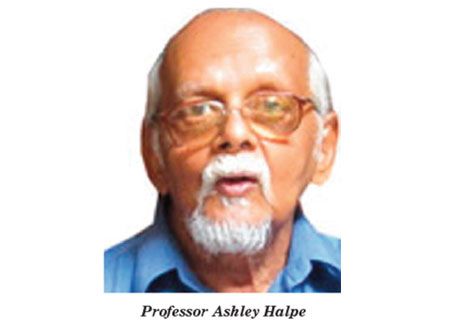
In Appreciation of Ashley Halpe: A Man for All Seasons

Tissa Jayatilaka, in The Island, 19 May 2021, where the ttitle runs: “Remembering Professor Ashley Halpe”

As we mark the fifth anniversary of Professor Halpe’s passing, we remember him with gratitude and continue to celebrate his life and work. He was a teacher for over 50 years both at home and overseas. He also enriched us by his research, poetry, paintings and translations; as well as by his labours as a chorister, actor, director of plays and administrator. In addition, he was a guide, philosopher and friend to generations of students, many of whom have distinguished themselves in diverse fields of activity.

Continue reading

3 Comments

Filed under accountability, art & allure bewitching, cultural transmission, education, heritage, life stories, literary achievements, performance, self-reflexivity, sri lankan society, tolerance, unusual people