
Following up on Till the Mountains Disappear, Dr. Srilal Fernando (Melbourne) and Avishka Mario Seneviratne have authored a new book Fruits of Virtue: An Early History of St. Joseph’s College.


Filed under accountability, architects & architecture, charitable outreach, cultural transmission, economic processes, education, heritage, historical interpretation, island economy, landscape wondrous, life stories, literary achievements, modernity & modernization, patriotism, performance, self-reflexivity, sri lankan society, unusual people, world events & processes
Sanjeewa Jayaweera, in The Island, 8 January 2023, with this title “IS THE CHAIRMAN OF THE PUBLIC UTILITIES COMMISSION OF SRI LANKA A HERO OR VILLAIN?”
Currently there is an ongoing tussle between the Power & Energy Minister Kanchana Wijesekera (KW) in one corner and Janaka Ratnayake (JR), the Chairman of the Public Utilities Commission of Sri Lanka (PUCSL), in the other. As a result, the Minister is on his own, whilst JR is supported by the CEB Engineers Union, CEB Trade Union Alliance, Electricity Consumers Association and pretty much the rest of the country!


Michael Roberts
This little presentation is a DEDICATION. It illustrates the potency and power of friends in producing an academic booklet in 2011. As it happens, the booklet bears the title Potency, Power & People in Groups and was financed by the good friends Godfrey & Amar Gunatilleke of the Marga Institute.
 The “Acknowledgements” and the “Foreword” taken together spell out the names of those friends who assisted this project. But let me single out Anura Hettiarachchi for his aid in this project and in the endeavours leading to my book on Sinhala Consciousness in the Kandyan Period (Colombo, Vijitha Yapa Publications, 2004) because he was struck down by heart failure recently.
To Anura, then, in gratitude I place this item in my website.
Filed under accountability, atrocities, British colonialism, citizen journalism, cultural transmission, democratic measures, demography, ethnicity, heritage, historical interpretation, insurrections, island economy, landscape wondrous, life stories, LTTE, modernity & modernization, patriotism, performance, photography, politIcal discourse, power politics, religiosity, self-reflexivity, Sinhala-Tamil Relations, sri lankan society, transport and communications, unusual people, war reportage, working class conditions, world events & processes
Michael Roberts

I was privileged to witness a striking win by the ADELAIDE STRIKERS at Adelaide Oval on the 5th of January 2023, where the Australian world witnessed the highest ever run chase in its BBL history. The Hobart Hurricanes had batted first and muscled a massive total: all of 229 runs. When the 19th over commenced with Nathan Ellis given the ball, The Strikers needed 25 more runs then and at the 20th with Faheem Ashraf given the ball they needed 11 runs to tie and 12 to win. 

Matthew Short Celebrates winning hit
KK de Silva** … responding to a Request from Michael Roberts (see Below for my Note to several pals)
 A = Ethnic Groups at latest census 2011, 2012 … https://en.m.wikipedia.org/wik
Sinhalese 15, 250, 081 74. 90%
Sri Lankan Tamils 2, 269, 266 11.15%
Sri Lankan Moors 1, 892, 638 9.30%
Indian Tamils 839, 504 4.12%
Sri Lankan Malays 44, 130 0.22%
Burghers, Eurasians 38, 293 0.19%
Others 25, 527
Total 20, 359, 439
……………………………….. Above figures are in line with figures provided by the Dept. Of Census & Statistics.
Features presented in the book VOLUNTEERS fROM CEYLON (2022) … supplemented by additional tit-bits from Richard Dickie Hermon of Trinity College who is now resident in Melbourne, Australia

Filed under accountability, Britain's politics, British colonialism, centre-periphery relations, communal relations, cultural transmission, economic processes, education, Empire loyalism, ethnicity, heritage, historical interpretation, island economy, landscape wondrous, life stories, martyrdom, patriotism, performance, plantations, politIcal discourse, self-reflexivity, sri lankan society, travelogue, unusual people, war reportage, world events & processes
The ceremonial opening of war heroes’ monument on 24 November 2022 was by the Chief of Staff of the Sri Lanka Army Major General Jagath Kodithuwakku, … RWP RSP ndu – Chief of Staff (යුධ හමුදා මාණ්ඩලික ප්රධානී), … Colonel of the Regiment Sri Lanka Light Infantry, … President – Army Sports Committee … Chairman – Sri Lanka National/Army Angampora Committee…. President Old Aloysian Military Association.
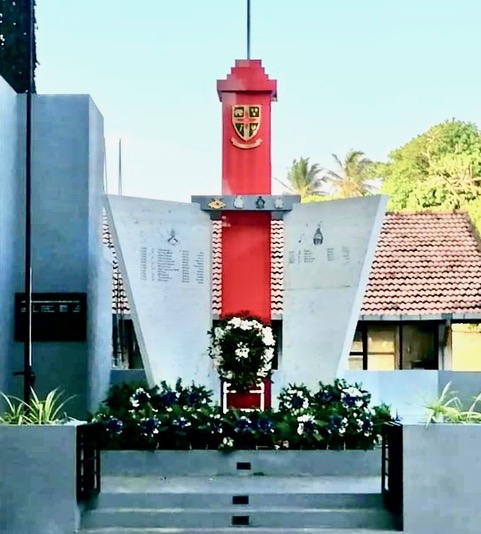
In a colourful ceremony conducted with the pomp, precision and pageantry that is synonymous with the armed services, the well-designed War Monument dedicated to Aloysians who gave their lives for the country during the senseless ‘war’ was declared open. Congratulations to the organisers and to those who worked tirelessly to establish this monument…. NOTE from the Aloysian Chroniclers
The Tamil Progressive Alliance (TPA) leader and Colombo District MP, Mano Ganesan received a telephone call from Ranil Wickremesinghe on 19 July 2022
It was a day before the Presidential election where the MPs were scheduled to vote and elect a new executive President to fill the vacancy created by President Gotabaya Rajapaksa’s resignation. Ranil Wickremesinghe, who was the then Prime Minister and acting as the interim President, was a candidate for the Presidential election.

Filed under accountability, american imperialism, centre-periphery relations, communal relations, debt restructuring, democratic measures, devolution, economic processes, electoral structures, ethnicity, foreign policy, governance, historical interpretation, Indian Ocean politics, island economy, landscape wondrous, language policies, legal issues, life stories, parliamentary elections, patriotism, performance, politIcal discourse, power politics, Rajapaksa regime, security, self-reflexivity, Sinhala-Tamil Relations, sri lankan society, Tamil civilians, Tamil migration, Tamil Tiger fighters, the imaginary and the real, unusual people, world events & processes
Chandre Dharmawardana, in The Island, 02 January 2023 where the preferred title runs thus: “Using SORTITION to prevent electing of same crooks to parliament”
The terrorism of the LTTE ended in May 2009, and most Sri Lankans looked forward to a dawn of peace, reconciliation and progress. Even Poongkothai Chandrahasan, the granddaughter of SJV Chelvanayagam could state that ‘what touched me the most that day was that these were poor people with no agenda ~ wearing their feelings on their sleeves~. Every single person I spoke to said to me, “The war is over, we are so happy”. They were not celebrating the defeat of the Tamils. They were celebrating the fact that now there would be peace in Sri Lanka’ (The Island, 23rd August 2009, http://archive.island.


Filed under accountability, authoritarian regimes, communal relations, cultural transmission, democratic measures, disparagement, economic processes, electoral structures, ethnicity, governance, historical interpretation, island economy, language policies, legal issues, life stories, parliamentary elections, patriotism, political demonstrations, politIcal discourse, power politics, press freedom & censorship, self-reflexivity, Sinhala-Tamil Relations, social justice, sri lankan society, Tamil civilians, trauma, vengeance, world events & processes
Senaka Weeraratna
Both the DRS in Cricket and Goal Line Technology in Soccer have a common origin in the ‘Player Referral’ concept conceived by Senaka Weeraratna in 1997.

This was the first occasion in world history that a case was made (in 1997), using the analogy of the apellate function of the legal system, to press home the point that we needed to adopt it on the playing field in a modified form in combination with modern technology, i.e. video play back in the hands of Third Umpire, to determine the accuracy of a decision made by an on field or ground umpire by way of a Review System.
Filed under accountability, architects & architecture, australian media, centre-periphery relations, citizen journalism, cricket for amity, cultural transmission, education, ethnicity, governance, historical interpretation, legal issues, life stories, modernity & modernization, performance, photography & its history, politIcal discourse, power politics, self-reflexivity, Sri Lankan cricket, taking the piss, truth as casualty of war, unusual people, world events & processes
 thuppahi
