Michael Roberts, presenting an article published in 2005 as a pamphlet by the ICES, Colombo with this title “The First Settlers and Their Claim to Ownership of Terrain/State. A Comparative Excursion” … an essay originally presented in Abdul Rahman Embong, Rethinking Ethnicity and Nation Building: Malaysia, Sri Lanka and Fiji in Comparative Perspective, Panbrit UKM, Bangi, Malaysia, (c. 2003) which was then reprinted as a booklet by ICES, Colombo in 2005 – see ISBN 955-580-099-5 I.
Category Archives: travelogue
Territorial Claims: First Settlers & Their Primacy
Filed under Aboriginality, ancient civilisations, animal world, British colonialism, centre-periphery relations, communal relations, cultural transmission, discrimination, economic processes, ethnicity, governance, heritage, historical interpretation, intricate artefacts, island economy, land policies, landscape wondrous, life stories, politIcal discourse, racism, religiosity, self-reflexivity, social justice, sri lankan society, tolerance, travelogue, unusual people, world events & processes
Fermenting Divisions, Favouring the Mighty … in the North & the East of Lanka
Tisaranee Gunasekara in Financial Times 2 April 2025 …. where the title reads “Cauldron-stirring time, again?” … while the highlighting is the work of The Editor, Thuppahi [with a caveat noted at the end of this presentation]
“Double, double, toil and trouble;
Fire burn and cauldron bubble…
For a charm of powerful trouble,
Like a hell-broth, boil and bubble.” – Shakespeare in Macbeth
In the run up to the 2019 Presidential election, there was Muhudu Maha Viharaya. While Candidate Gotabaya, reassuring in his moderate mask, did the kovil and mosque rounds, his official and unofficial surrogates busied themselves stirring the extremist cauldron. In the Pottuvil Muhudu Maha Viharaya, Muslim extremists are destroying statues depicting the Buddha’s eighty great disciples, social media posts claimed. These statues, built by the Rajapaksa administration in 2013, are being razed to the ground under the Sirisena-Wickremesinghe administration in 2019. If that Government is re-elected, the same horrendous fate will befall the Samadhi statue, the Tholuwila statue and the statues in Gal Viharaya.
Share this:
Filed under accountability, anti-racism, authoritarian regimes, centre-periphery relations, communal relations, discrimination, disparagement, economic processes, ethnicity, governance, historical interpretation, land policies, legal issues, life stories, Muslims in Lanka, politIcal discourse, power politics, Rajapaksa regime, religiosity, self-reflexivity, Sinhala-Tamil Relations, slanted reportage, social justice, sri lankan society, travelogue, truth as casualty of war, unusual people, zealotry
Karuna in Britain in 2008: The Legal ‘Knots’
DBS Jeyaraj, in the Financial Times, 28 March 2025 where the title reads “How UK-sanctioned “Col” Karuna was deported from Britain 17 years ago”
Vinayagamoorthy Muralitharan alias “Col” Karuna
After the UK sanctions were imposed the Tamil newspaper “Thamilan” interviewed Karuna about it. Karuna was dismissive saying that the UK sanctions would not affect him or his politics in any way. Karuna denied that he was responsible for any human rights violation. Speaking further he said that if he was guilty of any human rights violation, the UK could have penalised him when he sought refugee status there. “Why didn’t they do it then? Instead they sent me back home safely,” pointed out Karuna. He went on to say that he was not bothered by the UK sanctions.
It is indeed ironic that a man who was deported from the UK years ago has now been forbidden from travelling to the UK due to the sanctions imposed in a different context. Is Karuna being honest in saying that the UK authorities deported him instead of penalising him for alleged human rights violations because he was not guilty of any such offence? What were the circumstances under which he went to the UK 17 years ago and what exactly happened to him then?
Share this:
Filed under accountability, asylum-seekers, authoritarian regimes, Britain's politics, centre-periphery relations, ethnicity, governance, historical interpretation, human rights, legal issues, life stories, LTTE, politIcal discourse, refugees, Sinhala-Tamil Relations, sri lankan society, Tamil migration, tamil refugees, travelogue, unusual people, world events & processes
Donald Friend’s Acid Readings of the Sri Lankan Scenario, 1957-1962
EXTRACTS From The DIARIES Of DONALD FRIEND, Volume 3** …. The Ceylon Diaries cover the period 25th January 1957 to 22nd July 1962 and run into 180 pages in small print. During this period Donald Friend, the gifted Australian artist, based himself at Bevis Bawa’s ‘Brief’, Bentota.
“His diary entries are pithy, sarcastic, self-critical and wonderfully observant of people, places and events. I dare say he was a better writer than a painter. One can only look on aghast at how little things have changed in Sri Lanka in nearly 50 years of turmoil. ….” .… (the author of this ASSESSMENT remains unclear; while the highlights are interventions on my part: Michael Roberts).
26th January 1957: Time drifts through all this…. carrying on his back, like a turtle, a weight of the idiotic likes and dislikes….
4th February: Who like Bevis, is a hypochondriac. They both make a fascinating hobby of pills and injections …
19th March: The horrid old guide jibbered on endlessly, telling whopping lies.
24th March: Ratnapura Resthouse – nauseatingly loud Americans and a rabble of Ceylon drunks.
11th April: Orientals fortunately regard madness as something allied to holiness.
Share this:
Filed under accountability, art & allure bewitching, Australian culture, australian media, Colombo and Its Spaces, communal relations, cultural transmission, disparagement, economic processes, education, ethnicity, governance, heritage, historical interpretation, landscape wondrous, life stories, paintings, parliamentary elections, political demonstrations, politIcal discourse, racism, self-reflexivity, Sinhala-Tamil Relations, sri lankan society, travelogue, unusual people, world events & processes
Deeply Lankika: John De Silva
Responding to a Request from An Aloysian Schoolmate and Friend named Roberts, John de Silva, aka “Johnny,” provided these fascinating genealogical details…… Michael Roberts
I am not too sure if I had sent you details of where I came from! In other words, who were my parents and who were their parents. This is often a mundane Family Tree exercise and bears not much significance in the scheme of things. However, I feel that my family connections are unique when it comes to the Island of Sri Lanka.
Share this:
Filed under commoditification, communal relations, cricket for amity, cultural transmission, Dutch colonialism, economic processes, education, ethnicity, governance, heritage, historical interpretation, immigration, Indian Ocean politics, island economy, life stories, nationalism, patriotism, plantations, politIcal discourse, Portuguese in Indian Ocean, self-reflexivity, sri lankan society, travelogue, unusual people, world events & processes
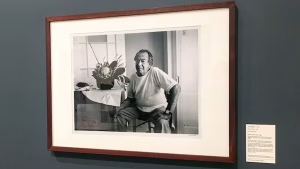
Wed Firm: Gregory Peck and His Veronique
An Item in Facebook presented by Nimal Dias Jayasinha
Share this:
The Thriving Undersea World around Shipwrecks around Sri Lanka
A recent news Item in The Island prompted me to ‘explore’ the web for items displaying the rich history of shipwrecks around our island with incidenal thoughts about the intrepid cluster of undersea explorers in the mid 20th century, namely: Mike Wilson, Arthur C. Clarke, Rodney Jonklaas, Hugh Stewart, Dinkalage et al.
Share this:
Lesser Known ‘Armwrestles’: The Baluchistan Liberation Army Within Pakistan
An Item in FRONTLINE …. Produced in India & One of the World’s Leading Journals
In yet another blow to Pakistan’s internal security, militants seized control of a train in the Bolan area of Balochistan on March 11. The Jaffar Express, with around 500 passengers in nine coaches, was travelling from Quetta to Peshawar. An army spokesperson said that the attack was quelled the next day after all 33 militants were killed. He added that 21 passengers and four soldiers were slain by the militants. The Balochistan Liberation Army (BLA) later claimed responsibility for the attack.
Share this:
Filed under accountability, centre-periphery relations, China and Chinese influences, communal relations, counter-insurgency, ethnicity, historical interpretation, Islamic fundamentalism, law of armed conflict, life stories, military strategy, nationalism, politIcal discourse, power politics, travelogue, world events & processes
An Epitaph for Charlie Ramanaden THEN, 13 March 1997
Dushy S. Perera
Jerry ‘Anna’ to his relations, Sir to his numerous subordinates and Charles to his friends, passed away suddenly whilst playing tennis (a sport close to his heart) partnering his son Pravin, at the Annual Darrawela Club Tennis Meet on 15th March, 1997.

He once told a friend that he would like to die playing tennis and also mentioned to me that he would like to see a Trogon (a rare endemic Ceylon bird) before he dies. It was only on the last Poya that Charles along with his good friend Doca drove into the Peak wilderness and had a glimpse of this endemic bird. So, in a sense, his wishes had been fulfilled.
Share this:
John D’Oyly’s Manifold Skills and the British Conquest of the Kandyan Kingdom
Rajitha Weerakoon in Daily Mirror, 11 March 2025, with this title “How D’Oyly used espionage to conquer Kandy?”
With the fall of the Kandyan Kingdom, the Kandyan Convention, ceremonially signed on March 10, 1815, completed the annexation of the island to the British Empire. This brought an end to the rule of Lankan Royalty.
Share this:
Filed under accountability, authoritarian regimes, British colonialism, British imperialism, centre-periphery relations, communal relations, economic processes, espionage, ethnicity, historical interpretation, insurrections, Kandyan kingdom, life stories, military strategy, patriotism, politIcal discourse, power politics, sri lankan society, travelogue, unusual people, world events & processes


