
Category Archives: sri lankan society

Jean Arasanayagam: Poet, Author, Activist

Sarah Hannan, in the Sunday Leader, 7 July 2013

arasanayagam-4co copy “We’ll all become spinners of endless sagas which we read in the silence of our eternal loneliness. We inhabit the world of exile, which lies within the Babylon of ourselves” – Jean Arasanayagam.  Dr. Jean Arasanayagam – is a renowned poet and author who has contributed immensely towards the English Literature circuit in Sri Lanka for over four decades. Having written poetry, prose and short stories in English she is celebrated by literati around the world and was recently honoured with a doctorate in letters by the Bowdoin College, USA. Joining In Conversation Dr. Arasanayagam shares her life as a person of letters and art. Having been a voice for the people who silently suffered the hardships of war, the writer asked her, what changes she sees in the society three years into peace and reconciliation under one flag. Continue reading

2 Comments

Filed under cultural transmission, education, ethnicity, female empowerment, gender norms, life stories, literary achievements, performance, sri lankan society, unusual people

Loudes Melorin Vincent: an example to us all and in service of AUSLMAT

Quintus de Zylva

MeloDr. (Mrs). Loudes Melorin Vincent is a proud product of the Batticaloa District. Her father was a mechanic and she struggled financially to complete her school education and then went to Peradeniya University to do a degree in dentistry. Her education was supported by the Burgher Union of Batticaloa. In June 2006 she graduated with a Bachelor of Dental Surgery. Her story is one of great effort in the face of severe financial stresses and one that should serve as a source of encouragement to all those students who want to study and rise up out of the vicious cycle of poverty that drags some children down. Continue reading

Leave a comment

Filed under female empowerment, life stories, performance, self-reflexivity, Sinhala-Tamil Relations, sri lankan society, unusual people, welfare & philanthophy, women in ethnic conflcits, world affairs

Living costs today in Sri Lanka

Harold Gunatillake

The rich, newly or otherwise, will be rich always; will never feel the hunger pains of the suffering masses. They live, most of them in architect designed homes, one or two luxury vehicles in the double garages, eating rich food, obvious from the visible obesity problems they carry. That class of achievers is essential in a capitalistic society to keep the economy viable and a necessary asset. This brief article focuses on the non-achievers, battlers and the unfortunates who are deprived of the basics in life, and the numbers seem to increase day by day. This could be assessed from the number of people begging on the roadsides near traffic lights, when you wait for the green light.

One year ago a good size papaw in the Wellawatte market was approximately Rs. 60 and today the same size papaw is Rs 200. Within a period of one year the prices have doubled and over. These fruits are locally grown without any care, or fertilizing with no cost to the producer. But why have the prices doubled within one year? Your guess would be as good as mine. Continue reading

4 Comments

Filed under economic processes, life stories, population, sri lankan society

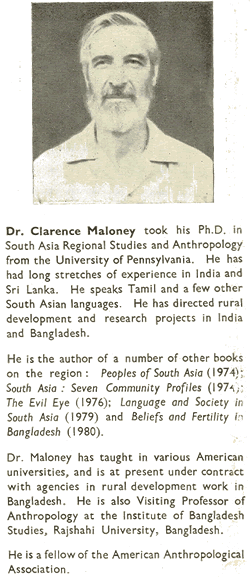
“The Beginnings of Civilization in South India” by Clarence Maloney

Clarance Maloney:  “The Beginnings of Civilization in South India,” Journal of Asian Studies, Vol XXIX, No 3, May 1970. Read the entire article by clicking here

This article was based on Clarence Maloney’s University of Pennsylvania PHD dissertation from 1968, “The Effect of Early Coastal Sea Traffic on the Beginning of Civilization in South India.” It is, alas, little known and has not been sufficiently deployed and/or engaged with in the studies of ancient Sri Lankan and Indian history.

Clarence Maloney has spent much of his life in South Asia, has a PhD in South Asian Studies from the University of Pennsylvania, and has written 9 books on the peoples and cultures of this world area. Among these books are The Peoples of South Asia  (584 pages, published by Holt, Rinehart and Winston in 1974) and People of the Maldive Islands.

maloney pic maloney book -maldives Continue reading

10 Comments

Filed under economic processes, heritage, historical interpretation, Indian traditions, population, sri lankan society, world affairs

Confronting Charlie Ponnadurai: Clarifying the Context of Disparaging Ethnic Epithets in Sri Lanka over the last 180 years

Michael Roberts

Charlie and I go back a long way – to Ramanathan Hall at Peradeniya University where we were freshers together in 1957 and thus were ragged together.[1] Charlie was known then as Charlies Ponnadurai, but he is now a “Sarvan” and resides in Germany with his German wife after years of work in Zambia and the Middle East. He has done me a singular honour in basing an essay on “Para Dhemalā” purely on my work. The reference is to “Pejorative Phases: the Anti-Colonial Response and Sinhala Perceptions of the Self through Images of the Burghers.”

Readers may have been misled into thinking this was either a book or an independent article. Not so. The title is that of a chapter, “Pejorative Phrases….,” which is the first chapter in the book People Inbetween. The Burghers and the Middle Class in the Transformations within Sri Lanka, 1790s-1960s,” – a large tome published in Sri Lanka in 1989 by Sarvodaya Book Publishing Services. This book was one part of a longer projected series involving myself, Percy Colin-Thomé and Ismeth Raheem. That venture was inspired in part by our discovery of a treasure trove, namely, the Lorenz Collection at the library of the Royal Asiatic Society in Colombo. It has not seen the fullest fruition; but the first step was People Inbetween which was almost wholly my work, albeit aided by citation-aid and other inputs from Colin-Thomé and Raheem.[2] Continue reading

5 Comments

Filed under British colonialism, disparagement, economic processes, ethnicity, historical interpretation, island economy, life stories, politIcal discourse, reconciliation, self-reflexivity, Sinhala-Tamil Relations, slanted reportage, sri lankan society, Tamil migration, tolerance, truth as casualty of war, world events & processes

Para Dhemalā

Charles Sarvan

Charles-Sarvan-150x150“…an alien Tamil speaking group with little or no history in the island” (Sunday Island, Colombo. 25 January, 2004, p. 7),  … quoted in my essay, ‘Reign of Anomy’.

I don’t remember hearing Sinhala spoken in the Jaffna of my childhood, but I’m over 75 and no longer trust my memory: perhaps, Sinhala was spoken here and there.    Be that as it may, it’s not relevant to what follows. We shifted to Colombo when I was 14, and I was almost immediately sent to St Thomas’, Gurutalawa (see, “Recollections of Gurutalawa”, Sunday Island, 5 July 2009). The context in which the word para was used at boarding-school, in Colombo and elsewhere; the accompanying tone of voice and facial expression, all indicated contempt, dismissal and rejection. Para was linked to Parayā (low caste) and that sufficed to convey meaning to me. The first time this particular linguistic stone was thrown at me was at Gurutalawa. Continue reading

6 Comments

Filed under British colonialism, cultural transmission, disparagement, historical interpretation, life stories, nationalism, politIcal discourse, racist thinking, Sinhala-Tamil Relations, sri lankan society, world events & processes

Botham’s feat/feet from north to south for FOG and Lanka

Rex Clementine, in the Island, 16 August 2013

BEEFY BOTHAMNo Ashes contest passes by without the memory of Sir Ian Botham. About to be sacked as captain in 1981, Botham stepped down as England skipper in humiliation after collecting a pair in the Lord’s Test with England trailing 1-0. What happened afterwards is history as playing under Mike Brearly, Botham won England the Ashes singlehandedly 3-1. Knighted in 2007, Sir Ian has stepped up to support several charitable activities including his walks across Europe for Leukemia Research. Yesterday Sir Ian announced his latest walk from Killinochchi in the North to Seenigama in the South over eight days to support the Sri Lankan youth. Continue reading

1 Comment

Filed under cultural transmission, disaster relief team, life stories, performance, reconciliation, Sinhala-Tamil Relations, sri lankan society, world affairs

Indian wheels chug into Kilinochchi

KILI TRAIN 33 KILI TRAIN 44 Continue reading

Leave a comment

Filed under economic processes, Indian Ocean politics, rehabilitation, Sinhala-Tamil Relations, sri lankan society, world affairs

Lost and at sea: the asylum-seeker debate in Australia

Michael Roberts, courtesy of ASIA SENTINEL, 12 August 2013

Electoral politics have swamped the debate on irregular migrants, the “boat-people that is, in Australia. There is no change of consequence however. Rudd, Abbott, the Greens and Letters to the Editor continue to present (a) many of the old shibboleths and oversimplifications that have skewed discussions of this issue for years. The motifs peddled in most quarters are also directed by (b) misinformation, exaggeration and fabrication and (c) ideological blinkers.

ASIA SENTINEL from Asia Sentinel

A self-evident fact is often glossed over: migration in modern times, whether legal, humanitarian or irregular, is a complex phenomenon. Given the diverse lands from which migrants have headed for Australia it follows that one must attend to regional differentiation in speaking about this topic. Yet sweeping generalizations are continuously voiced – not only by politicians and human rights lawyers, but also by concerned citizens of compassionate heart and, on the other side, by intransigent Aussies on the Right. Continue reading

Leave a comment

Filed under Afghanistan, asylum-seekers, australian media, cultural transmission, economic processes, historical interpretation, immigration, legal issues, life stories, people smugglers, slanted reportage, sri lankan society, world events & processes

Lanka Nesiah passes away: LANKA loses a perceptive scribe and ecumenical patriot

A Tribute in Colombo Telegraph, with title “No more Shanie column”

Lankanesan-NesiahColombo Telegraph is sad to announce the death yesterday (Aug. 11) in London of one its recent and most respected columnists, Lankanesan Nesiah. As a writer he used the pseudonym Shanie, a pseudonym derived from all six letters of his surname Nesiah, saying he did not wish to be “white-vanned.” His precision and the use of language through elegantly employed turns of phrase, were clearly from his father, Kunasekaram Nesiah. who was Head of the Department of Education at Peradeniya and, as a school boy at St. John’s, the proud recipient of the runner-up prize for essay writing in the British Empire. Continue reading

Leave a comment

Filed under democratic measures, heritage, historical interpretation, life stories, literary achievements, politIcal discourse, Sinhala-Tamil Relations, sri lankan society, tolerance, unusual people