Category Archives: sri lankan society

Addressing Jehan Perera’s Recent Piece on Reconciliation in Sri Lanka

Lakshman Gunasekara …. with highlighting and a cartoon imposed by The Editor, Thuppahi

What ‘re-conciliation’ ??

Jehan Perera, a very good friend and long-time colleague, at least uses the term “re-conciliation” which was intelligently adopted by the Mahinda regime at the end of the military phase of the ethnic conflict (with a resounding defeat for the LTTE). That regime conveniently picked up that word from among local liberal activists who had begun using it — taking it from South African post-Apartheid peace-building parlance.

Continue reading

4 Comments

Filed under accountability, authoritarian regimes, centre-periphery relations, chauvinism, communal relations, constitutional amendments, democratic measures, economic processes, education, electoral structures, ethnicity, governance, historical interpretation, legal issues, patriotism, politIcal discourse, power politics, power sharing, self-reflexivity, Sinhala-Tamil Relations, sri lankan society, Tamil civilians, tolerance, unusual people, world events & processes

In Appreciation of Professor Lakshman Jayathilake, Committed Engineering Professor & Patriot

Lionel Bopage, in The Sri Lankan Guardian,  Septmber 2021, where the title reads “My Indelible Memories of Professor CLV Jayathilake” …. with highlighting emphasis added by The Editor, Thuppahi

I am extremely saddened by the news I heard this morning, that Emeritus Professor CLV (Lakshman) Jayathilake, a Fellow of the Institute of Engineers, Sri Lanka, has succumbed to Covid and passed away. He has impacted my life in many ways on several occasions.

 When I was studying at the Faculty of Engineering, University of Peradeniya, he was a lecturer in the Mechanical Engineering Department. I was studying for a Mechanical and Electrical combined degree in engineering, a rare combination at the time.

Continue reading

1 Comment

Filed under accountability, centre-periphery relations, communal relations, constitutional amendments, discrimination, education, governance, heritage, historical interpretation, insurrections, Left politics, legal issues, life stories, patriotism, politIcal discourse, power politics, security, self-reflexivity, social justice, sri lankan society, truth as casualty of war, unusual people, working class conditions, world events & processes

Mevan Pieris: From Cricket Ball to Books, Phials & Paintbrush

MEVAN PIERIS has recently turned his mind to artwork with paintbrush, while yet sustaining his commitment to the academic disciplines in which he has devoted his endeavours during the past few decades by reproducing and/or renovating portraitures of eminent scientists; while also creating paintings of his own — both portraits and scenarios.

This is  a photograph of the restored painting of Professor Juan Pedige Charles Chandrasena who joined the University College in 1923 and was Professor of Chemistry in 1932 and retired or died soon afterwards. This Portrait is unsigned and the  guess is that it is the work of David Paynter. The painting was in a very bad state with certain areas of the canvas having deteriorated and sprinkled all over with wall paint through neglect. The frame was also damaged and here and there the paint had begun to peel off.

Continue reading

1 Comment

Filed under Australian culture, cricket for amity, education, Eelam, ethnicity, heritage, landscape wondrous, life stories, patriotism, performance, photography, self-reflexivity, sri lankan society, Tamil civilians, teaching profession, travelogue, Uncategorized, unusual people, world events & processes

Exploring the Etymological Strands of the Word “Thiruketheeswaram”

Chandre Dharmawardana

The word stub “ket,”, கேத, in the place name:  Tiru-k-keteeswaram,  திருக்கேதீசுவரம்

In finding a meaning for the component –ket– in Tiru-ket-heesvaram, well known Engineer Thiru Arumugam has quoted an interpretation given in 1849 by Pridham which leans on a mythological tale of Vishnu’s exlir of mortality that fell into the hands of a demon. The demon was said to be cut into two and became Rahu and Ketu (.இராகு கேது) recognized in astrology.  Predham stretches his imagination very far to convert the Tamil -கேத- sound to கேது in finding  an “explanation” or rationalization for the stub  -கேத- found in the place name.

Continue reading

Leave a comment

Filed under ancient civilisations, architects & architecture, art & allure bewitching, centre-periphery relations, cultural transmission, demography, economic processes, ethnicity, heritage, Hinduism, historical interpretation, Indian religions, Indian traditions, island economy, landscape wondrous, life stories, literary achievements, pilgrimages, religiosity, self-reflexivity, Sinhala-Tamil Relations, sri lankan society, Tamil migration, the imaginary and the real, transport and communications, travelogue, world events & processes

Vijaya and Kuveni: Two Legendary Figures of the Pali Chronicles

Chandre Dharmawardana

“This may confuse some since Madura became a part of the Chola kingdom, and that Vijaya called for a Chola princess after rejecting Kuveni. In reality, many south Indian kings sought North Indian brides as they were fair-skinned”.**

Cholas, Pandyas, and Cheras, are mentioned in the Ashokasthamba (Asoka-Pillar) inscriptions (3rd century BC although some historians think the pillar inscriptions may have been even earlier). When did Vijaya come to Tambrapanni? Is Vijaya even a real person?

I believe there have been many invasions (basically, not necessarily invasions, but people coming in even to farm, fish or trade, and by boats and settling down). Even Vijaya’s landing as described in the Pali chronicles was accidental.

Continue reading

4 Comments

Filed under Aboriginality, ancient civilisations, art & allure bewitching, cultural transmission, heritage, historical interpretation, Indian religions, Indian traditions, landscape wondrous, life stories, literary achievements, politIcal discourse, self-reflexivity, Sinhala-Tamil Relations, sri lankan society, Tamil migration, the imaginary and the real, transport and communications, travelogue, unusual people, world events & processes

Jehan Perera on the Requisites for Political Reconciliation

Jehan Perera, in The Island, 3 August 2021, with this title “Restoring reconciliation process cannot be piecemeal”


The government is making a resolute effort to turn Sri Lanka around and put it in the direction of rapid economic development. The systematic manner in which it has been conducting the Covid vaccinations has earned recognition by WHO as well as the international community. The value of the military in getting things done on a large scale with minimum of delay has been manifested in the partnership that they have struck with the health authorities. The memory is fading of how some of the government leaders dabbled in alchemy and the spirit world to find an antidote to the COVID virus, despite being vested with the responsibility to strengthen the health of the country’s people. There is also increased space being given to civil society to engage in protests, such as the protracted teachers’ strike and the agitation against the expanding mandate of the Kotelawala Defence University.

Continue reading

2 Comments

Filed under accountability, centre-periphery relations, citizen journalism, communal relations, democratic measures, devolution, economic processes, governance, historical interpretation, Indian Ocean politics, landscape wondrous, life stories, LTTE, nationalism, patriotism, performance, political demonstrations, politIcal discourse, power politics, power sharing, Rajapaksa regime, reconciliation, rehabilitation, security, self-reflexivity, Sinhala-Tamil Relations, slanted reportage, sri lankan society, Tamil civilians, Tamil migration, tamil refugees, the imaginary and the real, truth as casualty of war, unusual people, vengeance, war reportage, welfare & philanthophy, world events & processes

FC De Saram in His Prime

F. C. De Saram, Cricketer Extraordinary 

  FC de Saram pulling during he course of his century for Oxford University against the touring Australian team at “The Parks” in Oxford in the mi-1930s

Continue reading

1 Comment

Filed under cricket for amity, cultural transmission, historical interpretation, landscape wondrous, life stories, sri lankan society, unusual people

Thiruketheeswaram: the Site of a Temple from Pre-Historic Times

Thiru Arumugam, being an article presented recently in The CEYLANKAN, Journal of the Ceylon Society of Australia. No. 3, August 2021

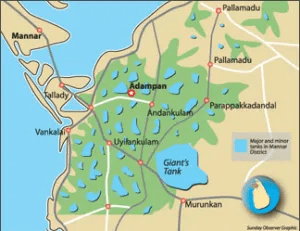
Thiruketheeswaram is located about eight km north of Mannar Town. It is on the coastal mainland of Ceylon, near the seashore on the direct coast road from Mannar to Jaffna. It has been the site of a Temple dedicated to Siva from pre-historic times. The place name of Thiru-Kethu-Iswaram has been devised as follows.  ‘Thiru’ means sacred or holy and “Iswaran” is another name for Siva. As regards ‘Kethu’, Charles Pridham in his 1849 book A Historical, Political and Statistical account of Ceylon and its Dependencies describes how the gods asked Vishnu to prepare an elixir which would make them immortal. The elixir was prepared by churning the oceans but a demon who was a bystander also managed to drink the elixir. When Vishnu realised this, he cut off the demon’s head, but he was too late as the elixir had already made him immortal. The two parts became Rahu and Kethu, which are significant planets in the Hindu astrological system. In order to propitiate his sin, Kethu (Fig. 1) wandered from place to place and ultimately reached the shores of Lanka. He performed severe penances and he   was ultimately blessed with the Lord’s vision and the place where this occurred was named Thiru-Kethu-Iswaram or Thiruketheeswaram.

Continue reading

3 Comments

Filed under ancient civilisations, architects & architecture, art & allure bewitching, cultural transmission, economic processes, heritage, Hinduism, historical interpretation, Indian religions, Indian traditions, landscape wondrous, life stories, literary achievements, meditations, photography, pilgrimages, politIcal discourse, religiosity, self-reflexivity, Sinhala-Tamil Relations, sri lankan society, tolerance, travelogue, world events & processes

The Sri Lankan Government and the Media within the Crossroads of War 2006-09

Palitha Kohona ,in The Sunday Observer, 28 June 2020, with this title Managing the media on the road to Nandikadal – Part 1″ ….http://www.sundayobserver.lk/2020/06/28/news-features/managing-media-road-nandikadal-part-1

The conflict with the terrorist LTTE dragged on for over two decades causing widespread death and destruction with no obvious end in sight. The Government, after the election of President Mahinda Rajapaksa, recognised, perhaps for the first time, that carefully managing the media, both domestic and international, was an important factor if this endless struggle were to be ended successfully. President Rajapaksa, a consummate politician, accepted the profound value of a non-antagonistic media and carefully orchestrated initiatives to secure this objective. As the world knows, the bloody conflict was eventually ended on the banks of the Nanthikadal Lagoon on May 18, 2009, through the colossal efforts and sacrifices of the security forces.

Tony Birtley of Al Jazeera at the warfront in late 2008 and Ranil Wijayapala in ??

Continue reading

Leave a comment

Filed under accountability, authoritarian regimes, centre-periphery relations, communal relations, Eelam, ethnicity, foreign policy, fundamentalism, governance, historical interpretation, human rights, insurrections, island economy, language policies, legal issues, life stories, LTTE, military strategy, nationalism, politIcal discourse, power politics, Rajapaksa regime, security, self-reflexivity, Sinhala-Tamil Relations, sri lankan society, suicide bombing, Tamil civilians, Tamil migration, Tamil Tiger fighters, terrorism, truth as casualty of war, UN reports, unusual people, violence of language, war crimes, war reportage, welfare & philanthophy, women in ethnic conflcits, world events & processes

Ceylon’s Importance in Resisting the Japanese War Machine in the 1940s

Tony Donaldson has retrieved an old  war film which presents some aspects of these moments  …. and a nostaalgic visit to the island by retired British fighting personnel


Continue reading

3 Comments

Filed under British colonialism, governance, heritage, historical interpretation, life stories, photography, power politics, security, self-reflexivity, sri lankan society, trauma, unusual people, world events & processes