Category Archives: social justice

Fermenting Divisions, Favouring the Mighty … in the North & the East of Lanka

Tisaranee Gunasekara in Financial Times 2 April 2025 …. where the title reads “Cauldron-stirring time, again?” … while the highlighting is the work of The Editor, Thuppahi [with a caveat noted at the end of this presentation]

 “Double, double, toil and trouble;
Fire burn and cauldron bubble…

For a charm of powerful trouble,

Like a hell-broth, boil and bubble.” – Shakespeare in Macbeth

In the run up to the 2019 Presidential election, there was Muhudu Maha Viharaya. While Candidate Gotabaya, reassuring in his moderate mask, did the kovil and mosque rounds, his official and unofficial surrogates busied themselves stirring the extremist cauldron. In the Pottuvil Muhudu Maha Viharaya, Muslim extremists are destroying statues depicting the Buddha’s eighty great disciples, social media posts claimed. These statues, built by the Rajapaksa administration in 2013, are being razed to the ground under the Sirisena-Wickremesinghe administration in 2019. If that Government is re-elected, the same horrendous fate will befall the Samadhi statue, the Tholuwila statue and the statues in Gal Viharaya.

Continue reading

Leave a comment

Filed under accountability, anti-racism, authoritarian regimes, centre-periphery relations, communal relations, discrimination, disparagement, economic processes, ethnicity, governance, historical interpretation, land policies, legal issues, life stories, Muslims in Lanka, politIcal discourse, power politics, Rajapaksa regime, religiosity, self-reflexivity, Sinhala-Tamil Relations, slanted reportage, social justice, sri lankan society, travelogue, truth as casualty of war, unusual people, zealotry

Reflections on Gananath’s Wide-Ranging Corpus of Work

Professor M.W. Amarasiri de Silva, about 3/4 years back inwhere the full title of the essay reads thus: Sinhalese Society Through The Prism Of Religion: An Appreciation Of Gananath Obeyesekere’s Work On Sinhalese Buddhism”

This article celebrates the remarkable scholarly contributions of Gananath Obeyesekere, specifically in the field of popular Buddhism in Sri Lanka. Obeyesekere, now aged 93, embarked on his anthropological career at the University of Ceylon (now University of Peradeniya), where he earned his undergraduate degree in English. Subsequently, he served as a lecturer and professor in the Department of Sociology from the 1960s to 1972, before moving on to the United States. He was Professor of Anthropology at Princeton University from 1980 to 2000.


Continue reading

2 Comments

Filed under accountability, ancient civilisations, art & allure bewitching, British colonialism, caste issues, centre-periphery relations, commoditification, communal relations, cultural transmission, economic processes, ethnicity, fundamentalism, governance, heritage, historical interpretation, landscape wondrous, language policies, Left politics, life stories, literary achievements, modernity & modernization, nationalism, patriotism, performance, pilgrimages, politIcal discourse, power politics, racist thinking, religiosity, self-reflexivity, Sinhala-Tamil Relations, social justice, sri lankan society, Tamil civilians, teaching profession, transport and communications, unusual people, vengeance, working class conditions, world events & processes, zealotry

Financial Restraint: Sri Lankan Government’s Initial Measures Applauded

Jehan Perera  

The government’s commitment to cut down on waste and corruption so that resources can be saved and added to enable economic growth can be seen in the strict discipline it has been following where expenditures on its members are concerned. There is a need, however, for new and innovative development projects that require knowledge and expertise that is not necessarily within the government. So far it appears that the government is restricting its selection of key decision makers to those it knows, has worked with and trusts due to long association. Two of the committees that the government has recently appointed, the Clean Lanka task force and the Tourism advisory committee are composed of nearly all men, and men from the majority community. If Sri Lanka is to leverage its full potential, the government must embrace a more inclusive approach that incorporates women and diverse others from across the country’s multiethnic and multireligious population, including representation from the north and east.

Younger Srilanka _ The winning combination – AKD & Dr. Harini. Sri Lanka gets a new leadership! ❤️_🔥🇱🇰 _ Instagram

Continue reading

Leave a comment

Filed under accountability, citizen journalism, debt restructuring, economic processes, governance, historical interpretation, island economy, legal issues, life stories, modernity & modernization, patriotism, performance, politIcal discourse, rehabilitation, self-reflexivity, social justice, sri lankan society, welfare & philanthophy

An Epitaph for Gananath Obeyesekere

Chandra R. De Silva, … with highlighting emphasis added by The Editor, Thuppahi

I write to add a few words to the outpouring of appreciations of Gananath Obeyesekere, a scholar whose research in anthropology, religion, myth, and cultural practices  has won him accolades across the world. I will not comment on the advances in knowledge and the discussions he provoked by his many scholarly works of which among the best known are Land Tenure in Village Ceylon, The Cult of the Goddess Pattini, Buddhism Transformed (co-author), The Work of Culture, The Apotheosis of Captain Cook: European Mythmaking in the Pacific, and The Doomed King. There has been much written on this world renowned scholar, and there will undoubtedly be more comments by experts in the years to come.

Continue reading

Leave a comment

Filed under accountability, art & allure bewitching, Buddhism, caste issues, centre-periphery relations, commoditification, communal relations, cultural transmission, economic processes, education, electoral structures, ethnicity, governance, heritage, historical interpretation, Indian religions, island economy, land policies, language policies, Left politics, life stories, modernity & modernization, nationalism, patriotism, performance, pilgrimages, plural society, politIcal discourse, power politics, self-reflexivity, Sinhala-Tamil Relations, social justice, sri lankan society, teaching profession, vengeance, working class conditions, world events & processes

Christina A. Bejan: Multi-Talented Authoress, Performative Artist, ….

A NOTE From the RHODES TRUST Secretariat, 24 March 2025

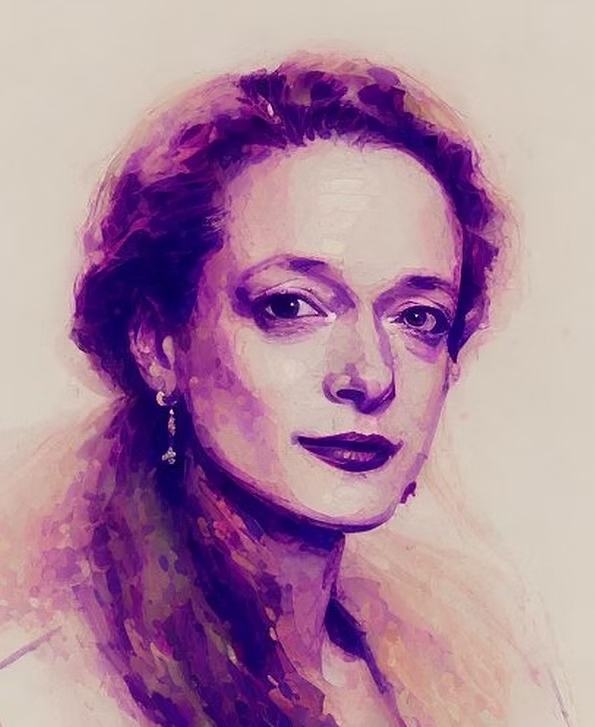
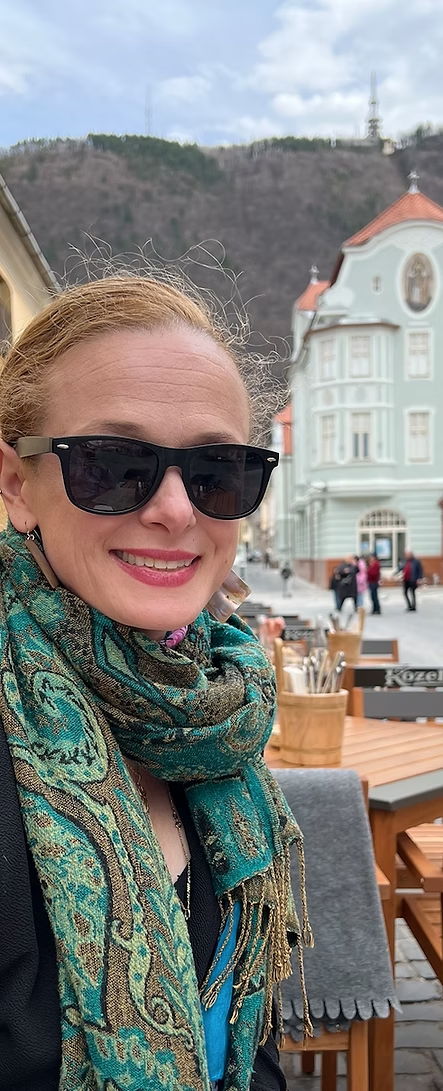
Cristina A. Bejan is a Romanian-American theatre artist, poet, and historian. A prolific playwright, Bejan has written nineteen plays, with productions in the United States, United Kingdom, Romania, and Vanuatu. Her hit play “Districtland” was bought for TV development, and Next Stage Press has released three of her scripts. She writes creatively in five languages and has published countless poems, plays, and poetry translations in literary journals and anthologies.

Continue reading

1 Comment

Filed under anti-racism, art & allure bewitching, authoritarian regimes, centre-periphery relations, cultural transmission, economic processes, education, ethnicity, Fascism, governance, historical interpretation, human rights, legal issues, life stories, patriotism, performance, politIcal discourse, power politics, racism, self-reflexivity, social justice, truth as casualty of war, unusual people, world events & processes

The Dirty Strands Within Sri Lanka’s Ruling Order Over Recent Years

ACL Ameer Ali, in Colombo Telegraph, March 2025, where  the title reads thus: “Has AKD Disturbed A Hornet Nest?

The disappearance of Inspector General of Police Deshabandu Tennekoon and Sewwandi the woman alleged to have supplied the gun in the murder of an underworld kingpin inside the court premise in Colombo, and similar disappearances previously of high officers in government service are proof of one indisputable fact in the recent history of Sri Lanka. They demonstrate how deeply interpenetrated are the crime world and officialdom in the country’s post-JR open economy or the so-called Dharmista Samaagaya. That openness not only made easier the entry and exit of goods and services and capital and labour but also criminals and contrabands. The market for narcotics and drugs for example, could not have grown so widely in Sri Lanka had it not been for this diabolic relationship.  At least that much could be gleaned from reading between lines Nandana Weeraratne’s, The Criminal History of Ranil Wickremasinghe 1977-1997 (Lanka Books 2024). That relationship between the underworld and officialdom became even more cordial after the civil war when Mahinda Rajapaksa and his clan became unchallenged heroes. Dubai and Qatar became offshore centres of operation for underworld kingpins, and profits made from criminal and illicit businesses were able to escape local tax net and Central Bank controls to find safe havens abroad. Didn’t Panama Papers identify members of Rajapaksa clan safekeeping their financial fortunes in offshore tax havens?

Continue reading

1 Comment

Filed under accountability, island economy, Left politics, legal issues, life stories, politIcal discourse, power politics, self-reflexivity, social justice, sri lankan society, the imaginary and the real, unusual people, vengeance, world events & processes

Ranil’s Responses to Al-Jazeera’s Hostile Questions

Darshanie Ratnawalli 


So, have you read Ranil’s Al Jazeera interview?

Has anyone who is expressing an opinion on Ranil’s performance at his interview with Al Jazeera’s Mehdi Hasan ingested the full content of this media circus? Even people like Himal Kotelawala (sympathetic to RW), Lakshan Wickrema (derisive of RW) and Crystal Koelmeyer (sympathetic to RW), whom I have so far read on this subject had not.

Continue reading

Leave a comment

Filed under accountability, atrocities, authoritarian regimes, centre-periphery relations, democratic measures, discrimination, disparagement, governance, historical interpretation, Indian Ocean politics, life stories, LTTE, performance, politIcal discourse, power politics, self-reflexivity, Sinhala-Tamil Relations, slanted reportage, social justice, sri lankan society, terrorism, truth as casualty of war, war reportage

Misunderstanding Manorani Saravanamuttu’s Character in Film

A Critical Review of the Film “RANI” which is entitled “Did Rani Miss Manorani?” with the sub-title “A film that avoids the “Mannerism” of a Biopic” by Rani Bhagya Rajapakshe …. 

“This is only how Manorani sees Richard. It doesn’t have a lot of what Richard did. Although Manorani is not someone who pays attention to the happenings in the country. It was only after her son was kidnapped that she began to feel that this was happening in the country. She had human emotions. But she was a person who smoked cigarettes and drank whiskey and lived a merry life.”  ……     Interview with “Rani” film director Ashoka Handagama by Upali Amarasinghe – 02.02.2025 ‘Anidda’ weekend newspaper, pages 15 and 19

 The above statement shows the key attitude of the director of the movie, “Rani” towards the central character of the film, Dr. Manorani Sarawanamuttu. This statement is highly controversial. Similarly, the statement given by the director to Groundviews on 30.01.2025 about capturing the depth of Rani’s character shows that he has done so superficially, frivolously?

Continue reading

2 Comments

Filed under accountability, art & allure bewitching, Colombo and Its Spaces, conspiracies, cultural transmission, historical interpretation, Left politics, life stories, martyrdom, performance, politIcal discourse, self-reflexivity, social justice, sri lankan society, trauma, unusual people, vengeance

Vale: In Appreciation of Dr. Sisira Jayasuriya, A Committed Scholar

Sarath Rajapatirana  & Premachandra Athukorala, whose appraisal is entitled “In Memoriam:   Sisira Jayasuriya, 1946-2025″

The distinguished economist Professor Sisira Kumara Jayasuriya, Sri Lanka-born and a scholar who spent much of his professional life in Australia, passed away on 18 February 2025, after a prolonged battle with cancer.  Sisira was a remarkable man: a highly respected economist whose intellectual contributions ranged far and wide; an influential public intellectual; a wonderful teacher, mentor, and institution-builder; and a deeply loved friend to many people across cultures and all over the world. Continue reading

3 Comments

Filed under accountability, cultural transmission, democratic measures, economic processes, education, governance, Indian Ocean politics, island economy, Left politics, legal issues, life stories, patriotism, performance, politIcal discourse, social justice, sri lankan society, Tamil civilians, tolerance, unusual people, working class conditions, world events & processes

Migration Scams Rampant in Sri Lanka

Niruni de Mel in The Island, 16 February 2024 where the title runs thus: “Scammed and Stranded: The Dark Side of Sri Lanka’s Migration Industry”

A fisherman from the quiet town of Mannar sold his mother’s, sisters’, and sister-in-law’s jewelry and, with a loan from his brother, paid a migration agent Rs. 12.8 million for a Canadian visa. Months later, he discovered the agent had vanished, leaving his family in crippling debt and his dreams in ruins. His story is not unique. Across Sri Lanka, countless desperate individuals fall prey to fraudulent migration schemes, losing their life savings in the process.

Continue reading

Leave a comment

Filed under accountability, atrocities, centre-periphery relations, commoditification, debt restructuring, demography, economic processes, ethnicity, historical interpretation, human rights, island economy, life stories, migrant experiences, politIcal discourse, security, self-reflexivity, social justice, sri lankan society, world events & processes