Category Archives: life stories

Para Dhemalā

Charles Sarvan

Charles-Sarvan-150x150“…an alien Tamil speaking group with little or no history in the island” (Sunday Island, Colombo. 25 January, 2004, p. 7),  … quoted in my essay, ‘Reign of Anomy’.

I don’t remember hearing Sinhala spoken in the Jaffna of my childhood, but I’m over 75 and no longer trust my memory: perhaps, Sinhala was spoken here and there.    Be that as it may, it’s not relevant to what follows. We shifted to Colombo when I was 14, and I was almost immediately sent to St Thomas’, Gurutalawa (see, “Recollections of Gurutalawa”, Sunday Island, 5 July 2009). The context in which the word para was used at boarding-school, in Colombo and elsewhere; the accompanying tone of voice and facial expression, all indicated contempt, dismissal and rejection. Para was linked to Parayā (low caste) and that sufficed to convey meaning to me. The first time this particular linguistic stone was thrown at me was at Gurutalawa. Continue reading

6 Comments

Filed under British colonialism, cultural transmission, disparagement, historical interpretation, life stories, nationalism, politIcal discourse, racist thinking, Sinhala-Tamil Relations, sri lankan society, world events & processes

A Tropical Romance Extraordinary: Sam Popham and his Trees

Ranjit Mulleriyawa, in the Island, 9 August 2013, here the title is “Popham Arboretum in Dambulla :A Sanctuary of Tropical Trees A ” Summer Romance with trees– with a Dowry of an Ecosystem Restored”

POPHAM 33 Beside the Dambulla-Kandalama road, is a unique Arboretum representing the flora of the semi-evergreen, monsoon dry forest of Sri Lanka. Its creator is an Englishman – Francis Home Popham, known only as Sam . Sam Popham was born on the 29th of February, 1923.He was educated at Eaton and Magdalene College Cambridge, where he graduated in History. He first came to Sri Lanka (then ‘Ceylon’) as a young British Naval Officer during the second world war. Based in Trincomalee, he would often travel through Dambulla admiring the forest vegetation on either side of the Dambulla-Kandy road. Back home in England after the war, Sam became a schoolmaster for a while, before returning to Sri Lanka a few years later as a Tea Planter. His love for trees, made him give up planting tea and assume responsibility as the Smithsonian Institute’s Principal Field Officer in the ‘Flora of Ceylon ‘ project. In 1963, he bought seven and a half acres of scrub jungle (abandoned ‘Chena’ land) in Kandalama, Dambulla and commenced his life’s most important work- Returning wasteland to nature- conserving the unique biological diversity of the ‘dry zone’ of Sri Lanka. Continue reading

2 Comments

Filed under life stories, unusual people

Botham’s feat/feet from north to south for FOG and Lanka

Rex Clementine, in the Island, 16 August 2013

BEEFY BOTHAMNo Ashes contest passes by without the memory of Sir Ian Botham. About to be sacked as captain in 1981, Botham stepped down as England skipper in humiliation after collecting a pair in the Lord’s Test with England trailing 1-0. What happened afterwards is history as playing under Mike Brearly, Botham won England the Ashes singlehandedly 3-1. Knighted in 2007, Sir Ian has stepped up to support several charitable activities including his walks across Europe for Leukemia Research. Yesterday Sir Ian announced his latest walk from Killinochchi in the North to Seenigama in the South over eight days to support the Sri Lankan youth. Continue reading

1 Comment

Filed under cultural transmission, disaster relief team, life stories, performance, reconciliation, Sinhala-Tamil Relations, sri lankan society, world affairs

Arguments in Australia as irregular migrant flow becomes an election issue

Rowan Callick, in The Australian, 12 August 2013, where the title is “A Different Destination

callickTHE drama of this especially intense election campaign is being shadowed by a more bitter struggle being played out in the tropical zone to Australia’s north, on perilous seas and in remote islands. The characteristically bold – or impetuous – Kevin Rudd solution to the asylum-seeker dilemma initially shook up the opposition as much as it did the people-smugglers, threatening to prise away Tony Abbott’s popular grip on the issue, as intended.

146788-asylum-seeker-boatIt may not fully unravel by September 7, nor is it likely on present evidence to demonstrate sustained success by then, despite the claims of Immigration Minister Tony Burke that asylum-seekers in Indonesia now “realise that what they have paid for is no longer available to them”. About 1900 have arrived since Rudd’s Papua New Guinea-Nauru solution was struck, but numbers have moderated in recent days. Continue reading

Leave a comment

Filed under accountability, asylum-seekers, Australian culture, australian media, economic processes, historical interpretation, life stories, people smugglers, politIcal discourse, population, Sinhala-Tamil Relations, tamil refugees, world events & processes

Lost and at sea: the asylum-seeker debate in Australia

Michael Roberts, courtesy of ASIA SENTINEL, 12 August 2013

Electoral politics have swamped the debate on irregular migrants, the “boat-people that is, in Australia. There is no change of consequence however. Rudd, Abbott, the Greens and Letters to the Editor continue to present (a) many of the old shibboleths and oversimplifications that have skewed discussions of this issue for years. The motifs peddled in most quarters are also directed by (b) misinformation, exaggeration and fabrication and (c) ideological blinkers.

ASIA SENTINEL from Asia Sentinel

A self-evident fact is often glossed over: migration in modern times, whether legal, humanitarian or irregular, is a complex phenomenon. Given the diverse lands from which migrants have headed for Australia it follows that one must attend to regional differentiation in speaking about this topic. Yet sweeping generalizations are continuously voiced – not only by politicians and human rights lawyers, but also by concerned citizens of compassionate heart and, on the other side, by intransigent Aussies on the Right. Continue reading

Leave a comment

Filed under Afghanistan, asylum-seekers, australian media, cultural transmission, economic processes, historical interpretation, immigration, legal issues, life stories, people smugglers, slanted reportage, sri lankan society, world events & processes

Lanka Nesiah passes away: LANKA loses a perceptive scribe and ecumenical patriot

A Tribute in Colombo Telegraph, with title “No more Shanie column”

Lankanesan-NesiahColombo Telegraph is sad to announce the death yesterday (Aug. 11) in London of one its recent and most respected columnists, Lankanesan Nesiah. As a writer he used the pseudonym Shanie, a pseudonym derived from all six letters of his surname Nesiah, saying he did not wish to be “white-vanned.” His precision and the use of language through elegantly employed turns of phrase, were clearly from his father, Kunasekaram Nesiah. who was Head of the Department of Education at Peradeniya and, as a school boy at St. John’s, the proud recipient of the runner-up prize for essay writing in the British Empire. Continue reading

Leave a comment

Filed under democratic measures, heritage, historical interpretation, life stories, literary achievements, politIcal discourse, Sinhala-Tamil Relations, sri lankan society, tolerance, unusual people

Acid waterlevels in Weliweriya region: Knee-jerk reactions in closing a cutting edge-factory

Mevan Pieris, in The Island, 11 August 2011, which has the title Keeping Dipped Products Glove Factory Closed Seems a Huge Mistake and a National Disaster”

I have read with great concern and sorrow, the reports that have appeared in the news papers regarding the events that have led to the temporary closure of Dipped Products Plc factory at Weliweriya. This organization began as a joint venture between Hayleys Ltd and Richard Pieris & Co Ltd in the mid-1970s at Kottawa, to add value to raw rubber at a time when the latex based glove making industry of our country was in its infancy. The venture began to produce gloves for the export market without any foreign technologists assisting, and has since then, grown to be the world’s fifth largest producer of household & industrial rubber gloves, in the world. During this journey, Dipped Products Plc (DPL ) has expanded operations to Weliweriya and Hanwella, generating employment to many Sri Lankans and has made a major contribution towards earning a good image for Sri Lanka in the global market, as a centre of excellence in rubber glove production. DPL has even been able to set up factories in other parts of the world and can be considered to be one of the best examples of how Sri Lankans can by their own capabilities, with little or no assistance from foreigners, become a global giant. Needless to say, during this period DPL has taken enormous care not to damage the external environment. A very high standard of social responsibility has been displayed by this organization. I have very recently supervised an undergraduate research project of the waste water disposal system at DPL and write this article with first hand knowledge of DPL practices, in the fervent hope that it would contribute towards solving the prevailing problem of national importance. Continue reading

3 Comments

Filed under economic processes, environmental degradation, life stories, politIcal discourse, slanted reportage, sri lankan society, welfare & philanthophy

Create an enemy, target Muslims, sharpen animosities … To what end?

Mohamed Saleem, in the Island, 7 August 2013, where the title reads “Need an enemy? Target Muslims: Souring Buddhist-Muslim Relations”

2a-Moorman Tamby =213For months Sri Lanka has witnessed orchestrated anti-Muslim campaigns. Some Buddhist-clergy, self proclaimed saviours of true Buddhism, branding as Bodu Bala Sena, Sinhala Ravaya and Ravana Balakaya are instigating Buddhists, particularly the youth, into a state of frenzy that manifests in hate rhetoric against the Muslims, desecrating their belief systems and places for congregational worship. Stereotyping and targeting with the intent of causing social disharmony, although unacceptable in any cultured society, the anti-Muslim exuberance in this country is flourishing as the perpetrators feel encouraged to perform under the watchful eyes of the law enforcement agencies that have no qualms about Muslims being picked as targets. Continue reading

Leave a comment

Filed under communal relations, cultural transmission, economic processes, fundamentalism, historical interpretation, life stories, nationalism, politIcal discourse, power politics, Rajapaksa regime, sri lankan society, tolerance

Galle Fort — ten generations in one street

Juliet Coombe, courtesy of the Daily News

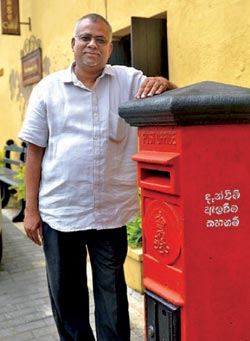
The British Colonial red letterbox sets the scene for the gargantuan colonial façade of The Heritage Café that straddles both Pedlar and Lighthouse Street replete with imposing columns, original courtyard, which considers the volatile horizon in pensive calm, solid and stoic, concealing the boundless ever changing energy and innervations of different generations and the buildings variable uses over the centuries.

MANHALManhal the owner of The Heritage Café explains with immense pride over a fish platter fit for a king that this is the only ancient fortress of its kind and that it is very much a living city, where you see fort children with satchels heading out to school early morning, street peddlers plying their trade daily, and the army running past keeping up a rigorous routine reinforcing why they are one of the best in the world. This is in dynamic contrast to other forts around Asia, which are in most part merely empty museums, with none of the historic families or life coexisting within their historic walls. Manhal always with a story to tell about the past and the biggest twinkly smile thinks his family has probably been living in Pedlar Street for around ten generations or more. “It’s difficult to know” explains Manhal, “as my family has been here for so long and since no records from the early years exist and we only have the oral history it is hard to know fully about our lives here in Galle. I am always seeking out new information and feel like an archaeologist some days putting the pieces of a puzzle together, both of this building and my family’s past lives in this ancient citadel.” Continue reading

Leave a comment

Filed under British imperialism, cultural transmission, heritage, historical interpretation, landscape wondrous, life stories, photography, sri lankan society, world affairs

Confusions and erasures around Black July among some educated Sinhalese youth

Iraj De Alwis, from GROUNDVIEWS, 31 July 2013,  where the title is “Forgetting Black July” .. so go to http://groundviews.org/2013/07/31/forgetting-black-july/ –  because that post includes (a) recordings of some interviews with young Sinhalese and Tamils, with the Sinhalese revealing appalling  ignorance about the events of July 1983; and (b) a few comments that were appreciative of De Alwis’s presentation in  thoughtful ways. ALSO refer to http://www.flickr.com/photos/sacrificialdevotion/

BLACK JULY --BBC Pic from BBC

I was born ten years after Black July. I am a Singhalese. A week or so ago, as the thirty-year anniversary approached, for curiosity’s sake, I did a small experiment. I asked some of my peers a question: “What do you know about Black July?” Of twenty-two Sinhalese, eighteen did not know what it was. I asked eight Tamil friends, all of whom knew, and had family experiences to share. Here are a few of those responses. Continue reading

1 Comment

Filed under cultural transmission, education, heritage, historical interpretation, life stories, nationalism, politIcal discourse, riots and pogroms, sri lankan society, Tamil civilians, tolerance, unusual people, world events & processes