Category Archives: life stories

Leonard Woolf: His Political Vision – From Innocent Imperialist to Pragmatic Internationalist

Jane Russell & Ruth Allaun**

leonard Woolf 11 Leonard Woolf went off to Ceylon in 1904 as innocent as a present-day wannabe writer who goes off globe-trotting in search of adventure and creative sustenance in his “gap “year. Woolf joined the Ceylon Civil Service (CCS) because he needed a respected pensionable job which would satisfy his family’s requirements, yet also feed his imagination and make him interestingly exotic to his Cambridge friends. It was a happy accident (the very definition of serendipity) which brought him to Ceylon. Both gained immeasurably.

But if Cadet Woolf cut a shine in his green collars at welcome parties in Colombo, he didn’t reckon on the dark and miserable side to his job – the “dirty work of empire” as Orwell called it – of supervising floggings, hangings, and the taking of witness statements from the nearly dead. Continue reading

7 Comments

Filed under British colonialism, British imperialism, cultural transmission, democratic measures, economic processes, education, ethnicity, governance, heritage, historical interpretation, life stories, politIcal discourse, world affairs

Charles Haviland’s Farewell Political Travelogue on Sri Lanka

haviland SEE Sri Lankan journey at http://www.bbc.com/news/world-27494822#sa-ns_mchannel=rss&ns_source=PublicRSS20-sa…..20 May 2014 Last updated at 17:24 BST

About 300 miles separate the old Dutch fort of Galle on Sri Lanka’s southern tip and Mullivaikal, the strip of land in the north where an army assault on Tamil rebels ended a civil war five years ago. The BBC’s Charles Haviland travelled up the coast passing fish markets and seaside resorts, eventually turning inland towards the ancient capital and ending up in a desolate former war zone. These are the stories of the people he met on the way.

Photofilm production by Paul Kerley. Publication date 21 May 2014

Leave a comment

Filed under discrimination, life stories, politIcal discourse, population, slanted reportage, sri lankan society, Tamil civilians, travelogue, truth as casualty of war, unusual people, vengeance, World Bank

Engaging Issues of Caste in India and Sri Lanka

Devanesan Nesiah, courtesy of The Island, 19 May 2014

Caste is observed by the overwhelming majority of Sinhalese and Tamils but the subject remains virtually taboo in public discussions. If it is mentioned in public, it is often either to hurl abuse or to negotiate a marriage. The latter is because for many of us caste is the most important factor in marriage. The former is because caste is yet widely accepted as a measure of social status; the latter because for many caste is the most important factor in marriage, even more important than character. I am not suggesting that the individuals should be identified by caste but I do think that the subject should be freely discussed as is done in India, although caste oppression there is much more severe than in Sri Lanka. Continue reading

2 Comments

Filed under caste issues, cultural transmission, democratic measures, discrimination, economic processes, governance, historical interpretation, Indian religions, Indian traditions, life stories, world affairs

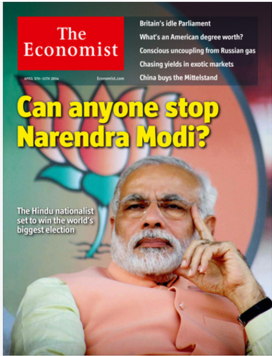
Modi’s comprehensive triumph: Lucien Rajakarunayake’s review

Lucien Rajakarunanayake …. in the Daily News, 17 May 2014

modi VICTORY CELEBRATIONS

By the time this is published, Narendra Modi, who leads the National Democratic Alliance (NDA) the centre-right alliance of political parties led by the Bharathiya Janatha Party (BJP), will be elected the next Prime Minister of India. The results so far (on Friday 16 morning) give Modi and the NDA he leads more than the 272 needed to form a single party government. This takes away the possibility of the BJP having to bargain with regional political parties, to form a government. Yet, the trend as counting continued yesterday largely in favour of the NDA – with Narendra Modi as Prime Minister from the BJP, has already resulted in intense jockeying for key Cabinet positions by leading members of the BJP such as Sushma Swaraj, Opposition leader in the Lok Sabha, Arun Jaitley, Opposition leader in the Rajya Sabha, Rajnath Singh, Chairman of the BJP, and LK Advani, the BJP’s Parliamentary Chairperson. Continue reading

1 Comment

Filed under accountability, governance, heritage, historical interpretation, life stories, performance, politIcal discourse, power politics, Rajapaksa regime, religious nationalism, security, Sinhala-Tamil Relations, sri lankan society, the imaginary and the real, unusual people, welfare & philanthophy, world events & processes

Blue Whales off Lanka south and Marine Biologist, Asha De Vos of Perth

SEE https://www.youtube.com/embed/o5MPbZZ4xJA?feature=player_embedded

Worlds Largest Blue Whale colony – Discovered in Sri Lanka

Uploaded on Apr 19, 2011 ……….http://www.srilanka.travel/…..
https://www.facebook.com/Awesome.SriL…

blue-whales-615 Continue reading

Leave a comment

Filed under heritage, life stories, photography, travelogue, world affairs

Roadblocks in the Path of Reconciliation in Lanka: Ideological Cancers within the Sinhala Universe

Michael Roberts, courtesy of Groundviews, where the title is a variation on that utilized here

Way back in the 1970s the manner in which Anagārika Dharmapāla conflated the concepts of “Ceylonese” and “Sinhalese” in one of his public exhortations (Guruge 1965) led me to argue that this was a powerful tendency in Sinhalese nationalist thinking and that this unexamined tendency was a major problem in securing political accommodation that would assuage the growing dissent among the Sri Lankan Tamils (Roberts 1978). The problem remains and has been marked in the theme motif for my thuppahi site, viz., “the Sinhala Mindset” (2009a).

It was highlighted once again in my article “Pillars for the Future” in Frontline on 22 May 2009 immediately after the Government of Sri Lanka, marshalled by the Rajapaksas and UPFA, defeated the LTTE military machine (Roberts 2009b). I argued here for a multi-faceted approach directed towards dismantling the practices which encouraged the majoritarian Sinhala part to elide itself as the whole of Lanka in ways that naturalized domination. Continue reading

4 Comments

Filed under accountability, authoritarian regimes, centre-periphery relations, communal relations, cultural transmission, discrimination, governance, historical interpretation, language policies, legal issues, life stories, nationalism, patriotism, politIcal discourse, power politics, power sharing, Rajapaksa regime, reconciliation, self-reflexivity, Sinhala-Tamil Relations, sri lankan society, Tamil civilians, TNA

New Light on the Hela Havula

Abstract of Garrett Field’s Essay in the Sri Lanka Journal of the Humanities, 2012, vol. 38: 1/2 entitled “Commonalities of Creative Resistance: Regional Nationalism in Rapiyel Tennakoon’s Bat Language and Sunil Santha’s Song for the Mother Tongue.” 

This article highlights commonalities of regional nationalism between the poetry and song of two Hela Havula (The Pure Sinhala Fraternity) members: Rapiyel Tennakoon and Sunil Santha. I reveal how their creative works advocated indigenous empowerment in opposition to Indian cultural hegemony, and against state solicitations for foreign consultation about Sinhala language planning and Sinhalese music development. Tennakoon challenged the negative portrayal of Sri Lankan characters in the Indian epic, the Ramayana, and Santha fashioned a Sri Lankan form of song that could stand autonomous from Indian musical influence. Tennakoon lashed out against the Sinhala-language dictionary office’s hire of German professor Wilhelm Geiger as consultant, and Santha quit Radio Ceylon in 1953 when the station appealed to Professor S.N. Ratanjankar, from North India, for advise on designing a national form of Sri Lankan music. Such dissent betrays an effort to define the nation not in relation to the West, but to explicitly position it in relation to India. A study of Tennekoon and Santha’s careers and compositions supplement the many works that focus on how native elite in South Asia fashioned a modern national culture in relation to the West, with an awareness of regional nationalist, non-elite communities—who also had a stake in defining the nation—struggling against inter-South Asian cultural hegemony. Continue reading

1 Comment

Filed under cultural transmission, heritage, historical interpretation, life stories, literary achievements, patriotism, politIcal discourse, sri lankan society

Romila Thapar on the doing of history — historical investigation/writing today

Professor Romila Thapar responds to Kuldeep Kumar in addressing the growth of Indian historiography, the tradition of dissent, and current attempts to stifle intellectual expression — courtesy of Governance Now magazine   Vol.05 Issue-06 (16-30 April 2014)

ROMILA THAPAR 22Your book The Past Before Us comprehensively deals with the historical traditions of early north India. One wonders why and how the view that Indians lack historical consciousness came to be accepted.

This book that I published six months ago is on historical traditions in what I call early north India – that is anywhere from 1000 BC to 1300 AD. The book is essentially a study of historiography and that is an area of historical writing that we have not paid too much attention to in India, particularly not with reference to pre-modern India. It’s beginning to become very important with modern Indian history but less so with pre-modern history. It is significant as it is the study of the historians and ideology of the time, which conditions the writing of history. So, it’s history commenting on history writing. Continue reading

Leave a comment

Filed under cultural transmission, economic processes, education policy, governance, heritage, Hinduism, historical interpretation, Indian traditions, life stories, unusual people, world affairs

Sri Lanka’s Politicians as a Scourge

Footprints In The Sands … by Derrick Mendis. s.j.

 DEREK MENDIS

Politics in Lanka is a dirty game

Sans sense of honesty, honour or shame.

On election-campaigns that squander millions,

When in power, make illicit billions.


Full of corruption, nepotism, crime,

They leave no footprints in the sands of time,

Self-seeking, self-serving, power-drunk quacks,

Cover up their crab-like, crooked tracks.


Parliament’s pack of jokers, jerks,

Abuse their power for self and perks,

Goons and buffoons, men of straw,

Brazenly bend and break the law.


They promise us the sun and the moon.

Pledges broken or forgotten soon,

Barefaced, through their teeth they lie,

On hollow words can we rely?


They flagrantly flout every rule in the book,

To come into power by hook or by crook,

From one party to another they jump,

Kiss President’s feet and lick his rump.


In sumptuous luxury they wine and dine,

Make ample hay while sun doth shine.

Of life’s best things they have their fill,

The taxpayers have to foot the bill.


They trot the globe and have a ball,

In five-star hotel, shopping mall,

Lavishly splurge like duke or count,

On bankrupt Lanka’s state account.


Their life is sweet, a bed of roses,

Gobbling Lanka’s scarce resources,

Our so-called rulers, leading lights,

Are a bunch of social parasites.


Their hands are soiled, palms well greased,

Our people, rich and poor are fleeced,

Most of them to the core are rotten,

They flaunt and flash their wealth ill-gotten.


How could these robbers ever dare

Their numerous assets to declare?

An auditor’s test they will not pass,

Many would end up behind bars.


Crime and corruption they cannot battle,

In their own cupboards many skeletons rattle.

A sincere statesman I fail to see

Among Sri Lanka’s powers-that-be.


Idolized heroes of yesterday,

Made traitors, villains of today..

Free-media muzzled, my country’s bane.

Journalists, editors attacked and slain.


Many politicians are vermin, pests,

Who earn fast-bucks and feather their nests,

They leave no footprints in the sands of time,

But craftily cover up their tracks of crime.


Rev Fr Derrick Mendis SJ

Colombo 4.


A NOTE: This poem has been circulated a number of times previously.  However, it is worthy of repetition, particularly in the present context.
Its author is Fr. Derrick Mendis, a Jesuit Priest, who was a brilliant student. He obtained a BSc Honours Degree in Economics. He then decided to qualify as a Chartered Accountant. The day he passed out as a Chartered Accountant, he declared his intention of joining the Society of Jesuits, which engages in evangelization and apostolic ministry, working in education, intellectual research and cultural pursuits, promoting social justice and ecumenical dialogue.

He is an amiable individual and is not averse to a sip of “spiritual” refreshment on social occasions, to complement his love of food. He is a talented musician, plays the piano and guitar [as well as the electron organ, ukulele, and flute]  wonderfully, has a magnificent singing voice and a lively sense of humour. This all contributes to him invariably being the life and soul of any social gathering. He amazingly also finds time to indulge in his love for the sea, by way of swimming, snorkelling, spear fishing and fishing with rod and line. A big man, he rides a tiny scooter, is quite rotund and sports a thick – now grey – beard. He is a highly respected priest, whose sermons are apparently outstanding, with a fair sprinkling of humour. He is, of course, quite outspoken, as his poem indicates. He is now retired from his pastoral role, but continues to work with lepers. He is quite a personality!


Leave a comment

Filed under citizen journalism, disparagement, governance, historical interpretation, legal issues, life stories, politIcal discourse, sri lankan society

Fulbright’s global vision is a LESSON to those with narrow parochial minds, Mr President

Amarakeerthi Liyanage’s Open Letter to Mahinda Rajapaksa

His Excellency President Mahinda Rajapaksa, The President Socialist Democratic Republic of Sri Lanka, Office of the President, Temple Trees, 150 Galle Road, Colombo 3, Sri Lanka.

MR PROCLAIMS

Dear Mr. President,

AMARAKEERTHIMy name is Liyanage Amarakeerthi, a Fulbright Scholar (1998-2000) and a university lecturer.

I am also a fiction writer of some fame and acclaim. More importantly, I am a Sri Lankan citizen who imagines a peaceful and prosperous Sri Lanka where all its citizens can live without any form of discrimination regardless of their ethnicity, caste, gender and so on. Usually I do not write letters to political authorities or any person wielding power. As an intellectual I keep a critical distance from all centers of power. I will certainly not write any letter to such authorities to gain personal favors of any sort. However, I often write in order to draw the attention of people like you, Mr. President, towards the important issues of our country. I publish such letters in the press, which is one of the important spaces for freethinking citizens to express their views on matters of national and international significance.  In some of my recent articles to the press I have argued that state funding for education in our country has dramatically dwindled under your presidency. Yes sir. It has gone down. I hope you have read some of those articles. Continue reading

Leave a comment

Filed under cultural transmission, life stories, literary achievements, patriotism, performance, politIcal discourse, Rajapaksa regime, self-reflexivity, sri lankan society, tolerance, unusual people, welfare & philanthophy