Category Archives: life stories

IPKF and Sri Lankan Military at Ease, 1987-90

Retd Brig. Sri Mudannayake … responding to the Items describing the Assault on Rajiv Gandhi by a SLN rating after the signing of the Indo-Lanka Pact

You might want to add that, once the IPKF arrived, Sri Lanka Army and the Indian Army troops acted in perfect harmony upholding best of military traditions. There were misunderstandings at times at mess, but they were addressed and resolved amicably.

One notable incident happened in Trincomalee at a check point where our Army and Indian troops briefly exchanged fire. No one was killed.  The SLA’s ‘ hot headed’ Brigadier in charge of the area was transferred out by Gen Ranatunga. The Indian Army Chief, Gen Krishnaswamy Sunderji, came to Sri Lanka and addressed SLA officers at Army Hq Colombo after the incident. Gen Ranatunga in his book referred to him as ” An Officer & Gentleman.”

Continue reading

6 Comments

Filed under accountability, governance, historical interpretation, indian armed forces, Indian Ocean politics, insurrections, landscape wondrous, law of armed conflict, life stories, patriotism, politIcal discourse, power politics, prabhakaran, Rajiv Gandhi, self-reflexivity, Sinhala-Tamil Relations, vengeance, world events & processes

History of Royal College in 1932 is ‘born again’

Yomal Senerath-Yapa, in Sunday Times, 11 August 2019

A reprint of “The History of Royal College”, a 1932 biography of the school authored by students, was launched at the BMICH yesterday in an event organised by the Royal College 1960 Group, in association with the Royal College Union.

Head of the Project Team Senaka Weeraratna hands over a copy of the second edition of the 1932 publication to Prime Minister Ranil Wickremesinghe. Royal College Principal B.A. Abeyratna stands by. Former Royal rugby football captain and coach U.L. Kaluarachchi made the keynote address at yesterday’s launch. Dr. Ajit Wijesundera and Mr. Vajira Gunawardene were the other members of the Project Team.

Continue reading

Leave a comment

Filed under British colonialism, education, heritage, historical interpretation, island economy, landscape wondrous, language policies, life stories, patriotism, politIcal discourse, Royal College, self-reflexivity, sri lankan society, unusual people

Lakshman Kadirgamar’s Legacy

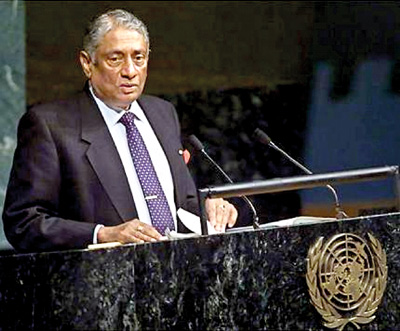
H.M.G.S. Palihakkara, in Sunday Times, 11 August 2019, where the title is “Lakshman Kadirgamar: The Legacy of an Icon”

Fourteen years ago this month, a suspected LTTE assassin snuffed out the life of Sri Lanka’s best known and widely admired Foreign Minister — Lakshman Kadirgamar. The media reported recently that authorities in Germany had arrested a suspect connected to this crime. This news brings into sharp relief the sorry state of accountability in our country. Even after fourteen long years, we have not yet been able to conclusively investigate and prosecute a single offender involved in this ghastly act of terror. Much else has happened though.

Mr. Kadirgamar’s diplomacy, while advocating human rights, prevented human rights issues from becoming foreign policy problems

Continue reading

Leave a comment

Filed under accountability, centre-periphery relations, ethnicity, foreign policy, governance, historical interpretation, human rights, Indian Ocean politics, landscape wondrous, language policies, legal issues, life stories, LTTE, nationalism, patriotism, politIcal discourse, power politics, self-reflexivity, Sinhala-Tamil Relations, unusual people, vengeance, world events & processes

Addressing the Issues of the Dr Shafi Shahabdeen Case

Malinda Seneviratne, in Daily Mirror, 4 July 2019, where the title runs  “Dr Shafi Sahabdeen and the proportionality of communalism”

I want Dr. Seigu Shihabdeen Mohamed Shafi cleared of all charges levelled against him with respect to unethical and unwarranted sterilization. I want him cleared because I want to believe that our medical profession is made of impeccably honourable and competent people. I want to believe that those who graduate from state universities in Sri Lanka learn the relevant skills and show absolute fidelity to professional ethics. I want him cleared because it would help dial down the lunacy among a certain section of the population to see a terrorist in every Muslim.

Continue reading

Leave a comment

Filed under accountability, chauvinism, communal relations, legal issues, life stories, politIcal discourse, social justice, sri lankan society, the imaginary and the real, truth as casualty of war

Frolicking with Whales and other beings at Ningaloo Reef off Western Australia, 1 August 2019

Man O’ Man ….Fred & Bev Leaney make me jealous

Continue reading

Leave a comment

Filed under Australian culture, landscape wondrous, life stories, performance, photography

Clobbering Rajiv Gandhi as Chastisement in 1987: A Guti Dheema

Michael Roberts

When Vijithamuni Rohana de Silva upended military discipline and attempted to clobber the Indian Prime Minister Rajiv Gandhi on the head as the latter was inspecting a guard of honour on 30th July 1987, he was indulging in an act of chastisement – a guti dheema in Sinhala parlance. As such, in my tendentious elaboration, Rohana de Silva was administering a medicinal pill in the vocabulary of archaic Sinhala – a vocabulary that has resonances within the term beheth guliya. [1]

The emphasis on guti dheema was a conjecture I presented way back in 2002.[2] In my reading now, one that Retd Commodore Somasiri Devendra does not share, the intricate details provided recently by Retd Lt KH Perera confirm this set of musings.

 Indo-Lanka Accord about to be signed on 29th July 1987

Continue reading

8 Comments

Filed under accountability, authoritarian regimes, centre-periphery relations, Eelam, foreign policy, governance, historical interpretation, Indian Ocean politics, law of armed conflict, legal issues, life stories, LTTE, military strategy, nationalism, politIcal discourse, power politics, riots and pogroms, security, self-reflexivity, Sinhala-Tamil Relations, sri lankan society, Tamil migration, Tamil Tiger fighters, terrorism, the imaginary and the real, unusual people, vengeance, war reportage, world events & processes

A Naval Rating’s Assault on Rajiv Gandhi, 30 July 1987: Detailed Account

Retd. Lt. KH Perera’s Account of the Background, Circumstances and Immediate Aftermath of the Assault on Rajiv Gandhi, on 30th July 1987

Preamble:  Via mediation by Rtd Commodore Somasiri Devendra,[1] Michael Roberts visited Retd Lt. KH Perera’s house at Boralasgamuwa on Thursday 25th July 2019 in the company of Devendra.  Retd Lt Perera responded readily to the questions presented about the attempt to clobber the Indian Prime Minister Rajiv Gandhi when he was inspecting a naval guard of honour gathered in front of the President’s House outside the Post Office in the Fort of Colombo on 30th July 1987. As Master Chief Petty Officer, KH Perera was in command of the naval ratings mustered for this important state occasion. The details elicited during our discussion and compiled here with aid from Somasiri Devendra are of considerable importance and cannot be overestimated. Continue reading

4 Comments

Filed under accountability, Eelam, ethnicity, foreign policy, governance, historical interpretation, Indian Ocean politics, landscape wondrous, legal issues, life stories, LTTE, martyrdom, meditations, nationalism, patriotism, political demonstrations, politIcal discourse, power politics

Naayakayo Koheydha! Rudderless Drift in Sri Lanka

Rajeewa Jayaweera, in Island, 5 August 2019, with this title “Leadership vacuum in Sri Lanka”

Imran Khan (IK), 67 years old Prime Minister of Pakistan, hails from an upper-middle-class Pashtun family in Lahore and is a graduate of Keble College, Oxford. He captained the national cricket team on the single occasion his country won the Cricket World Cup in 1992. Aged 39, IK took the winning last wicket. A philanthropist, he raised funds for two state of the art hospitals in Lahore and Peshawar. He also served as Chancellor of the University of Bradford from 2004 to 2014. Pakistan Threek-e-Insaf (PTI or Pakistan Movement for Justice) was founded by IK in April 1996. He led PTI to victory in the 2018 general election and was elected as Prime Minister on August 17, 2018.

Continue reading

2 Comments

Filed under accountability, american imperialism, centre-periphery relations, China and Chinese influences, democratic measures, economic processes, foreign policy, landscape wondrous, life stories, modernity & modernization, performance, politIcal discourse, power politics, self-reflexivity, sri lankan society, unusual people, welfare & philanthophy, working class conditions, world events & processes

Lapses, Holes and Bumbling Officers in Sri Lanka’s Security Organisations

Officers from the Attorney General’s Department appeared before the Parliamentary Select Committee (PSC) investigating the Easter Sunday attacks this week to defend the department’s position. They said they came to clear a wrong impression created in society over the department’s role with regard to a file related to the National Thowheed Jamaath (NTJ). The documents in the file had been forwarded to the AG’s Department by the Terrorist Investigation Division (TID) in 2017 and 2018.

Giving evidence on behalf of the AG’s Department were Deputy Solicitors General (DSG) Dileepa Peiris and Azad Navavi.Army Commander Lt. General Mahesh Senanayake also testified this week, appearing before the commission for the second time. Others who gave evidence this week were former Defence Secretary Kapila Waidyaratne and Acting TID Director Superintendent of Police Jagath Vishantha. Continue reading

Leave a comment

Filed under accountability, atrocities, centre-periphery relations, communal relations, disparagement, governance, historical interpretation, Islamic fundamentalism, legal issues, life stories, politIcal discourse, power politics, security, self-reflexivity, sri lankan society, terrorism, the imaginary and the real, trauma, truth as casualty of war, unusual people

Harvesting the Talents of the Sri Lankan Diaspora

Jeevan Thiagarajah, in Daily News, 29 July 2019, where the title is Implementing Brain gain initiative. Our diaspora”

There is sheer waste of rich resource and benefit to Sri Lanka by our failure to tap into the rich resource available in the Sri Lankan Overseas Communities. There is no co-ordinated effort to tap into this rich willing resource. In the end what most do is undertake personal initiatives. This is what a lot of people do.There are two ways to implement the brain gain: either through the return of the expatriates to the country of origin (Return Option) or through their remote mobilization and association to its development (Diaspora Option).

Continue reading

Leave a comment

Filed under anton balasingham, centre-periphery relations, cultural transmission, democratic measures, economic processes, governance, heritage, island economy, legal issues, life stories, modernity & modernization, politIcal discourse, rehabilitation, self-reflexivity, sri lankan society, tourism, transport and communications, welfare & philanthophy, world events & processes