Category Archives: liberation tigers of tamil eelam

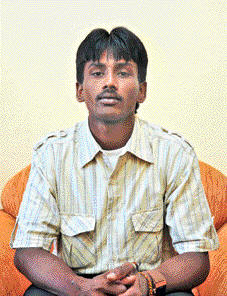
Thulasitharan Santhirarajah, LTTE arms procurer, sought deal, but…

Sean Parnell, in The Australian, 31 July 2012, where the title is “AFP rejected refugee offer to name names”

AN accused backer of Tamil terrorists held in custody in Melbourne for the past four years tried to strike a deal with US and Australian authorities in a desperate bid to avoid being returned to Sri Lanka.The former head of the Melbourne International College, Thulasitharan Santhirarajah, was arrested in 2008 after a series of raids by the AFP, acting on behalf of the FBI.

The Australian yesterday revealed Attorney-General Nicola Roxon in February signed off on the extradition of Santhirarajah, who is accused of providing support to the now-vanquished Liberation Tigers of Tamil Eelam. At the time of his arrest, Mr Santhirarajah, now 38, was living in Melbourne with his wife — an ethnic Tamil previously granted refugee status — and their son. He had moved to Australia on a business visa and was granted a bridging visa while he sought permanent residency. Continue reading

Leave a comment

Filed under accountability, asylum-seekers, atrocities, historical interpretation, liberation tigers of tamil eelam, life stories, military strategy, politIcal discourse, Sinhala-Tamil Relations, Tamil migration, terrorism, world affairs

Turning Tiger Personnel into Lankan Citizens?

 Michael Roberts, courtesy of Groundviewswhere it was presented on  28 October 2011, and where some blog comments will be found 

Whatever the death toll during the last stages of Eelam War IV in 2009 the official government data in that year acknowledged that 11,696 (9078 male and 2024 female)[1] of those who survived had identified themselves or been identified as members of the LTTE — whether combatants or active functionaries. There were others who had been arrested elsewhere in the island (that is beyond the battlefields), often on flimsy evidence, in the years 2006-09. Muralidhar Reddy stresses that “once bracketed in the category of a combatant, irrespective of the degree of their involvement in the war, there was no mechanism for those detained to prove their innocence.”[2]

 Distribution of Certificates-30 Oct 2011–Pic by BCGR

In parenthesis let me add that grapevine information from Tamil sources indicate that in April-May 2009 quite a few Tigers seem to have successfully merged themselves with the population that was deemed civilian and placed in the IDP camps in Menik Farm and elsewhere. Several commentators with some familiarity with the IDP camps have indicated that these detention centres were like the proverbial colander and that a significant number – estimates vary widely from 1,000 to 10,000 — slipped out of the IDP camps in mid-2009 and found their way abroad. It is alleged that at least 500 of this lot were “hardcore LTTE.”[3] Continue reading

8 Comments

Filed under citizen journalism, IDP camps, liberation tigers of tamil eelam, life stories, Rajapaksa regime, reconciliation, rehabilitation, Sinhala-Tamil Relations, Tamil civilians, Tamil Tiger fighters, welfare & philanthophy

Visual Evidence I: Vitality, Value and Pitfall – Borella Junction, 24/25 July 1983

Michael Roberts, 29 October 2011

Pic by Chandragupta Amarasinghe 

The anti-Tamil pogrom of July 1983 in the southern reaches of Sri Lanka stirred me to the bone: generating anger and depression in alternate moods as  I ruminated from a distance in  Australia in the mid-1980s. Much later, when on study leave in Lanka in 1991, I picked up testimonies and tales about specific incidents of killing and threat during those dark days in Colombo, including one relating to the killing of Arumanaiyagam, a former young colleague.

When I flew from Katunayake to Charlottesville inVirginia for the second stage of my leave on a semester fellowship, it was in a particular mood that I sat in the planes and reflected upon that horrible occasion. The relative isolation of my quarters in Charlottesville suited that mood. It was there that I penned “The agony and the ecstasy of a pogrom: southern Lanka, July 1983” – a literary essay rather than a social science document, one that amounted to a personal statement of protest and anguish.

This essay eventually appeared in an anthology of my essays, namely, “The agony and the ecstasy of a pogrom: southern Lanka, July 1983,” in Roberts, Exploring Confrontation. Sri Lanka. Politics, Culture and History, Reading: Harwood Academic Publishers, 1994, pp. 317-27. An invaluable facet of this presentation was the inclusion of two photographs from the Tamil Times of November 1983 depicting mob scenes at Borella Junction on the night of 24/25th July 1983. Extracted from the poor reproductions in the Tamil Times, these photographs would have made a fastidious cameraperson squirm because they lacked sharp definition. But the definition was good enough to reveal striking content – content of the sort that would make viewers squirm because of the inhumanity of man-upon-man they revealed to all and sundry. Better versions of these pictures that are now reproduced within this post would already have bought this point home to readers. Continue reading

12 Comments

Filed under atrocities, communal relations, fundamentalism, gordon weiss, historical interpretation, liberation tigers of tamil eelam, life stories, martyrdom, racist thinking, religious nationalism, Sinhala-Tamil Relations, suicide bombing, truth as casualty of war, world events & processes

Being a Tamil under the LTTE: Teacher Murugesu speaks out

Courtesy of the Sunday Observer, 2 October 2011 where the title is  “Tamil, Sinhala or Muslims of Wanni long for Alternative Leadership”

Web Editor’s Note: While the appearance of this news rport in translation form the Thinakaran in a government-run newspaper may generate scepticism, I think this is ahighly significant representation from hard-earned expereince. I stress here that I have myself sought information on conditions in Thamililam in the period 1995-2009 inclusive of the ceasefire stages with an eye on the degree of support for the LTTE. My information garnered thus far is fragmentary, but Anoma Rajakruna was working  intermittently on the topic of female empowerment in LTTE land in the mid-2000s and indicated that the poltical sentiments of people were constrained by the degree to which their family networks depended on the LTTE dispensation for daily livelihood — precisely the message conveyed by Murgesu the teacher. One should also attend to the title of the book conveeing NBen Bavinck’s diary record, namely, Of Tamils and Tigers and the evidence that is presented on the years 1989-1992 in Volume One. Michael Roberts

Any Tamil who lived through the horrors and unimaginable human sufferings during the last battle at Mullivaikkal in Mullaitivu would never even dream of leading the Tamils in the path of another war. The bitter memory of it is indelibly registered in the minds of the people of the Vanni and it is they who directly encountered the dire consequences, burdens and untold sufferings caused by that last battle. Nor do they have any right to talk about the last stages of that bitter battle. Anyone who witnessed the happenings of May 19 will never think of forcing the Tamils into another war”– So said an emotionally-charged Vanni resident Ariyakutty Murugesu, one time teacher and the father of two former LTTE women cadres. He was one among those who suffered and experienced the heart-rending tragedies and miseries of the last battle. He is a man of an intellectual calibre. He was a teacher at several schools in the Northern peninsula and had also worked as a freelance journalist, including for the Lake House publication .

Speaking out his mind in a brief interview with Thinakaran, our Tamil language daily, he said that the war was forced on the people of Kilinochchi, Mullaitivu and Mannar and they had to Continue reading

Leave a comment

Filed under accountability, authoritarian regimes, communal relations, democratic measures, IDP camps, liberation tigers of tamil eelam, life stories, LTTE, military strategy, politIcal discourse, prabhakaran, Rajapaksa regime, reconciliation, rehabilitation, Tamil civilians, tamil refugees, Tamil Tiger fighters, unusual people, welfare & philanthophy

A Tiger Wheeler-Dealer & Two Conscripts recant and reject Tiger cause

Item by S. Thilainathan in  the government rag, Daily News, 30 Sept. 2011

Sasikumar- From D-News

Sarachandran in Thamililam during visit –Pic courtesy of National Post

Two Tamil youths, Kumaravel Sasikumar and Gunasingham Visaban who underwent immense suffering due to LTTE atrocities, in an exclusive interview, praised President Mahinda Rajapaksa for his exemplary leadership in completely eradicating LTTE terrorism from our motherland. They also said that if the President had not given directions to the Armed Forces to end this 30-year-old terrorist war despite mounting foreign pressure, Sri Lanka would have continued to be in turmoil even today.

Ex-LTTE cadres, 21-year-old Kumaravel Sasikumar was born in Homagama. Thereafter his parents who are from Vavuniya settled in the Vanni area. Sasikumar said that in 2006 when the A9 road was completely closed down due to mounting LTTE violence, he was trapped in Visvamadu. During this period, the LTTE started to replenish its depleting cadres by forcefully dragging innocent boys and girls, ignoring their unwillingness to join the LTTE cadres. Continue reading

1 Comment

Filed under accountability, authoritarian regimes, liberation tigers of tamil eelam, life stories, LTTE, Rajapaksa regime, reconciliation, rehabilitation, Sinhala-Tamil Relations, Tamil civilians, Tamil migration, tamil refugees, Tamil Tiger fighters, terrorism, world events & processes

Sandwiched in between: Tamil Dissidents and Others in the Furnace of War & its Killings, January 1989-December1990 via Ben Bavinck’s Diary

Sharika Thiranagama rides a bike in emulation of her mother Rajani Thiranagama nee Rajasingam for the biographical documentary NO MORE TEARS

As the ethnic conflict in Sri Lanka escalated from July 1983 and the Tamil liberation struggle developed along several militant paths, Tamils throughout the island were placed in a difficult position. The focus here is on the sentiments of those identified in the census as “Sri Lanka Tamils” as distinct from “Indian Tamils” – wherever they resided in the island.[1]

But within this framework the emphasis is on those Sri Lankan Tamils who resided in the northern and eastern parts during the period extending from August 1988 to October 1992, the time spanned by the first volume in Ben Bavinck’s diaries. Note, here, that Bavinck was a fluent Tamil speaker and because of his long experience in the Jaffna Peninsula in the 1950s-70s he was, as Val Daniel suggests, a de facto Tamil in sentiment.[2]

However, he did not look Tamil. On several occasions he was treated as a foreign NGO person or even as “a foreign dignitary.” In the period of his diary, moreover, he was attached to the National Christian Council and was undertaking welfare and relief measures throughout the island. As such, he was able to intervene on behalf of people who were at the receiving end of the conflict. A good part of this work took him to the north on many occasions. Therefore his dairy extracts reveal the thinking of many of his friends, acquaintances and others in this region during the period of warfare between the Tigers and the Indian Peace Keeping Force (till late 1989) and, thereafter during the short interregnum of peace negotiations from January to April 1990 and, thirdly, the renewal of war between the LTTE and the government of Lanka (GoSL) from June 1990 onwards.

A theatrical dramatization of the murder of Rajani Thiranagama by the National Film Board of Canada with Sharika Thiranagama in the role

 His information, therefore, is a voice of his times and conveys invaluable information. It should not be dismissed as “gossip,” though of course some of the reportage has to be treated cautiously as second-hand or third-hand reportage of events that Bavinck did not witness himself. These tales, clearly, must be sifted and evaluated in the light of other contemporaneous information Continue reading

11 Comments

Filed under accountability, anton balasingham, atrocities, citizen journalism, Eelam, female empowerment, historical interpretation, indian armed forces, Indian Ocean politics, liberation tigers of tamil eelam, life stories, LTTE, martyrdom, politIcal discourse, prabhakaran, reconciliation, Sinhala-Tamil Relations, sri lankan society, Tamil civilians, Tamil Tiger fighters, terrorism, unusual people, war crimes, women in ethnic conflcits, world events & processes

Recent Works on Sri Lanka’s Ethnic Conflict

Asoka Bandarage, The separatist conflict in Sri Lanka, terrorism, ethnicity, political economy, London & New York, Routledge, 2009, ISBN 0-415-77678-3 (hbk) & 10-203-88631-3 (ebk) 279 pp

N. Manoharan, Democratic dilemma. Ethnic violence and human rights in Sri Lanka, New Delhi, Samskriti,  2008, 279 pp, (pbk) ISBN978-81-87374-50-3

MR Narayan Swamy, The Tiger vanquished. LTTE’s story, Sage Publications, India, 2010 189 pp, ISBN 978-81-321-0459-9 (pbk)

 Ana Pararajasingham (ed.)  Sri Lanka: 60 years of independence and beyond, AMM Screens, Chennai, for Centre for Just Peace and Democracy, 2009, 621 pp, with articles by Lionel Bopage, Neil de Votta, Bruce Kapferer, John Gooneratne, Dagmar Helmann-Rajanayagam, David Rampton, Peter Schalk, Kristian Stokke, Jayampathy Wickramaratne among others.

Michael Roberts, Fire and Storm. Essays in Sri Lankan Politics,Colombo: Vijitha Yapa Publications, 2010 … ISBN 978-955-665-134-8… 336 pp, 33 illustrations

Michael Roberts, Potency, Power and People in Groups, Colombo, Marga Institute, 2011, 128 pp and 78 pp illustrations, incl. of rare images (pbk), ISBN 978-955-582-129-2

Anton Sebastian, A Complete Illustrated History of Sri Lanka, 696 pp, 444 illustrations

Gordon Weiss, The Cage, Pan Macmillan Australia, 2011 … 352 pp, 24 illustrations

                                             SOME ARTICLES

Kumar Reupesinghe, “Ethnic conflicts in South Asia: the case of Sri Lanka and the Indian Peace-keeping force (IPKF),” in Subrata Mitra (ed.) Politics of South Asia,  volume V,  London, Routledge, 2009, pp.  315-35.

Daya Somasundaram, “Collective trauma in the Vanni — a qualitative inquiry into the mental health of the internally displaced due to the civil war in Sri Lanka,” International Journal of Mental Health Systems, 2010 ….This is an Open Access article distributed under the terms of the Creative Commons Attribution License (http://creativecommons.org/licenses/by/2.0), which permits unrestricted use, distribution, and reproduction in any medium, provided the original work is properly cited].

Daya Somasundaram, “Parallel Governments: Living Between Terror and Counter Terror in Northern Lanka (1982-2009),” Journal of Asian and African Studies, 2010, 45: 568-583, doi:10.1177/0021909610373899; http://jas.sagepub.com/content/45/5/568.abstract

 Symbolic burning of DC bill, late 1960s

ALL IMAGES are reproduced from the book Potency listed above. The signature image is a depcition of the Kotahena Riots, 1883.

2 Comments

Filed under anton balasingham, atrocities, authoritarian regimes, Eelam, fundamentalism, gordon weiss, historical interpretation, Indian Ocean politics, island economy, language policies, Left politics, liberation tigers of tamil eelam, life stories, LTTE, martyrdom, political demonstrations, prabhakaran, Rajapaksa regime, religious nationalism, Sinhala-Tamil Relations, sri lankan society, Tamil Tiger fighters, terrorism, trauma, violence of language, world events & processes

NDTV on Propaganda War in Sri Lanka

“Truth vs Hype: The propaganda wars in Sri Lanka,” An NDTV production running for 26 min, 30 sec, September 10, 2011…….. with Srinivasan Jain as investigative reporter

 Pic from Times

In a country ravaged by war until two years ago,Sri Lanka, on the surface, seems to have made peace. However, below the seemingly calm veneer are many layers of complex questions which are as important as the task of rebuilding the war torn areas of the North and East, questions of rights, justice, resettlement and political autonomy.

SEE  http://www.ndtv.com/video/player/truth-vs-hype/truth-vs-hype-the-propaganda-wars-in-sri-lanka/210461&cp

COMPARE the visual images in still form in the following: TIMES Aerial Images, NFZ Last Redoubt, 23 May 2009  = http://www.flickr.com/photos/thuppahi/sets/72157626922360092/

 Murali reddy outside hospital at Nandikadal, mid-May 2009  –Pic by Kanchan Prasad

* Indian Reporter Pics at NFZ-14-to-18 May 2009 =http://www.flickr.com/photos/thuppahi/sets/72157626797805167/

*Final Battle, NFZ Last Redoubt, 13-19 May 2009 = http://www.flickr.com/photos/thuppahi/sets/72157626921596968/

* Mullivaikkal Hospitalin NFZ Last Redoubt = http://www.flickr.com/photos/thuppahi/sets/72157626797848747/

Leave a comment

Filed under accountability, atrocities, historical interpretation, IDP camps, Indian Ocean politics, liberation tigers of tamil eelam, life stories, LTTE, military strategy, pilgrimages, prabhakaran, propaganda, Rajapaksa regime, reconciliation, rehabilitation, Sinhala-Tamil Relations, sri lankan society, Tamil civilians, Tamil Tiger fighters, truth as casualty of war, unusual people, welfare & philanthophy, world events & processes

Val Daniel’s Introduction of Ben Bavinck and Ben’s Diary over the Years of Conflict in Lanka

E. Valentine Daniel, August 2010

Modern warfare, by any measure, is a display of excess; but the excesses just before the end of wars—the excess of inhumanity, indiscriminate use of force, a frenzy of unmatched cruelty, wanton destruction and devastation, blind firepower, unworldly carnage followed by gratuitous torture as well as generalised infliction of pain—exceed everything that comes before. If this was true at the end of the American Civil War and at the end of the Second Battle of the Marne,  in Hiroshima and Nagasaki, and Dresden at the end of World War II,then it was also true in the far less infamous 27-year old war between the Sri Lankan state and the Liberation Tigers of Tamil Eelam, which ended on 18 May 2009.

Bavinck with Tiger ‘boys”  

The bang with which it ended on the streets of the capital city of Colombo was mightier than the bang with which it ended on the battlefield of Mullaitivu; while all the unwilling and frightened children whom the LTTE, at their final hour, had recruited with bravado, didn’t even have a chance to whimper. They were mowed down. It is worth noting that the OED finds that in American slang, in kinship with the Indian hemp, bhang, “bang”, also describes the effect of a hallucinogenic   drug, such as cocaine. Such was the victors’ jubilation on the streets of Colombo after the war had ended: other-worldly.

 This war was called a “civil war,” which is an oxymoron, a violence of language upon the common Latin root, civilis, from which have issued citizen, civic, civility, civilization. How paradoxical, obscene, wrong and insulting to both savage and beast that the “civilized” (and who would deny that Tamils and Sinhalese belong to a great and old civilization?) choose to qualify their own extreme indulgences in violence as “brutal” or “savage”. In fearsome symmetry, the end of the war resembled its beginning. Once we discount the hundreds of “first causes” of the civil war, hypostasised and hypothesised by hundreds of scholars, politicians, commentators and citizens, we may mark the beginning of the Sri Lankan civil war as the 23 July 1983, the day the display of hatred – a spectacle in its own right, a literal flaring up of violence, arson and mayhem, stoked by a government charged with protecting its citizens, which unleashed a pogrom against the Tamil-speaking minority – that swept through the South as an angel of death. The beginning was as grotesquely carnivalesque as the end. But if there was an excess of cruelty during these moments, there were also extreme acts of kindness. There are many accounts of Sinhalese soldiers refusing to shoot to kill, touched to the quick by the law of karma and the Buddhist concept of karunava. Many are the accounts of priests and nuns, at the risk of being fired at from behind, who secreted children, women and the feeble to freedom from the spit of land where they were trapped with the LTTE. Some LTTE cadres themselves, coming to terms with the odds they faced, protected the stealthily escaping trickles of civilians. Why is it so difficult to admit to one’s own enemy’s virtues? The balanced account of Ben Bavinck’s diary forces us to examine this selfcensure Tamils and Sinhalese impose on themselves. Continue reading

9 Comments

Filed under accountability, citizen journalism, historical interpretation, Indian Ocean politics, liberation tigers of tamil eelam, life stories, LTTE, military strategy, prabhakaran, reconciliation, Sinhala-Tamil Relations, sri lankan society, Tamil civilians, Tamil Tiger fighters, terrorism, unusual people, world events & processes

LTTE consumed Rajiv … and, NOW, drama in court and off court

P. Krishnaswamy, in The Sunday Oberver, 11 September 2011

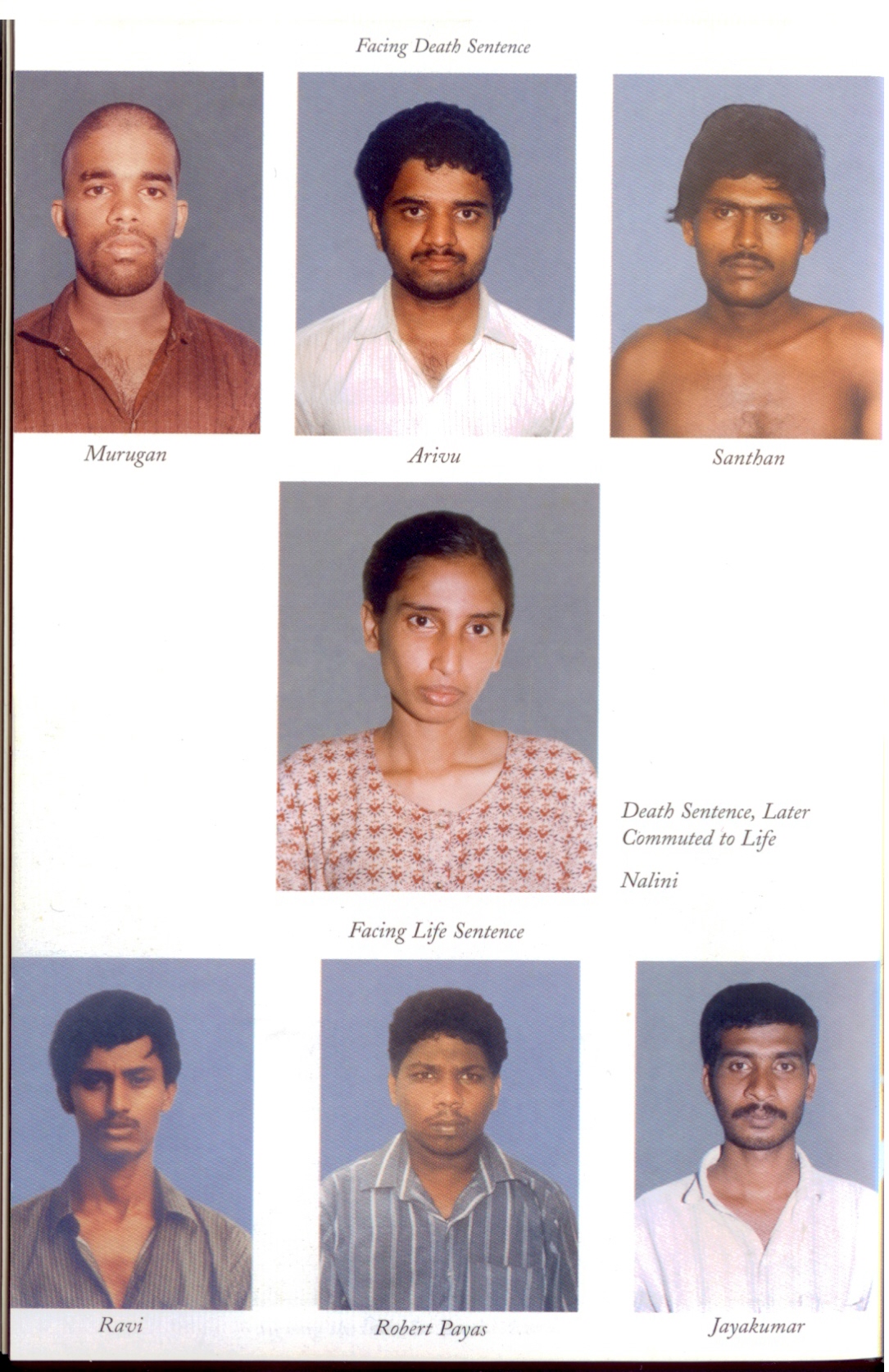
The family of the victims killed along with the former Indian Prime Minister Rajiv Gandhi demanded that Murugan, Santhan and Perarivalan should be hanged, the Indian Express reported. The latest demand came after the clemency plea for the three death row convicts in the Rajiv Gandhi assassination case grew louder. The family of victims, joined by a large numbers of Indian Congress workers, sat on a day-long fast opposing the clemency for the three convicts. Former Union Minister EVKS Elangovan and other Congress leaders also participated in the fast.

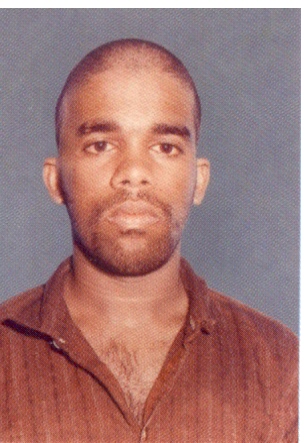
Murugan

Seven underlings —Pics from Kaarthikeyen D.R. and R. Raju The Rajiv Gandhi Assassination. The Investigation,   Slough: New Dawn Press Inc. 2004

The Tamil Nadu Assembly on August 30 had passed a “unanimous” resolution requesting the President to reconsider and commute the death sentence awarded to the three convicts. The Madras High Court, too, on the same day stayed the execution of the accused for eight weeks, which was earlier scheduled for Friday. The three are currently lodged in Vellore Jail, according to the Indian Express report.

Early days: Steel-helmeted, stern looking security men, with machine-guns at the ready, were guarding the Colombo High Court premises at Bullers Road (later named Bauddhaloka Mawatha), with some of them positioned even at distant rooftops, when the trial-at-bar inquiry on the “Neerveli Murder and Robbery’” came up for hearing before High Court Judge C.L.T. Moonamale from the first week of January 1983. Tamil Eelam Liberation Organisation (TELO) leaders Kuttimani, Thangavel alias Thangathurai, Sivasubramaniam Sellathurai alias Thevan, Sivapathan Master and Nadesuthasan were the accused in the case. That probably was the first case against terrorism and terrorists tried under the Prevention of Terrorism Act (PTA) in a Sri Lankan Court. Senior police and army officers, finger-print experts and government analysts were summoned as prosecution witnesses during the Court proceedings. A tense situation emerged every time the heavily-guarded accused who were in detention under the PTA were brought to the Court and taken back in a prison bus. What also unfolded in the Court was that the accused, hailing from Velvettithurai, the birthplace of Velupillai Prabhakaran, were professional smugglers.  

Sivarasan and Dhanu wait for the kill


The Gandhi family in mourning vigil 

Subha (reserve suicide bomber) and Nalini pictured in crowd

Continue reading

1 Comment

Filed under accountability, historical interpretation, Indian Ocean politics, liberation tigers of tamil eelam, life stories, LTTE, political demonstrations, Rajiv Gandhi, suicide bombing, world events & processes