Category Archives: indian armed forces

Deceiving Consumers: Impressions count when it comes to misleading consumers

Stephen King, courtesy of http://www.monash.edu.au/news/show/impressions-count-when-it-comes-to-misleading-consumers … with some extensions in the web-links from this Editor.

Christmas is coming, which means consumers are out looking for great deals to fill stockings and feed the family. And for retailers and manufacturers, the temptation to add “spin” to their marketing is high. However, these businesses must be careful not to step over the legal line when trying to boost their sales. Under Australia’s competition and consumer laws, a business must not engage in conduct that is misleading or deceptive, or that is likely to mislead or deceive. Of course, the devil is in the detail. When does marketing hype turn into illegal behaviour?

A current matter before the courts provides a good example of the issues. The Australian Competition and Consumer Commission (ACCC) is taking legal action against a number of poultry companies. At the heart of this matter is the term “free to roam”. Specifically, have the poultry producers engaged in misleading and deceptive conduct by claiming that their chickens have been raised in barns where they are “free to roam,” despite those chickens each having only about 500 square centimetres of space?

This case has brought a variety of responses from experts in animal welfare. Two examples are here and here. However, these experts miss the point. The law does not simply highlight claims that are incorrect from a scientific perspective. Rather, the law considers if the claims made by a producer are likely to mislead or deceive consumers. Continue reading

1 Comment

Filed under accountability, australian media, Eelam, indian armed forces, life stories, LTTE, politIcal discourse, propaganda, reconciliation, Sinhala-Tamil Relations, Tamil Tiger fighters, truth as casualty of war, world events & processes

Sandwiched in between: Tamil Dissidents and Others in the Furnace of War & its Killings, January 1989-December1990 via Ben Bavinck’s Diary

Sharika Thiranagama rides a bike in emulation of her mother Rajani Thiranagama nee Rajasingam for the biographical documentary NO MORE TEARS

As the ethnic conflict in Sri Lanka escalated from July 1983 and the Tamil liberation struggle developed along several militant paths, Tamils throughout the island were placed in a difficult position. The focus here is on the sentiments of those identified in the census as “Sri Lanka Tamils” as distinct from “Indian Tamils” – wherever they resided in the island.[1]

But within this framework the emphasis is on those Sri Lankan Tamils who resided in the northern and eastern parts during the period extending from August 1988 to October 1992, the time spanned by the first volume in Ben Bavinck’s diaries. Note, here, that Bavinck was a fluent Tamil speaker and because of his long experience in the Jaffna Peninsula in the 1950s-70s he was, as Val Daniel suggests, a de facto Tamil in sentiment.[2]

However, he did not look Tamil. On several occasions he was treated as a foreign NGO person or even as “a foreign dignitary.” In the period of his diary, moreover, he was attached to the National Christian Council and was undertaking welfare and relief measures throughout the island. As such, he was able to intervene on behalf of people who were at the receiving end of the conflict. A good part of this work took him to the north on many occasions. Therefore his dairy extracts reveal the thinking of many of his friends, acquaintances and others in this region during the period of warfare between the Tigers and the Indian Peace Keeping Force (till late 1989) and, thereafter during the short interregnum of peace negotiations from January to April 1990 and, thirdly, the renewal of war between the LTTE and the government of Lanka (GoSL) from June 1990 onwards.

A theatrical dramatization of the murder of Rajani Thiranagama by the National Film Board of Canada with Sharika Thiranagama in the role

 His information, therefore, is a voice of his times and conveys invaluable information. It should not be dismissed as “gossip,” though of course some of the reportage has to be treated cautiously as second-hand or third-hand reportage of events that Bavinck did not witness himself. These tales, clearly, must be sifted and evaluated in the light of other contemporaneous information Continue reading

11 Comments

Filed under accountability, anton balasingham, atrocities, citizen journalism, Eelam, female empowerment, historical interpretation, indian armed forces, Indian Ocean politics, liberation tigers of tamil eelam, life stories, LTTE, martyrdom, politIcal discourse, prabhakaran, reconciliation, Sinhala-Tamil Relations, sri lankan society, Tamil civilians, Tamil Tiger fighters, terrorism, unusual people, war crimes, women in ethnic conflcits, world events & processes

Forbidden Fruits? Niromi de Soyza under Scrutiny

Michael Robertscourtesy of www.groundviews.org, where the article appeared earlier  under a slightly different title

The literary world is now poised on the brink wondering if the Tamil Tigress (Allen & Unwin, 2011) is going to join Forbidden Love (Random House, 2003) and The Hand that signed the Paper (Allen and Unwin, 2000) in the house of literary infamy. Has the Tamil lady who uses the nom de plume Niromi de Soyza[1] woven an autobiographical tale of lies that match those coined by Norma Toliopoulos and Helen Darville who wrote their memoirs as Norma Kouri and Helen Demidenko?

When Kouri’s book was challenged by the Jordanian National Commission for Women on the ground that it contained 70 exaggerations and errors, Random House Australia indicated that “they were satisfied with the veracity of the story, [though] names and places had been changed to protect the identities of those involved.”[2] Their defense did not hold up for long as Malcolm Knox spearheaded the media questioning in Australia. Random House pulled the book from the shelf [3] – but that was after the first run of this memoir had sold over 200,000 copies in Australia alone and after “enthusiastic Australians voted it among their favorite 100 books of all time.”[4]

Pirapāharan, Ambassador Dixit and Major-General Harkirat Singh, Commander of the IPKF in a relaxed mood after a conference on 26 Sept. 1987 and before a split developed and the LTTE went to war with the IPKF — Pic from Sachi Sri Kantha, “Prabhakaran and the LTTE”

 When Demidenko’s manuscript was submitted to the Universityof Queensland Pressin 1993, they had rejected it,[5] but The Hand That Signed the Paper appeared in print under the masthead of Allen and Unwin in 1994. It is said that the Allen & Unwin editorial staff believed that it was essentially autobiographical, though they persuaded the author to alter the family’s name in the book to “Kovalenko.”[6] The book won the Vogel Award for a first novel in 1994, which was followed in 1995 by the most prestigious literary prize inAustralia, the Miles Franklin Award, as well as the Gold Medal of the Association for the Study of Australian Literature. When it was subsequently discovered that Demidenko had no Ukrainian background, a literary storm erupted. This furore was further exacerbated by Darville’s continued evasions as well as her manifest anti-Semitic prejudices.

    The issue facing us today, therefore, is whether Tamil Tigress is going to join such ‘august shelves’ in some attic that contains Forbidden Love and The Hand that signed the Paper. The latter books are placed within the context of serious issues, honour killing in Continue reading

1 Comment

Filed under asylum-seekers, australian media, authoritarian regimes, cultural transmission, Eelam, gordon weiss, historical interpretation, indian armed forces, life stories, LTTE, martyrdom, military strategy, news fabrication, prabhakaran, Rajapaksa regime, Rajiv Gandhi, reconciliation, Sinhala-Tamil Relations, Tamil civilians, Tamil migration, Tamil Tiger fighters, terrorism, truth as casualty of war, world events & processes

Sleeping with the enemy, Tekwani lived with the Tigers

Amanda Ross, 16 November 2010, from http://www.upiu.com/culture-society/2010/11/16/Sleeping-with-the-enemy-Tekwani-lived-with-the-Tigers/UPIU-1431289942817/

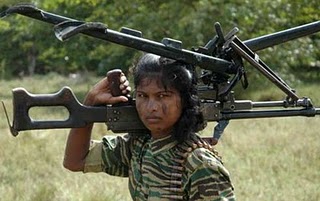
Embedded journalism is a governmental practice of attaching a journalist to a military unit involved in armed conflict to control the information the journalist receives.  Associate Professor with the Asian Pacific Center for Security Studies Shyam Tekwani was not embedded when he reported on the Liberation Tigers of Tamil Eelam, or the Tamil Tigers as a photojournalist for an Indian news magazine.  Tekwani titled his talk “Sleeping with the Enemy” to express how he came to photograph the group as an insider. Sri Lankan government officials refused to grant Tekwani and other journalists access to Tamil Tigers areas. So Tekwani entered Sri Lanka illegally, using Tamil Tiger boats from the tip of India to the northern boundary of Sri Lanka and lived with the Tigers for weeks. If the Sri Lankan military had seen him during this time he would have been treated as a Tamil Tiger and killed.TigeTiger fighter with cyanide capsule relaxes in camp –Pic by Tekwani (copy with Roberts)

In a talk to a group of Michigan State University students as part of the Visual Journalists Reporting in Asia Colloquium series, Tekwani explained that the LTTE was considered the most successful terrorist organization due not only to the fact that they are the only terrorist group to have assassinated two world leaders, but that the LTTE pioneered the use of suicide bombers and had advanced media skills.  The talk focused on Tekwani’s work in Sri Lanka covering the ethnic conflict between the majority Sinhalese, who controlled the government, and minority Tamils. During this war, which lasted for over 27 years, the Tamil Tigers grew from a rag tag group of boys to a highly organized military that included an air force and navy.Working without governmental protection, or even press protection, led Tekwani into dangerous places. At one point, the boat he was in with the Tamil Tigers sank, separating him from the Tigers. A local family took him in and hid him from the authorities to save his life. Yue Xu, a journalism master’s student at Michigan State University said: “His experience is just like a Hollywood big movie! So adventurous!” When Tekwani later visited the family that saved his life they requested he smuggle their son out of the country to save him from being forced to join either the LTTE or the Sri Lankan military. This decision resonated with Xu who said: “I don’t know if he was right or wrong, but it would be hard for any of us to make that decision.” In the end Tekwani guided the young man safely to India.

Velupillai Prabhakaran led the Tigers through force of personality, and by killing anyone he felt threatened his position. He was a secretive man who only met with two journalists during his 30 year tenure at the head of the LTTE. In 2009 the Sri Lankan military killed Prabhakaran and his family.

Michigan State University student, Joyce Walter said of Tekwani’s statement that “one man’s terrorist is another man’s freedom fighter”; “It is interesting how this notion must have guided him in reporting on one of the most violent conflicts in our generation, … it must have been difficult to avoid taking a side with or against the LTTE.” During the time that Tekwani was with the Tigers, India sent troops to fight to LTTE. This meant that he photographed the Tigers brutally killing his own countrymen.

“I am a medical school dropout,” Tekwani told the students, “I dropped out after two semesters to because I couldn’t handle the blood and gore.” After dropping out of medical school Tekwani then decided to enter journalism in hopes of being able to make a difference in the world. Although Tekwani began as an editor he soon decided to become a writer since he was sure he could write better than the work he was reading. He then decided to enter photojournalism when he realized photographers always get a “ringside seat to history.”

His first photo assignment was to photograph Mother Theresa. He brought two rolls of film and when he finished the first roll Mother Teresa settled down and presented a perfect photo opportunity.  At that moment, he realized that he didn’t know how to load the film.

“{She} must have uttered a prayer for me after that because after that things looked up,” he said to the students.

Tags:shyam tekwani, ltte, liberation tigers of tamil eelam, michigan state university, visual journalists reporting in asia


1 Comment

Filed under accountability, authoritarian regimes, Eelam, indian armed forces, Indian Ocean politics, life stories, LTTE, martyrdom, military strategy, power politics, prabhakaran, suicide bombing, Tamil Tiger fighters, terrorism, unusual people, world events & processes

Indian Military Modernisation continues

Andrew Campbell, for  Future Directions International Research, Indian Ocean Research Programme

Background:  The second of three Indian Navy Shivalik-class stealth frigates, the INS Satpura,was commissioned on 20 August 2011 in Mumbai. The Indian Defence Minister, A.K. Antony, has also announced that the Indian Government has signed a deal to procure 40 Hawk trainer aircraft for the Indian Air Force and 17 for the Indian Navy, from Hindustan Aeronautics Limited. Both developments are part of a larger build up to combat piracy and check perceived growing Chinese influence in the Indian Ocean. Continue reading

1 Comment

Filed under indian armed forces, Indian Ocean politics, world events & processes